
From Pandemic to Endemic
Season 19 Episode 1904 | 29m 2sVideo has Closed Captions
Covid-19 cases are dropping. Are we approaching the end of the pandemic?
Covid-19 cases are dropping. Will this be the end of the pandemic, or just a lull before another variant arrives? Is this the right time to lift mask and vaccine requirements? How should schools respond? Our panel discusses what the "new normal" might be. Panelists: Dan Getz, D.O, Francisco Velazquez, M.D, and Brian Simmerman, M.D.
Problems playing video? | Closed Captioning Feedback
Problems playing video? | Closed Captioning Feedback
Health Matters: Television for Life is a local public television program presented by KSPS PBS
From Pandemic to Endemic
Season 19 Episode 1904 | 29m 2sVideo has Closed Captions
Covid-19 cases are dropping. Will this be the end of the pandemic, or just a lull before another variant arrives? Is this the right time to lift mask and vaccine requirements? How should schools respond? Our panel discusses what the "new normal" might be. Panelists: Dan Getz, D.O, Francisco Velazquez, M.D, and Brian Simmerman, M.D.
Problems playing video? | Closed Captioning Feedback
How to Watch Health Matters: Television for Life
Health Matters: Television for Life is available to stream on pbs.org and the free PBS App, available on iPhone, Apple TV, Android TV, Android smartphones, Amazon Fire TV, Amazon Fire Tablet, Roku, Samsung Smart TV, and Vizio.
Providing Support for PBS.org
Learn Moreabout PBS online sponsorship(wondrous music) - [Narrator] Our world changed two years ago, when COVID took over our lives, we retreated to our homes and wore masks.
Then vaccines gave us hope until variants posed more questions than answers.
While experts say we won't completely eliminate COVID, there will come a day when it's no longer a pandemic, and when hospitals aren't overflowing with patients, what is the end game?
Our expert panel walks us through the next phase, From Pandemic to Endemic, right now on Health Matters.
- [Narrator] Health matters is made possible with the support of Providence Inland Northwest Washington.
- [Lady] Oh, life, how we admire you, all your twists, and turns and wild rides you take us on, you are the reason we'll always provide world class healthcare, Providence.
We see the life in you.
(upbeat music) - Good evening and welcome to Health Matters.
I'm Teresa Lukens.
The highly contagious Omicron variant continues to fill up hospitals, claim lives, and stress the healthcare system.
The good news is that it appears the number of new COVID cases is going down, and there's reason for optimism.
But this isn't the first time that we've said that.
Joining us tonight with the latest information is Dr. Francisco Velazquez.
Dr. Velazquez currently serves as Chief Health Officer for the Spokane Regional Health District, one of 34 local public health agencies serving Washington's 39 counties.
And Dr. Dan Getz is Chief Medical Officer for Providence Healthcare and oversees acute care for five hospitals in Eastern Washington.
Prior to his current duties, he practiced emergency medicine for 13 years at Providence Sacred Heart Medical Center, where he served as the department medical director for six years.
And Dr. Brian Simmerman is a pediatrics physician at Providence Medical Park Pediatrics, Dr. Simmerman joined Providence in 2014 and has practiced pediatric healthcare for 21 years in Spokane.
He currently serves as the Division Chief for General Pediatrics for Providence in the Spokane market.
Thank you all for being here tonight to talk about this important topic.
Here we go again.
Dr. Velazquez, as it stands today, how is Spokane County doing with the Omicron variant?
- Well, good afternoon.
Actually, as you mentioned, there's cause to be optimistic.
Our numbers are coming down.
The rate per hundred thousand is decreasing and it has decreased in the rest of the state.
Although we're still at about a thousand cases, per hundred thousand, we see it's much lower than the higher number we had several weeks ago, about 5,000 thousand per hundred thousand.
But, has continues to trend down.
We do need to remember though that we're still in the surge, we still have a little bit of work to do.
We still have 200 patients in the hospital and seven of those unfortunately are pediatric cases.
So cause for optimism, but we need to remain vigilant and not really take our foot off the pedal yet.
We have a little bit of work to do for the next few weeks.
- A lot of talk about we are in a pandemic, but moving toward an endemic, explain what that means.
- Well, actually, probably the best way to define pandemic and endemic is a disease, particularly a communicable disease, when its endemic is in effecting a defined geography and population group.
So if you think about it, when COVID-19 was first identified, it was identified in a particular province.
So at that point it was endemic.
A pandemic is an endemic with a passport.
It basically means it can go across countries and continents, which is what we have seen thus far, a communicable disease that has really covered the globe.
And that is the biggest difference between endemic and pandemic.
Now with endemic disease, it doesn't mean that it's gonna be less of a concern.
We know that from the flu, where we still see mortality with the flu every year, but it does mean that it has more predictability in terms of how it's going to behave.
And also we know more about what do we need to do to minimize risk for those that could be at higher risk for this particular disease.
- Dr. Getz, talk about what we're seeing right now at Providence Hospitals in Spokane.
- We still have a lot of patients in the hospital with COVID, it is getting better.
And as we see case rates get lower in the community, that will translate to lower hospitalizations, but COVID patients can take a few weeks to get better out of the hospital.
And so it takes a while for us to see that declining rate here, but we're optimistic.
- And Dr. Simmerman, Dr. Velazquez mentioned, there are a lot of children that have been hospitalized and sick with the Omicron.
What can you tell us about the patients you've seen or about those who have been sent to the hospital?
- Yeah, so Omicron has been an impressively different variant in everybody, but in kids it's, you know, so contagious that it, usually often when a family member came home with it, that everybody was sick with it.
And so the number of kids that have been effected in the last month and a half has been tremendous.
I think nationally there are 12 and some odd million children that have had COVID diagnoses.
And I think over four million of those who have been diagnosed in the last six weeks.
So it's been an impressive number nationally and locally for the number of kids that have had this new Omicron variant.
Most of those kids, thankfully do not end up getting that sick, and do not end up hospitalized.
This last variant, it's actually presented or shown up with symptoms a little bit differently than some of the other ones.
It still shares fever and some of the respiratory stuff, but it had a little more of an upper airway sort of symptomatology.
So a lot of these kids presented croupy.
And so they kind of have this sort of classic barky cough.
Some of them though, if that swelling in that upper airway progresses, it can actually be fairly hard for them to breathe.
And Dr. Getz, I'm sure had lots of experiencing croupy kids in the ER in his ER days, but that was a little bit of a different presentation, this last variant, but it's greatly effected the kids, lots of sick kids and then lots of secondary implications from what that meant to those children and to families as well.
- And the ones that have ended up in the hospital, do most of them have preexisting conditions or I guess, what sends them to the hospital in most cases?
- Yeah.
I don't know if the other two docs can speak to specifically what's been going on recently, but generally speaking, yes, those kids that already have preexisting conditions are much more vulnerable to more significant or severe disease.
There are examples where kids that did not have other preexisting issues, did just get, for some reason, significantly ill and ended up hospitalized.
The good news is, is because this last variant seemed to be a little less aggressive with the lower respiratory, that there weren't as many intubations needed.
And so there were just different reasons why they're hospitalized, but I don't know if Dan, Dr. Getz, if you have any specific comments on recent pediatric admissions, I have not personally had any.
- Yeah, no, I think you summarized it up pretty well.
I mean, COVID's interesting.
A lot of the kids that were being admitted, they're often too young to be vaccinated.
And I think that's similar things that we've seen across the adult population is that largely we're taking care of unvaccinated patients and, you know, that's that children are in that same group, generally.
- Dr. Velazquez, testing became a challenge, especially in January when we were seeing a high number of cases or people that had symptoms, had been exposed.
Where do we stand right now with testing?
- That's a great question actually, a lot of progress has been made when you look at testing options and I'm gonna focus a little bit more on testing that is available to anyone in the community, as opposed to the clinical diagnostic testing that has been done in facilities for clinical purposes.
Because the testing capacity at the clinical level has always been very strong.
Where we had more of a challenge was on those patients or consumers that needed a test because of exposure or potential symptomatology that may or may have been COVID, or for other reasons.
And there were not very many places to go.
And we did advise people, please don't go to the emergency room to get a test.
That's not the place to go.
And let's try not to use up the clinical space, but by now we actually have at least two drive-thru, or drive-up locations in the community.
We have three others in the community.
We have been deploying testing, utilizing the libraries.
And there are a lot of tests that are available over the counter, at drug stores, retail stores, online, both from retail, as well as through the Department of Health and the federal government.
So there are plenty of tests that are available now.
The caveat is the demand at one point in time was really, really much larger than the supply.
And it hit at a point in time when there were supply chain issues because of weather, transportation, and manufacturing.
So it was a combination of factors that made it look like there wasn't enough testing available for the community.
Now there's a lot of other options.
And I will ask people to go to our website and click on the testing tab.
And it will tell you basically where you can go and what all the options are.
That's a great question.
- There have been some discussions about the the reliability of the home test compared to the PCR test.
How much should we trust those home tests and how often should we test if we do have symptoms?
- So if you think about the natural progression of diagnostic testing, as a general rule, when we have a disease that is going to remain in the community, we do start at the higher end centers, then we go to healthcare.
Then we go to ambulatory.
Then we usually end up with consumer options.
And we've seen that with many, many tests and many of those consumer based options, over the counter type tests are derivatives of some of the testing that is used clinically, that is prepackaged and done a little bit differently for the consumers.
So these tests tend to be really good.
So my advice will be if you test positive, let's assume that you're positive.
And the reason why I say that is because if you look at the gold standard that we have, which is PCR, the molecular viral testing, the difference in diagnosis or in diagnostic capability between that and the antigen test that you can do over the counter, there's a gap of about 12 to 16 hours in which the PCR will detect the virus earlier than the antigen test.
So if you are positive, more than likely you are considered to be positive for that reason, if you're negative and you have been exposed, we do recommend serial testing if possible, meaning at least two tests, at least 24, 48 hours apart to close that gap of the 12 to 16 hours in the event that you happen to be one of those early tests that are negative.
So that's a that great question.
And again, go to our website, there's a lot of instructions there, but tests are reliable.
They work very well, and I will encourage people to utilize the testing.
It's better to have the answer than to wonder whether you are or are not positive.
If you've been exposed, please talk to your provider.
If you're symptomatic, please talk to your provider.
And I'm sure some testing will be advised depending on your condition and the timing of the exposure.
- We are starting to see some of the restrictions ease up, some of the things being lifted, mask mandates, that sort of thing.
Dr. Getz, how concerned are you about things moving too quickly?
As far as the perspective of hospitals?
- You know, I think if we, we use a scientific approach and we start removing restrictions based off community incidents, and we start following things like transmissibility that are not ratio, how quickly is this spreading in our community?
I think we can do it safely.
I'd be fearful of an approach that just kind of shotguns everything, because we're certainly very different stages across the state, due to the levels of vaccination and community masking and things like that.
So I think we're getting to that point where we can do it, but it's probably, as Frank said, gonna be done in stages.
- And will those in the hospital still be required to wear masks?
- Oh yeah, that's a really important distinction.
So if we reach a point in the community where it's no masking, we'll still be masking in the hospital.
And we have to remember that we're taking care of a very vulnerable population, a little different standards apply in healthcare than they do, you know, going to a grocery store.
- And Dr. Simmerman, a lot of debate around kids wearing masks in school.
And for that matter anywhere, what is your take on kids wearing masks?
Has it been harmful for them?
Do you suggest that they continue to do that?
- A really good question.
And I think the answers are still not quite back to us yet.
I think it's still being reviewed and researched.
And I think that the, some of the results that have come back so far on some of these reviews are mixed.
So there have been some indications that kids wearing masks may inhibit some of their ability to communicate or understand some communications, read emotions, and may have some other sort of psychological impact.
But additionally, there are some reviews that have shown that that has not been the case.
They actually have, recently, there has been some published material on toddlers.
This was from the first year of the pandemic, when they were home with their parents.
And they showed that toddlers in 2020 had significantly improved verbal skills relative to those toddlers from 2019.
So probably literally from spending time with their parents and had nothing to do with masks.
But, I think that the masks question overall still needs to be answered, but I think that we do have good information that tells us that masking does help to decrease the transmissibility of COVID.
And in all honesty, it probably decreases the transmissibility of some other viral things going around this winter.
And I support kids being in school.
And I think that if masks help to decrease the chances that they get something that causes them to have a fever and a cough and therefore need to be tested and out of school for more days, then I support that.
So at this point, I still think it's a good sort of way to keep children in school, learning together, and developing those relationships and social skills that they.
- You know, I'm curious, you see kids in your practice, in your office, what do they say about the mask?
Do you ask them, do they offer any comments about wearing masks?
- That's a good question.
I think most of the time, if I do hear comments, it probably reflects the parent's approach to the masking I think.
So some parents that may have some frustrations with masks, you might occasionally hear a comment from kids on that, that most parents that are just rolling with it, you don't, you don't hear much about it.
Kids are just, they're sort of used to it.
- And Dr. Velazquez, as we do start to ease restrictions, are you concerned that people will stop the vaccination process, that they'll become a little bit more complacent about getting vaccinated and getting a booster and that that will end up being an issue?
- Well, actually, if you look at some preliminary data from around the country, we've seen a little bit of a slowdown in vaccination appointments, and I do want to take this opportunity to remind everyone, that vaccines and boosters have worked really well, will continue to work really well.
And if the disease does become endemic, which is, you know, likelihood, it will be, we still need to worry about how do we protect the population from potential morbidity and or mortality and vaccines have proven to be the best tool that we've had thus far, and more than likely will continue to be the best tool that we have on a go forward basis.
You just take some clues from other diseases like the flu, where vaccination is a critical component of prevention every year.
- And Dr. Getz, would you say that most of those hospitalized are the unvaccinated?
- Yeah, the vast majority, you know, if I had to throw numbers, I'd say it's conservatively over 90% every time we look at it.
And I think there's a large segment of the population that I hope is re-looking at the evidence if they chose not to get vaccinated.
So a lot of time has passed.
And I think the data is pretty convincing at this point for most everybody, the vaccination is safe and does a great job of keeping people out of the hospital, it does a great job of keeping people from dying of this illness.
And I think one of the things that have been holding people up, they're still worried, well, it doesn't keep me potentially from getting the virus.
You may be three to five times less likely to get the virus when you're vaccinated.
But what's really important is if you do get the virus, your risk of death or being hospitalized is much, much lower.
And so encourage people that haven't been vaccinated yet, if they had safety concerns, sit down with their primary care provider or their advanced practice provider, whoever takes care of them, and discuss the literature again.
And a lot of people are really starting to realize this is safe and it's the better decision for their health.
- And Dr. Simmerman, we just learned here in the last few days that Pfizer at least has put a pause on rolling out the vaccine for kids ages six months to five years old, they want a little bit more data before they do that.
That was the last age group to be included in vaccinations.
Can you talk about that?
- Yeah, it sounds like from what I've read and been, and told through the American Academy of Pediatrics, that Pfizer's data just needs to be expanded particularly for their two year to two.
Four, two year to four year old group.
So I think that the data that they were presenting in the youngest, the six month to two years, sounded fairly consistent and they were pretty happy with that.
The issue that has been raised is that whether or not that the dosing that was used, which was the same dosing all the way from six months through four years, was not quite as effective in two to four year olds.
And so they were, they're looking at adding a third, basically a third shot.
So a second booster to that to see if they can get the same response.
And it sounds like they didn't have that data fully gathered.
And so they're having to go back and get that together before they present that back to the FDA.
- I can imagine this is probably the biggest question that you get during the pandemic, is whether or not to vaccinate children coming from parents.
- It's a big question.
And it's an interesting conversation and it just varies family to family.
There are many families that are excited and their basic questions are when and where can we get the vaccine for our kids?
Then there's a group probably that's sort of in the middle, that's somewhat interested, but somewhat cautious.
And so they have questions just about the vaccine safety and how new is it and you know, what could be sort of long term issues?
And then there are some families that simply really aren't very interested for a number of reasons, but in those conversations, just to try to share some of the information about how these vaccines have been so effective at preventing severe disease and hospitalizations can sometimes be just difficult, trying to find the best way to sort of visit with them about that information.
- Where do you steer parents for more information, if they need it, where do you send them?
- Yeah, usually try to send them to sort of reputable websites if they're going online.
So I think that the CDC, albeit the CDC's website has so much information now about COVID, it can be a little bewildering, but I think that they provide very good information if you take your time to pick through that, it's very helpful.
I think that the Washington Department of Health presents very good information, and then usually I'll use the American Academy of Pediatrics website and they have very good COVID information and how that's working for kids as well.
- Dr. Getz, the crisis within the crisis has been the toll that the pandemic has taken on healthcare workers, particularly nurses.
They're leaving that profession at an alarming rate.
Can you speak to that and how you at Providence are dealing with it?
- Yeah, you know, health care has been short workers for years.
Nurses, physicians, techs, all the way across the board.
And I think what's been so challenging is we've had two years really in a crisis situation.
So nurses especially have been working in a very high stress environment.
And there's lots of job opportunities for nurses outside of hospitals, whether they're signing up to work as travelers or they're signing up everywhere.
It's really been an issue, I think nationwide, where nurses are sometimes leaving hospitals that are very understaffed to go work at hospitals elsewhere that are paying higher rates.
So it's really taking care away from certain communities and providing elsewhere.
But I think ultimately to get to the problem we have to, we have to really focus on how do we train more healthcare workers in the future?
How do we get to high school kids and get them on that vocational path?
And the same applies across the board.
It's not just nurses, it's respiratory therapists.
It's people that work in the laboratory, physicians, we have lots of communities that are underrepresented and we have to make it easier for them to get into the professions.
- Dr. Velazquez, so much information out there.
A lot of it misinformation, people going the wrong direction.
When they're looking for information, it's created a major divide in this country and in Spokane County, what is your best advice for making sure you're getting solid information as we move forward with the pandemic?
- Yeah, I'm glad you brought that up.
'Cause my advice to all is the same advice I followed myself.
Number one, you can speak to your trusted provider, whomever that may be, your physician, your PA, your NP, and ask for guidance.
Second, do some research, go to credible websites.
You can go to a Spokane Regional Health District, Department of Health, and the CDC.
And I agree with Dr. Simmerman.
The CDC has a lot of information, but it's actually very good information and is credible and vetted information, which means it's something that you can follow.
And ultimately you can go to other sites like John Hopkins has a great site.
Mayo clinic has a great site.
Go to reputable places in healthcare.
And if you look at our providers locally, they actually have a lot of information on their websites, too.
So I will try to stay within that, the context of that, because if you start to, and I do that, I look at the web and see what's out there.
And if you put Omicron news, you will see, I don't know, thousands of things come up and some of them, you look at it and even without having a scientific background, you wonder like, hmm, what is that?
So stay within those.
And if you have any questions, please use your provider as a source of credible information.
They're there to provide you not only the best care, but the best information, they know you better than anybody else.
I talked to my provider, I did my research way back when, and that's how I got vaccinated, recommended it to my family and my friends.
So I think if we all put a little bit of effort, we can get the best information that is available.
There's no question about it.
- Let's talk a little bit about mental health as we get toward the end of the program, because that's another piece that's become a major issue in the last two years.
And Dr. Simmerman, particularly for kids, first, it was, you know, staying home, doing school online, masking, any number of things, how this has effected kids?
What have you been seeing?
What are parents concerned about?
- So for the years preceding COVID, the rates of anxiety and depression in our preteen and teenage youths has been going up.
So it wasn't a completely new issue, but it really, really exploded after this whole COVID sort of pandemic has occurred over the last two years.
The number of kids, not just teenagers, but even in the pre-teen years that have presented to our office with concerns about depressive symptoms, anxiety, fear about, you know, leaving their home or doing other things, increasing suicidal thoughts, and by the fall of 20.
So in the first year, Washington had a survey of youth so 11 through 17, and what was unbelievable to most of us is that literally over half of the kids at that, in that sort of fall time period, had reported having thoughts about wanting to self harm or kill themselves over half the days in the prior two weeks, which was an astounding statistic from this survey.
And so it really brought to light the magnitude of what was going on with our kids.
And so it's been a tough couple years, I think, I don't know what the number is now.
I know last fall, it was around 140,000 children had lost a primary or secondary caregiver.
And so there's been a lot of loss for some of our kids nationally.
It's been a tough two years and their mental health has really suffered with that.
- And just a few seconds left, Dr. Velazquez, I know you don't have a crystal ball, but can you give us kind of some final thoughts on the next few months, how you anticipate them looking?
- Sure, so as I mentioned at the beginning, we're on the downward trend, which is good.
If that downward trend continues, that means we will have less cases.
If we have less cases, we can probably relax some of the public health guidance as Dr. Getz mentioned, there are metrics that can be used to guide that process, which will allow us to have a spring and summer much better than we have been able to do in the last couple of years.
But I do believe that it is important for us to remain vigilant.
If this disease becomes endemic, it will be with us.
And that means we will need to continue to learn.
We will need to continue to manage risk for those that are at a high risk, and we will need to learn how to live with it and protect ourselves from any of the potential negative side effects, of having COVID-19, whatever variant we may have in the future.
'Cause one thing is for sure, this virus has taught us that it certainly can learn to mutate at a rate that we really haven't seen in other viruses, commonly.
So cause for optimism, a little bit of vigilance, a little bit of diligence and we'll make it through, and it will be much better for the rest of the year.
- Very good, thank you all for being here.
Thank you, Doctors, for your insight tonight, and that will do it for this addition of Health Matters.
You'll find some helpful information on tonight's topic on the Health Matters page at ksps.org, and be sure to join us April 14th, when we focus us on organ donation and transplants.
Until next time, I'm Teresa Lukens, stay safe and goodnight.
- [Narrator] Health Matters is made possible with the support of Providence Inland Northwest Washington.
- [Lady] Oh, life, we hear you beating out the rhythm of our days.
We know you live fully.
It's why we pioneer new treatments, because when it comes to matters of the heart, you deserve world class healthcare.
Providence, we see the life in you.
(upbeat music)
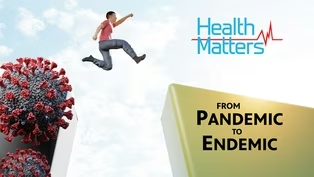
From Pandemic to Endemic FEB 17
Preview: S19 Ep1904 | 30s | Covid-19 cases are dropping. Are we approaching the end of the pandemic? (30s)
Providing Support for PBS.org
Learn Moreabout PBS online sponsorship
- Science and Nature

Explore scientific discoveries on television's most acclaimed science documentary series.

- Science and Nature

Capturing the splendor of the natural world, from the African plains to the Antarctic ice.












Support for PBS provided by:
Health Matters: Television for Life is a local public television program presented by KSPS PBS