Prairie Sportsman
Fungus and Forge
Season 14 Episode 9 | 27m 46sVideo has Closed Captions
Knifemaker Scott Wendt and foraging for chaga and chanterelles.
Knifemaker Scott Wendt and foraging for chaga and chanterelles.
Problems playing video? | Closed Captioning Feedback
Problems playing video? | Closed Captioning Feedback
Prairie Sportsman is a local public television program presented by Pioneer PBS
Production sponsorship is provided by funding from the Environment and Natural Resources Trust Fund and Shalom Hill Farm. Additional funding provided by Big Stone County, Yellow Medicine County, Lac qui...
Support provided by:


Prairie Sportsman
Fungus and Forge
Season 14 Episode 9 | 27m 46sVideo has Closed Captions
Knifemaker Scott Wendt and foraging for chaga and chanterelles.
Problems playing video? | Closed Captioning Feedback
How to Watch Prairie Sportsman
Prairie Sportsman is available to stream on pbs.org and the free PBS App, available on iPhone, Apple TV, Android TV, Android smartphones, Amazon Fire TV, Amazon Fire Tablet, Roku, Samsung Smart TV, and Vizio.
Buy Now
Providing Support for PBS.org
Learn Moreabout PBS online sponsorship(bright music) - [Bret] Get ready for another episode of "Prairie Sportsman".
Join us as we venture into the winter woods in search of chaga, a medicinal fungus with incredible health benefits.
And we'll meet a blacksmith who crafts and sells his own knives, perfect for any outdoor adventure.
And we'll join Nicole Zempel for a fast forage.
Welcome to "Prairie Sportsman", I'm Bret Amundson.
We got another great show for you starting right now.
(light music) (uplifting music) - [Narrator] Funding for "Prairie Sportsman" is provided by the Minnesota Environment and Natural Resources Trust Fund.
As recommended by the Legislative Citizen Commission on Minnesota Resources.
And by Mark and Margaret Yackel-Juleen on behalf of Shalom Hill Farm, a retreat and conference center in a prairie setting near Wyndham, Minnesota.
On the web at shalomhillfarm.org.
And by Live Wide Open, Western Minnesota Prairie Waters and the members of Pioneer PBS.
(bright music) - [Bret] While winter in Minnesota offers plenty of recreational opportunities, it can be a restless period for mushroom foragers.
- [Mike] I think most people are, yeah, they're waiting for morel season come April.
And especially, this time of the year in Minnesota where we can almost see the light on the horizon, right?
- [Bret] We're in Northern Minnesota with Mike Kempenich, who is known as - The most interesting man in the woods is Gentleman Forager.
(Mike chuckling) - [Bret] Amidst this winter wonderland, he searches for a distinctive mushroom renowned for its medicinal benefits.
A rare fine that can require a lot of time in the woods.
- [Mike] You got snowshoes, you got cross-country skiing, you got ice fishing, you got snowmobiling.
So there's plenty to do up here.
And it's very active area if you get around the towns, especially for the snowmobile crowd.
But I'm left alone in the woods for the most part on the chaga hunt.
(Mike chuckling) (cheerful music) (gentle music) My partner up here in the Northwoods, Larry Krachowski is a very accomplished trapper.
So this was one of his that he made himself.
And, yeah, it keeps you incredibly warm.
It's my go-to winter foraging garb, yeah.
Always a conversation starter at the bar too.
- [Bret] Mike's mission today is to find some chaga.
- [Mike] Chaga is super interesting.
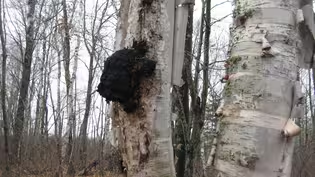
I mean, it's a fungus, it's a mushroom but it doesn't have a classic stem and cap.
It's what's called an asexual fruiting body.
It doesn't look at all like a mushroom.
It basically looks like a piece of burnt wood growing from the side of about 1 in every 10,000 birch trees.
And it's also something that's killing the birch tree.
It's a parasite.
(light cheerful music) 'Cause it usually enters through some wound in the tree and starts there.
It takes 5 or 10 years for that conk to grow.
But birch has a compound called betulin in the bark of the birch tree.
And that is consumed by that piece of chaga.
And those had a lot of beneficial compounds that have shown great promise.
And really it's a widely used mushroom for its medicinal benefits.
People use it to brew a tea.
It's referred to as an adaptogen.
So it helps regulate a lot of different body function.
And it's also shown that it has some ability to help fight cancer.
It's absolutely not a cure-all, which I do see a lot of people sort of putting it in a category that doesn't really exist.
But it's a very, very healthy routine you could get into.
(cheerful instrumental music) - [Bret] Chaga, a term originating from Russia describes this burnt charcoal-like fungus.
Unsurprisingly, Russians and other Eastern European countries were the first to utilize chaga for its medicinal benefits during the 15th and 16th centuries.
Historical records from that era suggest chaga could combat infections, ulcers and tumors among other ailments.
Russian author, Aleksandr Solzhenitsyn further elevated chaga's profile by featuring it in his novel, "Cancer Ward".
- [Mike] And that really popularized it.
It was very, very well known in Russia and a lot of eastern European countries.
I think here in the States, again 15 years ago, I really didn't talk to many people who had much knowledge about it.
(water bubbling) It's a very small amount.
Really like about a teaspoon of ground chaga could be used to brew probably two or three cups of tea.
A piece maybe half the size of my fist I can use to brew probably 10 or 15 gallons of tea.
- [Bret] Finding chaga starts with locating birch trees.
Birch trees are predominantly found in the northern hemisphere.
And the further north you go, the more you'll find.
Minnesota being no exception.
- Well, I mean birch first.
And it's sometimes a little bit difficult for some people to tell the difference between birch and poplar or aspen.
And really it's the paper that you see.
That sort of papery bark and the aspen is always gonna be completely smooth.
But they can be very light colored and looking an awful lot like a birch.
I'm also looking for like trees that are pretty mature.
I'm not really looking for eight inch diameter trees.
And so that's about, and that's a good looking, you can tell that these trees are already compromised.
They're already either dead or dying.
And that's kind of a good candidate.
So when I see groupings like that, I wanna take some extra time to look around them.
And the other thing you gotta wanna make sure too is that you're checking behind the tree.
I can only see what's in front of me right now.
And often you'll go around the tree and sure enough there'll be a nice honk on the backside of it.
- [Bret] And when you do find chaga, you may need to get some height on it.
- It can be anywhere on the tree, right?
I mean, sometimes it's really nice and they're right there and it's easy to harvest.
Sometimes it's 40 feet up in the tree and it's taunting you and you have to get a little creative.
And frankly, I would say probably half of the time you find chaga it's out of reach.
So yeah, I'll just carry a foldable collapsible ladder that fits in my trunk.
And I've got a 15 foot reach I can get to anyway.
And that gets put into use quite a bit.
(Mike chuckling) (upbeat guitar music) (light guitar music) - [Bret] While many forages can be done with a small knife, chaga requires a stronger touch.
- [Mike] You need really a hatchet or some blade that's very, very, or that's not flexible rather, it's very firm.
Yeah, it's a very sort of tough deal to get out of there.
A hatchet honestly is the best thing.
The face of the tree, the mushroom is actually growing in part of the tree.
So you kind of have to get behind it and kind of pop it out that way.
But it's not something that you do delicately.
You really gotta get in there and get at it.
It's one of the things that I want people to be aware of is, you know, everybody gets excited when they find something like that.
Because it's fairly rare and they're excited about the properties, they've read about it.
And so when they do come across it, they tend to over harvest it with the idea that it's valuable.
But if you hop on eBay, you can buy chaga all day long for a very cheap price.
And it's not really something you're gonna get rich at.
So I just encourage people to take what you need.
If you're going to use it and you're gonna drink the tea then absolutely, I think that's perfectly fine.
- [Bret] Once a part of the chaga's harvested, it won't grow back.
So it's best to harvest the entire growth from the tree.
- 'Cause after you've harvested that chaga it needs to dry.
It's gonna probably weigh three or four times what it ultimately will weigh after you've dried it.
So make sure that you're putting it in a place that has a lot of air circulation, not any kind of closed container or it will mold.
If you're just sort of letting it take its course can take many, many weeks.
Or you can speed it up a little bit, use a dehydrator of some type.
Or break it up into smaller chunks would make it a lot faster as well.
But you definitely wanna dry it as soon as you're harvesting it.
- [Bret] For making a chaga tea, Mike recommends grinding it.
- Boy, you really have to have a serious grinder or you'll break your grinder.
It's very, very hard.
But it also contains a lot of the nutrients you're after.
So you kind of want that blend of that hard black exterior and that golden interior together.
I've picked up like an, it's literally an industrial grinder.
I don't think anything at the store is probably gonna hold up very long.
And that works great.
And I think this was meant for rocks or something.
(Mike chuckling) So it hasn't broke yet anyway.
(light charming instrumental music) - [Bret] Now while chaga tea is a long established tradition, Mike hopes to incorporate these medicinal nutrients into other food and drinks.
- [Mike] I'm excited because I'm doing some top secret talks right now with a beverage company.
I don't probably wanna go further than that but a very interesting beverage that chaga would be an ingredient in.
I really like to think in terms of, well, how can we, you know, people might know about it.
But it may not be something that they're really gonna introduce into their normal routine 'cause it's not part of their normal routine.
But if we can deliver it in something that's very normal, you're drinking a soda every day you might as well drink this healthy one.
And the same I think is true of mushrooms.
We use Lion's Mane in a peanut butter because if you're taking Lion's Mane because you need help with memory.
probably a great thing if you eat peanut butter toast every day.
You don't have to remember, you're already doing that.
(light piano music) - [Bret] As our time with Mike came to an end, we found ourselves empty handed.
Mike wasn't able to find any chaga during our Northwoods adventure but that's not surprising.
After all they say chaga's found on just one in every 10,000 birds trees.
(light instrumental music) - He said, "I think he might like doing that.
He can just get some frustration out by beating steel."
And so I did.
And when I first started, I guess- - Did that work?
- It worked.
- [Nicole] To know a mushroom they're just like getting to know people really.
- [Bret] A hardened piece of steel forged in fire, sharpened by hand.
Knives have come a long way since humans first sharpened stones and are now considered one of the most important tools ever created.
(thrilling mystical battle music) Today the idea of handmade knives and tools is left to a select few who find pride in self-sustainability.
And the ability to create, the process itself can also give people a way to heal.
- Basically, my pancreas blew up or started leaking.
The enzymes that digest your food began to digest my internal organs.
- [Bret] For one Minnesota man, the idea of becoming a blacksmith and creating unique, one of a kind knives became an obsession.
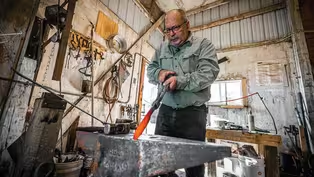
(thrilling mystical battle music) (country violin music) In the small Minnesota community of Big Bend, you'll find Scott Wendt sweating out the heat in his shop.
But it's not the hot summertime sun causing the mercury to rise.
It's a gas forge where Scott makes knives and an assortment of other objects.
- How the forge works is just on a Venturi system, air, oxygen and gas.
And then what it does, it forces this hot gas into flame down into this chamber.
- [Bret] Scott has made over 1000 knives.
And while he enjoys the craftsmanship, he didn't always want to be a blacksmith.
- I wouldn't describe myself as a professional blacksmith by any means, I'm a hobbyist.
It's more of an obsession than it is a profession.
I've been pretty fortunate in my life.
I've had four lifetimes.
My first 18 years I grew up on a dairy farm, rode horse every day.
My dad probably doesn't know this but I used to let the young cattle out just so I could take my horse, go find them and round them up and bring them back.
When I turned 18, I went to college for law enforcement and I was a state trooper and a police officer for the next 34 years.
And then at 2011, when this illness came, I had to retire.
Looking for something to do, and Bruce Ferguson from the Montevideo High School hired me to be an aide.
And then he mentored me into being a success coordinator.
I worked with kids for nine years, helping them get their homework done, building relationships with them.
So that was my third lifetime.
And then I turned 62 and I retired.
And now I'm kind of doing this blacksmith and thing full-time.
(light Chinese melody) In 2011, I had necrotizing pancreatitis, ended up in the hospital for almost 10 months.
And I lost more than half my body weight.
I got down to 140 pounds.
They wanted me to go to the gym and work out.
And I had this external drain bag and I wasn't gonna do that.
And my son sent me a video and he said, "Hey dad, I think you'd like to do this.
This guy built a forge out of a brake drum."
Still have the brake drum, coal forge, "And he uses that."
He said, "I think you might like doing that.
You can just gets some frustration out by beating steel."
And so I did.
And when I first started, like I said- - Did that work?
- It worked, it did.
It got rid of some of my frustrations.
It also gave me the exercise.
I started out with like a half ounce or a half a pound hammer.
And I would forge for maybe 20 minutes.
And I didn't have enough energy to go to the house.
I'd have to call my wife on the cell phone, she'd have to come down and carry me back to the house basically.
Well, this went on and I got better at it.
And what started out as a way to help my health turned into an obsession.
(dramatic music) (Chinese melody music) (beating drums) (hammering slamming) - Did you just feel achy or what?
- Yeah, I just had severe pain.
I woke up, I was gonna go to work and I had a pain in my upper stomach.
I'd been fighting this pain for a while.
Six, seven months going to the doctor on and off and they really weren't sure what it was.
And then that morning, January 6th, 2011, I woke up, I knew I couldn't go to work.
But I thought, well, maybe if I just wait a little while it'll get better.
By 10 o'clock in the morning.
I knew I wouldn't even be able to drive myself to the hospital.
I was in so much pain.
They took me to Willmar.
I was in Willmar for, I don't know, a week or something.
Don't know any of it.
I was gone, in a coma.
- You were in a coma?
- Yeah, they flew me, it was a drug induced coma I think so I didn't feel that pain.
And then they flew me to Rochester.
And then I was there from January 11th until finally the end of September, early October, I was able to come home and- (thrilling music) I'd went to this surgeon.
I'd lost all this weight and I went to the surgeon and the surgeon said, "You're not a candidate for surgery.
Why don't you go on home?"
Telling me, "Okay, you need to get your affairs in order."
I came home, I had a horse at that time.
I worked with that horse a little bit.
It was just nice to get home.
After about six weeks he said, "Mr. Wendt, how are you doing?"
I said, "I think I'm getting better."
He said, "Well, why don't you come on over here, we'll do some tests."
Go back, the same surgeon that told me that I was no longer a candidate for surgery said, "I don't know what happened.
Your body healed itself," for the most part.
So I started out with this and this is what I made.
Just these S hooks.
And I made probably two five gallon buckets full before I got one that I liked.
I was terrible at it but I didn't give up.
I just kept going and going.
- [Bret] The exercise was healing his body and the accomplishments were healing his mind.
- To be able to take a piece of steel that looks almost like this and turn it into this with just your hand, hammer, anvil and a forge.
It's my sweat and I have blisters and burns and what have you from doing this stuff by hand.
So it's just that sense of pride you get that you're able to do something that 20% of the population probably couldn't do so.
- What did you make that you were so proud of that you said, "Yeah, I wanna keep doing this.
I really like this."
- I started out making railroad spike knives just like every other blacksmith in the country.
And when I switched over and started making knives and all of a sudden I've got compliments.
Guys would send me pictures that they'd been out to Montana elk hunting or they'd been out to Wyoming antelope hunting.
And they had my knife and they butchered the deer with something that I made with my hand.
And they were thanking me and saying, that got me going.
- [Bret] Most knives will take Scott 7 to 10 days to complete.
But he does some special orders that take a little more time.
- If there's a law enforcement officer, fireman, EMS, military, their spouse will send me their uniform.
And then I make the handle out of that.
So they'll have a knife, a blade that's forged.
The handle is made from a uniform that they wore during their service.
(tribal music ) (thrilling music) - [Bret] As a member of law enforcement, his interactions with teenagers weren't always positive.
But working in the schools for nine years changed his attitude.
- I always say those kids saved my soul.
- [Bret] One day those kids that he worked with needed a project.
So they built him a gas forage that he still uses today.
- So it's kind of cool.
I still have the forge that my kids built.
- Did you ever think you'd get to this point way back when you were looking for something to do and you beat on a brake drum?
- Never, never.
My entire purpose when I started was to develop my muscle tone back.
That was it.
And then I thought I'd go back to being a farmer.
- How cool is it to be able to take something that was probably destined for a scrapyard and turn it into something beautiful?
- Yep, the best part of working with steel is some of this steel came from the ground in Northern Minnesota, taconite iron ore. Got shipped out to Pittsburgh, Pennsylvania, they turned it into steel, got shipped somewhere else, turned into leaf spring, put in a car, ended up back in a scrapyard in Minnesota.
And now I'm gonna make a knife out of that ore that came out of our ground.
Yeah, it's cool.
I get kids in here, my grandson is gonna be a blacksmith.
That's all he wants to do.
He's seven years old and he comes down here and pound stuff out.
But he knows the history.
He knows that this steel very possibly could have came from the ground in Northern Minnesota.
So next summer I'm gonna take him up to the mines, take him down in the mines so he can see where they got the steel that he's gonna pound out his knife with.
- That's cool.
- Yeah.
(mythical battle music) Like I said, I put my name on it.
A hundred years from now, somebody's gonna look at that knife and say, "Who's S.Wendt?"
You know, who's that guy?
(mythical battle music) - [Bret] Scott's knives are a functional piece of Minnesota artwork that doubles as a unique form of recycling.
They sell for between $25 and $65, unless it's a custom job.
They can be found at Hunted Treasures in Watson, Minnesota or by emailing wendtsforge@gmail.com.
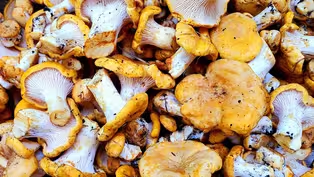
(mythical battle music) (cheerful music) (bright guitar music) - I am sitting in a small patch of chanterelle mushrooms.
And so the super fun thing is when you see one, you're gonna see more.
And that's what's happened right here in this spot.
Differing sizes here.
But again, in the Minnesota River Valley worms, insects, they like to get into those mushrooms.
And so we're gonna check them also for that before we toss them in the basket.
But when you're IDing a mushroom, you wanna make sure that there are no lookalikes or if there are find out what those are.
And you wanna be as sure as you can before you decide that you're gonna consume something.
Now with chanterelles, well, there are different things you look at when IDing a mushroom.
You look at the stems, you look at the gills, you look at the caps but also smell.
And sometimes taste is an indicator of what kind of mushroom you have.
And then if in doubt, I always recommend spore printing as well.
But here is just a little, and we'll show you how they vary in size too.
But here's a little tiny chanterelle and they live in symbiotic relationships with the trees and they do like a mixed woods.
And I never get tired of that smell.
They smell like fresh apricots or even peaches and kind of fresh air.
And again, I leave the bottom in the ground.
I don't wanna disturb the mycelial network that's going on underneath the ground.
The stuff that we can't see.
And I know these are small because they do have a tendency to get larger.
But I also do not want the bugs and worms to invade and they tend to like to in this spot.
So we'll just show you how different they can be in different stages, how their appearance kind of changes.
And that's another thing when IDing a mushroom too.
When you get to know a mushroom, they're just like getting to know people really.
And over time their personalities really stand out.
Same thing for a mushroom or for a plant.
And you wanna catch a glimpse if you can of any new to you mushroom in its varying stages.
And here this is a really great, great example in this spot as we can see.
And their appearance changes just a little bit, but the telltale signs of ID really don't change.
The folds are there in all stages.
That wonderful smell is there.
And then we get into the larger ones.
These are beautiful 'cause they're elusive.
But when you see one, you're gonna see more.
Then they just pop out from everywhere.
And these ones are bug free it looks like.
I always give it a little check in the field.
And then any little scrappy parts I may cut off I just put right back where I found the mushroom.
And then always try to leave no trace.
And that's not just to keep patches a secret, you wanna leave it like you found it.
So a small little guy, right?
But the stem has already been munched on, enjoyed by, looks like some little tiny worms.
So sometimes I'm able to cut those sections out.
The hedgehog mushroom, very similar in taste and that wonderful smell to the chanterelle.
They get no bugs and I don't understand that.
But hey, they're great to harvest and easy to clean 'cause they're bug free.
And again, just a little quick clean in the field, check it out, do any trimming that's necessary.
But yeah, these are one of my favorites.
They're a versatile, mild tasting mushroom.
Great in pasta dishes, great in soups, great as just a side to whatever you're eating.
But my favorite way, because they are so fruity smelling and sweet people use them as, or make chanterelle ice cream out of them.
They make different desserts out of them.
I make a cake so I do like a mushroom glaze on top of a cake.
And it's excellent.
Obviously as they grow, their folds really start to show.
When they're young the caps are grounded around their stem.
And then as they grow, they vase out or like fold outward and create just beautiful vase like mushrooms.
And this is I think the closest one we have in the basket to that is that's starting to happen.
Aren't they pretty?
(light guitar music) (gentle instrumental music) (gentle instrumental music) - [Narrator] Funding for Prairie Sportsman is provided by the Minnesota Environment and Natural Resources Trust Fund, as recommended by the Legislative Citizen Commission on Minnesota Resources.
And by Mark and Margaret Yackel-Juleen on behalf of Shalom Hill Farm, a retreat and conference center in a prairie setting near Wyndham, Minnesota.
On the web at shalomhillfarm.org and by Live Wide Open, Western Minnesota Prairie Waters and the members of Pioneer PBS.
Video has Closed Captions
Clip: S14 Ep9 | 2m 51s | Join Gentleman Forager Mike Kempenich on a quest for rare chaga mushrooms in Minnesota. (2m 51s)
Fast Forage: Chanterelle Mushrooms
Video has Closed Captions
Clip: S14 Ep9 | 5m 35s | Forager Nicole Zempel shares tips on finding and enjoying chanterelle mushrooms sustainabl (5m 35s)
Video has Closed Captions
Clip: S14 Ep9 | 10m 27s | Minnesota blacksmith Scott Wendt handcrafts unique knives, turning his passion into healin (10m 27s)
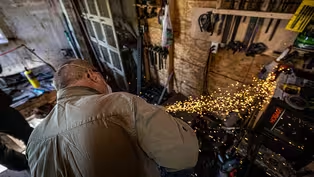
Preview: S14 Ep9 | 30s | Knifemaker Scott Wendt and foraging for chaga and chanterelles. (30s)
Providing Support for PBS.org
Learn Moreabout PBS online sponsorship
- Science and Nature

Explore scientific discoveries on television's most acclaimed science documentary series.

- Science and Nature

Capturing the splendor of the natural world, from the African plains to the Antarctic ice.












Support for PBS provided by:
Prairie Sportsman is a local public television program presented by Pioneer PBS
Production sponsorship is provided by funding from the Environment and Natural Resources Trust Fund and Shalom Hill Farm. Additional funding provided by Big Stone County, Yellow Medicine County, Lac qui...