
A Young Family Navigating Spinal Muscular Atrophy (SMA)
The story of a young family with two children who have spinal muscular atrophy (SMA).
From
A Young Family Navigating Spinal Muscular Atrophy (SMA)
Clip: Season 1 | 4m 30sVideo has Closed Captions
The story of a young family with two children who have spinal muscular atrophy (SMA).
This excerpt is the story of a young family with two children who have spinal muscular atrophy (SMA). SMA is a rare genetic neuromuscular disease that affects the part of the nervous system that controls voluntary muscle movement. It is a deteriorating disease — and children with this form of SMA may survive to two years of age or older.
From
Problems playing video? | Closed Captioning Feedback
Problems playing video? | Closed Captioning Feedback
Funding for KEN BURNS PRESENTS THE GENE: AN INTIMATE HISTORY has been provided by Genentech, 23andMe, Cancer Treatment Centers of America, Alfred P. Sloan Foundation, Gray Foundation, American Society of...
A Young Family Navigating Spinal Muscular Atrophy (SMA)
Clip: Season 1 | 4m 30sVideo has Closed Captions
This excerpt is the story of a young family with two children who have spinal muscular atrophy (SMA). SMA is a rare genetic neuromuscular disease that affects the part of the nervous system that controls voluntary muscle movement. It is a deteriorating disease — and children with this form of SMA may survive to two years of age or older.
From
Problems playing video? | Closed Captioning Feedback
Where to Watch The Gene
The Gene is available to stream on pbs.org and the PBS app.
Buy Now
The Gene Explained
What the heck is a gene, anyway? This animated series won’t get you a PhD, but it does clear up a few mysteries about how genes work and what they might look like in the future. (Microscope not required.)(melancholic music) - [Narrator] Jase got his first dose of the experimental treatment called nusinersen through an infusion into his spinal fluid when he was just 18 days old.
- [Mom] We were on a journey.
It was kind of like miracle or bust.
We're gonna have a miracle or we're just going to lose him.
Our hope was that maybe our baby would be able to at least sit or eat normal food or maybe he would walk even.
What are you doing?
Are you sitting up?
It's a miracle.
It's January.
January 24th.
- [Dad] As time goes on, and Jase begins to do things that Ariel didn't.
- [Mom] Is crawling.
- There's this new hope.
Like hey, it looks like we're going to get to raise him.
- [Mom] I love how you walk with your hands up.
Yes.
- Yay.
- We were at some friend's house for the evening and I set Jase down on the floor.
Daddy's there.
And Jase just took a couple steps and it was like oh my goodness, he's doing it.
Like that's more than he's ever done before.
Oh, good job.
- Are you ready to go?
- [Mom] Jase was just going back and forth between us and we kept backing up and he would go further.
- Come to daddy.
You're doing so good.
Whoa!
That was amazing.
- [All] Yay.
- [Mom] Everyone that was there was standing around cheering and it was awesome.
- [Man] Yay, whoa.
- That's wonderful.
- And then on our way home, it was just quiet and we were all just kind of like (sighing).
Like did that really?
This really happened.
(trampoline squeaking) - [Narrator] Jase recently celebrated his third birthday unaware that he is a medical pioneer who represents the promise of a genomic revolution decades in the making.
- I'm gonna get you.
- [Narrator] He and two dozen other pre-symptomatic children in the trial are all doing well.
They need spinal infusions of the drug every few months but without them, they would almost certainly no longer be alive.
(Jase chuckling) - I bet you can't catch me.
(Jase screaming) - There's just time in this journey where the full seriousness of it hits us and we're like we're looking at something and we're holding a person who like Earth has never seen anything like this before.
This has not been possible.
This is amazing and yet it's also really normal.
- I'm a dreamer.
I mean, he's just my little son so I'm just taking these moments for what they are and loving him, loving life.
Loving the season of life that we're in.
After each moment where there has been a dramatic success doesn't just enliven the people who are working on that disease, it has ripples across the field.
It's one more reason to believe that those decades of really hard slogging are finally beginning to yield up some really remarkable events and that makes everybody interested in working harder and probably recruits new people into the field who maybe were holding back for fear that this wasn't ready yet.
It seems to be ready now.
Video has Closed Captions
Preview: S1 | 30s | The science, history & personal stories of the human genome. (30s)
The Race to Sequence the Human Genome
Video has Closed Captions
Clip: S1 | 1m | A peek into the race to sequence the human genome and some of the possible consequences. (1m)

The Most Human Thing We Have in Common
Video has Closed Captions
Clip: S1 | 43s | The human genome and this generations responsibility to protect, understand, and intervene (43s)
How Many Genes to Build an Organ Like the Brain?
Video has Closed Captions
Clip: S1 | 1m 15s | How many genes does it take to build an organ as complex as the human brain? (1m 15s)
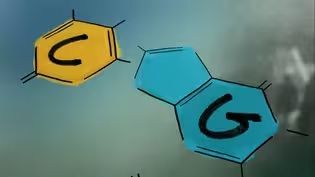
Video has Closed Captions
Clip: S1 | 53s | Examine what makes up the perfectly symmetrical double helix. (53s)
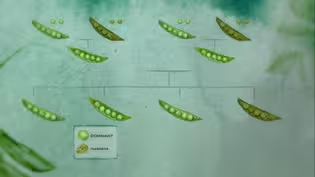
Video has Closed Captions
Clip: S1 | 41s | Dive into the difference between dominant and recessive genes. (41s)
Video has Closed Captions
Clip: S1 | 52s | Did you know that the DNA can be read whole or in part, producing different results? (52s)
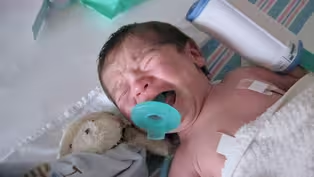 Now Playing
A Young Family Navigating Spinal Muscular Atrophy (SMA)
Video has Closed Captions
Clip: S1 | 4m 30s | The story of a young family with two children who have spinal muscular atrophy (SMA). (4m 30s)
Providing Support for PBS.org
Learn Moreabout PBS online sponsorship









Support for PBS provided by:
Funding for KEN BURNS PRESENTS THE GENE: AN INTIMATE HISTORY has been provided by Genentech, 23andMe, Cancer Treatment Centers of America, Alfred P. Sloan Foundation, Gray Foundation, American Society of...