
Good Jobs Now, Black women entrepreneurs, Boblo Boats film
Season 7 Episode 22 | 26m 46sVideo has Closed Captions
Employment for returning citizens, Black businesswomen and the Boblo Boats documentary.
Future of Work host Will Glover talks with Detroit Action about the employment barriers returning citizens face and the organization’s Goods Jobs Now program. Plus, contributor Stephen Henderson explores the unique challenges of two Black women entrepreneurs in Detroit. And, contributor Daijah Moss learns more about a new documentary that details the history of Detroit’s Boblo Boats.
Problems playing video? | Closed Captioning Feedback
Problems playing video? | Closed Captioning Feedback
One Detroit is a local public television program presented by Detroit PBS
Good Jobs Now, Black women entrepreneurs, Boblo Boats film
Season 7 Episode 22 | 26m 46sVideo has Closed Captions
Future of Work host Will Glover talks with Detroit Action about the employment barriers returning citizens face and the organization’s Goods Jobs Now program. Plus, contributor Stephen Henderson explores the unique challenges of two Black women entrepreneurs in Detroit. And, contributor Daijah Moss learns more about a new documentary that details the history of Detroit’s Boblo Boats.
Problems playing video? | Closed Captioning Feedback
Where to Watch One Detroit
One Detroit is available to stream on pbs.org and the PBS app.
Providing Support for PBS.org
Learn Moreabout PBS online sponsorship- [Narrator] Just ahead on One Detroit: Our series on the "Future of Work" looks at the challenges and opportunities for returning citizens wanting to enter the workforce.
Plus, we'll talk with two Detroit entrepreneurs about overcoming the difficulties facing minority women business owners.
And a new film offers a piece of nostalgia for Detroiters who rode on the Steamboats to Boblo Island Amusement Park.
It's all coming up next on One Detroit.
- [Narrator 2] From Delta faucets to Bear Paint.
Masco Corporation is proud to deliver products that enhance the way consumers all over the world experience and enjoy their living spaces.
Masco.
Serving Michigan communities since 1929.
Support for this program is provided by the "Cynthia & Edsel Ford Fund for Journalism" at Detroit Public TV.
The Kresge Foundation.
- [Narrator 3] The DTE Foundation, is a proud sponsor of Detroit Public TV.
Among the state's largest foundations committed to Michigan focused giving.
We support organizations that are doing exceptional work in our state.
Visit DTEfoundation.com to learn more.
- [Narrator 4] "Nissan Foundation" and "Viewers Like You".
(upbeat music) - [Narrator] Just ahead on this week's One Detroit: Two African American women business owners in Detroit open up about the challenges of becoming entrepreneurs and offer advice for women hoping to follow in their footsteps.
Plus, a new feature length documentary looks at the rich history of the steamboats that once took riders to the Boblo Island Amusement Park.
And the current efforts to preserve the ferries.
But first up, our ongoing future of work series examines the barriers faced by returning citizens hoping to find jobs.
And explores some of the solutions.
In our recent Future of Work Virtual Town Hall, I spoke with the executive director of Detroit Action, Branden Snyder, about his organization's program designed to help formally incarcerated individuals find good jobs.
Now, we talked about how the initiative provides valuable skills training and partners with potential employers.
(upbeat music) - That's what I wanted to talk to you about is, in particular, your "Good Jobs Now" program.
So why is it necessary?
Who is it for?
What's the overall goal for Detroit Action's "Good Jobs Now" program?
- We can do many of the workforce development tactics.
We can do many of the skills and services that are needed by the housing and (indistinct) that are needed by the formerly incarcerated are needed by young people in order to place them into the jobs of today through direct community organizing, developing leaders to be able to tell their stories, to be able to feel like they have social capital, to have a community, and also to be able to grow as people in our community.
And we do that through just traditional community organizing, developing people's ability to just be able to have a conversation, to tell their story, to have a community and own the experiences of their world, and only experiences of their community.
- When we're talking about returning citizens, unhoused young people, how many people are we talking about who might be struggling with getting into the job market or getting into a place that actually has a living wage?
Or is sustainable to raise that quality of life?
As you put it, maybe to dampen that exploitation.
- On average, when you think about the entire prison population, unfortunately African Americans constitute maybe about 34% of that population.
In Wayne County, we know that there's approximately 7,500 people who are coming home every year.
Who are coming home from incarceration.
Who are coming from... Who are coming from jails.
Who are undertrained.
Who are, in many cases, locked out of the community in which we live.
And for us, what that means is that we have 7,500 people yearly that we have an opportunity to really engage and to be able to provide the tools that they need to be able to make a living and be able to make ends meet.
Targeted individuals being released and connect them in the career opportunities, given the reentry population, the tools that helps to get recidivism and giving folks a career path.
And opportunity strengthens families and communities.
And so for us, it's simple things like being able to connect people to our canvas.
Our year round canvas programs where they're able to have a community to be able to tell their stories, to be able to be be around other people who've experienced the same things and see that they're working on policy solutions to crime and safety.
Or it's other small niche things like just being able to get people IDs and birth records.
- As we're talking about this, the question that strikes me is if you know a person who has been formally incarcerated is looking for a job, what are they hearing?
If they do have the credentials, if they do get the certificate to be able to do whatever the job is, but there's still a gap there, it's still not quite linking up.
What are they hearing from employers who are essentially keeping them out of these positions?
- One of the things that people talk about is just being left on red, if you will.
And so, having... And so, part of the work that we do and part of work that our partners like "Michigan Liberation" or "Michigan United" and other community organizations in our state, really have been fighting for, is how do we make sure that more fair chance hiring is happening to where people can come do an interview, show their skills, show their development, and be judged based on that.
And then, once they have a background check being run, versus that checking that box be the practice that keeps people in or out.
I think that that's one policy solution that many of our organizations have been fighting for, both locally at the city but also at the state over the last few years could attest to.
There was a fair chance hiring bill that was introduced during the last session by representative Cynthia Johnson out of Detroit.
And so things like that are key and important.
- Post pandemic, employers have been having a hard time getting people through the door to do all sorts of jobs across all sorts of sectors.
Has that changed the success rate for people getting hired that maybe previously were locked out of certain positions?
Has that... Have you seen any market change?
- Yeah, we think so.
And we think that those who are of the populations that we serve and that we organize are the folks who are the first out in the first often disqualify.
And so we know that overall, black and brown workers are going to be the ones who bear the brunt of exploitation.
Who bear the brunt of discrimination in the workplace.
And so, part of the work that we believe in is not only being able to develop the skills and develop the skill sets of these workers, but then also be able to give them a place to where they can grow and be able to have worker power.
- Right.
And so, because we're not all (chuckles) business titans, we're not all policy makers, but I like to think that we all wanna help.
What are some things that the average person can do to either help Detroit Action and its mission or just to help the people that are coming back into their community or people who are in their communities that need this kind of help?
Where would you send people?
What would you tell 'em?
- Yeah.
I guess from a... From one standpoint, it's like if you are an employer, as you take a chance on a person, be able to offer and be able to invest in.
And utilize the sort of fair chance hiring practices that reduce discrimination and reduce exploitation of folks who have criminal convictions on their background.
And then, I think, finally, if you're a community member or maybe you are somebody who's been directly impacted and wants to make change or wants to be involved, or may want to be involved in a service, you can reach us out at detroitaction.org online.
Or any of our social media is: Detroit Action, or Detroit-_Action on Twitter and IG.
And if it's... Our work is about the holistic cycle of development people to become leaders.
So not just being able to provide folks a charity, but also thinking about it as solidarity for the long haul.
Being able to give people the experiences to where if you come in, you can be a leader on these policy fights.
So if you are somebody who is experiencing that direct need, it a opportunity to both come in, maybe for a need, but also stay and be a participant.
To be able to provide and give back for the future.
- [Narrator] And you can see more of my conversation with Brandon Snyder about The JOBS Project at onedetroitpbs.org.
Although women own 42% of US businesses, a study by the National Association of Women Business Owners shows female entrepreneurs are facing a tougher time growing their business compared to their male counterparts.
And it's even more difficult for minority women.
American Black Journal host, Steven Henderson spoke with two African American women business owners who received financial and marketing grants from "Comcast RISE", a program created during the pandemic to help small businesses owned by women and people of color.
(upbeat music) - So I am one of the co-owners of Detroit Dance Center.
We are located in Midtown Detroit.
And, myself and my two other partners, Dominique and Jasmine, we all used to teach together.
We taught dance together at a dance studio in Detroit.
And we've taught together.
As I was a teacher, they were students.
And then, we all became teachers.
And then, the pandemic happened.
And so, we were kind of on a hiatus.
Everybody was sitting at home and zoom classes and everything like that.
And it started off as just like a little playful banter like, "Oh, if I had a studio I would do this."
"If I had a studio, I would do that."
And the discussions became a little serious moving forward.
Next thing, about a year later, we opened up our studio in September of 2021.
And it was kind of weird trying to figure it out during the pandemic, but that's how we all got started.
- Yeah.
Yeah.
And what were some of the risks, I guess, that you felt, or some of the challenges that you faced in making that decision?
- Mm-hmm.
Oh, definitely, yeah.
The pandemic.
That's really what it was.
- Let's start there, right?
(chuckles) - Yeah.
It was really that.
We were thinking, "Would parents want their kids to be around other kids so close?
And if we had classes, how many kids can we put in a classroom and work on social distancing?"
So it was really unknown how the public would react.
Or would we have students starting in 2021 that would want to be in person and not have to do virtual dance classes?
- Yeah.
Yeah.
Chinonye, tell us how you came to decide to be an entrepreneur.
- Yeah.
So I always tell people entrepreneurship found me.
And I say that because about eight years ago, my brother came to me needing a natural deodorant.
He was changing his lifestyle, changing his diet, and was going vegan.
So he wanted something that was vegan, and that actually worked.
At the time, I studied chemistry in college, I also got my Master's in Public Health, and so I was always been tinkering with formulas and things like that.
So I was able to make it for him.
And on this journey of making this natural deodorant, I realized that some of the chemicals in my workplace, I was working at a global automotive company at the time, I was making sure we were evaluating the chemicals that were coming into our plants.
And some of...
I saw a lot of crossing.
And so I said, if I'm banning this from coming into a plant because it's unsafe for people to work in a large manufacturing environment, then why are we putting it on our skin even though it's at smaller doses?
But we're still doing that every single day.
And that's just compounding onto us.
And so I was like...
I just started doing more research.
I started talking to friends and family.
And when I learned about how many people were suffering with different skin elements, from eczema, to psoriasis, dry skin, being allergic, I was very shocked 'cause I had never experienced any of that.
And so, I realized that my brother came to me for a reason and I was gonna create this solution.
So that's when I created ILERA Apothecary.
And the goal of ILERA is to make people feel confident in their skin.
"ILERA" literally translates to health in the Yoruba language in Nigeria.
I'm a first generation American.
And so really tying my roots, tying my education, tying who I am into a product that helps people.
And so essentially, that's how ILERA Apothecary came to be.
And that's what we're about: growing competence through skincare.
- I wanna talk about what some of the day to day reminders, I guess, that you get about the challenges that exist because of who you are.
The things that might be easier for other people who start and own businesses than they are for you.
Chinonye, I'll start with you this time.
- It's interesting because in business, you don't know what you don't know until you come across that hurdle, and then you have to start figuring it out.
And I don't have just like a dedicated group of people that I can go and say, "This is what I'm dealing with.
How can you help me, or where do I go?"
It's like, "I talked to one person, they introduced me to another person."
And so it's like the time to resolve issues, the more that I'm like learning about business and getting familiar with it, it decreases.
But you have to be intentionally in those spaces to even get that access.
And I know, when I was applying for the Comcast grant for marketing, it was like, "I don't need the money right now, but what I need is for people to know about my business because essentially the money will come back from there."
And so really just understanding what you need in business and how you can make it work for you, even if it is something as a tangible dollar.
- Yeah.
Yeah.
I mean this idea that you need the support of other people, other people who own businesses, other people who know what it's like to start a business.
Linda, talk about how that challenge looks if you're an African American woman and trying to make a business work.
- Yep, absolutely.
Well, one good thing about me and my business partners is that we are career professionals first and dancer second.
We have that passion for dance.
We love to dance, but we do other things.
Myself, I am an internal auditor, been for over 20 years.
My partner, Jasmine, is a chemistry teacher.
So she works on all the curriculum development.
And then, Dominique is a project manager.
So with those things, we're able to work, the business, put out processes and procedures and operations, and know about customer service.
However, we struggled a lot with that marketing.
So being able to use that Comcast grant to join other groups that are similar with doing dance studios and how do you get students in and bring in the babies so you could help them grow up within your studio, and everything like that.
So that has been a struggle.
And then on a personal level, because we are minority women, we're also mothers.
So our husbands have had to take on the role of "Mr.
Mom", if you wanna say.
(man chuckles) 'Cause we teach classes in the evening.
So my husband is running around, picking up the kids from school, dropping 'em off.
And he comes home late at night saying, "Oh, I'm pooped."
I'm like, "Oh, really?"
(man chuckles) Isn't that so interesting?
So that's a challenge of just being able to definitely have that support system.
- So, I want both you to talk just a little about the grant, the Comcast RISE grant.
But also I want to have you give some advice to people out there who might be thinking about starting their own business and maybe apprehensive about the idea, maybe don't think that it will work, or that they'll have the support.
Talk about both of those things and how they kind of work together.
Linda, I'll start with you this time.
- Okay.
Yeah, definitely.
With the Comcast grant, definitely the application process, I think, prepares a person, an entrepreneur, to be able to make sure that they have all their ducks in a row before they're hitting market.
So it asks a lot of questions about, "What is your budget?"
"How do you foresee yourself after 12 months?"
"What are some of your obstacles?"
"What are some of your risks?"
"What are the markets looking like?"
So just those questions alone, if you don't have those answers to those questions, you might not be in that position quite yet to hit market.
But, it's not a...
It's done for, and you can't do anything about it.
It's really like, "This is what it's gonna take as an entrepreneur."
- Understand your why.
Why are you going into business?
Often, I found that people have said they're going into business because they don't wanna work for another person.
But what they don't realize is that when you go into business, you get a lot more managers.
You're answering to your customers.
You're answering to your employees.
Your vendors.
Everyone.
And so really, understand what value are you bringing.
Why you?
And what difference are you trying to make with your business?
- [Narrator] And finally, a new documentary out now provides a history lesson on the one time popular destination for Detroiters: Boblo Island.
It's called, Bolbo Boats: A Detroit Ferry Tale.
It tells the story of the two passenger steamboats that took visitors to the Island Amusement Park.
The film's director, Aaron Schillinger talked about how the documentary explains Boblo's history from a rather unique perspective.
One Detroit contributor, Deja Moss has the story.
(upbeat music) - [Deja] I want to tell you a story about an island between Detroit and Canada, known as Boblo.
(girl growling) - The Boblo experience was the boat ride there.
- [Man] Getting on a boat.
Giving a man a little ticket.
And you on a boat.
You having fun, you partying.
- [Deja] My sister Claire and I would take families by the thousands for a summer of fun.
- [Woman] Wasn't no white, no black, it was just everybody together.
And that's what made it the "Bob-Lo boat".
- [Woman] A new documentary sheds light on the history of an old amusement park: Detroit's Boblo Island.
And the most popular way to get there: The Bob-Lo boats.
Director, Aaron Schillinger gives some insight on the new film.
- [Aaron] So "Boblo Boats: A Detroit Ferry Tale" is a feature link documentary about the history and the current restoration efforts of the Bob-Lo boats that used to take people to Boblo Island: the amusement park in between Detroit and Canada.
It took just about seven years for me to produce.
It features archival footage that was filmed on the island in, like, the 70s when they used to use 35 millimeter cameras.
And so, we're gonna be able to show this footage at 4K resolution.
So it's really exciting for audiences to see this for the first time.
It also features a lot of stop motion animation that we use to kind of bring back some of other people's fond memories of the park.
Boblo Island as an amusement park, closed down in 1993.
And once the park closed down, the boats were kind of fell to ruin.
But now that Detroit's having an economic resurgence of sorts, people are realizing that these are national historic treasures, and they're trying to save them.
(boat squealing) When I was living in New York City, I was approached by a nonprofit to do a fundraising video for a steamboat.
And I go out to film the boat.
And I see this giant rusting steamboat in dry dock in Toledo, Ohio.
And my first thought was, "Why don't you guys just build a new boat?"
But that nonprofit, the SS Columbia Project, was like, "No.
You really don't understand.
You have to talk to some people who grew up going to Boblo Island on this amusement park."
And I was like, "Okay."
And so, I start talking to people and all these fond memories (boat engine roaring) just start flooding out of people's mouths.
So a lot of people who went to Boblo Island thought there was only one boat, but there's actually two sister steamboats: the "SS Columbia" and "St. Claire".
So in 2015, SS Columbia was purchased by New York nonprofit.
And she's currently in Buffalo, New York awaiting further funds for the restoration.
And that kind of left St. Claire as Detroit's last vestige of Boblo Island.
And she's owned by a doctor, which is a little bit unconventional.
And St. Claire is currently in the Detroit River.
She's docked where a lot of people can see her.
The film is narrated by Martha Reeves.
She's famous for "Heatwave" and "Dancing in the streets".
And we were really fortunate enough to get her.
We chose to tell the story from the perspective of the steamship, SS Columbia because first of all, she's the oldest surviving passenger steamboat in America.
And she kind of has this lo and mythology about her.
And so we thought, it'd be really interesting to make it a ferry tale told from the perspective of the steamboat.
(cool music) - [Woman] I really wish we still had Boblo.
It gives Detroiters something to do.
(cool music) - [Man] How can this pee?
How could we lose this (speaks faintly) great historic institutions?
- You just can't get rid of this boat.
Like, this is part of history.
- [Woman] The film doesn't just focus on the restoration of the Bob-Lo boats and the nostalgic memories of rides to Boblo Island.
It showcases an important but little known Detroit story tied to America's civil rights movement.
- There was a Supreme Court ruling about integration on the Bob-Lo boat that really did start to change history in America.
- One of the most important parts of the "Boblo Boats" film is the story of civil rights pioneer, Sarah Elizabeth Ray.
A lot of people don't know that all amusement parks across America used to be segregated.
And all of those parks have their own journey to integration.
And in Detroit with Boblo Island, it was in 1945 when a young 23 year old secretary named Sarah Elizabeth Ray was forcibly removed from the boat.
And it's kind of incredible because she went straight to the NAACP and with the help of the NAACP, sued the Boblo company.
And that case went all the way to the US Supreme Court where Thurgood Marshall ended up arguing her case.
And after she won on the Supreme Court level, the NAACP actually used the Boblo case as a test case leading up to Brown versus Board of Education.
So many people have incredibly fond memories of riding the Bob-Lo boat to Boblo Island.
And the film pays tribute to all of these really happy memories, but it also appeals back the nostalgia to see what stories or characters might be hiding underneath.
So that's everything from the past history of segregation and desegregation of Boblo which a lot of people really never thought about: the history of segregation.
And the current efforts to save the steamboats themselves.
Every now and then, they pop up in the news, but we wanted to really (beeps) kind of do a deeper dive into what it takes to save a Bob-Lo boat.
We were fortunate enough to release the film theatrically, and people can see it currently all over the state of Michigan.
(cool music) - [Narrator] You can find out more about "Boblo Boats:A Detroit Ferry Tale" on onedetroitpbs.org.
That will do it for this week's One Detroit.
Thanks for watching.
Make sure to come back for One Detroit Arts and Culture on Mondays at 7:30 PM.
Head to the One Detroit website for all the stories we're working on.
Follow us on social media.
And sign up for our weekly newsletter.
- [Narrator 2] From Delta Faucets to Bear Paint, Masco Corporation is proud to deliver products that enhance the way consumers all over the world experience and enjoy their living spaces.
Masco.
Serving Michigan communities since 1929.
Support for this program is provided by the Cynthia & Edsel Ford Fund Journalism at Detroit Public TV.
The Kresge Foundation.
- [Narrator 3] The DTE Foundation is a proud sponsor of Detroit Public TV.
Among the state's largest foundations committed to Michigan focused giving.
We support organizations that are doing exceptional work in our state.
Visit DTEfoundation.com to learn more.
- [Narrator 2] "Nissan Foundation" and "Viewers Like You".
(upbeat music) (upbeat piano music)
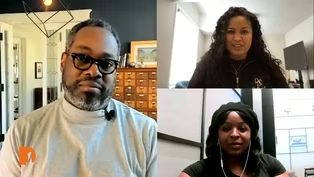
Black women entrepreneurs face unique business challenges
Video has Closed Captions
Clip: S7 Ep22 | 8m 46s | Black women entrepreneurs face an uphill battle for business growth compared to men. (8m 46s)
Detroit Action on employment barriers for returning citizens
Video has Closed Captions
Clip: S7 Ep22 | 7m 30s | Nearly 7,500 returning citizens come home from incarceration in Wayne County each year. (7m 30s)
Providing Support for PBS.org
Learn Moreabout PBS online sponsorship New Episode
- News and Public Affairs

Top journalists deliver compelling original analysis of the hour's headlines.

- News and Public Affairs

Today's top journalists discuss Washington's current political events and public affairs.

 New Episode

 New Episode




 New Episode
Support for PBS provided by:
One Detroit is a local public television program presented by Detroit PBS