
Goodbye Plants, Hello Fire Safety
Clip | 7m 53sVideo has Closed Captions
Controversial proposal to protect homes from wildfires by forcing homeowners to remove vegetation.
How draconian should California’s fire protection regulations be? In partnership with the Los Angeles Times, we profile Zone Zero, the state’s controversial plans to protect homes from future blazes by forcing property owners to remove most vegetation immediately around their homes. Will Zone Zero ensure homes survive fires, or will it destroy ecosystems and neighborhood character?
Problems playing video? | Closed Captioning Feedback
Problems playing video? | Closed Captioning Feedback
Earth Focus is a local public television program presented by PBS SoCal
Goodbye Plants, Hello Fire Safety
Clip | 7m 53sVideo has Closed Captions
How draconian should California’s fire protection regulations be? In partnership with the Los Angeles Times, we profile Zone Zero, the state’s controversial plans to protect homes from future blazes by forcing property owners to remove most vegetation immediately around their homes. Will Zone Zero ensure homes survive fires, or will it destroy ecosystems and neighborhood character?
Problems playing video? | Closed Captioning Feedback
How to Watch Earth Focus
Earth Focus is available to stream on pbs.org and the free PBS App, available on iPhone, Apple TV, Android TV, Android smartphones, Amazon Fire TV, Amazon Fire Tablet, Roku, Samsung Smart TV, and Vizio.
Providing Support for PBS.org
Learn Moreabout PBS online sponsorship[background music] -When I saw the fire start, and I saw the smoke coming over our neighborhood, I knew from experience that where the smoke goes is where the fire goes.
-There are three main ways that a home can burn: flames, embers, and heat.
-My neighbors already caught on fire two doors away, and we tried to fight it with a garden hose.
It was too hot, the winds were too fierce, there were too many embers.
It was at that point I knew we weren't going to stop it.
It's still hard to talk about.
I witnessed my neighbor's homes burn down.
Immediately after the fire, when it's fresh on your mind, that's when we need to really look at how it impacted us or our neighbors or friends, and look at our own property and realize this can happen.
"It did happen.
Can this happen to me?"
-Fire experts over the years have developed two main lines of defense to protect homes from these threats.
One is home heartening, so the things that you can do to the home itself.
Then you have defensible space, what you can do to the yard itself to reduce the chance of your home igniting.
California, over the years, has developed stricter standards closer and closer to the homes.
It has Zone 2, which developed in the '60s, out 100 feet, where you have to space out all of your trees; you can't have any dead vegetation.
It has Zone 1, introduced around 2006.
This is 30 feet out from the home.
Then the strictest is Zone Zero within the first 5 feet of a home.
The most controversial proposal in Zone Zero is whether or not you can have any living vegetation at all.
This would mean that you couldn't have any shrubs, you couldn't have flowers or cactuses, you couldn't even have grass within the first 5 feet of your house.
-What is Zone Zero going to do to the aesthetics, the charm, and the basic livability of our communities?
I truly believe that my vegetation saved my structure.
When we were here that night.
The homes around us were burning; those hedges saved my life.
I hid in those hedges.
I still had water in the hoses.
My husband was on the roof.
I was in the backyard.
The home behind us was fully engulfed and collapsing on itself.
It rained sheets of flames down on us, but because I had those hedges, I was protected.
It goes against every part of my experience fighting this fire to think that if I had not had those hedges, I would have been burned, and I would have been in greater danger.
-Zone Zero and all of the defensible space requirements apply to areas that have a very high fire hazard.
The state maps these out.
Over the years, they've been increasing the amount of land that's in these areas.
In California, this is about 6 million acres of urban developed areas.
We're talking about millions of Californians that, within a few years, will have to implement all of these Zone Zero regulations and requirements.
-Bougainvillea, very flammable up next to the house.
Rosemary, any plant that's got that oil that smells good, they burn very hot and very fast.
We're not saying you can't have it, we're just saying don't put it right next to your house.
Put it far enough away when it burns, it's not going to set the house on fire.
-The rules as they stand call for the removal of all vegetation within 5 feet of any structure in the very high fire hazard severity zones, with some exception for trees.
In Los Angeles, where we have very small lots, particularly in this neighborhood, like Silver Lake, where I live, that means the removal of quite a bit of vegetation.
In Silver Lake in particular, we stand to lose, by some estimates, up to 18% of our tree canopy.
If I look out my window, most of the vegetation I see would be at risk of removal under the Zone Zero rules.
A lot of it would be under threat for sure, and all of the benefits that come with that vegetation.
The cooling effects, the biodiversity, the hedges in the neighborhood.
These are like condos for birds.
We see the birds coming in and out of these hedges all the time.
There are privacy, security, beauty, aesthetics, pollution mitigation.
There are just so many impacts that this vegetation has.
It would be a massive removal of these plants.
-There's a lot of competing values here.
If all you care about is wildfire risk reduction, you can just pave over everything, and nothing's going to ignite.
People care about the plants that they have.
They like living in an ecosystem.
On top of that, removing all this vegetation is not cheap.
It can often cost thousands of dollars for people.
If you're suddenly going to impose this requirement and there's not a lot of ways for people to get financial support to do that, that's another burden that exists on people.
-I have heard the statements that a hedge had saved the house because it blocked the embers.
You can't really say that unless you were there.
I witnessed the homes in my neighborhood burn.
I've been on many strike teams and watched how homes burn.
It's very difficult to come in afterwards and say, "Oh, that's what happened."
Bottom line, for whatever reason, it didn't meet the requirements for combustion.
I had one lady say, "Hey, the one house on the block survived because the hedge was there."
Well, what about the other 40 houses that have hedges that didn't survive?
That, to me, is not a good ratio.
-Scientists are still trying to figure out how effective Zone Zero is, and what different proposals here might actually be the most effective.
There's been a lot of studies in these big fire labs where they'll reconstruct homes inside a lab, they have these big fans, and they'll create a fire, ignite a structure, and just look at what happens.
When we step away from the lab and look in the real world, the picture is much more complex.
A lot of these steps reduce the risk of your home burning down in a fire, but they don't bring it down to zero.
-There are aspects of Zone Zero that absolutely make sense: wood fencing, the gates up against the house, those can be replaced with masonry walls, steel gates, and non-combustible hardscape around your home.
Those applications, I completely support.
-The more time that passes after the fire, and the further you are from the fire, you start to become complacent again.
It becomes a story in the past.
The challenge is keeping it fresh in your mind, and to learn of what happened and how you can protect yourself and continue to take that action.
It's more than just your own property; it's also your neighbor doing what they can so the fire doesn't start on their property.
It's a community issue.
We don't want to be that first house in the community that sets the rest of them on fire.
If I do the home hardening and the vegetation management on my property, I'm ensuring that my house doesn't catch on fire, so it won't set my neighbor's house on fire, but if my neighbor has vegetation and their house catches on fire, it can burn mine down, so we're protecting each other.
The Community That Transforms Food Scraps Together, Stays Together
Video has Closed Captions
Clip | 5m 50s | L.A.’s garden activists create a composting movement. (5m 50s)
Meet the People Rescuing Food, Feeding Neighbors & Helping the Climate
Video has Closed Captions
Clip | 6m 32s | Saving perfectly good food from dumpsters (6m 32s)
Video has Closed Captions
Clip | 6m 27s | We explore why enough water couldn’t be pumped through fire hydrants to protect homes from burning. (6m 27s)
 Now Playing
Goodbye Plants, Hello Fire Safety
Video has Closed Captions
Clip | 7m 53s | Controversial proposal to protect homes from wildfires by forcing homeowners to remove vegetation. (7m 53s)
Can You Build a Fire-Proof Home?
Video has Closed Captions
Clip | 7m 46s | How to rebuild after L.A.’s devastating wildfires. (7m 46s)
Earth Focus Environmental Film Festival 2023 (Preview)
Preview | 30s | The fifth annual Earth Focus Environmental Film Festival features five days of screenings. (30s)
Clip | 8m 17s | Taylor Yard is now an undeveloped and still-contaminated site adjacent to the L.A. River. (8m 17s)
Earth Focus Environmental Film Festival
Preview | 1m 18s | Earth Focus Environmental Film Festival (1m 18s)

Cold Rush? The Changing Arctic
Clip | 14m 41s | "Earth Focus" looks at the changing face of the Arctic today. (14m 41s)
Fukushima: Can it Happen in the US?
Clip | 7m 21s | Fukushima was not a Japanese nuclear disaster. (7m 21s)
Cambodia: Fight for Areng Valley
Clip | 10m 47s | The Chong people are fighting to protect their forests. (10m 47s)
Inside Illicit Ivory and Rhino Horn Trade
Clip | 6m 41s | Inside Illicit Ivory and Rhino Horn Trade (6m 41s)
Unacceptable Risk: Firefighters on the Frontline
Clip | 12m 52s | Fires are becoming more frequent, larger and more devastating than ever. (12m 52s)
China: Religion and Environment
Clip | 13m 37s | Filmmakers Gary Marcuse and Shi Lihong capture a surprising trend in China. (13m 37s)
Hope for Rhinos? New Approaches to Save Endangered Species
Clip | 14m 31s | Rhino horn is more expensive than gold or platinum. (14m 31s)
Making Coastal Communities More Resilient to Extreme Weather
Clip | 5m 48s | Joshua Saks looks at how America's communities can be protected. (5m 48s)
Paying for Climate Change: A Reinsurance Industry View
Clip | 6m 32s | Climate change is anticipated to have a big impact on the insurance industries. (6m 32s)
Encroaching Tides: What's at Stake for the US
Clip | 6m 32s | The eastern coast of the United States has one of the highest rates of sea level rise. (6m 32s)
Sacred Economics: A Post Money World?
Clip | 11m 55s | Charles Eisenstein speaks to Earth Focus about his new book Sacred Economics. (11m 55s)
Neonics: Toxic Until Fully Tested
Clip | 8m 58s | Scott Hoffman Black speaks about the impact of neonicotinoid pesticides. (8m 58s)
Neonics: Driving Declines in Biodiversity
Clip | 8m 26s | Dr. David Goulson speaks about the impact of neonicotinoid pesticides. (8m 26s)
Clip | 5m 43s | Earl Blumenauer talks about why protecting pollinators in the US is the national interest. (5m 43s)
Clip | 11m 29s | Shrimp farmers tell us to reject contaminated shrimp from Bangladesh. (11m 29s)
Killing the Senate Filibuster Could Inspire Bipartisanship
Clip: Special | 27m 36s | Jon Christensen moderates a conversation with former Nevada Sen. Harry Reid. (27m 36s)
Sen. Cortez Masto: Pursuing a Green Economy
Video has Closed Captions
Clip: Special | 1m 9s | Cortez Masto has a goal to grow a clean energy economy that includes jobs for the future. (1m 9s)
Sen. Cortez Masto: Protecting the Outdoors is Nonpartisan
Video has Closed Captions
Clip: Special | 37s | Protecting the environment should not be considered a partisan issue, Cortez Masto says. (37s)
Sen. Cortez Masto: On Reid’s Environmental Legacy
Video has Closed Captions
Clip: Special | 54s | Sen. Harry Reid struck a balance when crafting inclusive environmental policy, she says. (54s)
Sen. Cortez Masto: On Growing Up in Rural Las Vegas
Video has Closed Captions
Clip: Special | 40s | Cortez Masto grew up in a rural Las Vegas with cowboys and ranches. (40s)
Sen. Cortez Masto: ‘A Microcosm of America’
Video has Closed Captions
Clip: Special | 1m 17s | Sen. Catherine Cortez Masto describes her state’s role in national politics. (1m 17s)
The New West and the Politics of the Environment (Preview)
Video has Closed Captions
Preview: Special | 1m | A quiet, little-known revolution is taking place in American environmental politics. (1m)
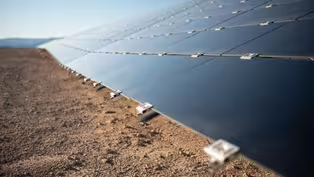
Moapa Solar Plant Addressed Injustice, Economy and Energy
Video has Closed Captions
Clip: Special | 5m 7s | Behind-the-scenes negotiations helped establish the Moapa transition from coal to solar. (5m 7s)
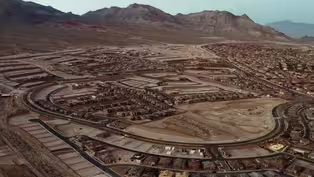
How SNPLMA Wove Urban Las Vegas Back Into the Environment
Video has Closed Captions
Clip: Special | 2m 17s | The legislation helped balance urban growth in Las Vegas with environmental conservation. (2m 17s)
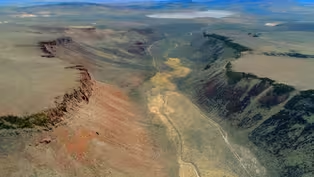
Black Rock-High Rock: The Negotiation Behind Conservation
Video has Closed Captions
Clip: Special | 8m 2s | A proposal to protect Nevada’s Black Rock Desert-High Rock Canyon received much criticism. (8m 2s)
Providing Support for PBS.org
Learn Moreabout PBS online sponsorship














Support for PBS provided by:
Earth Focus is a local public television program presented by PBS SoCal