
Oklahoma GOP Insurance Commissioner Forum
Season 2026 Episode 1 | 57m 44sVideo has Closed Captions
A moderated conversation between the 4 Republican Oklahoma Insurance Commissioner candidates.
Rich Lenz and J.C. Hallman moderate a 1-hour conversation between 4 Oklahoma Republican Insurance Commissioner candidates. This year's Republican candidates are Chris Merideth, Marty Quinn, Greta Shuler and Bob Sullivan. Recorded inside OETA's Oklahoma studio live on June 9th, 2026.
Problems playing video? | Closed Captioning Feedback
Problems playing video? | Closed Captioning Feedback
Election Coverage is a local public television program presented by OETA
Oklahoma GOP Insurance Commissioner Forum
Season 2026 Episode 1 | 57m 44sVideo has Closed Captions
Rich Lenz and J.C. Hallman moderate a 1-hour conversation between 4 Oklahoma Republican Insurance Commissioner candidates. This year's Republican candidates are Chris Merideth, Marty Quinn, Greta Shuler and Bob Sullivan. Recorded inside OETA's Oklahoma studio live on June 9th, 2026.
Problems playing video? | Closed Captioning Feedback
Where to Watch Election Coverage
Election Coverage is available to stream on pbs.org and the PBS app.
Providing Support for PBS.org
Learn Moreabout PBS online sponsorshipThis is the 2026 GOP Insurance Commissioner Candidate Forum presented by ETR in partnership with Oklahoma Watch.
Hello everyone, and welcome to our studios in Oklahoma City for a live one hour forum with the Republican candidates seeking to become Oklahoma's next Insurance Commissioner.
I'm Rich Lenz.
I will be moderating tonight's forum, along with reporter Jesse Holman of Oklahoma Watch, who has written a series of articles on the Insurance Commissioner's office and specifically dealing with homeowners insurance issues.
Jesse, welcome.
Thanks, Rich.
Thanks so much.
Yeah, so my work was really a deep dive on homeowners rates.
And that to some extent is going to inform how we proceed here.
We'll alternate between broad questions that give the candidates room to introduce themselves and express their philosophies, and very specific questions that will let them articulate the nuts and bolts of exactly how they're going to regulate the industry and protect consumers.
There might be some surprises in there, too.
We hope there will be.
We should note the lone Democrat candidate for this office, Craig McIntyre, is running unopposed in the June 16th primary, and therefore, we've elected to invite the four GOP candidates to join us tonight.
However, we will interview Mr.
McIntyre tomorrow, and that interview will air during the Oklahoma News Report this Friday, June 12th at 7 p.m.. Let's introduce our four candidates seated in alphabetical order from my left to right, Chris Meredith from Edmond, Oklahoma, Marty Quinn from Owasso.
Greta Schuler, who lives in Shawnee, and I know our resident Bob Sullivan.
Welcome, all.
Welcome.
Now, we want to remind all of you and our viewers that this is a forum.
It's not a debate.
Your answers aren't going to be timed, but please be respectful of time and allow everyone to engage fully in the conversation and with that, let's give each of you a chance to introduce yourselves to Oklahoma voters.
And we'll begin with Chris Meredith.
Hi, I'm Chris Meredith, running for insurance commissioner, reside in Edmond, Oklahoma.
I'm a lifelong Oklahoma and grew up in Midwest City.
Decided to move to Edmond to raise a family with my wife of 27 years.
Just recently celebrated our anniversary, and we have four kids, 23, 18, a pair of twins.
I don't know if it's a pair, but to to boy girl twins.
And, 25 years in the insurance industry, it started as a claims adjuster.
I never expected to be in insurance.
My background's in science, biology and bioterrorism.
But, somehow God worked me into this, world of insurance, and I never looked back.
And 25 years later, here I am.
Never thought I'd be running for insurance, Commissioner, but this is the path that's in front of me.
Marty Quinn, I'm Marty Quinn, living in a Wausau, Oklahoma.
Lived almost 30 years in Carmel, Oklahoma.
Started out working for shelter insurance.
Close to 40 years ago.
And, that started in Arkansas.
Took a management job in Kentucky.
That job brought me to Oklahoma in 1995.
And, so we've been in the insurance business about 40 plus years.
Agent manager, we, we've traveled in three of those states, and, but most of our time has been spent in Oklahoma.
Also was fortunate because of all the contacts that you make in, in the insurance business, that people thought enough of us to ask us to run for insurance, insurers.
Commissioner.
For state representative in 2010.
We were successful.
2014 we moved over to the Senate unopposed.
And, we have, continued to stay engaged in and that industry and look forward to having the opportunity to be your next insurance commissioner.
Kershaw.
My name is Greta Schuler.
I was born and raised here in the great state of Oklahoma.
I'm a lifelong Republican, deeply rooted Christian.
I got into insurance right out of college, so I have almost two decades as an agent.
I was successful as an agent, moved up into my company, into management, and was successful there as well.
I had a team underneath me, did that for quite a few years.
I owned several businesses, so I'm a multi small business owner, so I'm very intimately familiar with all of the problems that businesses are experiencing with insurance as well as being an agent that but the 2023 tornado really changed my perspective on what was happening in insurance.
I learned a lot of things, as a total loss on my part, I learned what it was like to be a climate.
And then my alma mater, Oklahoma Baptist University, all of the buildings on that campus were touched by that tornado as well.
And there was a point at which you could not get any insurance.
And when I asked the CFO what the insurance commissioner was doing, he said, who's that?
So that was my first step to run.
My second step to run was, the my district as a city council person caught fire as we were evacuating the people from their homes.
I actually saw two of those homes burn.
But we were we were blessed that we only lost two and still are lost 200 out of those 200 homes.
I'm hearing that a lot of homeowners have not been paid on their claims, and that was the biggest step for me to run for this race.
So I am supported by local policyholders and businesses who are being affected by this.
And I'm just here to serve Oklahoma and, and a hard working role as an insurance commissioner.
Thanks so much.
Mr.. So, good evening.
My name is Bob Sullivan.
I'm a fourth generation Oklahoman, born and raised in this state, grew up in small rural clearing, Oklahoma, and attended Vinita High School and graduated from Oklahoma State University and found my way into the insurance industry.
First off, as a commercial underwriter for an insurance carrier.
And, for the last 16 years, though, I've been an independent agent working alongside Oklahoma farmers, ranchers, homeowners, and business owners throughout the state of Oklahoma to help them manage the risk of daily life and protect what they've built.
In the state of Oklahoma.
What drew me to this race was in that 16 year career, working alongside so many hard working Oklahomans and feeling the pain that the insurance industry has yielded for them and their their families and their lives.
And seeing that something can absolutely be done to fix the state of insurance in the state of Oklahoma.
And, with my background as an independent agent, working alongside hundreds of various insurance carriers throughout my career, and each and every day, I think we need to bring more competition and, more options to Oklahoma families and business owners.
And I'm the person for that job.
Okay.
Thank you so much.
So onto our first question.
And this is one of the longer ones.
Last year, newspaper articles began to question both Oklahoma's use and file rate making system and Commissioner Glenn Moretti's oft repeated claim that he was prohibited by law from challenging excessive homeowner rates.
The relevant statutes changed recently with the passage and signing of House Bill 3781.
Critics have acknowledged that 37 and 81 is a step in the right direction, but they question whether the law provides enough time for rate challenges and whether Oklahoma has the actuarial infrastructure to effectively implement these changes.
All of that is pretty wonky sounding.
But my question is not, Mr.
Quinn, if you become commissioner, what additional changes would you like to see that would enable you to effectively protect Oklahoma homeowners from arbitrary rate increases?
Well, first of all, I think that you have to, see what that piece of legislation is going to do.
Is it going to help, do we need to enhance or do we need to change it, or do we need to put it into effect, and see if it actually it doesn't go into effect until July 1st of 2027.
So you're defined by the question.
It sounds like you're trying to make changes before you see whether the changes did any good or not.
I think the biggest thing that we have to do to lower homeowner rates is look at cost.
Look at tort reform, and any other aspects that affect the risk, cost exposure, wind, hail, all of those things go into, the end result of how much did it cost that company in losses in any given year?
Tort reform.
As we talked about last night, you just saw that USAA, sent back almost $1 billion to its members.
Why did they do that?
Because of the the tort reform laws that was changed in Florida in 2023, 2024.
And it, it lowered their legal expenses from 3.4 billion to 117 million.
And on top of that, they gave a 14% rate decrease.
Why would we want to set around to July of 2027 to see if that piece of legislation is going to go into effect?
The marketplace we've got, when we know full well of an example, that is working not in just that state, but in other states.
Okay.
Thank you very much.
So the question was, is there any, you know, additional legislation, any further changes to the law that you would like to see happen that would then even enable you to effectively protect home, policyholders?
I don't I don't believe I can speak to what future changes to the actual law specifically, but as far as making the insurance department more sound to work with that law, it's going to take more actuaries.
We don't have enough actuaries at the insurance department.
And there a question was asked of us last night about whether it would take money.
The insurance department is self-funding.
They it has plenty of funding to to hire more actuaries.
So that is going to be part of what I would do with that new bill.
Thank you.
All right.
Bob Sullivan, you know, I think we talk a lot about tort reform.
It's been, bandied about at the state legislature for decades now, and we've yet to see anything meaningful come about.
We were successful in passing worker's compensation reform, which, took the workshop system from a legal based system to an administrative law system.
And we we've seen tremendous results from that as a result.
I think we can go a step beyond that, even I think at the federal level, there's efforts being made to stop third party litigation funding, which are emboldening the plaintiff's bar to try more cases and maybe take some cases that are less meritus, to court and try those.
I think if we can stop the flow of third party litigation funding, we can stem the tide of legal system abuse in the state.
And I think that would yield positive results similar to what Mr.
Quinn has been describing.
The last answer to this first question, Chris Meredith.
Yes.
So, you know, you asked about 37 and 81, and I am excited about the potential as I've traveled this state, the people of Oklahoma have told me they do not feel like everyone's got their back.
This law is a good step in the right direction to restore trust.
And before we do anything else with this particular piece, I want to get this one installed, get it working and make sure people understand.
Right now, insurance companies can raise rates and then they tell us about it.
This reverses that where we get to look at the rates and then see if they're appropriate or not.
And then we can tell the people of Oklahoma about it.
Because the biggest problem right now is trust is broken.
People see their rates rise.
They don't know why, they don't think anyone's got their back.
This is going to allow us to say, we've got your back and present the data of what we find.
And doing these reviews to them to clear up the confusion if they're excessive or not or, you know, what's going on.
The biggest problem right now is, is exposing and bringing it to sunlight, how the process is working and what's going on.
Okay.
Thank you very much.
Next question is, is also a significant one.
In 2003, the United States Supreme Court handed State Farm a significant victory when it overturned a $145 million damages jury award against the company in a case known as Campbell v State Farm.
The decision stands today as precedent on limiting punitive punitive damages, which makes it harder to hold insurance companies accountable for bad behavior.
State farm won in Campbell, but the decision was remarkable because both conservative firebrand Antonin Scalia and liberal icon Ruth Bader Ginsburg dissented in the in the decision.
In the oral argument, Scalia made a remarkable statement about how we should punish insurance companies that behave badly.
Please listen.
No amount of money will suffice.
Maybe we have to send them to jail.
Well, about whatever it takes to stop them.
I mean, what if nothing will stop them but sending them to jail?
Well, in this case, sending them to jail was an option that the Supreme Court of Utah mentioned.
And that State Farm doesn't seem to take very seriously.
They think the state Supreme Court of Utah doesn't understand its own law.
That is Scalia speaking with noted, legal scholar Laurence Tribe.
And I'm sorry for going on, but again, in the end, it's a short question.
Miss Shuler, do you agree with Justice Scalia that perhaps it's time to stop trying to punish bad faith insurers with money awards and instead consider putting insurance executives in jail when they cheat Oklahoma policyholders?
I'd be willing to look at that.
I there's a point at which there's not a monetary value that is painful enough.
And so when it's depending on what type of criminal activity has taken place, then it, it should be people should be held accountable for their bad behavior.
And if money's not not an object to them, finding them doesn't do any good.
So, yeah, I can see it being.
Would you pursue that as commissioner if if it's if it's necessary.
Absolutely.
Okay.
All right.
Thank you, Mr.
Sullivan.
Lock them up.
Yeah.
I'm.
I think that's actually, probably one of the fairest ways to solve an issue like this where there's widespread abuse and dissolving of trust in the insurance system.
The problem with fining insurance companies is we, the rate payers, the policyholders in the state of Oklahoma, ultimately bear the cost down the line for whatever fines are levied against an insurance carrier.
So I think if you really hold their feet to the fire and you're considering jail time or some type of imprisonment, that's cost neutral to the policyholders.
And honestly, the insurance commissioners existing to protect policyholders.
And I think this could be a great way to do that.
Okay.
We have two in favor of anti Scalia.
How about you Chris Meredith.
Well to be honest I don't know much about the case at all.
But I do know this.
If a person has broken criminal law in Oklahoma, they absolutely should be an option on the table.
That absolutely should be an option.
And that is correct.
I mean, who pays for lawsuits?
The people of Oklahoma, the homeowners insurance policyholders pay for the lawsuits through their premiums.
And so by fining insurance companies, that is less effective.
So we need to look at things like licenses and doing business in the state and potential criminal penalties, if that criminal law has been broken.
I mean, that's seems pretty common sense to me.
And finally, Mr.
Quinn, it you just, you know, jail time is not the answer for everything, you know?
And, but one of the things that I think that has happened in this scenario is that maybe the bad actors are not the ones that are being held accountable.
You know, as long as you can hide behind billions of dollars of reserves, from some company.
What if there was evidence that there was criminal things that was done by, you know, whatever department or whatever individual that was over that department?
When you start tapping into their resources instead of the insurance resources.
I don't think you'd have to talk about jail time.
I'm not opposed to making sure that we hold people accountable, but I can tell you that it has been proven for decades that more and more lead to litigation.
More and more severe payouts is not working.
So we have to look, at other options.
And I think jail time is just a way of getting us on TV, saying that we need to send people to jail, and that's not enough.
So just just to clarify, are you saying you don't want any you don't want big punitive damages and you don't want to send anyone to jail?
I didn't say that.
I didn't I didn't want big punitive damages.
What I want is punitive damages that are in line with.
Here's an example.
Why do we pay to $2 million out on a roof?
Claim?
Well, I think this is Scalia's point.
You know, that the punitive damages, by the nature of the term, it's a punishment.
It is intended to punish the insurance.
So are you going to send roofers to jail when they defraud senior citizens?
We're not doing that.
And I think as, as, as others have said, if there's criminal behavior, they should be held accountable.
I don't mind punitive damages as long as they are with in line, but as long as it is unlimited, all you're doing is fooling yourself because the first check is written by the company, and the last check is written by everybody in here.
And that system has not worked.
Now it sounds good when after when I have an attorney walk up to me and say they didn't handle your claim, I get you $1 million.
Well, I think that's why do we want to advertise like that?
I think this is this is what Scalia is saying.
He's saying no amount of money is enough, right?
You know, it's it's it's it's Scalia who is is saying that it's got to be even more than $145 million punitive judgment.
Jail is not always the option.
I mean, jail is not always the best option.
I think that there's a lot of other options that are to be viewed rather than us getting on TV and and a form and acting like we're for sending people to jail.
It's a great conversation.
We're off to a great start here.
You're going to find out that, my questions tend to be shorter, but your answers don't necessarily need to be.
So here's my first question for Bob Sullivan.
Has Glenn Mueller really done a good job as insurance commissioner?
Yes or no?
And please explain your answer.
No, I don't believe Commissioner.
Already he's done a good job or an effective job in adequately regulating the property and casualty marketplace in the state of Oklahoma.
We've seen rampant rate increases, doubling and tripling of homeowners insurance premiums across the state of Oklahoma.
And it's it's crippling the economic mobility of our citizens.
And then when asked to look into this or conduct hearings or, or do that job that he's entrusted by the state of Oklahoma to do, there's there's a political answer or a punt to a later date when people in the state of Oklahoma are hurting and being crushed by rising insurance premiums.
So, no.
How about you, Chris?
You know, I don't know that it's fair with hindsight, 2020.
I mean, it's really easy to look back and say, here's the things that he should have done or should not have done.
I think overall, he's done a good job.
There are areas he needs to I would have done differently.
Absolutely.
And what would be one?
Well, let's just talk about roofing.
You know, we know roofing is driving most of the cost pressures.
And I talked to legislature ten years ago and told them, if you do not fix roofing, insurance companies are leaving.
And this is exactly where we're at, and nothing was ever done.
And, you know, as you know, if that was me ten years ago, I would have been in the middle of that right then.
That would need to be on top of this stuff because the, you know, the roofing, whether it's the industry itself needing to be cleaned up or if we need to build stronger homes, the the fortified was going right back, you know, around ten plus years, you know, five, ten years ago.
That's I wanted to be on the forefront of that, not waiting, for disaster to come.
And this is here we are.
And that that's hindsight 2020.
So that's.
I'm not sitting here blaming him.
I'm just saying those are the things I would have done differently coming out the gate.
Mr.
Quinn promo or promo?
It's, I think it's one of those things that you're going to you're going to sit here tonight and say that you've got a guy that's been in office for eight years, and you're going to sit here and say, no, he hasn't done a good job eight years.
You don't think he's done anything worth anything?
I think that I think that's a silly question to try to get it into a yes and no answer.
Go back and look at any to give us an example of what he's done.
Well, then it wasn't a yes or no.
It was a explain.
Okay.
Or you think he's in the middle someplace, but something that you feel he's done.
Well, I'll give you an example.
Sure.
I don't know that there is a better insurance staff in any state in this union.
And I think he's used that to, to, a great degree to make sure that that Oklahomans are served to the best.
Is there ways that we can improve that?
One of my main points is I want to expand on consumer protection.
I won't that has already been mentioned.
And it is in, in works, we're going to need more actuaries so that we can look at those actuarial studies a lot faster and get get results.
But I'm not going to sit here and say that a quality Christian, human man who has committed his life to the insurance industry has not done a good job just because he didn't give me the ruling that I wanted for political reasons back before the election and and before the the, runoff, results are there.
You can't play with those those tools.
So he stood his ground.
He made some people mad when he didn't do that.
And and that's why that, that he's on the bad list.
But the reality is, when you take his, his career, and look at it, thoroughly, there are many, many, many things.
I'll stop there.
Miss.
Miss Shuler, you know, the commissioner has presided over huge rate increases, only now calling for a hearing on competition.
Do you think the commissioner has done a good job?
Here's the most important thing.
It's not what I think.
It's what my constituents think.
And what I'm hearing along the campaign trail and what I have heard in the thousands of times, is that fraud and complaints of fraud have fallen on deaf ears.
This is a consistent problem throughout the entire state.
It's throughout all the different lines of insurance.
It is consumers.
It is professional risk managers.
It's agents.
It's everyone across the board who is saying that fraud is totally an unchecked, there there's a whole industry that they are begging for someone to come in and enforce the laws that govern their industry.
And the insurance commissioner has the capability of doing that.
And I'm hearing that there's just laws being broken all over the state, and no one's doing anything about it.
And complaints and complaints and complaints have been made and it just falls on deaf ears.
So it really doesn't matter what I think, it's what I'm hearing and what constituents want.
And that is no, there's there's not what they what they want is not being done.
I think it's fair to say that all of you are industry insiders.
This is your profession.
But explain to me why it might not be a bad idea to try an outsider to be the insurance commissioner, somebody, perhaps, with executive experience, a business experience who could come in and just bring fresh ideas and a fresh energy.
And why you think it's important that somebody who knows this industry in inside and out be commissioner?
Why not a maverick, an outsider?
And Chris will begin with you.
Yeah, I, I you know, despite being in industry, I know I cannot claim to be an outsider, but I am different than than the normal candidate because I'm the only one that's run the claims organization and been in claims.
We haven't had anyone in the department in claimed leadership, in a long time, as far as I know, ever.
I mean, I don't I don't know how far you want to go back.
And I think that's part of the problem.
I mean, you're talking about a system that's very complex, and I do think you need to know know something about it.
I mean, the average person, they don't even know what their deductible is.
You know, their favorite RCB or ACB.
So you know that I do think it needs fresh eyes.
Not the standard, you know, salesman and politician, coming in to, to do the same thing we've always done when your car breaks down, you don't take it back to the salesman, you take it to the mechanic, who knows how the engine works and how to rebuild it.
And that's what I am.
I'm a mechanic.
I've worked on the claims process.
That's the part that everyone's depending on.
On your worst day, that works.
And right now, it's not working.
And so that's why I'm running.
I'm running to fix that because I've been in that chair and seen how it works.
And I also bring in how public policy works.
Mr.
Quinn, your chance.
There's there's states out there that have, you know, the appointed commissioner.
And I've had people that I've known through the, the years in the legislature.
They served in different, capacities, within the state insurance department.
Some several of those were appointed and some of them left and brought somebody else.
And, you know, occasionally may ask a question.
Well, who's going to get, who's going to get the commissioner job?
And the question would be, the answer would be whoever wrote the biggest check, is that the system that we really want, we fight against it all all day long.
So there's a reason why there's requirements, for, the insurance commissioner to have insurance experience.
And, I just think that it's extremely important, for, for people to have that understanding.
And if you've been in it as long as I have you, you cannot be successful in it without getting down on, the average individual's level and letting them know that you care about them.
I want to help you with you.
I want to listen to your questions.
I want to listen to your problems.
I want to help you find solutions.
And it's those type people that take those type traits going to the commissioner's office.
And because they still care about this person here and this person here, then they can handle that job and they know what they're talking about.
They don't have to ask somebody, you know, outside the industry to give them their opinion.
Should we be looking for an insider or an outsider?
In which one are you?
I I'm definitely the outsider.
I do have almost two decades as an insurance agent, but I by far am.
I mean, obviously I have red hair and my name is Greta.
So I'm definitely the outsider in this group, and I'm a lady.
So, but I also own multiple businesses, which the, the importance of that is the fact I've been self-employed for well over ten years now, and the importance of that is that I know how to make it work.
I know how to make the hard decisions, and I know how to work within a budget.
I know how to manage a team.
But I'm I tell you, the most important thing about being a business owner is you have to take the emotion out of it.
When you get emotional about anything, making decisions and and someone who's who's been on the inside of whether it's insurance and having, you know, a lifelong position at one place, you're going to have a lot of emotions attached to that.
And so to make sound decisions and taking the emotion out of it is going to be almost impossible for someone who's so ingrained in the industry.
So I am different because I have that business mindset.
I have that ability to take the emotion out of it and not look at it as, oh, that's my friend.
So I'm not going to do what needs to be done with that person if they're breaking the law or, you know, not following the guidelines within their licensing and things like that.
So that I take the emotion out of as a business owner.
Thank you, Mr.
Sullivan.
Now, I think that personally, I believe I strike the best balance of both.
Obviously, I've been in the insurance industry my entire career, but as an independent agent for 12 of those 16 years, I was self-employed, built my book of business, and built my agency, so to speak, from the ground up, from starting, from nothing.
And working alongside business owners for most of my career, predominantly in the commercial insurance space.
You get a great insight into how good businesses are run and how to operate the business side of the insurance department.
I think that kind of experience and that breadth of experience within the industry is invaluable.
I also have the deepest understanding of the types of contracts that that form these insurance policies across every line of coverage, every industry in the state of Oklahoma, and seeing how the various stakeholders in our insurance ecosystem operate with one another.
I think that's key insight that's going to be integral to the success of the Oklahoma insurance market moving forward.
Thank you very much.
Next question is another longer one.
The ongoing State Farm saga in Oklahoma has raised fundamental questions about who has the power to regulate insurance in the state, the commissioner or the attorney general?
By any standard, the position of the commissioner is invested with huge powers, but that was not always the case.
For example, 30 years ago, a five member panel appointed by the governor assisted the commissioner on all property and casualty decisions, including homeowners insurance.
That panel was eliminated, which means the commissioner ship now has extreme powers, perhaps too much powers.
Mr.
Quinn does investing that much power in a single individual concern you?
And would you be open to limiting the powers of the office that you seek to hold?
Well, I think the the people that may be watching this show, I think all they have to do is look and see at how appointments, in this state have served the people very inadequately.
So that's not a solution you're going to go back to.
And the fact is, is AG doesn't have more, has more power than the commissioner.
He can step in any time that he wants to, whether you've got a really good commissioner or whether you got a port commissioner.
But at the end of the day, you have to decide, is the person that you're electing to be the next commissioner or are they going to use those powers, properly?
You get overly aggressive, you run companies out.
If you don't if you don't get aggressive enough, they take advantage of the control of the consumer.
Again, it's one of those dying.
If you do is dying if you don't.
And as one of the, candidates, you know, I've got too much experience.
I've been to.
I've been in the insurance industry way too long.
I can't be the one chosen.
On the other hand.
Well, he spent 12 years in the legislature.
He's a politician.
Oh, we can't elect him.
But I forget that I was a consumer for a lot longer than any of those choices.
I was born and raised on a cattle farm.
I worked in a restaurant, flipping hamburgers, sweeping floors and mopping floors.
I owned businesses outside the insurance business.
Most of my time has been spent outside the legislative body.
But a big portion of that in three different states, that is is a huge plus for me, is that I got the opportunity to work with individuals all over trying to solve their issues.
And at the end of the day, what you have to have is the heart.
Do I really want to help those individuals as commissioner, I want to help those individuals and with anybody.
If you have the wrong person in the office, they'll abuse that power.
If you don't have the right person in office, they may not use it properly either.
It's not the system.
You can have good and bad people in any system that you choose.
And and I think that the way that it is right now gives the people of Oklahoma the choice every four years to say, this guy go back four years ago, why did they reelect Glenn Moretti?
Why was that?
I don't know, ask them.
But four years ago it was a a huge majority that said that he was there.
I'd rather depend on the people of Oklahoma not a five, five vote panel of people trying to make it.
Are some governor appointing that.
Okay.
Thank you.
Mr.. Sure.
Does the commissioner have too much power?
I it would depend on who as far as whether bringing that back a panel back, instead of having just the commissioner, it would depend on who appoints that and who.
Because if it's if it's gone to bring it back, it really needs to be evaluated.
Who would be making those appointments for those roles?
But it as far as the insurance commissioner having too much power, I really think this is where voters need to fully vet their candidates and look into them and figure out who the right person is, and make sure that they won't abuse that power and that they won't or or not not use the position in a manner in which it's created and supposed to be utilized.
So I this more falls back onto the voters, and I really hope that they look into their candidates and make the best decision and not not based upon, you know, just fluff, for lack of a better way.
But it just.
Thank you.
Absolutely.
I'm not in favor of increasing a bureaucratic method of controlling insurance and regulating in the state.
I think our state entrusts the insurance commissioner with the kind of power that currently exists to do, do right by the people of Oklahoma.
And that, to Marty's point, that's why we elect that position every four years.
I think it's up to Oklahoma to find the candidate that they have that trust in, because trust is ultimately the foundation of an insurance contract to begin with.
And, and entrust them and know that they're the kind of candidate that lives by a moral code.
I myself am an Eagle Scout, and I've always applied that Scout Oath and Scout Law to my everyday life ever since I was a little kid.
And and I think it's important to know that your next insurance commissioner needs to have that set of values that Oklahoma values and put Oklahomans first.
And so I'm absolutely in favor of keeping the power structure with the insurance part of it.
The way it currently is.
And this, wrap up this question with you, Chris Meredith.
Thank you.
You know, I got a good question on TikTok from someone who said the insurance commissioner in Oklahoma is the most worthless, perilous position in government across the country.
And I thought that's actually not true at all.
And I responded, I said, look, the insurance commissioner has the power that they want to wield.
They're an elected position by the people in the whole state.
That's who we work for.
And Oklahoma doesn't need another politician.
We don't need something like that.
What we need is an advocate, a transformational leader in Oklahoma.
I can promise you this wherever the cost, costs, and risks drive your premiums up.
And if it's roofing fraud, litigation reform, impaired driving, and I can tell you right now mad void victims of impaired driving.
Allie, rocks.
If you hear me, you will have no better advocate ever in pushing out impaired driving, distracted driving, and saving lives on the roads.
Because that's going to I mean, the human toll is catastrophic.
That's where I go.
But it is also driving our rates up.
And I want to get after that and be an advocate for the people of Oklahoma, not just sitting in an office.
Okay.
So one of you is going to represent the Republican Party against a Democrat.
Craig McIntyre.
So I'd like to ask you, do you know much about Craig McIntyre and how are you going to approach the general election if you are, in fact, selected and prevail in the primary?
Gretta Schuler I actually know Craig pretty well.
We're from the same town.
His wife and my husband taught together at the same school for about ten years.
He owned a bicycle shop in the Main Street area where I own a building as well.
He and I actually talked, for quite a while, months and months, about whether he was going to run.
He told me he wasn't.
And the last day of filing, he decided to run, I guess.
So, I know what he wants to do.
And it is fully aligned with the Democratic Party agenda.
And he's an actuary, and I think he's a very intelligent man.
And it will be fun.
And and I've told him, I can't wait.
So, Bob Sutherland, how would you approach a general election if you're the nominee?
Sure.
So I mean, my understanding is Mr.
McIntyre comes from as great a said an actuarial background and product management background within an insurance environment.
So that tells me that he's got a pretty deep knowledge of the industry and forms and filings, and obviously the math component being an actuary.
So I look forward to debating somebody with that type of insurance knowledge pedigree that, that is not unlike my own, proud holder of a chartered property and casualty underwriter designation, which is the highest possible insurance designation one can get from a continuing education perspective, the equivalent of a master's degree in insurance.
And, so having that background on my side, I look forward to having some spirited debate with Mr.
McIntyre.
Mr.
mayor?
Yeah, I'm excited about, running against Craig.
And I just met him last night for the first time.
No, nothing about him.
But my approach is not changing.
It's the same message.
Reduce cost, reduce risk, improve trust, fix trust in the system.
But I am very, very focused on, being that I want to show people, all people, that the Republicans can bring something to the table and fix an issue with no excuses.
And, you know, this is my realm.
Insurance is my road.
No, there's other things out.
There's education, all these hot button topics, property taxes, you name it.
But we need to own this as a party.
And we need to fix this and show people that we have ideas and that we actually deliver.
And, Mr.
Quinn, I just think you have to look at it as the next person up.
And, at this point in time, as far as your campaign is concerned, people, are leaning one way or the other.
And I doubt very seriously that, you know, you're getting either out of the primary or out of the runoff is is going to change.
I don't think it would be very wise for you to change what has got you to the point, that you're facing the Democratic challenger.
So I will continue, as is, the only thing that will do is, is amp it up a little bit and work that much harder.
And I just want to say very quickly again, that Jake and I are going to interview Craig McIntyre tomorrow.
That is going to air as part of the Oklahoma News report, this Friday night.
Sure.
And the next question in Oklahoma's last legislative session, lawmakers proposed a number of things that did not become law.
For example, Representative Andy Fugate suggested that the insurance department create a kind of report card for insurers that would make it easy for policyholders to decide who to do business with.
That didn't happen.
Senator Julia Kurt fought to stop insurers from using bad credit scores to charge people more for insurance.
That's just two, two examples, Mr.
Sullivan.
If you become commissioner, do you pledge to become a robust and muscular defender of policyholder interests?
And what are the immediate, tangible things that you can do in the short term to change things for the better in a way that policyholders feel immediate?
Absolutely.
The consumer protection aspect of the insurance commissioners role is the one that's most near and dear to my heart.
I think that we have a tremendous amount of opportunity to increase transparency regarding proposed rate increases, which the legislature granted us some additional authority to police, as you all mentioned before.
But also, I think we need to have serious reform with how policy language is communicated and certain exclusions and deductibles are communicated to policyholders throughout the state.
And I think we need a more standardized, easy to understand method of doing that.
I being an independent agent myself, I'm, I'm absolutely a believer that a good independent agent or a good agent, can facilitate that for any client or any policyholder in the state.
But for the, people who like to do their business online or shop, for their insurance in that way, I think there needs to be a more easily understandable way to dissect a very complex and complicated legal document that an insurance policy ultimately is, beyond that, I mean, I think we just need to be very focused on the consumer throughout this process.
And and that's a big part of our plan to fix the insurance market for Oklahoma is to be very consumer focused and advocate on their behalf in a very robust manner.
I thanks, Mr.. Meredith.
What can you do fast that people are going to feel proactive?
So, you know, day one, we're going to launch a roofing task force and go out into the field and begin auditing the roofing claims system.
And in that means both sides.
We're looking for roofers who are doing a good job, but we're looking for roofers who are or maybe they're not registered.
They're not licensed, are not supposed to be doing business here.
Who are breaking the law, will refer those over as needed.
And we're also looking at the insurance claims side.
We're trying to be proactive with, hey, was this denied appropriately or not?
Was it, you know, was there problems in the claims file.
And then taking it a step further and going, why.
That's something the insurance departments across the country are not doing is going to that next step.
You know, you're having delayed, return calls.
You're not getting back to the customers.
Why?
And let's go fix it.
If you're breaking the law, you reap the consequences.
You're held accountable.
But the key piece to this is to make sure that disputes are getting resolved.
While we're going out there being proactive, let's find the disputes and get them resolved before they become lawsuits and start costing everybody money.
And kind of the last piece of that is the report back.
I want to be able to come on with every quarter and tell people we reviewed 100 files.
I found 80 that were done right.
I found ten contractors that were wrong.
And we refer them to the AG or the SIB wherever they need to go.
And we also found ten claims that we thought were done incorrectly.
And we've escalated that and asked them to be looked at again.
And this is a proactive approach.
We want to get ahead of these things before it starts costing us money and costing the consumers money.
And this is going to show them that we're out there working on their behalf.
Mary Queen, if you're the commissioner, how do you hit the ground running?
Well, you're going to hit the ground running, by putting the consumer, first.
When I first started going out west and all the different corners of the state, the big topic that you heard in the news, in the media, was all the affordability.
But it took a matter of days, at least a matter of weeks, before you realized real quick that there was some accountability issues and then some consumer protection issues.
And we started talking about that, at least in February or March of last year.
And we've continued to talk about that and talk about ways that we can make sure that the individuals just something as simple as knowing that I need to do or take this next step, just knowing that I can call this area, knowing that there's going to be a friendly voice there answering that call, whether it's roof claims, if, and Chris has mentioned that talked about it many times, it's not just it's not going to just take the insurance commissioner, you're going to have to talk to municipalities.
You're going to have to talk to counties.
How is it that we're going to keep, roofers from coming in here from Kansas, an ice cream truck signing up contracts?
How are we going to stop that?
All of those top things have to be done as soon as possible.
We've got 30 day.
We've got, 60 day.
We've got 90 days.
Everything has to be done as fast as possible.
But the main thing that I want consumers to know, I've been a consumer a long time, and it's it goes back to, well, do you have enough insurance expansion?
Oh, you've got too much.
We can't trust you because, oh, you're in the legislative system.
So because you're in the legislation, we can't trust you.
But yeah, when we get ready to change those laws, who do we go to?
We go to the legislature.
So I'm telling you, it's going to take that experienced hand that's got experience in that area and in the legislative area and the insurance area and that of the consumer, and has a servant heart that wants to get out here and take care of the people.
And it's something that we can do.
And finally, Greta, so the the biggest focus that I would have immediately after being elected is to get our fire ratings down.
Oklahoma is very rural.
We have high fire ratings and a lot of areas, which is important for the entire state, because even if you don't live in that neighborhood, that has the high fire ratings, that is still going in.
As to the rates of how the actuaries calculate our homeowners rates.
So we need to be working on mutual aid agreements with the fire departments to get those fire ratings down immediately.
That that is a very quick thing to do, and it's up to 30% of a homeowner's policy cost.
So that is and it's and it's easy and it doesn't cost anything.
It's a net zero.
I mean there's no it's it's a win win.
So that would be my first thing.
The second thing is going to be fraud.
That's also dramatically affecting our costs.
Any time that there's fraud and abuse of the policies or if, there can be so many different types of fraud, but false claims, policies being take money being taken for policies and the policies not being purchased by that.
There's so many other things that can be going on, but fraud needs to be very much knocked down and hopefully eliminated.
So those two things okay, so we've got about well, less than ten minutes left in our forum.
It's been a great conversation.
I appreciate it very much.
We've been discussing, homeowners insurance for the majority of this time.
But what other types of insurance do you feel are in need of reform and change?
Health insurance, whatever it might be.
And, Chris Meredith will begin with you.
Yeah.
I immediately jump to auto.
I mean, auto, I was kind of alluding to it before.
It's been on my mind a lot with, some of the stuff that's been in the news with some of our people, getting killed by impaired drivers.
And a lot of people come to me, they say my insurance went up.
I have, you know, I, I never get tickets and those types of things.
And I always tell them I said, yeah.
And the teenage girl that was driving home from her job at night got hit by someone who's on, you know, impaired going the wrong way on the highway and the problem is the other people around you, if even if you're a perfect driver.
And so we need to get more aggressive with that and it, you know, just like anything else, you know, I'm a business leader.
What gets measured gets done.
And you have to have accountability and ownership.
And I am willing to take ownership of impaired driving, distracted driving if no one else wants to lead the fight, I will lead it.
There are plans out there to get that under control and those will help.
In addition to uninsured motors, those things will help lower our rates, but more importantly, they're going to save Oklahomans lives.
And I have I feel very much called to lead on that and use the bully pulpit of the commissioner to get that done.
Immediately, Mr.
Quinn, I think it's natural for, the vast majority of the people, if you're not going to if you're not going to talk about homeowners and autos, probably the next our health insurance is next.
And, health insurance is a big, big sector.
Some people have that paid for them.
Some people, don't.
So the ones that have to pay for that themselves, it's a bigger ticket item that, that constantly, looking at and wondering why and things continue to go up as much as it is.
So I think that we have to, as we do on the property casualty side, we have to bring more carriers and we have to have more people that want to compete.
But, for that business, but I do think especially when you get into, you know, some of the individual coverage that's on the auto policy, there's so many people out there that are just looking for, the cheapest policy until something bad happens to them.
I've got I think we've got to do a better job inside the companies.
I think we probably need to do a little bit better job inside the licensing department, to make sure that when those people are getting into the business that they have a desire to spend time educating those individuals.
This is the coverage that you're buying?
Not.
I'm not going to sell you the cheapest policy.
I'm going to give you coverage and let you know what those calls.
Thank there's a good education, an education opportunity that we should look at when we're talking about, auto insurance, to where the people know what they're getting, show them the way that they can save some dollars, but it's an expensive, it's an expensive part of the budget, and we need to look at it just like we need to do, look at health insurance.
The sure that Chris, you're I. I like what he said about the impaired drivers.
That's very important.
I was actually on the horn to get, the bill put the about us by Mattox Bias Act passed.
That was a huge thing.
And so we're really glad that act was passed, thank goodness.
But I want to focus on health insurance.
We have a lot of employers who are making the move to Self-Insure.
And, that is very problematic because they're doing it due to cost.
But but it's problematic because it's pulling insurers out of the pool and it's making our local local pool smaller.
So we've we've got to figure out a way to get health insurance rates down again.
That goes back to a lot of fraud.
That can be an answer to that as far as making those rates lower.
But we need to get health insurance rates lower and keep these big companies from keep them keep them low and keep them in the pool so that that they're not self insuring and not, not doing things like stop losses and, and that kind of thing.
Yeah.
Mr.
Sullivan yeah.
I mean, we certainly have a lot of, a lot of targets, to focus on with regard to the overall insurance marketplace.
Certainly, in the auto space, impaired drivers, distracted drivers and uninsured drivers are driving up that auto insurance market pretty dramatically.
But, onto the business side of things, really, you're seeing employers throughout the state of Oklahoma burdened by additional costs on the health insurance side for their employee benefits program.
That's being largely driven by pharmaceutical spend.
And I think we need to see increased reform and focus on pharmaceutical benefit managers and sort of these vertically integrated health insurance owned pharmacy entities that I think are driving up costs for for business owners and for individuals throughout the state.
And then on, as I mentioned before, on the liability side of the commercial space, third party litigation funding is is driving up the frequency of lawsuits against health care providers and various other industries throughout our state.
And if we can close that loophole, we can see some improvements and rebound downward in those rates.
Okay, so we've got about four minutes left in this in this form.
So I guess because you all about a minute.
So let's end on this question.
If you had to tell the viewers and tell us the one reason you're running for this office, one reason you're going through all this, what would it be?
I think we've got just about 45 seconds for each of you, so we'll just go left to right.
Chris.
Meredith.
Yep.
Oklahoma.
Listen to me.
I worked in government affairs for 13 years.
What that means is I have worked with lawmakers and departments of insurance all across this country.
Some of them take up good ideas and fix this problem.
Others have not.
And I am fed up and had enough of watching us sit by while we can fix these things, but we choose not to.
Therefore I that is why I'm running in this race, because I'm going to bring those ideas that are working across the country, and I'm going to advocate for them.
That means on home and auto and these are things that we can lower cost, lower risk, we can lower premiums and save lives.
And that's why I'm running Marty Quinn, my experience in every category, if you want to look at the insurance industry, more experience, if you want to look at the legislative and call it a politician if you want to, but that's where are you going to have to go to get bills passed and make changes more experienced?
Matter of fact, nobody else has any experience in that area.
In insurance industry, legislative, industry, and having always been in touch with the consumer in every part of the careers that I've had.
Insurance, mopping floors, waiting on tables, every single bit of it has contacted that consumer.
Nobody else has that level of experience to talk about accountability, affordability, consumer protection, our tort reform, workers comp reform.
I'm the only one here that ever voted down that bill, Marty Quinn.
And so you need to have as your next insurance commissioner.
We've got to Schuler.
Final thoughts Isaiah 3021 I heard the whisper in my ear of which path to take and, I just this is where I've been led.
There's it's I know I bring a lot to the table as far as being a business owner and being a Christian, and and I represent the consumers.
So that's why I'm here.
And Bob Sullivan get the last word.
I'll say.
I'm not a politician, but I'm a professional who spent 20 years in the insurance industry fighting for homeowners, families, small businesses.
I've seen how big insurance can rig the system against the consumer, and I know exactly how to fix that.
I'm a fourth generation Oklahoma.
I'm a son.
I'm a father, I'm a husband, and I'm a man of faith.
And I believe that God put us here to protect the people and serve the people of the state of Oklahoma.
And that's what I intend to do.
We deserve lower rates, better service, and more value for the premium dollar that Oklahomans spend.
And I'm committed to delivering that for the state of Oklahoma.
Thank you.
Jake.
Any final thoughts from you before we say goodbye?
I think it's been a spirited exchange.
I think we've we've heard, you know, what we promised, but they had the opportunity to to express their philosophies and, and, and demonstrate their knowledge.
So I think it's been a pretty successful event.
Well said.
And congratulations to all of you.
Did very, very well.
But that is all the time that we have for tonight's forum.
We hope it was informative to voters who will head to the polls on June 16th to select one of these four candidates to represent the Republican Party in next November's general election.
We want to thank Chris Meredith, Marty Quinn, Greta Schuler and Bob Sullivan for their time.
One of these four, or Democrat Craig McIntyre, will replace Glenn Moretti as Oklahoma's next insurance commissioner.
And again, Jake and I will be speaking with Kennedy McIntyre this week.
And that interview will air this Friday night at 7:00 on the Oklahoma News report for, Jake Hallman and myself.
Thank you very much for watching.
Have a good evening.
And.
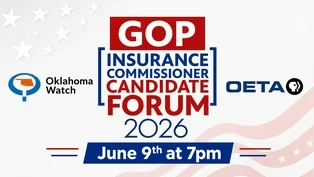
Oklahoma GOP Insurance Commissioner Forum Promo
Preview: S2026 Ep1 | 30s | A look at our upcoming conversation with Oklahoma's Republican Insurance Commissioner candidates. (30s)
Providing Support for PBS.org
Learn Moreabout PBS online sponsorship New Episode
- Drama

Hugh Bonneville stars in a crime drama inspired by one of the largest robberies in British history.

 New Episode
 New Episode
 New Episode
 New Episode
 New Episode



Support for PBS provided by:
Election Coverage is a local public television program presented by OETA