Prairie Yard & Garden
Growing and Selling Hemp
Season 37 Episode 12 | 28m 45sVideo has Closed Captions
R Bottled Gold grows hemp for CBD products.
Mary visits R Bottled Gold near Parkers Prairie to learn about the hemp industry from owners Matt and Casey Ruckheim.
Problems playing video? | Closed Captioning Feedback
Problems playing video? | Closed Captioning Feedback
Prairie Yard & Garden is a local public television program presented by Pioneer PBS
Production sponsorship is provided by Shalom Hill Farm, Heartland Motor Company, North Dakota State University, Friends of Prairie Yard & Garden, and viewers like you.
Support provided by:


Prairie Yard & Garden
Growing and Selling Hemp
Season 37 Episode 12 | 28m 45sVideo has Closed Captions
Mary visits R Bottled Gold near Parkers Prairie to learn about the hemp industry from owners Matt and Casey Ruckheim.
Problems playing video? | Closed Captioning Feedback
How to Watch Prairie Yard & Garden
Prairie Yard & Garden is available to stream on pbs.org and the free PBS App, available on iPhone, Apple TV, Android TV, Android smartphones, Amazon Fire TV, Amazon Fire Tablet, Roku, Samsung Smart TV, and Vizio.
Buy Now

Visit the Prairie Yard & Garden Website
Do you love gardening? Consider becoming a friend of Prairie Yard & Garden to support this show and receive gifts with your contribution. Visit the link below to do so or visit pioneer.org/donate.Providing Support for PBS.org
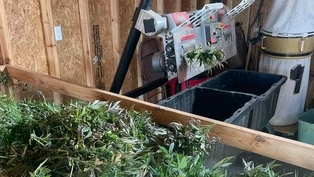
Learn Moreabout PBS online sponsorship<b>(bright gentle music)</b> <b>- Years ago my son suggested</b> <b>we do a show on hemp</b> <b>or even medicinal marijuana.</b> <b>Then when we were doing a show</b> <b>with Roger Wagner</b> <b>a few years back,</b> <b>he mentioned they use a</b> <b>part of their greenhouse</b> <b>to start some hemp plants</b> <b>for an area farmer.</b> <b>Well, those things set me on</b> <b>a mission to find a grower</b> <b>that can teach us about</b> <b>that relatively new crop.</b> <b>I'm Mary Holm, host of</b> <b>"Prairie Yard and Garden,"</b> <b>and come along as we</b> <b>travel to Parkers Prairie</b> <b>to learn all about</b> <b>growing and using hemp.</b> <b>- [Narrator] Funding for</b> <b>"Prairie Yard and Garden" is</b> <b>provided by Heartland</b> <b>Motor Company,</b> <b>providing service to</b> <b>Minnesota and the Dakotas</b> <b>for over 30 years in the</b> <b>heart of Truck Country.</b> <b>Heartland Motor Company,</b> <b>we have your best</b> <b>interest at heart.</b> <b>Farmers Mutual Telephone Company</b> <b>and Federated</b> <b>Telephone Cooperative.</b> <b>Proud to be powering</b> <b>Acira, pioneers in bringing</b> <b>state-of-the-art technology</b> <b>to our rural communities.</b> <b>Mark and Margaret Yackel-Juleen</b> <b>in honor of Shalom Hill Farm,</b> <b>a nonprofit rural</b> <b>education retreat center</b> <b>in a beautiful prairie setting</b> <b>near Wyndham, Minnesota,</b> <b>and by Friends of</b> <b>Prairie Yard and Garden,</b> <b>a community of</b> <b>supporters like you</b> <b>who engage in the long-term</b> <b>growth of the series.</b> <b>To become a friend of</b> <b>"Prairie Yard and Garden,"</b> <b>visit pioneer.org/pyg.</b> <b>(bright upbeat music)</b> <b>- When I went in</b> <b>to get my hair cut,</b> <b>I noticed the salon</b> <b>has a whole line</b> <b>of products made</b> <b>from hemp seed oil.</b> <b>I do tend to have dry</b> <b>skin, so I decided to buy</b> <b>and try one of</b> <b>those body lotions.</b> <b>Well, it worked really good,</b> <b>and I wanted to find out more.</b> <b>It turns out that Matt and</b> <b>Casey Ruckheim grow hemp</b> <b>on their farm near</b> <b>Parkers Prairie</b> <b>and make several products</b> <b>from their hemp crop.</b> <b>I called to see if we</b> <b>could come for a visit,</b> <b>and they said sure.</b> <b>So here we are at R Bottled</b> <b>Gold.
Welcome, Matt.</b> <b>- Thank you, Mary.</b> <b>We're glad to have</b> <b>you here today</b> <b>and ready to share our story.</b> <b>- What is your background</b> <b>or how did you get started?</b> <b>- So it's kind of a long story,</b> <b>but I was looking for a</b> <b>high tonnage forged crop</b> <b>for my beef cows, and a</b> <b>picture of a hemp plant</b> <b>showed up on my phone,</b> <b>and it just made me do</b> <b>a bunch more research</b> <b>and we ended up going</b> <b>to a hemp conference in</b> <b>Rochester, Minnesota.</b> <b>That kind of attending</b> <b>that conference</b> <b>kind of sealed the deal</b> <b>that we were gonna go</b> <b>ahead and try this.</b> <b>So our first year of</b> <b>growing was in 2019.</b> <b>I had to get licensed by</b> <b>the state of Minnesota first</b> <b>and pass the background</b> <b>check and get fingerprinted</b> <b>and have my picture taken</b> <b>and all that kind of stuff.</b> <b>But after that it was just a</b> <b>matter of finding some seed,</b> <b>which we were able to</b> <b>locate some out of Oregon,</b> <b>and that's the variety that</b> <b>we are still using today.</b> <b>- So what is the difference</b> <b>between marijuana</b> <b>and hemp and cannabis?</b> <b>I hear all those terms.</b> <b>- So both marijuana and hemp,</b> <b>they're both from</b> <b>the cannabis family.</b> <b>The main difference</b> <b>between hemp and marijuana</b> <b>is that hemp only contains</b> <b>a very small amount of THC,</b> <b>which is the chemical compound</b> <b>that gives a person a high.</b> <b>Marijuana has a level</b> <b>that's way higher, like,</b> <b>10 to 20% THC.</b> <b>And for our hemp plants</b> <b>to even be harvested,</b> <b>we need to pass a test</b> <b>that the state of Minnesota</b> <b>comes out and does, and</b> <b>that has to be under 0.3%.</b> <b>So it's a very,</b> <b>very small amount.</b> <b>So we want our CBD levels</b> <b>to be as high as possible,</b> <b>and we want our THC levels</b> <b>to stay below that 0.3 so</b> <b>that we can harvest even.</b> <b>Both of 'em towards the end</b> <b>of the season will increase</b> <b>in potency in the plant.</b> <b>So the big thing for us</b> <b>is that we have it tested</b> <b>by the state of Minnesota</b> <b>soon enough so that</b> <b>we pass that test so</b> <b>that we can harvest.</b> <b>If we didn't pass, we</b> <b>would end up having</b> <b>to destroy everything</b> <b>that you see here.</b> <b>So this year we passed</b> <b>the test at 0.235%.</b> <b>So we had a lot of wiggle room,</b> <b>and that was a big relief</b> <b>to just get over</b> <b>that little hurdle.</b> <b>- Do you have to get a license</b> <b>and how did you do that?</b> <b>- So I just basically had</b> <b>to fill out an application</b> <b>to the state of Minnesota,</b> <b>and once they did</b> <b>the background check,</b> <b>and I passed that,</b> <b>we basically just had</b> <b>to go in and get</b> <b>fingerprinted and, you know,</b> <b>have our pictures taken.</b> <b>You have to designate</b> <b>the location.</b> <b>Then after the plants</b> <b>have been transplanted,</b> <b>we have to go to the Farm</b> <b>Service Agency and certify</b> <b>how many plants</b> <b>or how many acres</b> <b>you put in and the variety.</b> <b>- [Mary] Does somebody come out</b> <b>and inspect your crop at all?</b> <b>- Once a season, the gentleman</b> <b>from the Minnesota</b> <b>Department of Ag comes out</b> <b>and he does the THC test,</b> <b>and he takes 30 different</b> <b>clippings off the top</b> <b>of the plants, about a two</b> <b>inch long section of the plant,</b> <b>and puts 'em in a bag and</b> <b>sends 'em off to a lab.</b> <b>And this year, took about two</b> <b>weeks to get the results back.</b> <b>- [Mary] How large of</b> <b>an area do you grow?</b> <b>- So I think we're</b> <b>just a little bit</b> <b>over an acre here this year.</b> <b>There's approximately</b> <b>1,400 plants.</b> <b>- These really look like shrubs.</b> <b>- They do actually.</b> <b>We have people</b> <b>that will drive up,</b> <b>and they will comment</b> <b>on how many pine trees</b> <b>we've planted and I'm</b> <b>like, "No, I'm sorry.</b> <b>Those aren't pine trees.
Those</b> <b>are actually hemp plants.
"</b> <b>It's a very interesting</b> <b>plant to watch grow.</b> <b>I really enjoy it.</b> <b>I mean, these buds as they form,</b> <b>it's just an amazing</b> <b>thing to watch.</b> <b>- [Mary] Can you please</b> <b>teach me a little bit more</b> <b>on how you actually start</b> <b>and grow these plants?</b> <b>- Sure, absolutely.</b> <b>(bright gentle music)</b> <b>- The upper Midwest has</b> <b>a rich history of dairy.</b> <b>At the turn of the 20th century,</b> <b>each small farm would only</b> <b>have at least one dairy cow</b> <b>that could provide the household</b> <b>with enough milk for cooking,</b> <b>while the cream was used</b> <b>for making butter.</b> <b>By the 1920s, local co-op</b> <b>creameries were dotting</b> <b>the landscape to</b> <b>provide communities</b> <b>with quality dairy</b> <b>products like milk,</b> <b>butter, and cheese, using</b> <b>locally produced milk</b> <b>and supporting local farmers.</b> <b>A lot has changed in the dairy</b> <b>industry since those days,</b> <b>but Minnesota still remains</b> <b>a large producer of milk</b> <b>and dairy products, ranking</b> <b>seventh in the nation,</b> <b>and is the sixth</b> <b>largest cheese producer.</b> <b>But there is more to</b> <b>cheese than a slice</b> <b>of American on a hamburger,</b> <b>or shredded mozzarella</b> <b>on your favorite pizza.</b> <b>Artisan cheese is</b> <b>growing in popularity</b> <b>with consumption growing</b> <b>five times faster</b> <b>than cheese consumption</b> <b>overall in the US since 2010.</b> <b>That is why we are</b> <b>visiting Redhead Creamery</b> <b>in Brooten, Minnesota.</b> <b>Here, co-owner, head cheese</b> <b>maker and resident redhead,</b> <b>Alise Sjostrom, has</b> <b>developed a full line</b> <b>of delicious gourmet</b> <b>artisan cheeses</b> <b>that are ridiculously good.</b> <b>- I would say that an</b> <b>artisan product in general</b> <b>is pretty subjective,</b> <b>but in my opinion,</b> <b>artisan means it's handmade.</b> <b>You're putting a lot</b> <b>of thought and care</b> <b>and heart into the product</b> <b>that you're making.</b> <b>In our case, there is some</b> <b>science into it as well,</b> <b>'cause we are making</b> <b>a dairy product,</b> <b>and you wanna make</b> <b>sure it's high quality,</b> <b>safe and good tasting.</b> <b>- [Mary] Much like</b> <b>those co-op creameries</b> <b>of the early 20th century,</b> <b>it all starts with the use</b> <b>of locally sourced milk as</b> <b>the essential ingredient</b> <b>of a great quality cheese.</b> <b>- [Alise] Locally sourced</b> <b>milk has a whole new meaning</b> <b>on our farm because we only</b> <b>use the milk from our cows</b> <b>on our farm, and so that</b> <b>considers us as farmstead,</b> <b>where we're utilizing</b> <b>the milk from our cows</b> <b>for our cheese right on site.</b> <b>- Consumers are also able</b> <b>to come here to our dairy</b> <b>and see our animals, learn</b> <b>how we take care of them,</b> <b>and note that the product</b> <b>is wholesome, it's fresh,</b> <b>and a good product</b> <b>for them to consume.</b> <b>- So when you are in need</b> <b>of flavorful quality cheese</b> <b>for your family</b> <b>or next gathering,</b> <b>visit minnesotagrown.com</b> <b>for a list</b> <b>of talented artisan cheese</b> <b>makers in your area.</b> <b>These plants are just beautiful,</b> <b>but where do you get</b> <b>the seed to start them?</b> <b>- So we have gotten our seed</b> <b>from a company in Oregon,</b> <b>mainly because the</b> <b>gentleman who was selling it</b> <b>spoke at a hemp growers</b> <b>meeting that I attended.</b> <b>Just the fact that I saw</b> <b>an actual human being</b> <b>was the reason that we</b> <b>went with this variety.</b> <b>Since we took the oil that was</b> <b>extracted from these plants</b> <b>and put it in our</b> <b>own product line,</b> <b>and customers have had</b> <b>great results with it,</b> <b>we've decided to stick with</b> <b>this same variety so that</b> <b>we have consistent</b> <b>results for our customers</b> <b>every time they purchase.</b> <b>- Matt, can you use seeds</b> <b>from the plants from one year</b> <b>to the next or do you</b> <b>have to buy new each time?</b> <b>- We have to buy new every year.</b> <b>Any seeds that we</b> <b>find on our plants,</b> <b>we actually can't keep.</b> <b>We had to sign an</b> <b>agreement that we would not</b> <b>keep any seed from these plants.</b> <b>- When do you start the seeds?</b> <b>- So we've played with the</b> <b>starting date a little bit,</b> <b>but generally in the</b> <b>first week or two of May,</b> <b>we will start these seeds.</b> <b>The later plantings</b> <b>that we've done are</b> <b>just as successful with</b> <b>yield on these plants.</b> <b>So I've actually done</b> <b>a little experiment</b> <b>with a few plants this</b> <b>year that were planted</b> <b>around July 1st, and</b> <b>they still produce buds.</b> <b>- So where do you</b> <b>start all these plants?</b> <b>- So we do it in our garage,</b> <b>and just the kids, my wife</b> <b>help out with all that.</b> <b>So initially it's</b> <b>about a month's time</b> <b>before we would transplant 'em,</b> <b>starting 'em in</b> <b>the 72 cell trays.</b> <b>We basically had to wait for</b> <b>the plants to be strong enough</b> <b>so that you could pull it out</b> <b>without tearing the roots off.</b> <b>So that was a little bit of</b> <b>learning curve our first year</b> <b>on knowing when to be</b> <b>able to transplant 'em.</b> <b>The peat pucks that we</b> <b>use this year, you know,</b> <b>you're just setting</b> <b>it right in the ground</b> <b>and not worried about</b> <b>tearing any roots off</b> <b>or kind of setting 'em back, so.</b> <b>- How do you prepare the soil?</b> <b>- So I took my great</b> <b>big tractor and disc,</b> <b>and you know, prep the ground,</b> <b>till it like any other field</b> <b>so that the ground</b> <b>was loose enough</b> <b>for the plastic laying machine</b> <b>to be able to work properly.</b> <b>- Well, it almost looks like</b> <b>there's kind of a raised area</b> <b>that the plants are growing in.</b> <b>How did you do that?</b> <b>- So that plastic laying machine</b> <b>kind of forms the bed as it's</b> <b>laying the plastic over it.</b> <b>So it kind of</b> <b>creates a tight mound</b> <b>so that the water can</b> <b>beat off the plastic</b> <b>and not pond over it.</b> <b>But with my gravelly soil</b> <b>type that I have here,</b> <b>I don't feel that that</b> <b>mound was necessary.</b> <b>If you were in some heavier,</b> <b>lower black heavy soil,</b> <b>you probably wouldn't want</b> <b>any ponding to take place.</b> <b>So to keep the roots, you know,</b> <b>outta that saturated</b> <b>area would be best.</b> <b>But that's just the machine</b> <b>that I had available to me</b> <b>and we rolled with it, so.</b> <b>- What kind of spacing do</b> <b>you use between plants?</b> <b>- Between plants, we have</b> <b>four feet between the rows.</b> <b>They could be planted</b> <b>closer together,</b> <b>but we plant them this</b> <b>far apart just so that</b> <b>for harvesting reasons</b> <b>we can get the ATV</b> <b>and the trailer between the rows</b> <b>and just to keep</b> <b>it mowed nicely.</b> <b>- What do you use for a</b> <b>mulch between the plants?</b> <b>- So the plastic basically</b> <b>covers up that dirt.</b> <b>It does a great job of</b> <b>keeping the weeds away.</b> <b>I mean, we did just a</b> <b>little bit of hand weeding</b> <b>around the plants, but</b> <b>the first year we did not,</b> <b>and that was a very</b> <b>steep learning curve.</b> <b>I'm still married,</b> <b>(Mary laughs)</b> <b>but that was a rough first go.</b> <b>- So do you have a machine</b> <b>that does the planting</b> <b>or are these all hand planted?</b> <b>- So we use a water</b> <b>wheel transplanter.</b> <b>There's a machine with a</b> <b>wheel on it with spikes in it</b> <b>that will poke the holes into</b> <b>the plastic and the soil,</b> <b>and at that same time that</b> <b>it's poking that hole,</b> <b>it allows a kind of a gush</b> <b>of water to enter that hole</b> <b>to kind of keep</b> <b>it nice and moist.</b> <b>And on the back of that</b> <b>machine, there's two seats.</b> <b>So two other family</b> <b>members will sit back there</b> <b>and alternate putting</b> <b>a plant in the ground.</b> <b>We do follow up behind and</b> <b>just make sure every plant</b> <b>is tucked into that hole</b> <b>so it's in there firmly</b> <b>and doesn't dry out.</b> <b>- How do you water 'em</b> <b>in afterwards then?</b> <b>- So there is a drip</b> <b>tape that is laid</b> <b>underneath the</b> <b>plastic at this...</b> <b>It's put down at the same time.</b> <b>We're running that off the</b> <b>garden hose from the house,</b> <b>and I did put some</b> <b>nutrients down,</b> <b>so I also used a water tank</b> <b>where we did mix that together.</b> <b>There's a kind of a main line</b> <b>that runs down the 12 rows</b> <b>that we have and then</b> <b>there's a valve going</b> <b>each way off that row.</b> <b>So it takes me about three days</b> <b>to get through a watering cycle.</b> <b>- And then how do you fertilize?</b> <b>- So generally I've had beef</b> <b>cattle that I've wintered</b> <b>in this area because</b> <b>I can't do it all.</b> <b>The cows had to go.</b> <b>And so this year</b> <b>was my first year</b> <b>kind of using a</b> <b>purchased product,</b> <b>but that was the</b> <b>nutrients were sent</b> <b>through the drip line</b> <b>to feed the plants.</b> <b>- Do you have to worry</b> <b>about critters at all,</b> <b>like deer or rabbits or mice?</b> <b>- So the deer do not affect</b> <b>it at all, which is amazing.</b> <b>We have a lot of</b> <b>deer around here.</b> <b>But they do walk across</b> <b>all my plastic right</b> <b>after I've got it laid</b> <b>and puncture all</b> <b>kinds of holes in it.</b> <b>So I'm not real</b> <b>happy when, you know,</b> <b>it's a spot for another</b> <b>weed to come through.</b> <b>But we have not had issues</b> <b>with the deer doing anything.</b> <b>We have turkeys.
Have</b> <b>no issues with that.</b> <b>We do see where</b> <b>mice will, you know,</b> <b>right at the end</b> <b>will start chewing</b> <b>at the bases of the plants.</b> <b>But nothing that</b> <b>will affect anything</b> <b>as far as production wise.</b> <b>- Do you have to worry</b> <b>about insect problems?</b> <b>- So as far as insects, we</b> <b>had transplanted this year,</b> <b>and my wife was mowing</b> <b>up and down the roads,</b> <b>and she's like,</b> <b>"Man, there's a lot</b> <b>of caterpillars out here.
"</b> <b>And so I came down</b> <b>and checked it out,</b> <b>and we ended up finding</b> <b>this great big monster thing</b> <b>that I've never seen before,</b> <b>and ended up having the</b> <b>agronomists from the co-op</b> <b>come out here and look around.</b> <b>And things were just</b> <b>crawling everywhere</b> <b>with caterpillars and armyworms,</b> <b>and there was a few that</b> <b>were on top of the plants.</b> <b>They'd made it up into the</b> <b>peaks, but they were dead.</b> <b>And the only thing we can</b> <b>figure out is there's enough</b> <b>potency in those</b> <b>leaves that, you know,</b> <b>it just protected itself.</b> <b>We did end up having, you know,</b> <b>some root feeding</b> <b>on some plants.</b> <b>Other than that it seems</b> <b>like things are pretty hardy.</b> <b>- I read something about a</b> <b>pollen sac that can form.</b> <b>What's that all about?</b> <b>- So these plants that you see</b> <b>here are all female plants.</b> <b>We do not want male plants</b> <b>to be growing out here,</b> <b>because they will</b> <b>release that pollen</b> <b>and pollinate our female plants.</b> <b>And when that happens, our</b> <b>female plants will produce seed</b> <b>instead of producing that bud,</b> <b>and our CBD production</b> <b>would drop way down</b> <b>for almost be nothing.</b> <b>So we are very diligent</b> <b>at walking the field here</b> <b>to make sure that one of</b> <b>these plants is not a male.</b> <b>So we're looking</b> <b>to find, you know,</b> <b>any sign of that and</b> <b>those plants get removed.</b> <b>We actually did not</b> <b>have a male plant</b> <b>this year or last year.</b> <b>Our first growing year,</b> <b>I think we had,</b> <b>like, six or eight.</b> <b>- [Mary] This is great,</b> <b>but can you tell me</b> <b>how you harvest and</b> <b>process the plants?</b> <b>- Absolutely.
I think Casey</b> <b>and my kids are gonna show you.</b> <b>(bright upbeat music)</b> <b>- I have a question.</b> <b>What are some plants</b> <b>that are more sustainable</b> <b>that don't require</b> <b>a lot of inputs?</b> <b>- That's a great question.</b> <b>I work at the arboretum</b> <b>doing plant conservation.</b> <b>So I work with a lot</b> <b>of native plants.</b> <b>So I like to think about using</b> <b>native plants in a garden.</b> <b>I think there are a lot of</b> <b>benefits to using native plants,</b> <b>especially thinking about</b> <b>Minnesota prairie plants.</b> <b>A sustainable garden</b> <b>to me is a garden</b> <b>that kind of takes</b> <b>care of itself.</b> <b>So you don't have to</b> <b>water a whole lot,</b> <b>you don't have to use</b> <b>a lot of pesticides.</b> <b>There's not a lot of weeds</b> <b>that become an issue.</b> <b>It houses a lot of pollinators</b> <b>and feeds a lot of pollinators,</b> <b>attracts a lot of birds,</b> <b>kind of does it all.</b> <b>Minnesota prairie plants</b> <b>are fantastic for that.</b> <b>They're very deep rooted</b> <b>so they, you know,</b> <b>once they're established,</b> <b>pretty much never have</b> <b>to water that garden.</b> <b>Since they're native, they</b> <b>will seed in very readily.</b> <b>A lot of the plants that you</b> <b>can get for a prairie garden</b> <b>will flourish on their own.</b> <b>They'll seed in, and</b> <b>one of the neat things</b> <b>about a prairie garden</b> <b>too is that every year</b> <b>it looks a little bit different.</b> <b>A good sustainable</b> <b>garden will also kind</b> <b>of flower throughout the summer</b> <b>so that there's</b> <b>pollinators available.</b> <b>It has things like bunch</b> <b>grasses that are very lovely.</b> <b>They may be counterintuitive</b> <b>for thinking about a garden,</b> <b>but they're great</b> <b>for pollinators</b> <b>in that they house pollinators.</b> <b>A lot of pollinators need</b> <b>those bunch grasses over winter</b> <b>for protection and</b> <b>shelter for predators.</b> <b>Think about legumes too.</b> <b>Things like prairie</b> <b>clovers and leadplants.</b> <b>Leadplant is a</b> <b>really great plant.</b> <b>Those feed the soil,</b> <b>so they're helping</b> <b>the plants around them as well.</b> <b>And asters, composite</b> <b>type plants,</b> <b>are great plants for a</b> <b>sustainable garden as well,</b> <b>because they flower at</b> <b>various parts of the year.</b> <b>And if you leave them</b> <b>up in the winter,</b> <b>they are fantastic</b> <b>seed sources for birds.</b> <b>I think some of the great</b> <b>things about a native garden</b> <b>are that they're</b> <b>beautiful all year round.</b> <b>They stick around for</b> <b>a really long time.</b> <b>They love where they live,</b> <b>so they'll keep putting</b> <b>themselves back out there.</b> <b>And they're great</b> <b>for other things too.</b> <b>Not just the flowers,</b> <b>not just the grasses,</b> <b>but all the other</b> <b>plants and animals</b> <b>that love those</b> <b>kinds of locations.</b> <b>(bright uplifting music)</b> <b>- [Narrator] Ask the Arboretum</b> <b>Experts has been brought</b> <b>to you by the Minnesota</b> <b>landscape Arboretum in Chaska,</b> <b>dedicated to</b> <b>welcoming, informing</b> <b>and inspiring all through</b> <b>outstanding displays,</b> <b>protected natural areas,</b> <b>horticultural research</b> <b>and education.</b> <b>- Casey, what's your role</b> <b>here in the business?</b> <b>- Well, I kind of like to call</b> <b>myself the chaos coordinator</b> <b>of this whole situation.</b> <b>Matt is pretty involved</b> <b>in the planting,</b> <b>and he kind of gets</b> <b>the logistics going,</b> <b>but we're support system</b> <b>for everything</b> <b>that happens here.</b> <b>- When do you</b> <b>harvest the plants?</b> <b>- So the state of</b> <b>Minnesota comes out</b> <b>and tests the plants for us.</b> <b>We have to wait until we</b> <b>get those results back,</b> <b>and then anytime after that</b> <b>when we feel fit to harvest,</b> <b>we can go ahead and do that.</b> <b>Historically, it's worked</b> <b>for us over MEA weekend.</b> <b>That just so happens</b> <b>to be when our kids</b> <b>are outta school and can help.</b> <b>So we have some extra hands</b> <b>to do that, and it just</b> <b>seems to have worked well</b> <b>this third week in October.</b> <b>- How do you harvest the plants?</b> <b>- Well, it's all hand done.</b> <b>We basically take,</b> <b>like, a hedge trimmer</b> <b>or a lopper that you can</b> <b>buy at any garden store,</b> <b>and we clip the whole plant off</b> <b>way at the bottom at the base.</b> <b>From there we load</b> <b>it onto a trailer,</b> <b>and then we take it to a barn,</b> <b>and we hang them upside</b> <b>down in the hay loft.</b> <b>- [Mary] What is the</b> <b>usable part of this plant?</b> <b>- So of this whole plant</b> <b>here, we take the top part</b> <b>or these, we call 'em buds.</b> <b>The big fan leaves</b> <b>we do not use.</b> <b>These leaves have no</b> <b>purpose for us to use.</b> <b>So what we want are the buds.</b> <b>There are tiny</b> <b>little leaves on here</b> <b>that we call sugar leaves.</b> <b>Those will stay on.</b> <b>But the big leaves,</b> <b>the fan leaves</b> <b>and the stems are</b> <b>not usable for us.</b> <b>- [Mary] About how many</b> <b>buds are on a plant?</b> <b>- Well, first we break</b> <b>it down into branches.</b> <b>On a plant this big, we'll</b> <b>probably, when we're processing</b> <b>we'll probably</b> <b>make up to 60 cuts,</b> <b>60 different branches</b> <b>on this plant.</b> <b>And bud count-wise, hundreds.</b> <b>Hundreds and hundreds.</b> <b>- [Mary] What do you do with</b> <b>the plant after you harvest it?</b> <b>- So we take it</b> <b>to a nearby barn,</b> <b>and we put them up in the hay</b> <b>loft and hang them to dry.</b> <b>We hang the whole</b> <b>plant together,</b> <b>and then once it has dried down,</b> <b>we'll take that plant</b> <b>back out of the barn,</b> <b>bring it to our shed,</b> <b>and that is when we</b> <b>cut the plants apart.</b> <b>- [Mary] What's the timeframe?</b> <b>For how long do you</b> <b>leave them hanging?</b> <b>- So in a perfect</b> <b>world it would take</b> <b>about 10 to 14 days to dry.</b> <b>We live in Minnesota,</b> <b>so our plants</b> <b>tend to freeze dry</b> <b>because it gets cold here</b> <b>the end of October.</b> <b>So usually what happens</b> <b>is they will dry down.</b> <b>When they come off the field,</b> <b>like, now this weekend</b> <b>they're probably</b> <b>at between 70 and 80% moisture.</b> <b>To process 'em, we like to run</b> <b>'em at, like, 15% moisture.</b> <b>So they have a lot</b> <b>of drying to do.</b> <b>Sometimes that requires us to</b> <b>bring them out of the barn,</b> <b>warm them up and dry them down</b> <b>before we can work with them.</b> <b>- [Mary] How do you</b> <b>do that with so much?</b> <b>- Little batch.
Small</b> <b>batches at a time.
(laughs)</b> <b>We pull out what we</b> <b>can fit in our shed.</b> <b>We run some heat in</b> <b>there with a dehydrator,</b> <b>and dry 'em down to the point</b> <b>where we can work with them.</b> <b>- [Mary] When the buds get dried</b> <b>down, what's the next step?</b> <b>- So when we bring them back</b> <b>in and we dry them down,</b> <b>we cut each branch</b> <b>off individually.</b> <b>We send them through what's</b> <b>called a bucking machine.</b> <b>That pulls all the</b> <b>buds off each stem.</b> <b>So we send one stem</b> <b>through at a time.</b> <b>It pulls the buds off.</b> <b>From there, it gets sent</b> <b>through what's called a trimmer.</b> <b>That will get rid of all the</b> <b>unnecessary leaves for us,</b> <b>and it leaves us</b> <b>with just the buds.</b> <b>From there we have to dry</b> <b>it down a little bit more</b> <b>so they are stable for storage</b> <b>before the extractor can</b> <b>extract the oil from them.</b> <b>So when they are dry and stable</b> <b>and separated into</b> <b>each individual bud,</b> <b>we put them in big super sacks,</b> <b>a three by three by</b> <b>three storage sack,</b> <b>and then we take them</b> <b>up to our extractor</b> <b>up in near Fergus Falls.</b> <b>So he'll start with the buds.</b> <b>He has a very</b> <b>sophisticated machine,</b> <b>a CO2 extractor it's called.</b> <b>And he will get oil</b> <b>essentially out of these buds.</b> <b>We get that in what</b> <b>we call raw form.</b> <b>From there it's taken to</b> <b>different manufacturers</b> <b>to be put into our products.</b> <b>So we have those</b> <b>professionally done.</b> <b>- [Mary] What are the products</b> <b>that are made from your plants?</b> <b>- So we have a quite a</b> <b>line of different products.</b> <b>We have a couple topical</b> <b>products that we use</b> <b>that are for your skin.</b> <b>We have a roll on and a</b> <b>body balm that are amazing.</b> <b>And then we have some</b> <b>ingestible products that you...</b> <b>We have a oil tincture that you</b> <b>drop underneath your tongue.</b> <b>We have gummies and</b> <b>then we actually have</b> <b>chocolate squares</b> <b>made out of our oil.</b> <b>And then we have a</b> <b>pet product line.</b> <b>So we have pet tinctures and</b> <b>pet chews for dogs and cats.</b> <b>- [Mary] Why are these</b> <b>such good products to use?</b> <b>- So CBD, the component</b> <b>that we're looking for,</b> <b>the CBD is a natural</b> <b>anti-inflammatory.</b> <b>So it's really good at anything,</b> <b>arthritis, pain, it's</b> <b>great for anxiety,</b> <b>for sleep issues.</b> <b>There's a number of things</b> <b>that CBD works really great for.</b> <b>- [Mary] Where are</b> <b>your products sold?</b> <b>- So we sell most of our</b> <b>products through our website,</b> <b>and then we ship</b> <b>to our customers.</b> <b>We do have our product line at</b> <b>the local chiropractic office</b> <b>in Parkers Prairie.</b> <b>And then if you know us,</b> <b>(laughs) you can give us a call</b> <b>and we will figure it out.</b> <b>- How have you developed the</b> <b>market for your products?</b> <b>- I think people are</b> <b>generally looking</b> <b>for natural ways to feel better.</b> <b>We are proud that we are</b> <b>a family owned business.</b> <b>Our kids are extremely involved</b> <b>in this whole process.</b> <b>People are looking for</b> <b>great local products.</b> <b>I think we've fit that</b> <b>category pretty well.</b> <b>- [Mary] Well, thank you so much</b> <b>to both you and Matt</b> <b>for letting us come out</b> <b>and teaching us all</b> <b>about this great product.</b> <b>- Absolutely.
We're</b> <b>happy to have you here.</b> <b>And you came on harvest day,</b> <b>so we might put you to work.</b> <b>(both laugh)</b> <b>(bright gentle music)</b> <b>- [Narrator] Funding for</b> <b>"Prairie Yard and Garden"</b> <b>is provided by</b> <b>Heartland Motor Company,</b> <b>providing service to</b> <b>Minnesota and the Dakotas</b> <b>for over 30 years.</b> <b>In the heart of Truck Country,</b> <b>Heartland Motor Company.</b> <b>We have your best</b> <b>interest at heart.</b> <b>Farmers Mutual Telephone Company</b> <b>and Federated</b> <b>Telephone Cooperative.</b> <b>Proud to be powering</b> <b>Acira, pioneers in bringing</b> <b>state-of-the-art technology</b> <b>to our rural communities.</b> <b>Mark and Margaret Yackel-Juleen</b> <b>in honor of Shalom Hill Farm,</b> <b>a nonprofit rural</b> <b>education retreat center</b> <b>in a beautiful prairie setting</b> <b>near Wyndham, Minnesota.</b> <b>And by friends of</b> <b>Prairie Yard and Garden,</b> <b>a community of</b> <b>supporters like you</b> <b>who engage in the long-term</b> <b>growth of the series.</b> <b>To become a friend of</b> <b>"Prairie Yard and Garden,"</b> <b>visit pioneer.org/pyg.</b> <b>(bright uplifting music)</b>
Providing Support for PBS.org
Learn Moreabout PBS online sponsorship

- Home and How To

Hit the road in a classic car for a tour through Great Britain with two antiques experts.













Support for PBS provided by:
Prairie Yard & Garden is a local public television program presented by Pioneer PBS
Production sponsorship is provided by Shalom Hill Farm, Heartland Motor Company, North Dakota State University, Friends of Prairie Yard & Garden, and viewers like you.