Prairie Yard & Garden
Growing Apricots, Apples and More
Season 39 Episode 11 | 28m 45sVideo has Closed Captions
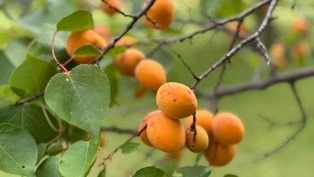
Fruit enthusiast Al Precht of Canby successfully challenged himself to grow and graft apricots.
Meet Al Precht of Canby, Minnesota, a fruit enthusiast who successfully challenged himself to grow and graft apricots, resulting in many trees loaded with fruit. Al began by focusing on growing and grafting apricots, and now enjoys many trees loaded with fruit. In addition to his plentiful apricots, he shares with host Mary Holm his cultivation of other fruits, and his vegetable garden.
Problems playing video? | Closed Captioning Feedback
Problems playing video? | Closed Captioning Feedback
Prairie Yard & Garden is a local public television program presented by Pioneer PBS
Production sponsorship is provided by Shalom Hill Farm, Heartland Motor Company, North Dakota State University, Friends of Prairie Yard & Garden, and viewers like you.
Support provided by:


Prairie Yard & Garden
Growing Apricots, Apples and More
Season 39 Episode 11 | 28m 45sVideo has Closed Captions
Meet Al Precht of Canby, Minnesota, a fruit enthusiast who successfully challenged himself to grow and graft apricots, resulting in many trees loaded with fruit. Al began by focusing on growing and grafting apricots, and now enjoys many trees loaded with fruit. In addition to his plentiful apricots, he shares with host Mary Holm his cultivation of other fruits, and his vegetable garden.
Problems playing video? | Closed Captioning Feedback
How to Watch Prairie Yard & Garden
Prairie Yard & Garden is available to stream on pbs.org and the free PBS App, available on iPhone, Apple TV, Android TV, Android smartphones, Amazon Fire TV, Amazon Fire Tablet, Roku, Samsung Smart TV, and Vizio.

Visit the Prairie Yard & Garden Website
Do you love gardening? Consider becoming a friend of Prairie Yard & Garden to support this show and receive gifts with your contribution. Visit the link below to do so or visit pioneer.org/donate.Providing Support for PBS.org
Learn Moreabout PBS online sponsorship(light music) - Years ago, we did a show with Jody Olson from Canby.
In addition to doing a great job on that show, Jody also gave me the names of several other people and topics in the area that would make interesting shows.
Well, Jody is a master gardener and knows her stuff when it comes to plants.
I am Mary Holm, host of "Prairie Yard and Garden," and let's go visit with one of the names on Jody's list to learn about growing apricots, fruits, and a whole lot more.
- [Presenter] Funding for "Prairie Yard and Garden" is provided by Heartland Motor Company, providing service to Minnesota and the Dakotas for over 30 years in the heart of truck country.
Heartland Motor Company, we have your best interest at heart.
(light music) North Dakota State University through its field to fork educational program, providing research-based information on growing, preparing, and preserving fruits and vegetables.
(light music continues) Mark and Margaret Yackel-Juleen in honor of Shalom Hill Farm, a non-profit rural education retreat center in a beautiful prairie setting near Windom, Minnesota.
And by Friends of Prairie Yard and Garden, a community of supporters like you who engage in the long-term growth of the series.
To become a Friend of Prairie Yard and Garden, visit pioneer.org/pyg.
(light music fades) (bright music) (bright music fades) - Growing up, I spent many days out in the fields baling hay or harvesting grain.
To come home all sweaty and hungry, it was such a treat to have fresh fruit like apricots that were always in season at harvest time.
When Jody suggested visiting Al Precht, because he loves to grow apricots right here in Minnesota, it took me right back to those delicious fruits mom had bought.
I called Al, and he said we could come to see his apricots and other fruits too.
Thanks, Al, for letting us come.
- Well, you're very welcome.
- Now, what is your background?
- Well, I started out outta high school in the navy.
I joined the navy right after I got outta high school, and that was my first experience with apricots actually.
I was stationed in Vallejo, California, it's up by San Francisco, and I was going to school there and I had to live somewhere in California, and we found a place in Napa, California, wine country.
So one weekend, we were bored and wanted to see what this area was all about.
We started just touring around the Napa area.
And as we were out there looking around, I saw a fruit tree off in the distance and it had some fruit on it, and I thought, "I better go check this out."
And it happened to be apricot, and it was ripe.
So I tasted, and I went, "Oh my God, I might have to grow some of these."
(Al and Mary laugh) The only experience I had with apricots before that was my mother had brought some home from the store and they tasted terrible, and I thought, "No, I don't like apricots."
After that day, I like apricots.
(Al and Mary laugh) - Well, how did you end up in this location?
- When I got out of the navy, I was looking for a place to live.
My good friend actually drove out to San Diego to pick me up after I was discharged.
And we drove back, and he says, "There's a place out in the country I always go hunting."
And nobody had lived here for years.
So he knew the guy that owned it, of course, 'cause he was hunting here all the time.
And so we moved out here.
And it was overgrown tall grass like the CRP up right by the house.
That was the spring of '77 when I moved here.
- [Mary] How did you get started growing apricots here?
- Well, I didn't go into it immediately.
It was probably six, seven years after I was here.
Maybe even more.
I'm not even sure.
But I happened to have the Gurney's catalog out, and on the back page was a two for one offer on apricots.
I was, "Yeah, I think I'll order that."
So I did.
And that was my first experience with growing apricots here.
I had two trees of apricots from Gurney's, and they turned out to be totally different trees.
The one in my center turnaround, the apricots were inedible.
They'd get a little yellow.
And they were hard, they stayed hard.
And when they did fall off, they were cracked and yellow and, ugh.
They had no taste at all.
Well, yeah, they had a bad taste.
(Al and Mary laugh) And the other one had a beautiful football-shaped apricot, and it tastes like Tang orange juice.
It was just excellent.
I think it was in late '80s, I grabbed a bunch of seeds from the good tree that I liked, and I went like that in my garden.
And the next spring, I had apricots coming up all over in my garden.
They took six or seven years before they bloomed from seed.
And I was tempted to pull 'em outta my garden 'cause I wanted my garden back.
I had to keep tilling around 'em.
I actually had the tractor over there and the chain dragged out.
I was ready to pull 'em out that fall.
They hadn't bloomed.
I hadn't done anything.
It's time to get my garden back.
And then as I thought about it, while I'm getting this all ready, I said, "Hmm, why don't I just wait till next spring and see if they bloom?"
And they did.
(Al and Mary chuckle) So it was that close to even just pulling 'em all out.
- [Mary] So did you do anything different to get 'em to bloom?
- No, I just waited.
(Al and Mary laugh) But it was Mother Nature, you know, doing what she does.
And it just takes a while for them to mature enough to bloom.
And they did.
And the fruit I tasted on that first apricot was just excellent.
I thought, "Oh my God, I almost pulled these out."
So they stayed.
And it turned out I had way too many trees in my garden, but I gave a bunch of 'em away.
And two of 'em that I gave away I did name because my landlord ended up with those two in front of his house, and they were both good.
So I got a graft of those and moved them back here on a grafted tree.
But that's where it kinda started.
And the ones that I left in my yard, I've got, one, two, three, four of 'em that I named because they were good enough fruit to name.
The ones that weren't good enough to name I didn't name 'em.
Once those trees proved themselves to be good apricots to eat, then I took pieces of those trees and grafted them onto Manchurian apricot root stock and planted 'em out here.
And once they got about this big, then I cut 'em off and grafted my good varieties on each of those right here, and that's what we have here now.
From then on, I've been grafting ever since.
(chuckles) - [Mary] Now, do you fertilize your trees too?
- [Al] No.
- [Mary] Okay.
Do you have to worry about a late spring frost disturbing your- - [Al] All the time.
- [Mary] Okay.
(Al and Mary laugh) Okay, so that can wreck your harvest.
- Well, yeah.
Apricots in Minnesota are not a dependable crop.
They are subject to hard winters where the flower buds actually freeze and die, and they just fall off in the spring, they won't bloom.
The tree itself is extremely hardy.
I have never had a tree die from deep, hard winters.
But the flower buds do.
- How do you know when the apricots are ripe and ready to eat?
- When they fall on the ground.
(Al and Mary laughing) That's the first ones I taste.
- [Mary] Okay.
And then how do you harvest all of these?
- [Al] A lot of people come out, and they grab all they can, and they go make wine, and they make jelly, and they make jam and preserve it, whatever they make.
It's whatever they can get.
- [Mary] Then do you have to do anything special in the fall to take care of your trees?
- [Al] No.
One thing I like to do is harvest a few seeds.
They're really good to eat.
It's just like any other nut.
You crack the nut open and there's a seed in, it's just like an almond.
- [Mary] Now, you grow more than just apricots, right?
- [Al] Right.
Apples.
That's what I started out planting before I ever got any apricots.
Apples and pears, raspberries.
- [Mary] Well, can we go see some of those, too?
- [Al] Yes, we can.
(light music) - If you've ever planted summer squash or zucchini, you may be amazed at how fast it grows.
You can almost watch it grow.
There is a national holiday, tongue in cheek, National Leave Zucchini On Your Neighbor's Doorstep.
Now, zucchini is a little different from winter squash.
It has a thinner skin, and it has a higher moisture content.
It's also much lower in calories than a typical winter squash.
It does contain vitamin C but not as much carotinoids, which make vitamin A in our body.
Zucchini's superpower is versatility.
Try it in different ways.
Try making zucchini boats.
Simply slice them lengthwise, scoop out some of the center and roast them, flip them over, fill them with taco meat or stuffing or pasta sauce and bake.
In meat dishes, you can add grated zucchini to meatloaf or meatballs.
You can also steam slices in the microwave, or saute them with garlic on the stovetop.
There are spiralizer tools available, or you can simply use a vegetable peeler to make zucchini noodles.
And if you have an air fryer, try making crunchy snacks by air frying zucchini chips.
If you want to trim back on your summer squash production, the blossoms are edible.
They have a mild flavor.
You can float them in soups, you can use them in salads.
And, as a bonus, they won't produce another summer squash if you have too many.
I'm Dr.
Julie, bringing the field to your fork.
Until next time.
(light music) - [Al] This is my favorite apple, Empire.
Have you ever heard of that?
- No.
- Well, I ordered these shortly after I moved here, maybe five years after I moved here.
I used to have a lot of apple trees in here.
But this one has really done well.
It produces every year.
It's not one of those that produces every other year, like a lot of apples do.
But it always has a crop.
It ripens around September.
It's a red apple.
And it's just excellent flavor.
And crispy, really crispy.
So that is my favorite apple.
- [Mary] Okay, what are some of the other varieties that you have?
- [Al] I have Wolf River.
It's an 1800s variety, huge apple.
I've got Golden Delicious.
And I've got one that I named Q. It was supposed to be Northwest Greening.
And it was marked Northwest Greening, but it is not a Northwest Greening.
I have no idea what it is, so I named it Q for question.
(Al and Mary laugh) - [Mary] Okay.
- But it is another excellent apple, it's my second favorite apple.
And then I have a few apples I've grafted onto my Wolf River.
And I'm getting ready to graft on to another apple I have over here.
I just pruned off some of the big branches this spring, and now they've got new growth.
That's where I'll graft onto next spring.
- So is the spring the best time to do your grafting?
- The grafting I do, yes.
(chuckles) It has to be done in the spring.
But there is a different type of graft you can do in August.
I'm just not good at doing that one.
It's a bud graft, they call it.
I don't know how to do that one very well, so I just stick to my spring grafting.
- [Mary] Do these trees, do you need to have a pollinator tree blooming at about the same time to get a good crop?
- [Al] Yeah, I think so.
But I have enough trees here blooming all the time so I don't worry about it.
The pears are a different story.
They definitely need a pollinator.
The one I have.
- [Mary] Well, these trees are out in the open.
Do you have trouble with critters?
- Yeah, the deer.
(Al and Mary chuckle) And even the rabbits.
I've got a fairly good-sized tree that had a trunk like that.
The rabbits girdled the trunk one year.
And mice.
- [Mary] What do you do to prevent the damage?
- [Al] Well, in the fall of every year, I wrap with tinfoil.
That's my wrap for protecting the trees.
But the mice just chew the tinfoil.
I didn't realize they would do that, but they did.
But the rabbits won't bother 'em.
Take a long sheet, and start at the base, and spiral it up the tree, and then I squeeze it.
And it stays on by itself, easy.
- [Mary] Okay.
How about the deer?
'Cause they can stand on their hind legs.
- Well, they'll chew on anything that's handy.
They're browsers, whatever's handy.
"Oh, I'll eat that."
You just deal with a little loss here and there.
And that's the trouble with my apricots, too.
So they won't ever get any more than this tall unless you protect them from the deer in the summertime.
In the summertime, the rabbits don't bother, so I don't have to worry about them in the summer.
But wintertime, definitely.
- [Mary] Okay.
- [Al] I just started some new seedlings three years ago in the spring, from seed.
And, first, I put a three-foot fence around the whole works, the whole row.
And then I even put a higher fence.
So I got six feet of chicken wire fence around those new apricots so the deer cannot mess me up again.
I started over so many times, you can't believe it.
(Mary chuckles) - Well, do you have any trouble with insect or disease issues?
- Not on the apricots.
The apples, I get a few worms in the apples, but I just eat around 'em.
I'm organic, so I don't spray.
- [Mary] What do you do with all your harvest?
- [Al] I eat all I can.
- [Mary] Okay.
(Al and Mary chuckle) - [Al] And I give away the rest.
- [Mary] Okay.
- [Al] Yep.
- [Mary] Al, do you have other fruits, too?
- I sure do.
I got pear trees.
I wanna show you them.
And I have plums, raspberries.
And raspberries just got down.
It's too bad you didn't get to taste them, but they're really good too.
But the pear, that's pretty interesting.
(bright music) This is Waterville pear, right there.
And it took many, many years before I ever got a crop.
They just don't bloom early in their life, I guess.
And that's what I was told.
Pears are very fickle about blooming in the early stages of their lives.
So I waited probably 20 years since I planted this thing before I ever got a bloom.
And then I didn't have a pollinator.
So I asked Jody Olson if she would let me have a piece of her pear tree, and I grafted it on this one.
And it finally bloomed this year, but I hadn't had a bloom before.
And this one, finally, gave me a full tree of blossoms this year.
And I had no pollinator.
I didn't think I would have Jody's tree either blooming, but, so I asked a friend of mine in Canby if I could borrow some of his branches, and he says, "Sure, take all you want."
And then I went and I got four or five branches from his trees, put 'em in a five-gallon bucket down at the base of this tree, and walked away.
And the pear finally got done blooming.
Even the blossoms in the bucket were still blooming.
But I noticed, all of a sudden, I've got pears setting on the whole tree.
(Mary chuckles) And this side of the tree where the bucket sits, I had the most pears, the opposite side had a few, and the top none.
(chuckles) So it worked, just using branches from another tree, setting it underneath the tree in a five-gallon bucket full of water.
- [Mary] So what was Jody's?
- [Al] Jody's is luscious.
And I did bloom a few days later than this, but it was, you know, I think it even helped pollinate a few.
So we got some pollination, finally, and a crop.
(chuckles) - [Mary] Do you notice the difference between the luscious and the Waterville?
- Well, hers is light green.
And mine, as you can see, has a darker green and red on it.
So they're totally different pears, very obvious.
It's a different pear, but it's just my grafting.
- Wow, that's just wonderful.
Do you have plants to encourage pollinators to come and fertilize all of your fruits?
- I don't plant anything specifically, but we didn't have hardly any bees this spring either.
I think maybe just flies or whatever.
Whatever insects landed on those flowers, it worked.
- [Mary] It looks like you have a lot of prairie plants here though, too.
- [Al] Well, this is my asparagus plot.
And I put this in really early when I first moved here.
Maybe the third or fourth year after I moved here I put this asparagus patch in.
It's dwindled down to very few asparagus plants, but you can see 'em.
And I get a good harvest every year.
I never worry about having asparagus.
And we eat asparagus every day.
Every day.
So since it is dwindling, I did plant a new asparagus plot this spring.
44 more plants, so we'll have lots.
(Mary chuckles) - [Mary] Well, you have all these fruits.
Do you do vegetables, too?
- [Al] Oh, everything you can imagine.
- [Mary] (chuckles) Can we see that?
- [Al] Yes, whenever you want to.
(light jazz music) - I have a question.
I've heard some parts of the Upper Midwest are now in Zone Five.
What kind of plants can I now try?
- Yeah, so there are some parts of the Upper Midwest that are in USDA Hardiness Zone Five now, which means that basically our winters have gotten a bit warmer and our growing seasons have gotten a bit longer.
In fact, here we are just bordering the Twin Cities here at the Minnesota Landscape Arboretum, and the arboretum happens to be right on that border between Zone Five and the Twin Cities, and where it's Zone Four farther west of the metro.
So we are starting to experiment with some Zone Five plants here at the arboretum.
Some that you could try at home would be the pawpaw, which is a Native American fruit.
The persimmon, which we're trying here a little bit.
There's a catalpa, purpurea tree that you could give a shot.
Catalpa is a really, really nice shade trees that provide a lot of dense shade.
So that's a nice option to try.
An ornamental plant for dry shaded gardens is an Epimedium, which is an Asian plant that is considered Zone Five that you could try here.
I do just wanna say that anything that we try for Zone Five, while we're in this marginal Zone Five zone, you should really approach it as experimental.
Maybe it would survive the first few winters.
But if we do get a really classic Minnesota-North Dakota winter that's really cold, it could die.
And so when we say Zone Five, we don't mean that we flipped a switch and all of a sudden we can grow hardier plants.
We're gonna try 'em out, see what works, see what doesn't.
Another thing that I wanna point out is I tried blackberries, Primocane blackberries in my backyard that were rated as Zone Five, I wanted to see if they would survive.
Here's the kicker.
Yes, they survived the winter, but they didn't produce fruit by the time we got a frost in October.
Sometimes a Zone Five plant, a warmer climate plant, means that it takes a longer season to actually develop the fruit or the crop that you're trying to grow.
So maybe even if it survives there, if your goal is to get fruit off of it, you might not because our season's still just not quite long enough.
You know, gardening's all about experimentation, so go ahead, try something new.
Just keep in mind that, you know, don't get too disappointed if something doesn't go quite the way you want it to right away.
We're all just having fun.
(light jazz music) - Well, this is my cole crop area this year.
I move it all around.
But this year, I harvested six beautiful white heads of cauliflower.
And these, coming later this year, must be the rain or something, they are not doing very well.
They don't produce a nice-looking head.
But my purple cauliflower are doing well.
And my purple cabbage are just awesome.
- [Mary] Why do you like the purple?
- [Al] The flavor.
It's unbelievable.
I put 'em in a refrigerator.
I was eating cabbage this spring from last year's crop.
They're stored in my refrigerator all year long, and the flavor is just excellent.
So I make sure I grow the purple cabbage every year.
- [Mary] How did you put 'em, or how did you keep 'em in the fridge?
Did you wrap 'em in anything, or what?
- [Al] I go to the grocery store and get groceries and they get a plastic bag, I use those bags to put the head in.
And they sit in the refrigerator just fine all winter.
- [Mary] Wow.
- [Al] Once in a while you gotta clean off a couple outside leaves when they start rotting.
But big deal.
- [Mary] This is just beautiful.
What variety is this?
- [Al] Graffiti, it's called.
(chuckles) - [Mary] Wow.
- [Al] Purple cauliflower.
And it tastes about the same as the white.
- [Mary] Okay.
- [Al] So... - Well, then do you grow tomatoes, too?
- Oh, yes.
That's my favorite food.
I can live on those things.
When I was working as a dozer operator, I would take an ice cream bucket full of tomatoes, and they'd be gone by noon.
I'd eat 'em all myself.
(Al and Mary laugh) So I love tomatoes.
I will never be without those.
- So what are the varieties that you like to grow?
- I grow Better Boy.
That's my favorite.
And Lemon Boy.
Those are the two I've stuck with now for years.
Years ago, I did a test.
I grew like a dozen different varieties, and I peeled them all and laid 'em on a plate, and I had the name on there, and then I'd judge them on a scale of 1 to 10, which ones were the best, and the Better Boy and the Lemon Boy were 10s.
Definitely a 10.
And I did grow a, German head is the name of the tomato.
It's an old heirloom variety.
They are really excellent as well, but you don't get a lot of tomatoes on the plant so it's not worth it when I got Better Boy and Lemon Boy.
(Al chuckles) - So how do you keep yours upright so that they're not tipping out all over the place?
- Well, I didn't for a lot of years.
And just maybe five or six years ago, I came up with a plan to fix that situation.
I had some old fencing, when I was a dozer operator, I buried a lot of trees and groves and stuff and I'd find these rolls of fence wire, and they said, "Put 'em in the hole and bury it," and I took a bunch of 'em home.
(Mary chuckles) Well, I had this 32-inch wide fencing that was just the perfect width.
And so I built cages.
What I do is I build my first layer of fencing with two-by-two posts, sharpen the end and pound 'em in the ground.
And then I run a string line between the two ends of the posts of the roll, and I put another post probably around every eight feet, I put a post, and I put it right along the string so they're in line.
And then I measure over 30 inches.
I got a 32-inch fence, I measure 30 inches over, and then I take my 32-inch fencing and I roll it.
Oh, actually I put in one-by-fours along those posts at about two feet, and then I roll the fencing out on that.
And so it's got an inch over on each side, and it sits on there just nicely.
There's hardly any work to it other than screwing the fencing together, I mean, the posting system together.
- [Mary] So then what do you do in the fall when you take everything down?
- [Al] Well, I save all the screws, put 'em in a bucket, and use them the next year when I move my crop to a different spot.
So I rebuild it every year.
And I have a lot of varying lengths of fencing so I can always get it to fit whatever length of row I have, and it works perfect.
- [Mary] So you do rotate your crops around the garden?
- [Al] Yes, I do.
- [Mary] Okay.
- [Al] Yes I do.
- [Mary] And why is that important?
- [Al] Well, diseases.
You gotta try to avoid the diseases as much as possible.
But sooner or later it'll get you anyway.
(Al and Mary laugh) - Well, this has been so interesting, and I'm so grateful that you let us come out and see all of your fruits and vegetables.
- Anytime.
And we'll let you taste them too, anything that's ready to eat.
(Al and Mary chuckle) - Sounds like a great idea to me.
- [Al] Yes.
(Al and Mary chuckle) (light music) - [Presenter] Funding for "Prairie Yard and Garden" is provided by Heartland Motor Company, providing service to Minnesota and the Dakotas for over 30 years in the heart of truck country.
Heartland Motor Company, we have your best interest at heart.
(light music continues) North Dakota State University through its field to fork educational program, providing research-based information on growing, preparing, and preserving fruits and vegetables.
(light music continues) Mark and Margaret Yackel-Juleen in honor of Shalom Hill Farm, a non-profit rural education retreat center in a beautiful prairie setting near Windom, Minnesota.
And by Friends of Prairie Yard and Garden, a community of supporters like you who engage in the long-term growth of the series.
To become a Friend of Prairie Yard and Garden, visit pioneer.org/pyg.
(bright music) (bright music fades)
 New
NewGrowing Apricots, Apples and More
Video has Closed Captions
Preview: S39 Ep11 | 30s | Fruit enthusiast Al Precht of Canby successfully challenged himself to grow and graft apricots. (30s)
Providing Support for PBS.org
Learn Moreabout PBS online sponsorship

- Home and How To

Hit the road in a classic car for a tour through Great Britain with two antiques experts.













Support for PBS provided by:
Prairie Yard & Garden is a local public television program presented by Pioneer PBS
Production sponsorship is provided by Shalom Hill Farm, Heartland Motor Company, North Dakota State University, Friends of Prairie Yard & Garden, and viewers like you.