Oregon Art Beat
Healing Through Making
Season 23 Episode 7 | 26m 49sVideo has Closed Captions
Sa'rah Sabino, Daniela Molnar, Fred Harwin
Artist Daniela Molnar traded in scientific illustration for abstract painting, utilizing pigments she forages herself, and deeply connecting to climate change; Moroccan-American painter Sa’rah Sabino explores what it means to be mixed race in the US; Fred Harwin is an “ocularist” - he makes prosthetic eyeballs, hand painting each one so it perfectly matches the patient’s other eye.
Problems playing video? | Closed Captioning Feedback
Problems playing video? | Closed Captioning Feedback
Oregon Art Beat is a local public television program presented by OPB
Oregon Art Beat
Healing Through Making
Season 23 Episode 7 | 26m 49sVideo has Closed Captions
Artist Daniela Molnar traded in scientific illustration for abstract painting, utilizing pigments she forages herself, and deeply connecting to climate change; Moroccan-American painter Sa’rah Sabino explores what it means to be mixed race in the US; Fred Harwin is an “ocularist” - he makes prosthetic eyeballs, hand painting each one so it perfectly matches the patient’s other eye.
Problems playing video? | Closed Captioning Feedback
How to Watch Oregon Art Beat
Oregon Art Beat is available to stream on pbs.org and the free PBS App, available on iPhone, Apple TV, Android TV, Android smartphones, Amazon Fire TV, Amazon Fire Tablet, Roku, Samsung Smart TV, and Vizio.
Providing Support for PBS.org
Learn Moreabout PBS online sponsorshipSupport for Oregon Art Beat is provided by... and OPB members and viewers like you.
WOMAN: So the foraging process, I think of it as primarily an act of listening.
It's a way to, like, go out into the world and to try to really pay attention to the place and what it offers.
MAN: When people come to me, they're experiencing a trauma that has not been addressed.
They're missing something.
And I have an opportunity to help them to get that something back.
WOMAN: I felt really lost in my story because I didn't understand part of myself.
As I'm exploring who I am fully as a human, I'm just making work as it comes.
[ ♪♪♪ ] [ ♪♪♪ ] What I love about painting is really just getting lost in it.
And I always say I wish I could paint with my eyes, because sometimes, like, the images that I can see or the images that I want to create, like, I wish I could just create more of them faster.
And I think being an artist is really about, like, creating something that doesn't exist yet to remember it forever.
This past summer, I had a show at the Portland Art Museum.
It was called "Away Home."
"Away Home" really came from two things: sports teams, and then the second point of view is really about a journey, so the idea of a way home, a journey really to finding myself, because this is the first time in my work that I started to talk about race and identity.
[ ♪♪♪ ] I grew up in Boston, Massachusetts.
I'm the youngest of four to a single mom.
Me and my siblings have different fathers, so I was actually the only brown kid in my family.
I was 11 years old when I started really becoming a basketball fanatic.
In school, when I was getting my degree in painting, I was painting basketball a lot.
I was just, like, trying to capture moments, like the feeling of it from a fan's perspective, what the game looks like or, like, the deep little kind of cropped moments of what's happening in the game.
And I didn't know why I was so obsessed with it.
I think from a cultural aspect, it really was something that made me feel like I belonged to it.
Because being mixed race, I didn't necessarily grow up with both races and understanding both identities.
But basketball kind of gave me a cultural agreeance with something, it gave me part of a culture, it gave me something that I felt like I could tie into more.
I could show up to school and argue about the game or argue about the best players.
But I really, really loved it.
[ ♪♪♪ ] So my father was born in Mohammedia, Morocco.
It's a very deep-rooted culture in so many beautiful crafts and arts and just, like, really beautiful language and food and so much color.
So this is a piece called "The Magic Carpet."
And it's a Berber rug.
It is woven in the Atlas Mountains of Morocco by women.
And it is a piece that's really special because it comes from a sketch that I actually did in 2013, where I started to mix Moroccan tiles with basketball courts.
Kind of fell in love with this imagery of bringing two worlds together.
I sent it to Morocco, and it sort of became a beautiful conversation with Berber women who actually wove the drawing that I sent over.
And where I'm sitting is sort of one side of the court.
Over here, another side of the court.
And actually these traditional diamonds that are going up are from traditional rugs, so the coolest actually thing, and I have a basketball here, I learned that this line and these two is actually the mark of the Berber tribe of North Africa.
So it's actually the indigenous mark of my ancestors, which is a really amazing and crazy moment, because I've just been so drawn to the image of a basketball for so long... that I didn't realize I was being drawn to something that was part of me.
That show at the Portland Art Museum was really the first time that I've dug into myself in a way where I wanted to tell the story about what it is to be mixed race or what it is to be a woman of color, what it means to feel like you're being put inside of a box.
"Genie in a Bottle," it's a self-portrait.
And it's meant to be through, like, the childlike version of myself.
I'm wearing a basketball jersey, it's half in Arabic.
It actually says my name in Arabic.
But if you look at the painting, it's actually myself stuck in four walls.
And it's the only Western frame in the entire show.
And it's actually a big gold frame, like it must be beautiful because it's framed by this culture, but actually it feels very trapped within the four walls of that frame.
In one space, I look a certain way.
And in another space, I look another way.
And I never-- There's not a space that represents me fully, which is why I think my work is really important, because I'm creating the space that looks like me fully and inviting people into, like, parts of my world that don't exist in the real world.
[ hip-hop music playing ] I just remember the opening of that show, a few friends of mine came up to me and were like, "I feel so seen by this work."
Chicago, look!
It was sort of an indescribable feeling, because I had never felt seen myself before.
It just felt like I was doing the right thing, that the work needed to continue to happen.
So I became obsessed with sneakers probably around the same age that I became obsessed with basketball.
And for a while, I was just, you know, trying to wear all these streetwear brands that were really making an impact in culture, specifically in Black culture.
I was in high school, and we had an assignment to make a self-portrait, and I decided that my self-portrait was going to be a picture of my shoes on the ground.
And, like, everyone started to know me as the shoe girl.
So today I am a practicing artist as well as a footwear designer locally here in Portland.
This was, like, one of my favorites.
It's crazy because I feel like my practice in painting made me a better designer in a lot of ways.
Shape, form, color, texture, pattern, all of the things that create a product, especially a fashion product, I'm using on a day-to-day in a different way.
[ ♪♪♪ ] After a year like 2020, I felt really lost in my story in general, because I didn't understand part of myself.
And I think as I'm exploring who I am fully as a human, I'm just making work as it comes, which is a really, I think, interesting way to create work, because I'm sort of healing through making.
So this painting that I'm working on is part of a series that I'm calling "Dreamgirl."
For me, I think the idea of dreamgirl, like, it's an action.
Like, what are your dreams?
And, like, how are you chasing them?
So I wanted to, you know, make an homage to my grandmothers, because I feel like if I did have the chance to know them, like, I'm walking for them in a way that their generation wasn't able to.
Now I'm in a really interesting place with my art, because I know I have a purpose to use this gift of creation in a really interesting way and to inspire the next generation of people to do the same.
[ birds chirping ] [ ♪♪♪ ] What does it mean to think about climate change from the perspective of art?
The New Earth Series, they give people a way to think about these issues that's sort of an inviting welcome rather than like a-- being barraged with more facts.
Every shape in this series is an image of real glacier loss in different parts of the world.
That's the shape of loss.
So I have these two NASA images.
This is Columbia Glacier up in the Canadian Rockies in 1986.
And this is the glacier in 2014.
It's like a scab was ripped off or like skin was ripped off, and that is the wound.
I was preparing to teach a class on climate change.
I was digging into, like, kind of the worst of the information and feeling a lot of what I couldn't quite identify at the time as climate grief, but that's what I was experiencing, a sense of hopelessness, helplessness.
I sort of paint with the water first, and then I drop those pigment mixtures into the water, and you'll see, it's kind of dramatic.
What we really need, rather than obsessing about consumer behavior and choosing the thing with the green label rather than the thing with the non-greenwashed label, is to think about how to create massive, systemic change.
It gives more gesture to the shapes.
So the heavier pigments are going to settle into those cuts.
After I graduated with a degree in scientific illustration, I got an internship at Scientific American, and I was there as a freelancer for about two years.
Those two years were really exciting.
I learned so much.
I also learned that I'm not really an illustrator.
My earlier work was hyperrealistic.
I started to get kind of burnt out, frankly, on representational painting, and it started to get a little bit rote feeling.
I also realized at that point that the art that first spoke to me, like as a young teenager, was abstract art.
[ ♪♪♪ ] I grew up going to the Museum of Modern Art in New York.
I think I was 15 and I was in the MOMA by myself, wandering around.
This Mark Rothko painting hit me like... You know, like a cyclone, heh, or like a tidal wave.
I sat in front of it for hours that day.
What Rothko was trying to do was, like, convey a spiritual experience of the void.
And I think at that point in my life, in my early 30s, I was like, what I actually need to be doing is closer to what the abstract expressionists were doing.
So the paintings in the Web Series were the first ones where I started to rely primarily on pigments that I foraged and found.
[ ♪♪♪ ] Pretty much everything in the world could potentially make paint.
So this is an invasive plant called pokeweed.
And that's going to make a lot of ink.
So the foraging process, I think of it as primarily an act of listening.
It's a way to, like, go out into the world and to try to really pay attention to the place and what it offers.
It seems like it would be like this color gray when I crush it, and it may or may not be a completely different color.
Nature is extremely important in my artwork.
It is really the root source of why I do what I do.
It's really special to, like, go out to these incredible places and find these pigments.
But there's also something really rewarding about just being in a random neighborhood in the middle of the grid and foraging from there.
[ laughs ] Not a bad haul at all.
So this is like my little treasure chest here.
Carbonized devil's club, a native plant that was used by the indigenous people to create tattoos.
You don't want to shake its hand.
These are elk bones.
They make a really beautiful, rich, rich, rich black.
Bone black is one of the oldest blacks when we look at cave paintings from prehistoric times.
So the terra cotta, this could be turned into oil paint, watercolor, tempera.
I'm going to make watercolor.
It's good for if you're feeling frustrated.
[ laughs ] It's actually a bit of a workout.
I like to, you know, have something that's kind of chunky.
I do a lot of residencies in different parts of the world, and I'll collect both pigment and water from wherever I am.
I could collect some hot-springs water, I could collect river water.
I think they have sort of different intelligences.
Part of the magic of making one's own paint is the subtleties that can arise in, like, a stone from here and water from here.
It's like a really... delicious sort of magenta.
The definition of an ecological system is cooperation and interrelationship, so I think of making paint in that way as a kind of ecology that I'm toying with.
[ ♪♪♪ ] This is rainwater.
And, like, I was kind of a serious child.
I think I've become much more playful as I've gotten older.
I never really thought I would think of meringue as a painting medium.
I spent a lot of time just hanging out on this cliff watching the waves, and you know how the waves kick up and the foam blows along the sand, and I just started thinking, like, how could I do that?
[ laughs ] [ ♪♪♪ ] It's pretty important to me that the process be fun, but fun in a way that's often, like, about experimentation and about removing my own capacity for control.
Oh, yeah, that's a neat one.
Cool.
[ ♪♪♪ ] When people come to me, they're experiencing a trauma that has not been addressed.
They're missing something.
And I have an opportunity to help them to get that something back.
I think of myself sometimes as a portrait painter, only instead of painting someone's portrait, I'm painting their eye.
And then when they insert it, it becomes a part of them.
I've seen people's entire lives changed by this little piece of plastic.
My name is Fred Harwin, and I'm an ocularist.
I start with the iris-- sometimes we call it iris button.
Let me measure the diameter.
I'll compare it with the seeing eye to get a good base color so I can then go ahead and work up in layers so I can get a realistic iris effect.
[ ♪♪♪ ] Next, I shape the wax model.
Wax is pretty easy to work with.
And I can add to it and remove quite easily.
This way, please.
Okay.
Look down.
And then I see how that fits.
But this is a hard wax, so it really simulates what the finished prosthesis is going to feel like and look like.
Once I'm satisfied with the wax model, then I make that model into acrylic.
You put it in this mold that you made from the wax, and then you put it in to cure.
After it's cured and it's cooled down, I separate the mold, and then I will grind that down and carve it down to get ready for painting.
[ ♪♪♪ ] My first job out of college was at the University of Michigan, Wayne County General Hospital.
And I was the medical illustrator there.
What I love about medical illustration is the opportunity to tell a story, to teach in a sequence.
One of the things I'm particularly proud of as a medical illustrator is having the opportunity to work in developing a two-volume atlas on cardiac surgery.
So I attended every surgery that was in the book, some of them several times.
And I was interested in beginning a facial prosthetic clinic at the Oregon Health Sciences University.
And then it happened to get down to eyes... found out I really, really enjoy the process of making them.
I spend approximately eight hours with a person over four appointments.
And I think that that is also part of the healing process, and they see me working and caring about them, because I do the work in front of them.
The fact that I'm in no rush, I want to make this the best that I can.
The challenge is how close, how real can I make this eye look?
I could look at this as a business.
I look at this as an artist.
I look at this as a studio.
I look at this as I'm creating a piece of art.
[ ♪♪♪ ] Some of the blood vessels are so fine, it's difficult to paint them, so I use a fine cotton thread, and I lay these down on them and move them around, and I'm trying to get a pattern that's similar to the other eye.
I always tell people not to party the night before I'm going to paint.
So I'm going to put a little something to mark the top.
Okay.
I always put a little painting on the top of each prosthesis, and it's something that's personal for that person.
Recently I decided, you know, I'd like to try painting.
[ ♪♪♪ ] Oil paints are limitless.
It's an amazing medium.
And I don't plan anything.
I just start going.
I love trees.
So I'm doing a combination of blood vessels and trees, and I'm really enjoying this.
This is freedom to express myself.
When I'm finished painting and I'm satisfied with the way everything looks, then a clear acrylic is put over the top of that.
Grind, pumice, and polish the prosthesis.
And then the prosthesis is ready to insert and then to put in place.
Look down, please.
Okay.
What keeps me going is it's never perfect.
So I'm always trying to make it better.
It's a combination of art and science.
Close your eyes tightly.
Squeeze done.
Open.
In our society, we think of them as opposing.
Open real wide, please.
I don't see it that way at all.
It's all part of the same.
Yep, looking pretty cool.
Wow.
That's awesome.
It looks totally different.
I have, you know, the opportunity to work with an artist who's getting to paint something that I'm going to carry around with me and show off to people, every person I meet, right?
Because every person I meet sees my eyes, and basically what they're seeing is Fred's art.
FRED: I feel if we have the opportunity, we can help others.
And so my little way, I feel I'm doing my part, and I feel good about that time that I have.
[ ♪♪♪ ] To see more stories about Oregon artists, visit our website... And for a look at what we're working on now, follow us on Facebook and Instagram.
Wow.
That's awesome.
[ ♪♪♪ ] Support for Oregon Art Beat is provided by... and OPB members and viewers like you.
Video has Closed Captions
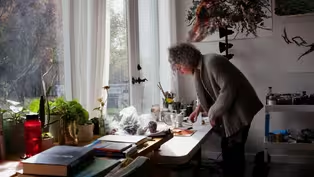
Clip: S23 Ep7 | 8m 57s | Artist Daniela Molnar creates abstract paintings utilizing pigments she forages herself. (8m 57s)
Video has Closed Captions
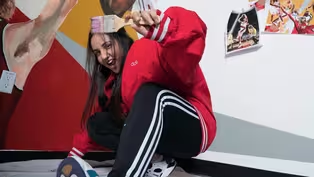
Clip: S23 Ep7 | 8m 12s | Moroccan-American painter Sa’rah Sabino explores what it means to be mixed race in the US. (8m 12s)
Providing Support for PBS.org
Learn Moreabout PBS online sponsorship














Support for PBS provided by:
Oregon Art Beat is a local public television program presented by OPB