Prairie Sportsman
Heart for the Hunt and Conservation’s North Star
Season 17 Episode 5 | 27m 46sVideo has Closed Captions
Follow a heart transplant recipient's pheasant hunt and MN Nongame Wildlife Program nears 50 years.
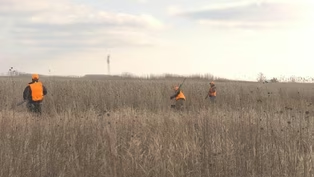
Prairie Sportsman’s Bret Amundson accompanies heart transplant recipient Mark Lehman on his first pheasant hunt since surgery and the Nongame Wildlife Program of the Minnesota DNR approaches 50 years of preserving the state’s wildlife.
Problems playing video? | Closed Captioning Feedback
Problems playing video? | Closed Captioning Feedback
Prairie Sportsman is a local public television program presented by Pioneer PBS
Production sponsorship is provided by funding from the Environment and Natural Resources Trust Fund and Shalom Hill Farm. Additional funding provided by Big Stone County, Yellow Medicine County, Lac qui...
Support provided by:


Prairie Sportsman
Heart for the Hunt and Conservation’s North Star
Season 17 Episode 5 | 27m 46sVideo has Closed Captions
Prairie Sportsman’s Bret Amundson accompanies heart transplant recipient Mark Lehman on his first pheasant hunt since surgery and the Nongame Wildlife Program of the Minnesota DNR approaches 50 years of preserving the state’s wildlife.
Problems playing video? | Closed Captioning Feedback
How to Watch Prairie Sportsman
Prairie Sportsman is available to stream on pbs.org and the free PBS App, available on iPhone, Apple TV, Android TV, Android smartphones, Amazon Fire TV, Amazon Fire Tablet, Roku, Samsung Smart TV, and Vizio.
Providing Support for PBS.org
Learn Moreabout PBS online sponsorship(gentle music) (gunshot pops) - Dad gummit.
- [Narrator] On today's "Prairie Sportsman", heart transplant recipient, Mark Lehman enjoys his first pheasant hunt since surgery.
- It sure good be out pheasant hunting again.
(laughs) - [Narrator] Then we learn the history of the Minnesota DNR'S Nongame Wildlife program as it approaches its 50th anniversary.
- Having been selected for the role of supervising this program into the future is a huge honor for me.
I do know the legacy of the program.
- Welcome to Prairie Sportsman, I'm Bret Amundsom.
We got another great show starting right now.
(lively music) (lively music continues) - [Narrator] Funding for "Prairie Sportsman" is provided by the Minnesota Environment and Natural Resources Trust Fund as recommended by the Legislative Citizen Commission on Minnesota Resources by Mark and Margaret Yackel-Juleen on behalf of Shalom Hill Farm, a retreat and conference center in a prairie setting near Windom, Minnesota.
On the web at shalomhillfarm.org and by the Friends of Prairie Sportsman.
To become a friend of Prairie Sportsman, visit pioneer.org/prairiesportsman.
(country music) (country music continues) - [Bret] Look, I'm not a fan of the gym.
I was never the healthiest eater.
Despite some lifestyle choices growing up, I'm a relatively healthy adult and I attribute that to a lifestyle in the outdoors and meeting people who've been given a second chance in life.
♪ I'm headed out ♪ I aint never lookin' back ♪ I'm living life ♪ I'm never going back Seeing someone go through a serious medical condition, it gives you perspective on life and how easily it can all go away.
(country music continues) ♪ If I ever had to go through it ♪ ♪ Whoa, oh, oh ♪ I'm puttin' my heart into it My food options have become more selective.
No more seed oils, very little store bought meat.
Most prepared meals involve wild game, cooked in goose fat or beef tallow.
One of my favorite meals is a variation on honey chicken only with pheasant instead.
With locally sourced honey each time I eat it, it makes me wanna hunt for more birds the next day.
In fact, most of my hunting has food prep in mind.
I've grown to love walking the swaying prairie grasses, watching my dogs tirelessly weave back and forth in front of me.
- [Bret] Over.
Thought she seen a little birdie there right away.
- [Bret] Now while upland hunting offers exciting action, I've also started calling it my gym with step counts routinely in the 14 to 15,000 range.
Miles tick off easily as I explore new and familiar haunts.
As more birds have fallen, my fire to leave each field with a limit has cooled.
While I do still sniff out every nook and cranny looking for roosters.
If my day is full of heart thumping, hen flushes, or even just a good afternoon of exercise, I'm all right.
(country music continues) ♪ Whoa ♪ I'm putting my heart into - [Bret] Over the years I've heard other hunters who've reached that level of contentment describe the experience as less about birds in the bag and more about the adventure.
- Ole, you can go a little further.
So Ole drove to Two Harbors.
- [Bret] More and more they would describe the enjoyment of introducing someone new to the activity.
- Got the boys from down south, Jake and Joe with us.
Jake has shot a pheasant.
Joe has not.
- [Bret] Earlier this year, Joe Ellis came up from Texas with a goal of shooting his first rooster.
After a few misses, he finally connected.
- [Bret] Right behind you, rooster.
Nice.
- [Bret] Using instincts he learned in the air force with a physical quickness attained during his collegiate football career.
- Oh man.
- [Bret] Nice.
Good job, Tiny.
There we go.
Hiding out.
You can bring it to you.
- [Friend] Hold.
Okay, good girl.
Drop it.
Good job, heck yeah.
Nice shot you didn't miss.
- Took the whole day.
(group laughs) - Perfect.
- Cheers, all right.
- [Bret] Another Texan, Mark Lehman visited Minnesota looking for the chance to hunt pheasants once again.
Well, I've taken a lot of people out hunting.
This was the first time I was with someone who'd had a heart transplant.
- Maybe the best day of my life and probably the scariest day of my life.
But you know, a pastor at home, I'm real close to actually three of 'em, three Lutheran preachers and I talked to every one of 'em before I wasn't into surgery, so I, I had some good help on my side.
(laughs) - [Bret] I met Mark on a hog hunting trip with Cory Loeffler.
We traveled to the lone star state, stayed at Mark's and we were able to fill a few coolers with pork.
So when Mark talked about wanting to hunt pheasants, Cory brought 'em to me along with Mark's wife and son.
- We do a lot of wild hog hunting and they tear up my farm land at home so bad and pastures.
So I was out with a group from, had a guy from England and a couple of from Amarillo and we were pig hunting.
I bet we walked seven miles that night, seven, eight miles killed, dozen pigs.
Had a real good time and I was just doing fine.
And two days later, all of a sudden I couldn't even make it to the bathroom.
I was so fatigued just all of a sudden, basically what happened, we couldn't figure out for a while what it was.
But basically my, I had a mitral valve on my heart prolapsed.
And I ended up next to the last day of the year in 2019 I got a heart transplant.
So I feel real fortunate they only do about 2,500 a year in the United States.
And that was 10 months ago.
So sure, good to be out pheasant hunting again.
(laughs) (country music continues) ♪ I'm living life ♪ I aint never going back ♪ Whoa, oh, oh (country music continues) ♪ If I had to go through it ♪ Whoa, oh, oh ♪ I'm puttin' my heart into it (country music continues) They wanted to gimme a mechanical heart called a LVAD.
You can't get around water.
You wear 16 pounds of battery, you have an extension cord coming outta your stomach you have to plug into the wall every night.
And I just told the doctor, I said, you know, I've been real fortunate and had a good life.
I just don't wanna live like that and I'm willing to accept the consequences.
So they didn't try to push the LVAD on me anymore.
Then I got the call, they had a heart.
(country music continues) ♪ I'm headed out ♪ I ain't never lookin' back ♪ I'm living life ♪ I'm never going back Is that pretty wet in there?
Man, that's dirty.
♪ Whoa, oh, oh ♪ If I had to go through it ♪ Whoa, oh, oh ♪ I'm putting my heart into it Right now, my biggest concern is getting the first pheasant before my son does.
'cause whoever, whoever gets the first bird, the other one's gotta buy him a cheeseburger.
(laughs) You know, I've been doing that since they were little kids and it's a big deal.
You know, I used to shoot birds out from under 'em.
All I can tell you is payback is heck.
(laughs) (upbeat country music) ♪ Driving through the world ♪ My feet tell me where to go ♪ I'm not afraid to step out outside ♪ ♪ And see the world for what it is ♪ ♪ Spendin' all my time - [Bret] We have three dogs along my lab, Mika and Corey's, two labs, Bonnie and Roo, who bears an uncanny resemblance to my lab, Tiny.
- My wife and I, we, one of the first big dates we ever had, we went pheasant hunting up in Hoxie, Kansas 42 years ago.
(Mark laughs) ♪ Ain't no place I'd rather be instead ♪ (upbeat country music continues) (gunshot pops) Dad gummit.
- [Bret] One thing I struggle with when bringing someone new out is finding a place to hunt with easy walking.
- Yeah, it's wonderful.
Y'all have public hunting land like this.
We don't have a lot of that at home.
It's pretty much all private, so you gotta kind of know somebody you know.
- [Bret] Do you have much for pheasants in Texas?
- [Mark] It used to be terrific and there's still pockets of them, but we've had a lot of years of drought, especially 11, 12 and 13 was terribly droughty.
- [Bret] Late season public land hunting in Minnesota usually means going where most people don't want to.
There might be one buried in here.
Oh yeah, she just caught it.
She's got it whatever it is.
(wings flapping) Hen.
(laughs) Hen.
Thick cover, snow.
Cattail sloughs.
This hunt was before we got much of the white stuff and before we froze up, but we still had to hit the heavy cover.
Yeah, I think we can cut through right here.
Mark and his crew dove in headfirst.
- Had this old game warden at home and he was a well respected man.
His theory was, it's always better to be hunting with your kids than to be hunting for 'em.
You know, that's the wonderful thing about pheasant hunting.
I was telling you earlier, it's a family sport, there's something for everybody to do.
It's what my dad, mom and I had, there was four of us kids and that's what we did on holidays.
We went pheasant hunting.
(laughs) (upbeat music) - [Bret] Where's Roo?
(upbeat music continues) Couldn't tell.
(wings flapping) That looks like a, yeah, see that looks like a rooster.
- [Mark] I think it was.
- Good shot, dad.
Nice shooting.
Dead bird.
Dead bird.
Dead.
Back.
(country music) ♪ I've got a new lease on life ♪ God gave me a fresh new start ♪ ♪ Second chance in this world ♪ I've got a -Roos got it.
I think it went for a swim.
Both the rooster and Roo.
(grasses crunching) - [Bret] You got Roo?
- That's a wet one.
♪ Whoa, oh, oh - Good shooting, Dad.
I'll buy you, I guess I'm gonna have to buy him a cheeseburger.
- We also had an apple pie and a malt on this one.
- (laughs) I don't know about that.
- [Bret] How cool is that to be out here hunting with your dad right now?
- It is awesome.
It is awesome.
- We gotta give credit where it's due.
If Bret wouldn't have had us here.
We wouldn't have got him.
If Roo wouldnt have found him.
We still wouldn't have.
(laughs) - [Roy] And I motivated you with cheeseburger.
- [Mark] Really?
You know who really ought to get a cheeseburger is Roo.
(group laughs) That's right.
(country music) ♪ Whoa, oh, oh ♪ If I had to go through it - [Bret] Congratulations, Mark.
Now go enjoy that cheeseburger and apple pie.
♪ I'm puttin' my heart into it (country music continues) (gentle music) Polaris or the North Star has long served as a guiding light in the world of wildlife conservation, the North Star state has often served as a beacon in its own right, especially since the founding of Minnesota's Nongame Wildlife Program in 1977.
- The fact that Minnesota was one of the first nongame wildlife programs and set the tone for many other states to follow is a real point of pride.
Nongame is all the species you do not hunt or fish.
It turns out that it's quite a few.
- [Bret] Minnesota's non-game program works to protect more than 500 wildlife species.
- It actually started with an assistant wildlife manager at one of our wildlife management areas in the state.
His name's Carfol Henderson.
(lively music) And the legacy of Carrol Henderson and work that he's done, engagement that he brought with that is really a legacy, a true legacy.
- Well, I have a few of the yarns to share with you tonight.
And basically a 50 year history of conservation.
(lively music continues) When the non-Game Wildlife program was created, I was literally overnight involved with creating a brand new program for Minnesota.
It had never been done before in that level, throughout the United States.
Our program started very modestly.
For the first year or so, I had Conservation Corps volunteer.
One person.
- [Bret] That first volunteer was Diane Vosick, who would eventually become a lobbyist for the Minnesota Audubon Council.
In that role, she was approached by then state Senator Collin Peterson to advise on language for legislation that would have a dramatic impact on Minnesota's wildlife.
A tax checkoff to fund the Nongame Program.
- I literally woke up in the morning and read about the new tax checkoff law in the Star Trib.
And I just about fell out of my chair.
My budget had been about $30,000 per year.
About half of that was my salary.
And all of a sudden, the next year we went over a million dollars.
- [Bret] While the new funding source allowed Carrol to expand his staff, his program was still small enough that he had a good deal of freedom granted from his supervisors.
- They said, you just do what you need to do.
And you know, that was like turning me loose in a candy store.
(upbeat music) - [Bret] Under Carrol's guidance the non-game program worked with partners to help save Peregrine falcons and bald eagles, reintroduced river otters to the Minnesota River, and perhaps most famously brought trumpeter swans back to the state.
- One of the reasons that the trumpeter caught my attention is that it was quote, an extirpated species from Minnesota.
We used to have them in significant numbers.
So I went to Alaska three times.
I brought back eggs, we hatched them, reared them for two years.
We turned loose a total of about 370 trumpeter swans over the course of those restoration efforts.
And as of two years ago, the total population estimate in Minnesota was over 50,000.
- [Bret] In addition to increasing the population of numerous species, the Nongame Program also helped grow the ranks of a relatively rare position, that of the conservation biologist.
- That's one of the things that I get most excited about is that it expanded this career field beyond the game manager to the wildlife manager and the nongame specialist who became excited about that as a lifetime career.
- [Bret] One person to discover this career path is the Nongame Program's current supervisor, Kristin Hall.
- I lived on a farm, so always working with animals and really aspired to be a vet 'cause that was the only job I knew that existed with animals.
Boy, and I went to school, college for pre-med.
I was at the University of Montana and I ended up taking a course called Intro to Wildlife Biology.
And I will credit that course with changing my trajectory in my life.
Like that's a job?
Yes, it really is a job.
Wildlife biology is a job.
Don't let anyone tell you different.
And conservation biology is an important one.
- [Bret] Minnesota's conservation biologists have been critical in helping some of the state's most iconic species.
But the non-game program has evolved to concentrate on less photogenic creatures as well.
- At first I took on projects that you might have considered like the low hanging fruit, the ones that were more obvious, like bringing back peregrine falcons or introducing trumpeter swans.
But now we have all the other creatures that have not been adequately addressed within conservation circles.
And Kristin has an opportunity to work with specialists now who are looking at everything from butterflies and moths to all kinds of other invertebrates that are all parts of the food web out there.
- So one of the areas of interest for the Nongame Wildlife Program currently is our state's bats.
White nose syndrome, which is a fungus, a disease that's heavily impacting our hibernating bats.
Those bat species are soon to be considered for listing.
And one of our main goals is to keep species off that's threatened and endangered species list some great research that's being done out of our Minnesota Biological Survey and with the University of Minnesota is working on what bat houses work and how that can provide maybe a temporary habitat for those bats to take refuge in while these environmental impacts kind of play out, allow them to persist and succeed so we don't lose them all together.
(gentle music) - [Bret] Minnesota's bats face a tough road ahead, but there is hope.
Other species that were once in danger of being lost are now thriving in the state and even serving as online wildlife ambassadors.
- So our eagle cam and our falcon cam, they're an opportunity for people to witness a conservation success story to peer into an eagle's nest or a Peregrine falcon's nest.
And they get to see something really incredible and powerful that they can relate to because it's parents and babies.
And so that's a really human experience as well that people can understand.
- Once you have done one of these projects, you get citizens telling you about the swans that are nesting on their personal lake or what their experiences were.
Seeing the loons up close, it gives them a personal point of contact with species where it's not just something that the DNR should be doing.
This is something that we all have a stake in.
We can all be involved, we can all put out nest boxes for wildlife.
All of those types of activities create a connectivity not only with the adults but with the kids.
We need to keep the kids involved and engaged.
That's how you keep this whole thing moving.
- [Bret] It was exposure to the outdoors at a young age that inspired Jessica Ruthenberg the non-game program's wildlife engagement supervisor, - My parents, they would take me on camping and hiking trips.
And I have these really memorable experiences of getting outdoors.
I understand how that can stick when someone's doing something hands-on interactive and they're immersed in the outdoors and it creates that sort of passion for the outdoors and wildlife.
We have a program called Bird by Bird, which is for elementary school students.
And through that program we're able to provide classrooms with bird feeders, with field guides, with binoculars.
We have volunteers who visit the classrooms and take the kids outdoors, birding just around their school yard or in their neighborhood.
And the whole program culminates with the kids getting to go on a field trip to a local nature center.
Another educational program we have is for young adults.
It's called EPIC, that gets kids outdoors with biologists in the field.
And this really immersive experience, we hope that it sparks interest in a career in wildlife conservation.
- [Bret] While the program works to inspire conservationists for tomorrow.
Today's Nongame Program staff consists of 25 people at various sites throughout Minnesota, but according to Kristin Hall, that core group is supported by a much larger team.
- Nongame Wildlife Program in Minnesota is Minnesotans because we're donation based.
That's what Minnesotans have invested in.
- [Bret] In addition to their financial contributions, Minnesotans have assisted the Nongame Wildlife Program to the donation of their time, namely as citizen scientists.
- People outdoors in the field collecting data and things like frogs and toads, chimney swifts and loons.
And we hope that it, you know, connects people with nature, but they're also really contributing to conservation and real research that we need done on vulnerable species.
- [Bret] These volunteers supplement the work of the program staff to help get a better understanding of wildlife populations.
- In order to tell if a species is rare or declining, you need to know where your starting point was and you need to know if changes are going on in their trends.
So that monitoring piece that we do, that base level monitoring is telling that story.
We're also doing monitoring with respect to the management that goes on out in the landscape.
We wanna find out what the response of wildlife is to that management.
Are we doing what we think we're doing out there on the landscape?
We didn't monitor, we wouldn't be able to have that science-based information in order to base our actions on.
(lively music) - [Bret] Since its start in 1977 with one dedicated employee, Minnesota's Nongame Program has made a tremendous impact on the state's wildlife.
Its future is still being written.
- I think the future of this program is based on its foundation, but also moving forward in a direction that really relies on strengths and partnerships.
The job is insurmountable to do alone.
- One of the things that became most apparent to me as I wrote my book and put it all together, I went back through my chapters and I counted up and I had relied upon nearly 200 people as the local experts on different species.
And out of those 200 people, about 50 of them are no longer with us.
So I think probably the best thing I can think of is that this is a way of remembering their legacy.
It it wasn't just me sharing my passion, it was sharing their passion.
And since they're not here anymore, - Having been selected for the role of supervising this program into the future has is a huge honor for me.
I do know the legacy of the program and it is hard to be in the conservation field.
It can seem hopeless at times, but then you sit back for a second, you realize we actually have a ton of information that we can put to bare on these big challenges and we can work with a lot of dedicated people to make incremental change.
And if you focus on those incremental things that you can make better or move forward on, that is fulfilling.
- [Bret] For these dedicated conservationists.
The rewards of the job sometimes appear years after their efforts.
- I was on the banks of the Mississippi River, it was in January, pretty cold, and I was watching swans out on the river and one of the swans separated from the flock and started swimming towards me.
I thought, oh, that's really unusual.
And it got closer and closer and I started snapping pictures and I could see his leg band.
And so I took a closeup of the leg band so I could get the number.
And it turns out that I had brought that bird back as an egg from Alaska in 1988, and now it was 1997.
And the swan just stood there.
So I started talking to the swan, just having a little conversation about the weather or whatever.
And so I just kept talking for maybe five minutes or so.
And then finally the swan turned and just swam back out to his flock.
And the only thing I could figure out is that he just stopped by to say, hi, Dad.
And thanks.
(lively music) - [Narrator] Funding for "Prairie Sportsman" is provided by the Minnesota Environment and Natural Resources Trust Fund as recommended by the Legislative Citizen Commission on Minnesota Resources.
By Mark and Margaret Yackel-Juleen on behalf of Shalom Hill Farm, a retreat and conference center in a prairie setting near Windom, Minnesota.
On the web at shalomhillfarm.org and by the Friends of "Prairie Sportsman".
To become a friend of "Prairie Sportsman", visit pioneer.org/prairiesportsman.
(upbeat music)
 New
NewHeart for the Hunt and Conservation’s North Star
Video has Closed Captions
Preview: S17 Ep5 | 30s | Follow a heart transplant recipient's pheasant hunt and MN Nongame Wildlife Program nears 50 years. (30s)
Providing Support for PBS.org
Learn Moreabout PBS online sponsorship
- Science and Nature

Explore scientific discoveries on television's most acclaimed science documentary series.

- Science and Nature

Capturing the splendor of the natural world, from the African plains to the Antarctic ice.











Support for PBS provided by:
Prairie Sportsman is a local public television program presented by Pioneer PBS
Production sponsorship is provided by funding from the Environment and Natural Resources Trust Fund and Shalom Hill Farm. Additional funding provided by Big Stone County, Yellow Medicine County, Lac qui...