Here and Now
Here & Now for May 29, 2026
Season 2400 Episode 2446 | 26m 45sVideo has Closed Captions
Watch the entire episode of Here & Now for May 29.
Watch the entire episode of Here & Now for May 29.
Problems playing video? | Closed Captioning Feedback
Problems playing video? | Closed Captioning Feedback
Here and Now is a local public television program presented by PBS Wisconsin
Here and Now
Here & Now for May 29, 2026
Season 2400 Episode 2446 | 26m 45sVideo has Closed Captions
Watch the entire episode of Here & Now for May 29.
Problems playing video? | Closed Captioning Feedback
Where to Watch Here and Now
Here and Now is available to stream on pbs.org and the PBS app.
Providing Support for PBS.org
Learn Moreabout PBS online sponsorshipPBS Wisconsin Original production.
>> Funding to help K-12 schools and lower property taxes should have passed, so say 80% of Wisconsinites polled.
[MUSIC] and gowns, what do job prospects look like under the new domain of AI?
[MUSIC] Tonight on "Here& Now" Charles Franklin on the huge support for the surplus bill that failed and where the candidates for governor stand on sharing revenue with locals.
A top state economist shares prospects for the labor market, and a look at the lawsuit questioning how state sheriffs aid federal immigration agents.
[MUSIC] 29th.
>> Funding for "Here& Now" is provided by the Focus Fund for Journalism and Friends of PBS Wisconsin.
>> The deal between Republican legislative leaders and Governor Tony Evers to use surplus dollars to reduce property taxes, increase school funding and give out tax rebates, failed in colossal fashion when most Democrats voted against it, and Republican candidate for governor, Tom Tiffany, blasted the bill ahead of the vote.
But when asked, most people across the state said they were for it.
A new Marquette Law School poll found 80% of Wisconsin adults say the legislature should have passed the measure.
Poll director Charles Franklin is here with more.
And thanks very much for being here.
>> Thanks for having me.
>> So have you ever conducted a poll with across the board bipartisan results on any issue like this?
>> There are a few, but they're really rare.
And on this one, with the 80% in favor, that was 77% of Republicans, 81% of independents, 82% of Democrats.
That is really an incredibly narrow range across party.
And it's also the same across ideology.
78% of liberals, 78% of conservatives and statewide, in every media market in the state, it's in the high 70s or 80s in support of the bill.
most resonant about why people wanted this?
>> Well, I think the fundamental thing is that it gives something that everybody wants at least a piece of.
In our other polling this year, we've seen concern about reducing property taxes is high with funding for special education is a 70% in favor of that.
And who doesn't want a check for 300 or $600 to a couple?
So there are popular elements there.
I think the other thing that's less obvious is that this is a kind of old fashioned compromise where everybody got something, and it's all about the good things you're getting rather than the bad things.
The conflict in politics and in the capital may have made it hard for that compromise to carry over in the actual votes, where you saw both some Republicans and all Democrats in the Senate voting no.
That that inability to reach a compromise and stick to it is much easier for the public to see this as a reasonable outcome, maybe harder for legislators.
>> So in your polling, you referenced the potential fiscal impact, but you surveyed people before the Legislative Fiscal Bureau actually put a specific $2.9 billion number on a potential projected deficit as a result of this.
Do you think if you had that specific number, it would have changed the results?
>> It might have changed it a little bit.
That report came out after we were already in the field, so it was too late to incorporate it.
But we did ask a separate question that said, some opponents have said this is fiscally irresponsible.
Do you think it would be better to wait until we have a better picture of next year's budget, or pass it now, even if that means a potential future budget deficit?
It was still 69% saying it should be passed.
Now just 21% say wait until later.
So having that information, those real doubts about the fiscal situation did lower support by 11 points, but it still left more than two thirds in favor.
And again, across the board, Republican, independent and Democrats still wanted it to happen.
Now.
>> Back to your results.
How surprising is it that usual party politics kind of don't apply here?
>> Yeah, it's very surprising because so little that we see in state politics is bipartisan this way.
I think part of what's going on is you had an odd combination of bipartisan support for the bill.
Governor Evers and Republican leadership.
But you also had bipartisan opposition, Tom, Tiffany's opposition.
Most of the Democratic candidates either were outright opposed or were very lukewarm about the bill.
And as we saw in the vote split, there were three Republicans in the Senate, enough to sink the bill without Democratic support, and all Democrats opposed.
So you had both bipartisan support and bipartisan opposition.
So what's a partizan to do when they're sent such conflicting messages?
And the result was just almost no difference in how the parties felt about the bill.
>> Now there is the piece about Governor Evers not working with his Democratic caucus on this, and then they mostly vote against it.
What do you make of Evers play in this legislation?
>> I think that's a politically stunning result, not one that most voters pay that much attention to day in and day out, but it surfaces the fact that for seven and a half years, Evers has really had to deal with the Republican majorities in the legislature.
The Democratic minority could do very little to help him, though it was vital for passing the most recent budget, for example.
But he just hasn't been forced politically to work with the Democrats in the legislature.
But this was really surprising that his party would desert him so completely on, you know, the sort of capstone bill of his term as governor.
>> You asked the question in your poll whether positions on this bill will affect the November elections.
Will it?
>> 25% said it would be very important for their fall vote.
I take that with a grain of salt.
Fall is still a good ways away, but what I think we can be certain of is that the issues of property tax funding for schools, those things are going to be at the center of our fall campaigns.
Even if voters have completely forgotten about this bill, and I'm not sure that they will forget about the bill.
But how do you sell that?
You're for property tax relief.
You're for school funding.
If both parties took such ambiguous stands on on this budget bill.
>> All right.
Charles Franklin, thanks very much.
>> Thank you.
>> The issue of trying to hold down property taxes while also being able to fund services pertains not just to schools, but to things like fire departments and EMS, like schools.
Cities also pass referendums, asking local voters permission to raise property taxes to pay for basic services.
Now, this has become more common in recent years, as state funding for local government continues to fall behind the cost of inflation.
In our ongoing series looking at the biggest issues in the race for governor "Here& Now", senior political reporter Zac Schultz asked the candidates if they want to see any changes to how the state shares revenue with local government.
>> In 2023.
Governor Tony Evers and legislative Republicans celebrated a bipartisan compromise that boosted funding for local governments by nearly 20%.
But after more than a decade of property tax freezes, local governments around the state have still been forced to go to referendums since then to ask the voters to raise their own taxes to cover the increased costs of basic services like police and fire protection.
We asked the candidates for governor if they want to see changes to how the state shares revenue with local governments.
>> I served two terms as a locally elected official.
I think we need to make sure that they are well funded.
I think, especially on the infrastructure side in regards to roads, because that's oftentimes the biggest thing for local units of government.
We need to make sure that they have good funding to be able to maintain their infrastructure, especially roads and bridges.
>> As the county executive, 80% of our local tax levy is going towards, you know, state mandated services.
These are services that, you know, most folks may not actually utilize, but those most used amenities, like our public parks, like our county zoo, like our county transit system, these are non-mandated services.
And it really puts those particular services that help to improve the quality of life for individuals who live in or around or just play in Milwaukee County.
Those are always on the chopping block.
And so we actually need a better course of action.
We need a better relationship with the state of Wisconsin for all local municipalities to be able to fund the necessary programs and services that their residents expect, but also rely on every day.
>> I think that the state needs to meet its commitment to local governments and to our public schools.
You know, the promise was that the state would cover two thirds of the cost.
And we have really very, very infrequently ever lived up to that.
Meanwhile, local property taxpayers are asked to raise their own already too high property taxes just to keep the lights on for our schools and keep the snowplows on the road and police and firefighters on the street.
That's not fair.
The state is sitting on a multibillion dollar surplus and has for years, and it's time that we reinvested that money where taxpayers expect and deserve it to be spent in our local communities.
>> When we have the number of referenda that are still going on, when, you know, places like Whitewater and Stevens Point have to go to, right, we have to go to referendum in order to create positions for firefighters.
That system is still not working the way it needs to work.
And so, you know, I think that no matter what we do, we need to ensure that the relationship between local government and state government is strong and that we're hearing what's happening at the local level.
And I think that we have for many years, as state shared revenue was frozen, I think we were not listening to local government as their costs were increasing.
>> The state has been starving our local municipalities and for over a decade now.
And so it's imperative that we have a more equitable shared revenue formula to make sure that our local municipalities have the resources they need.
They say when government is the government that's closest to your door, is the government that's going to pass policies that impact you quickest.
So it's it's it's for communities.
It's necessary for our communities to have municipalities that have the resources to provide the services that people need.
>> We do need more investment in local government.
When I talk to municipalities and cities all across the the state, they are really struggling to be able to provide the services that their constituents expect.
Basic services.
We're talking about making sure that their parks stay open, their public libraries stay open, that there's a public pool that that kids can go to in the summer.
So we're going to have to look at that formula of how we fund municipalities and cities to make sure they can provide those services.
>> You know, local governments are really struggling under the weight of a lack of funding.
We need to do better and make sure that local communities have resources.
My platform of building the economy is really focused on looking at the main streets around the state, saying, what do you need?
What are your priorities?
Giving some resources so that then they can start to generate momentum and be able to have local economies that are providing good jobs, health care and the services that Wisconsinites need.
>> There's long been a funding flaw that has made it more difficult for municipalities to be able to get the resources, or even the money that goes to Madison, to come back at the same rate.
This has been an issue in Milwaukee.
That's why we've seen the raise in sales tax in the city of Milwaukee and Milwaukee County.
But that didn't change the formula.
The percentage is still the same.
So effectively, there's even more money coming in.
But at a time also when people are feeling the pinch, you know, at the grocery store or anytime they're at any checkout counter.
Now we have this increased sales tax, which is making it even harder for people.
But the reason that is the case is because Madison has failed in the legislature, has failed to actually implement a real solution to make it easier for municipalities to get the support they deserve.
And we're going to be convening a group of local elected officials of mayors very soon to be able to have this conversation, have this discussion in a real way.
>> Reporting from Madison.
I'm Zac Schultz for "Here& Now".
>> Wisconsin's unemployment rate sits at 3.5%.
That's lower than the national average.
But for people newly entering the job market like recent graduates, what are their prospects?
Is the labor market cooling and what role does AI have?
That's a lot of questions.
We take them to Scott Hodek, economist with the state Department of Workforce Development.
And thanks >> Yeah, absolutely.
Thank you.
>> So what does the Wisconsin labor market look like right now for new entrants into it?
>> And we're seeing some deceleration, some slowing at the national level.
And, you know, a couple that with with rising prices, which are a real drag on the economy and some of the other indicators that show some changing spending patterns and, you know, flattening trend in real disposable income, savings rates, things like that.
And we're definitely seeing then, you know, a slowing national economy.
And of course, then in Wisconsin, we feel that as well.
When I, when I look though at at our overall labor market, there are there are some bright spots too.
I mean, like you noted, we, we do have a historically low unemployment rate.
So if you look at, say, national job openings, data, you do tend to see that there the higher rates and the separation rates tend to be really tight together.
But there's still, you know, a relatively speaking, a decent amount of openings.
We've had plenty of times in the past where we've had, you know, technological change.
And that definitely does cause some disruption.
We've actually done work for the Governor's task force on AI and looked into where there's exposure amongst these occupations to AI, and there's a lot there.
There will be a lot of exposure, but it doesn't necessarily indicate substitution.
And a lot of cases it will be folks working with AI.
And that's that's something we're already seeing.
That said, new grads have always adapted, and there are a lot of job openings out there.
And given demographics just with the retirement of the baby boomers, there are a lot of positions coming open that are simply because of retirements.
So there there actually are a lot of openings and opportunities out there.
It's just a matter of kind of connecting to them.
>> What are the so-called hot jobs right now?
>> Yeah, a couple of the industries.
And again, so I'm going to base this off growth, but we're seeing a lot of growth in health care.
And that makes sense with an aging population, but also with retirements.
And we're seeing a lot of growth in construction as well.
And you might you might look at construction and say, okay, well, that's, that's mostly manual labor.
And it's there is a lot of that, but it's not always the case as well.
There's skilled trades like electricians and plumbers, there's machine operators, and then you've got the larger companies that do require accountants and it.
And so you do have a lot of different occupations mixed in in these fields that have been doing well.
But also, you know, if you look at manufacturing over the over the last few years, it's been a downward trend in employment.
And honestly, over throughout the the past decades, we've seen staggered drops in employment, in manufacturing, which we've seen nationally as well.
This is a kind of a developed world sort of trend.
But what we do see is that there are still there's still difficulty hiring into, into manufacturing as well.
And it's, it we're looking at a ton of employment in Wisconsin and a ton of a ton of output and contribution to our gross domestic product here.
So there are a lot of positions there that are open as well, but we don't necessarily think about that sometimes as job seekers.
Like, is this industry growing?
If not, should I not apply there?
And the truth is, there's so many retirements across a lot of these different industries that it's it's more a matter of thinking of finding kind of the occupations that fit.
Right.
>> So what are your long term projections for trends?
The economy?
I mean, are people like you looking at potential recession?
>> Well, we don't really speculate on on what we're going to see in the future.
What I can tell you is that the trend right now has been has been slowing.
That said, if if you were to just sort of grab news articles around the country, you would see that that while that some economists are projecting that it'll climb back up, some are projecting that it will have we'll have lower GDP this this year.
And there there are not actually a ton of them calling for a recession immediately.
Again, you know, that doesn't necessarily mean that we won't have one or or that one isn't coming.
But what I see right now, what I can see right now is what I can tell you.
And that's that we're seeing a slowing economy.
But even despite all the, the, the pushback from things like, you know, tariffs, the war in Iran, rising prices, things like that, we're still seeing growth and we're still seeing low unemployment rates.
And and here in Wisconsin, we can look at our unemployment insurance claims data.
And we're still seeing that on trend and below the last couple of years as well.
So so there, yeah, it's, it's, it's, it's difficult to say with all the volatility and uncertainty right now, what we'll see going forward.
>> Yeah, indeed.
All right.
Well Scott Hodek thanks so much.
>> Absolutely.
Thank you.
>> A federal judge in Madison today considered the case of a Wisconsin tribal nation restricting non-tribal fishing for walleye and muskies.
Members of the Lac du Flambeau band of Lake Superior Chippewa Indians arrived at the courthouse after traveling since before dawn to hear the arguments before the judge.
The state of Wisconsin filed a federal complaint and early this month was granted a temporary restraining order to prevent the fishing prohibition against Wisconsin licensed anglers.
The tribe seeks to restrict fishing on 19 lakes, including fence, white sand and Flambeau in Vilas County, arguing a loss of walleye and muskellunge population.
>> There's 260 lakes on the Lac du Flambeau reservation.
If we were to shut down 19, there's 241 more lakes you can fish and the.
19 you can fish also with different species.
It's just the muskie and walleye we're trying to preserve.
We're trying to see them make a comeback.
And I don't know why we have to fight about it, but I guess that's just the way things happen.
>> The initial temporary injunction allows all fishing to continue on the 19 disputed lakes.
Following today's hearing, Judge William Conley will decide whether the Lac du Flambeau has sovereign authority to restrict non-tribal members from fishing within its reservation.
In other news, a lawsuit against five Wisconsin sheriffs in Walworth, Brower marathon, Kenosha and Sauk counties over Ice detainers or immigration holds waffles between being heard in state or federal court.
A federal judge in Madison this month remanded the case to the Wisconsin Supreme Court.
The sheriffs wanted heard in federal court and have appealed that remand.
The question before any court is whether those 48 hour ice holds are legal in Wisconsin.
Our next guest unpacks the issue.
Bryna Godar, staff attorney at the UW Law School State Democracy Research Initiative, joins us now.
Thanks very much for being here.
>> Thanks for having me.
>> Well, first of all, how does an Ice detainer work?
>> An Ice detainer is a request sent by Ice to local or state law enforcement agencies, asking them to hold somebody for an additional 48 hours beyond when they would otherwise be released under state law.
And these are voluntary requests.
So the local law enforcement officers can decide whether to follow that request or not.
If they do follow it, then the person would remain in custody beyond when they would otherwise be released.
>> Waiting for Ice to come and retrieve them.
>> Yes.
Yeah.
>> And so how common is the use of these Ice detainers across Wisconsin?
>> So according to some data from October 2021 through June 2025, I sent more than 3300 detainer requests.
Not all of those were necessarily honored, coming in.
And counties really vary in whether they are working with Ice to honor those, or if they have policies that limit how frequently they honor those detainers.
>> Presumably, this has ticked up during the current Trump administration.
So what has that cooperation on the part of sheriffs and sheriff's departments resulted in?
>> So the petitioners in this case are arguing that that results in unlawful detention of individuals past when they would typically be released.
And that can have significant impacts for individuals potentially dealing with child care or dealing with missing work.
This can apply to people who are not just at the end of a criminal sentence, but also in pretrial detention.
So who might otherwise be detained for a relatively short time?
Those additional couple days can have a significant impact.
And there are also concerns that cooperation between local law enforcement and Ice can erode trust in local communities with law enforcement, and lead to underreporting of crimes and less of a close relationship with the immigration community.
>> So the lawsuit argues that these holds are not legal because sheriffs have no authority with administrative warrants to conduct a second arrest of someone.
Would you expect that the state and federal courts would have a different view on that?
>> I think it depends on whether they view this as really an issue of state law or federal law.
So the plaintiffs in this case are arguing that this is really just an issue of state law.
And that is something that you would sort of expect the Wisconsin courts to actually have the more expertise on and be able to decide in a more authoritative way.
What the respondents are arguing is that there's this federal law issue of whether federal law sort of independently provides some basis for that arrest authority.
And so if they succeed in getting this case into federal court, the federal courts might be more open to that.
And it seems like respondents think that federal court might be more favorable to it because they are seeking to get it into federal court.
enforcement, under state statute, can arrest if there are reasonable grounds to believe that the person is committing or has committed a crime.
Wouldn't an argument be that someone entering into the country illegally and staying constitutes a crime?
>> So first of all, the statute, it is not a crime under state law to enter and be in the country unlawfully.
And so it's not clear that that statute itself would give the authorization for state law enforcement to make that arrest.
But even if it did, federal law only criminalizes a narrow subset of immigration violations, particularly entering the country unlawfully.
So somebody, for example, who enters with a lawful visa and then overstays that visa has not actually committed a federal immigration crime.
Also, Ice detainers can issue two folks with green cards who then are facing deportation proceedings because they have committed a crime subsequent to entering the country, but they are not actually unauthorized until they go through those proceedings.
And so there are many people who are subject to Ice detainers who have not committed any sort of federal immigration crime.
>> So if it is decided in state court, would it only apply in Wisconsin versus applying nationally if it was decided in federal court?
>> Yes.
So if it's decided in Wisconsin, it would only apply in Wisconsin.
The reach of a federal court decision would depend on what issues they decide and also what level of court it gets to.
So if the federal court ultimately rules mostly on Wisconsin law and based on Wisconsin statutes, then it wouldn't apply beyond the state.
It would just sort of be persuasive to other courts, like a Wisconsin Supreme Court ruling would be as well, if the federal court were to rule on more of a blanket federal law issue, and particularly if that were to get appealed up to the Seventh Circuit or the US Supreme Court, then that could have broader national implications.
goal, for it to go all the way up?
is.
The merits briefing hasn't happened yet, either at the state level or at the federal court level.
The Federal court remanded based on a timing issue of the filing.
And so we don't really have a good sense yet of how viable it would be for this to become really a major federal law case that goes all the way.
>> All right.
Well, we'll see what happens.
Bryna.
Godar, thanks so much.
>> Thank you.
>> For more on this and other issues facing website at PBS wisconsin.org and then click on the news tab.
That's our program for tonight.
I'm Frederica Freyberg.
Have a good weekend.
>> Funding for "Here& Now" is provided by the Focus is provided by the Focus Fund for Journalism and friends of PBS Wisconsin.
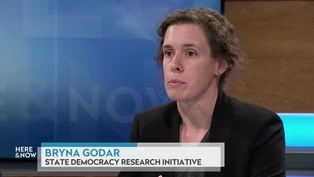
Bryna Godar on a Lawsuit Over Immigration Holds in Wisconsin
Video has Closed Captions
Clip: S2400 Ep2446 | 5m 33s | Bryna Godar on a lawsuit against county sheriffs over the status of 48-hour ICE detainers. (5m 33s)
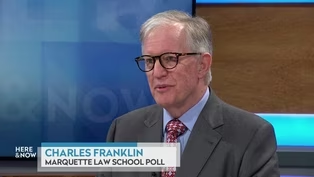
Charles Franklin on Polling Wisconsin's Budget Surplus Deal
Video has Closed Captions
Clip: S2400 Ep2446 | 6m 14s | Charles Franklin on voter support for a bipartisan spending bill was defeated. (6m 14s)
Here & Now opening for May 29, 2026
Video has Closed Captions
Clip: S2400 Ep2446 | 1m 6s | The introduction to the May 29, 2026 episode of Here & Now. (1m 6s)
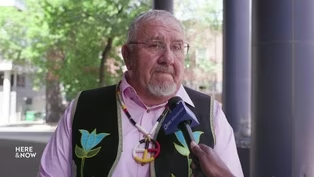
Lac Du Flambeau Tribe Fights State Lawsuit On Fishing Access
Video has Closed Captions
Clip: S2400 Ep2446 | 1m 22s | A federal court heard a state of Wisconsin lawsuit over tribal fishing limits on 19 lakes. (1m 22s)
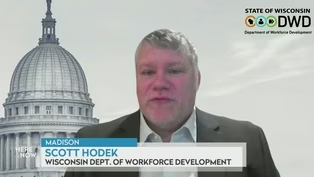
Scott Hodek on Wisconsin's Job Market, Layoffs and AI's Role
Video has Closed Captions
Clip: S2400 Ep2446 | 7m 22s | Scott Hodek on shifts in the job market and impacts of artificial intelligence. (7m 22s)
Wisconsin's 2026 Governor Race and Local Government Funding
Video has Closed Captions
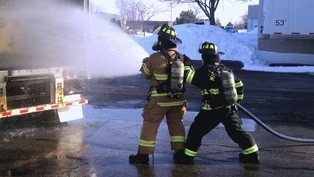
Clip: S2400 Ep2446 | 6m 12s | Candidates in the 2026 race for governor on shared revenue to local government. (6m 12s)
Providing Support for PBS.org
Learn Moreabout PBS online sponsorship New Episode
- News and Public Affairs

Top journalists deliver compelling original analysis of the hour's headlines.
 New Episode
- News and Public Affairs

Today's top journalists discuss Washington's current political events and public affairs.

 New Episode
 New Episode
 New Episode
 New Episode
 New Episode
 New Episode
 New Episode
 New Episode
Support for PBS provided by:
Here and Now is a local public television program presented by PBS Wisconsin