Windows to the Wild
Hidden Treasures
Season 16 Episode 7 | 26m 46sVideo has Closed Captions
Jason Berard is the Stewardship Director at the Upper Valley Land Trust.
Jason Berard is the Stewardship Director at the Upper Valley Land Trust. When he's not working, he's exploring. Along the way he discovers some of NH's "hidden treasures" such as the "Skull Mine" and the mystery of the sunken boat at Smith Pond. Host Willem Lange tags along with Jason to experience some of these oddities, himself.
Problems playing video? | Closed Captioning Feedback
Problems playing video? | Closed Captioning Feedback
Windows to the Wild is a local public television program presented by NHPBS
Windows to the Wild
Hidden Treasures
Season 16 Episode 7 | 26m 46sVideo has Closed Captions
Jason Berard is the Stewardship Director at the Upper Valley Land Trust. When he's not working, he's exploring. Along the way he discovers some of NH's "hidden treasures" such as the "Skull Mine" and the mystery of the sunken boat at Smith Pond. Host Willem Lange tags along with Jason to experience some of these oddities, himself.
Problems playing video? | Closed Captioning Feedback
How to Watch Windows to the Wild
Windows to the Wild is available to stream on pbs.org and the free PBS App, available on iPhone, Apple TV, Android TV, Android smartphones, Amazon Fire TV, Amazon Fire Tablet, Roku, Samsung Smart TV, and Vizio.
Providing Support for PBS.org
Learn Moreabout PBS online sponsorship[birds, bugs chirping] Northern New England is full of thousands of miles of trails that lead you mostly from point A to point B.
But now and then, if you happen to get off the trail, you may just discover an unexpected treasure.
That's what we're going to do today.
So stick around.
[theme music] [soft music] Welcome to "Windows to the Wild."
I'm Willem Lange.
Last summer we were filming some students who were canoeing on the Connecticut River.
And I met a man named Jason Berard, who was there to teach them some outdoor skills.
He was from the Upper Valley Land Trust.
Well, a few months later, I got a note from Jason, telling me about some of the mysterious and odd places he's come across while hiking.
Naturally, I was curious.
And I still am.
So here's Jason.
[laughs] Hi, Will.
Hi.
These really are mysterious places.
Yeah.
You know, my favorite thing to do out in the woods is just wander.
Yeah.
If you do that long enough, you see some pretty strange things.
I should think.
Where are we today?
Today we are at Smith Pond Shaker Forest.
Which is one of the Upper Valley Land Trust's 20 Conservation Areas.
Oh yeah, right.
Let's see, we'll be seeing the remnants of the Shaker Waterworks system, a couple of reservoirs and a canal.
Maybe some chestnut trees.
Ah, chestnut trees.
And a da Vinci Bridge.
The da Vinci Bridge?
OK, I'm looking forward to that.
OK.
I can't think of any reason not to get going, can you?
Yeah.
It's going to get hot later.
It sure is.
It's getting hot already.
Yeah, OK. Vamanos.
[laughter] Let's go.
[upbeat music] Are bikes allowed here?
You know, the trails aren't particularly optimized for mountain bikes.
But they, mountain bikers, do come out here from time to time.
It took me a couple tries to find the trailhead parking lot.
But I found it.
Drive about a mile east of the Shaker Museum on Route 4A in Enfield.
And you'll come upon a sign for Smith Pond Shaker Forest.
That's where we begin our hike.
We're on Smith Palm Loop Trail, a 7.3-mile and fairly easy hike.
[upbeat music] Jason's taking us to a place where Shaker history sits hidden.
I guess you're not going to replace that?
But we're visiting more than the past.
It's a story about engineering, sweat, and sheer determination.
[upbeat music] The Shakers founded the Enfield community in 1793.
It became home to three families, where brothers, sisters, and children lived, worked, and worshipped together.
They believed in equality of the sexes and races.
They practiced celibacy and pacifism.
That way of life continued in Enfield, until 1923, when declining membership forced the Shakers to close the community and sell the property to an order of Catholic priests.
There's a third member of our party hiking with us today besides Kiki, but far more important, Alan Strickland.
You're a volunteer here, or what?
I do.
I help everybody in the land trust.
Great, great.
So you wander around here a lot?
Aimlessly.
[laughter] Aimlessly and endlessly?
Yeah.
That's great.
Well, pleasure to have you with us.
Thank you.
Again, we may need you to help carry the old man out.
You never know.
All right.
So hang on.
Nine of them.
If you look alongside the path, you'll see what remains of a canal, etched in the forest floor.
The Shakers dug it by hand to move water from uphill to their community downhill.
Water powered their mills and grew their food.
Yeah, we're not too sure of the timing of the different components of the water system.
Because the records for the Shakers for this community burned in the fire.
But my guess is this was probably one of the earlier reservoirs.
Yeah.
They probably worked their way up the hill adding more reservoirs and more canals as they needed more water.
[soft music] The canals lead us to what was, about 180 years ago, a reservoir.
We step off the path and down over a bank.
Look up, and there sit the remains of a stone dam.
It was blown out years ago by a storm.
A spillway survived, as if to remind us that the people who built it knew what they were doing.
There you go.
Yeah.
There.
Whoa, look at that.
The stone is four feet across.
It's got to be who knows how long it is on this end.
Yeah.
Wow.
And it's just one after the other that forms the ceiling of this spillway.
It's just amazing.
And where they got the rocks.
You know?
Yeah.
I mean, they must have quarried them.
Go find me a tall, foot-long slab, you know?
[laughter] Yeah.
I mean, it's a shame that the records burned.
It would be so nice to know the sequence of how.
And they knew what they were doing with this spillway business, to save the dam.
[soft music] This is just an amazing feat.
Of not only muscle and bone and human nature and grit, but of engineering too.
They build a stone spillway here that would take the pressure off the dam.
Unfortunately, at one point, it must have been overwhelmed.
But jeez, what a job to build this dam.
Beautiful.
[birds chirping, singing] This property, it's a really unique combination of unusual natural resources and cultural resources.
And really, both of those things would have been at risk if this property were developed.
I mean, it's 1,000 acres.
You could probably put an awful lot of house lots on 1,000 acres, given whatever the zoning is in Enfield.
Can you imagine the traffic going down through Mascoma?
Oh, God.
So the canals, all of the Shaker history could have been lost.
Yeah.
The chestnut trees could have been lost.
Yeah.
And it would have placed a significant burden, I imagine, on the infrastructure.
Now if this were all developed So you saved it.
Yeah.
Now, how much interest is there in the Shaker history?
Do people ask about that a lot, or what?
They do.
It's a really interesting aspect of this property.
Yeah.
The Shaker Museum down the road.
Ah, yeah, OK.
It runs up here, when they're doing it.
They talk about this at all?
Yeah.
Yeah.
Good.
Great.
We were cleaning up an old campsite, an old cabin site.
It was wet that first year.
Not everything that Jason and Alan want to show us is off the trail.
Underneath.
Yeah, there's three or four arch spans and then the deck.
The da Vinci Bridge is part of the trail.
It crosses over Shaker Brook.
They're sort of H's.
And they self-support.
[soft music] Oh, I see what you got.
You got like, a queen post.
Underneath.
Yeah, there's three or four arch spans.
Then the deck is run over the top of that.
The arch spans, they're sort of H's.
And they self-support.
We did add hardware to it, but you don't need to.
[soft music] Folks from the Upper Valley Land Trust manage all of this property.
In fact, they've built the bridge with help from volunteers.
Lovely.
Kind of a big bridge for a little brook.
But it was an awful lot of fun to make.
And it does keep the brook up-- or the bridge up out of the brook bed.
Makes it a little more fun as well.
That's the difference, yeah.
Mhm.
As we prepare to move on, a trail runner and her dog show us that the bridge is as useful as it is interesting.
C'mon, good boy.
All right, you guys are looking great!
Hello, thank you.
You're welcome.
Have a good run!
Come on, good boy!
[whistles] [soft music] Well, we've followed the canal now, up to the da Vinci Bridge.
And I can only imagine what's next.
[laughs] So the whole trail system here, we could keep going and end up at the pond this way.
But I think for today, we'll drive around to the other trailhead on Smith Pond Road.
And we'll head into the pond from there.
OK, good.
There's the canoes over there, somewhere.
We've got some canoes stashed.
We'll try to get out on the water.
Ha-ha!
Okie dokey.
Maybe we'll go for a swim even.
Who knows?
God, I hope not.
OK, let's go.
[upbeat music] We're heading to Smith Pond.
It's the source of water that once fed the canals, the reservoir, and life of the Shaker community.
[upbeat music] On the way back to the trailhead parking lot, Jason stops us.
He asks if we notice anything unusual off the trail.
And it takes a few minutes, but there it is.
Wedged between a limb and a tree trunk, 20 feet off the ground.
[laughter] I mean, that, in that instance, in that instance I just had a chuckle and thought, gosh, some guy threw that up in a tree thinking he was going to shoot his deer there that winter.
And then, it's still there.
Who knows how long?
I mean, that chair is now folded up so that it's hard to imagine anyone ever being able to actually have sat in that chair.
Last fall we did a scavenger hunt out here.
And one of the things people were supposed to try and find was a tree and a chair.
Nobody found it.
Nobody found it?
Nobody found it.
Well, you got to know where look, you know?
I think I spend a lot of my time in the woods just gazing, staring, staring up instead of down.
I've been by here hundreds and hundreds of times and I've never seen it.
[laughter] Now you'll never miss it.
I've never seen it.
Now you'll never miss it.
That's true.
Yeah.
So this cellar hole is about a mile away from Tunis Road.
And it's about a half a mile away from Wolfboro Road.
And there are no other roads around here.
So I'm struggling a little bit to imagine how long ago it must have been that someone lived here, and how they got up here.
These discoveries are the reasons Jason likes to step off the trail.
He knows the treasures await those who dare to wander.
I think if you spend enough time outside wandering around you're going to come across some weird stuff.
Some of the weird things that I've come across are this funky quartzite mound here on Smith Pond, that it's shaped like a skull.
Up on Moose Mountain in Hanover, there's a just random wood stove sitting in the middle of the woods.
High up on the mountain.
Not near any trail, not near any cabin.
It's just there.
Hey all, Jason Berard, Stewardship Director here at Upper Valley Land Trust.
Out monitoring a conservation easement along the Connecticut River.
And I came across this really funky box culvert.
Off we go.
[water rushing] Yep.
Feet are soaked.
Man, look at the stones.
They're huge, in the ceiling.
Ooh, very funky.
It's got all this stonework along the edge of the canal.
All right, anyway, that's me signing off from Upper Valley Land Trust.
Thanks.
Take care.
Sometimes I study some of the back story beforehand and go try and find these places.
And sometimes my absolute favorite thing to do is just wander without a plan for the day.
And if I come across something, then do the research afterwards to try and figure out what the heck was going on there.
[soft music] Smith Pond awaits our arrival.
I'm sure they must've cut through here.
And so is its only human resident.
[soft music] Greg Baker is an orthodontist.
He lives and works in Hanover, New Hampshire.
But this is where Greg loves to be.
He's the only private landowner on the 1,000-acre conservation area.
My cabin is around the corner.
So I've spent the last years living in that cabin.
This is how Greg gets around the pond.
He discovered this place by chance.
In the early 2000s, I was taking a commuter flight into the Lebanon Airport.
And I flew over the area.
And I said boy, look at that place.
There's no houses at all.
The next week, I got the tax maps to see who owned land here.
And everybody wants a place on the water, obviously.
But so I looked and I found that Fish and Game owns 5,000, 4,000 or 5,000 acres here.
There was another parcel of 50 acres, and another parcel that had 12,000 acres.
So I called the guy from Texas who owned that.
I asked him if he wanted to sell it.
And he said no.
Then I called the lady with the 50 acres.
She'd had it in her family for, like, probably 50 or 60 years.
I called her and asked her.
I made her an offer.
And she laughed at me.
So then I countered the offer.
I said, all right, I'll give you $95,000 and free dental work the rest of your life.
And she did laugh a little bit after that.
I said, call me if you're interested.
It was funny.
Two weeks later, she called me up.
And she basically called me and said, OK, $95,000.
And I never met her.
So obviously I didn't do any dental work on her.
[upbeat music] At one end of the pond, a dam holds back about 63 acres of water.
That's an area of 63 football fields.
It was built by the Shakers to feed their water system.
But that was a long time ago.
This water went out the stream and went to where we were this morning, through the canal.
And they used it for their power and their meals.
Yeah, the canal fed the millpond down at the mill.
Yeah.
At the Shaker village.
Yeah.
Clever guys.
A lot of work.
A lot of work to turn a mill.
[laughs] Lot of work to dig a canal.
Yeah.
It's a long one, and four rocks, oh, God.
It must be at least two miles.
Really?
That long, huh?
Down, yeah, back to the over there.
Well, there's to them.
They're all gone now, none left.
Oh well.
Yeah.
This is a beautiful spot.
I'm glad Greg saved it, you know?
Yeah.
The next surprise was that I realized when the water disappeared in that next summer, that there was a problem with the dam here.
And so then I dug a little deeper into the dam.
And I found out it was condemned in 1971.
I began to wonder if that was the best investment of $95,000 or not.
Because the water was pretty much 50% gone in the summer here.
And it was leaking under this dam, about 200 gallons a minute.
[soft music] The State's Attorney General ordered the dam removed.
Greg and a partner said no.
They wanted to preserve the pond, and had a plan.
I talked to my partner from Texas.
So we started the process of re-engineering and rebuilding it.
And we met the historic people, the historic preservations, the anything that was related to the Shakers.
Like the back stone, we had to keep.
The first dike over there, we couldn't disrupt those stones.
Then there was the loon people, the Wildlife or the Water Resources.
There's all these.
You saw my permit board.
There's like, 15 permits, Army Corps of Engineer, so that process took five years.
[upbeat music] And about $900,000 to replace the dam.
Habitat at Smith Pond was saved.
So too was the dam's history.
Greg eventually put his property into easement.
The Upper Valley Land Trust manages it.
Without Greg and Paul Cavicchi, investing the money in repairing those dams, it would not have been possible for any conservation entity to take ownership of that property.
The liability of the condemned dam would have just been too great for anybody, any nonprofit, to handle.
[upbeat music] There's nothing like this place.
You know, you don't see places like this that don't have cabins all around it.
So my goal was to preserve it.
Because I like outdoor spaces better than I do indoor spaces, basically.
When he was in our office signing the conservation easement, he wept.
It meant so much to him.
He'd probably be really mortified if I told you that.
But he cares so much about this place.
And I mean, it's obvious in how he know everything he said today to you guys but it's really nice to have a neighbor that cares as much about this place as we do.
Yeah.
[piano music] After paddling around islands and into small bays, Jason and Greg take us to a place where a treasure rests underwater.
This sunken relic, we're not quite sure what it is.
Nobody ever did dived on it.
A retired National Park Service diver did come and dive here and did an archaeological study of the vessel.
[bubbling] The weird thing is, part of it has plywood.
Covered with plywood.
Which you would think I would have thought that would have meant that it was at least from the 20th century.
But apparently plywood has been made since the 1840s, or something.
Yeah, it has.
But it probably has turned up like a sled.
And it has runners on the bottom.
Oh, well, OK.
So I think it would be pushed across the ice.
Yeah.
It looks like whatever it was used for, that it was intentionally scuttled.
It's got rocks weighting it down and a hole in the bottom of it.
[soft music] What we have now is a beautiful conservation area managed by the Upper Valley Land Trust.
It's open to the public.
And Greg thinks that's a good thing.
[upbeat music] (SINGING) Ah, ah, ah.
Ah, ah, ah.
You can have a stressful day at work.
But when you go through that gate down there, the stress just tapers off as you get up here.
(SINGING) Ooh, ooh.
The natural world is, it makes people heal, I think.
(SINGING) Ah, ah, ah.
I think that creating large tracts of land that are conserved like this, as well as small pocket parks in urban areas, keeping communities connected to the world, the natural world around them, is just so important.
You know, like Greg said, it's what keeps you centered.
And it's what keeps you calm.
For young kids, it's what helps them acquire what teachers call executive function skills that help them regulate their emotions and their decision making.
It's just, it's important to creating a healthy community.
And I think it's a way that we can help give voice to the natural world.
[upbeat music] (SINGING) Ah, ah, ah.
Ah, ah, ah.
The Upper Valley Land Trust manages more than 200 easements.
They're all open for public use.
If you visit, Jason suggests you take time to seek those hidden treasures.
[upbeat music] People are welcome to wander wherever they want.
Maybe they'll find another weird thing in the wood that they can tell me where it is.
[upbeat music] Well, we're ending our day.
And a warm one it was, here at Greg's camp, on Smith Pond.
It's a beautiful place.
It's been a beautiful day.
And I want to thank all these great guys behind me for making it possible.
I'm Willem Lange.
And I hope to see you again, on "Windows to the Wild."
[piano music] Support for the production of "Windows to the Wild" is provided by the Alice J. Reen Charitable Trust, the Fuller Foundation, the Gilbert Verney Foundation, and viewers like you.
Thank you.
[piano music] [stringed quartet music] [chime]
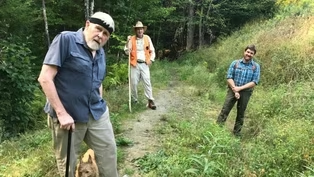
Preview: S16 Ep7 | 20s | Some of New Hampshire's "hidden treasures". (20s)
Providing Support for PBS.org
Learn Moreabout PBS online sponsorship















Support for PBS provided by:
Windows to the Wild is a local public television program presented by NHPBS