
History, Mystery and Chemistry
Season 1 Episode 22 | 26m 46sVideo has Closed Captions
Who are the people in this old freighter movie? And where could PFAS be in your home?
A mysterious decades-old home movie chronicles a Great Lakes freighter journey, and our team of experts answer some questions about the film. Can our audience help with more information? And a journalist wondered how much PFAS was in his blood, his home, and his cat so he tested everything and shared the results.
Problems playing video? | Closed Captioning Feedback
Problems playing video? | Closed Captioning Feedback
Great Lakes Now is a local public television program presented by Detroit PBS
History, Mystery and Chemistry
Season 1 Episode 22 | 26m 46sVideo has Closed Captions
A mysterious decades-old home movie chronicles a Great Lakes freighter journey, and our team of experts answer some questions about the film. Can our audience help with more information? And a journalist wondered how much PFAS was in his blood, his home, and his cat so he tested everything and shared the results.
Problems playing video? | Closed Captioning Feedback
How to Watch Great Lakes Now
Great Lakes Now is available to stream on pbs.org and the free PBS App, available on iPhone, Apple TV, Android TV, Android smartphones, Amazon Fire TV, Amazon Fire Tablet, Roku, Samsung Smart TV, and Vizio.
Providing Support for PBS.org
Learn Moreabout PBS online sponsorship- [Ward] On this edition of "Great Lakes Now," we take a trip back in time to solve a decades-old Great Lakes mystery.
- Like most of the boat nerds who watch these sorts of things, I start looking for clues.
- Judging by the angles where the film is taken, this is probably a guest of the captain.
- [Ward] And, what items in your home could be exposing you and your cat to PFAS?
- There are dozens of things in here that are made with the chemicals, am I getting a slow drip of poison?
- [Announcer] This program is brought to you by, the Fred A. and Barbara M. Erb Family Foundation.
The Charles Stewart Mott Foundation.
Laurie & Tim Wadhams.
- [Announcer] The Consumers Energy Foundation is committed to serving Michigan.
From preserving our state's natural resources and sustaining our future, to continuing business growth, academic achievement, and community involvement.
Learn more at consumersenergy.com/foundation.
- [Announcer] The Richard C. Devereaux Foundation for Energy and Environmental Programs at DPTV.
The Polk Family Fund, Eve and Jerry Jung, The Brookby Foundation, Founders Brewing Company, and viewers like you.
Thank you.
- Hi, I'm Ward Detwiler.
Welcome back to "Great Lakes Now."
Our first story is all about an old home movie we found in an online archive.
It was shot aboard a freighter on the Great Lakes, but that's all the information we have.
I wanted to know who shot this film and when?
What freighter are they on?
And can we identify the places and people we see on the screen?
But to figure that out I needed help, so I called Roger Hulett, director of the Great Lakes Lore Maritime Museum, Carrie Sowden, archeological director at the National Museum of the Great Lakes, Joel Stone, senior curator at the Detroit Historical Society, marine historian Roger LeLievre, and Michelle Briggs, chief park ranger at the Soo Locks, U.S. Army Corps of Engineers.
(upbeat music) We watched the film and tried to do some research to solve the mystery.
Michelle, what were your thoughts when you first saw the film?
- Like most of the boat nerds who watch these sorts of things, I start looking for clues to try to kinda unravel the mystery.
I was curious who was behind the camera, and as I was watching the things they were filming, it seemed apparent that it was probably a guest on board.
They were filming a lot of things that the crew and people who live and work aboard a freighter would have just considered mundane, everyday things and not really all that interesting.
- Judging by the angles and perspectives where the film is taken, this is probably a guest of the captain.
- These vessels, they were built with passenger cabins, not lots of them, but a few.
And they were often given by the shipping company to people that were important to the shipping company.
- Taking a trip on a Great Lakes freighter for most people, is a once in a lifetime opportunity.
And frankly, you would wanna document every single minute of it.
(drum roll) - Well, in the first shots of the film, we see a freighter loading up with cargo.
What do we know from what we see in the film?
- I can tell from watching the footage that this is an iron ore-carrying vessel.
It's a standard laker, which means it has a forward pilothouse and then cabins at the stern end as well.
This is not a self-unloading bulk carrier.
So this is before the self-unloading bulk carriers became the standard.
- Right, freighters built since the '50s have been self-unloaders that use a conveyor belt on a boom to move cargo onto the shore.
This boat doesn't have a boom arm, so it had to be unloaded some other way, and it was definitely built before the 1950s.
Any idea where this dock is?
- That is in Duluth, that's the Duluth harbor.
If you look, the camera will pan up and you'll see the top of it.
That's where rail cars actually go from the mine after the ore was crushed.
- And then those men that you see kind of clambering around up in there are called pin knockers.
And they would pop a pin.
And those those chutes would lower down and the cargo would rush into the ship just like it was a waterfall.
My suspicion is that this is the west side of the DM and IR ore dock number six.
- Oh yeah, the Duluth Missabe and Iron Range Railway ore dock number six in Duluth, does look like the right spot.
(upbeat music) Here's a picture of another freighter loading at that dock.
You can see the locomotive up on top of the dock.
And those rail cars would be dumping their cargo down chutes into the cargo holds on the freighter.
Here's the location shown in the film, and here's the dock in 3D from Google Earth.
Sure looks like a match to me.
Now all this footage is taken on the freighter, so we never see the name of the ship.
Roger, any idea of what this boat is?
- I knew right away it was a vessel from the Great Lakes Steamship Company by the smokestack.
That black stack with what would have been a gold band if that were in a color photo.
And the name that immediately popped to mind was the Smith Thompson of that fleet.
So I compared the picture on the video with other photos of the Smith Thompson, and a lot of boxes were checked.
- Oh wow!
I'm looking at a picture of the Smith Thompson, and that looks like the boat.
The Smith Thompson was built in Toledo, Ohio in 1887.
She was 438 feet long and could carry 4,700 tons of iron ore, not a giant by today's standards.
- When you compare that to the 1,000 footers, some of those can carry almost 70,000 thousand tons of taconite pellets, which is today's equivalent of the raw iron ore. (upbeat music) - Well, after we see the freighter loading up in Duluth, the next thing we see is a place I recognize.
It's the Soo Locks on the St. Mary's River, which takes ships from Lake Superior down to Lake Huron.
So the freighter has sailed across Lake Superior and it's heading south.
Michelle, this is your territory, tell me what you see in the film.
- The first thing that really noticeably comes into view is a hydropower plant that was built around 1906 at the upper end of the rapids.
I also notice attached to that hydropower plant there's an addition on the far left side.
That is a building that is still at the Soo Locks.
It was added to that power plant in 1932, and we call it Unit 10.
So because Unit 10 is there and its construction is finished, we know for sure that this footage could not have been before 1932.
- Okay, so we know where we are, and we know it was after 1932.
Any other clues?
- It doesn't seem to have a lot of a military presence and there was a military presence beginning at the Soo Locks in 1939.
- That's right, during World War II they thought the Soo Locks might be attacked.
- The locks were so strategic at that time that they put in 50 anti-aircraft guns during the war.
Any kind of a small plane that was goin' over the Soo Locks at that time was shot down, which they didn't have any incidents, but that was meant for that.
They also put barrage balloons all around the Soo Locks.
They were 30 feet long.
They looked like dirigibles and they were on steel cables anchored deep into the ground.
So if a dive bomber was gonna go in, they figured the Germans would be ones that would try to dive bomb it.
So if they would go in they'd get tangled up in the cables, the steel cables that these dirigibles were tied to.
They also had mesh, heavy-duty screen underwater to catch any submarines that might come through.
They also were worried about boats bein' sabotaged in the locks.
And my grandfather, he was a captain at that time, and all the officers on the lake freighters were required to carry firearms in case somebody tried to get on the boat, either through some other method or they just hopped aboard while it's in dock and then try to sabotage it.
They were authorized to shoot on sight somebody that was strange on their vessels.
- At one point 12,000 troops were stationed in Sault Ste.
Marie.
I guess the locks were pretty critical to the economy and to wartime production.
I mean, they're still pretty critical to the economy today too, right?
(playful music) - The Soo Locks in the Great Lakes shipping industry are often described as the linchpin of the Great Lakes navigation system.
And certainly for the upper lakes that is true.
Currently, 100% of our domestic iron ore supply is coming on boats through the Soo Locks.
The only places in the U.S. we are presently mining iron ore are in the western UP of Michigan and the Mesabi Range in northern Minnesota.
And all of that ore that is going to steel mills on the lower lakes has to be loaded onto boats and carried through the Soo Locks.
- Yeah, they're building a new lock now because currently only one lock, the Poe, can handle the big 1,000-foot freighters.
- The current Poe Lock were to ever go down for any length of time it would cripple the economy because traffic would probably grind to a stop very quickly.
And then the auto industry would tank, the steel industry would tank, and there'd be a lotta difficulty getting grain down to the markets on the lower lakes and to the world.
It would be just a disaster if the Poe went down.
(playful music) - [Ward] These guests on the boat were obviously excited to go through the Soo Locks.
- You know I think as a passenger, it is a really kind of one of the interesting fun high points of the trip.
And one of the kinda interesting things is you can feel the boat rising and falling.
It's kind of like when you're in an elevator.
You can feel internally that change in elevation.
And that's kind of a fun thing, which is the reason people pay to take tours.
- During this section of the footage, while they're still at the Soo Locks, the camera pans over and we see another freighter called the Horace S. Wilkinson.
Why do you think he shot that?
- The Wilkinson was a fleet mate of the Smith Thompson.
And it looks like maybe there are some greetings being exchanged between the two captains.
They're yellin' or they're waving or something like that, which was very common back in those days.
- I wanna break in and show you something I didn't know about when I talked to these experts.
In this shot we see three passengers walking on deck.
The woman on the left has a magazine.
And on the back of that magazine is a full-page ad for Chesterfield cigarettes.
Chesterfield ran a different ad every month.
This is the ad that we see in the film and it's from August 1937.
So we know the film is after that, but before 1939 because there are no troops at the Soo Locks.
Okay, back to the conversation.
Well, leaving the Soo Locks, we know they didn't go west to Lake Michigan.
They came down through Lake Huron, through the St. Clair River, through Lake St. Clair, and on to the next place we see, which is the Detroit River.
You can see the Ambassador Bridge in the distance, which was completed in 1929.
- When they panned the city you could actually see a building called the Penobscot Building.
And my grandfather, before they built the bridge, he said he was sailin' back before they built the Ambassador Bridge.
He said they always could tell when they were comin' into Detroit because the Penobscot Building, which was the tallest building at the time, had an antenna on top and it had a huge, red, lighted ball on top of it.
And you could always tell when you're gettin' close to Detroit, they'd look out for that red ball on the Penobscot Building.
- Yeah, that's right, when the Penobscot Building was finished, it was the eighth tallest building in the world, and the tallest in America outside of New York and Chicago.
They've recently restored that red orb on top.
- We also see the ferries.
The Detroit River passenger ferries were ubiquitous on the Detroit River, back and forth between Detroit and Windsor.
A lotta people lived in Detroit and worked in Windsor or vice versa.
And so those vessels were running every 15 or 20 minutes.
And they stopped running in 1938.
- Okay, so we know this film had to be shot before the end of the 1938 shipping season, which came on December 16th.
What else can you tell us about Detroit during that time?
- Detroit was the automotive hub of the country and of the world.
And Henry Ford had built his River Rouge plant and they were turning out cars with the iron ore that was brought in on the freighters and the coal and the limestone that was brought in on the freighters to make steel.
That was a bustling area.
- So, do you think Detroit was the destination?
Or do you think it was somewhere else further south?
- Our best guess is that is Conneaut, Ohio, and it's the Pittsburgh and Conneaut Dock Company facility there, just judging by the set up and the number of unloaders.
(playful music) - Yeah, what are these things we're seeing?
Because these machines are crazy.
- What you're seein' there is called Hulett unloaders.
It's spelled exact same way as my last name.
Hulett unloaders is where a person sat inside of the actual steam shovel that went down into the boat and jawed up a whole lot of iron ore. And then they maneuvered that jaw back out, up and over, and dropped it into rail cars.
- Oh, wow!
Hulett unloaders were invented in Conneaut, Ohio in 1898.
And they made it much faster and cheaper to unload ore. And some of them were still in use into the 1990s.
I can't believe there's a guy in there running those big jaws.
- Those guys were the privileged lot of that.
That was really a skilled job because they had to line those things up and not smash the hatch coamings around where the shovel entered into the boat.
So those guys were really, very skilled operators.
(playful music) - The next shot features three well-dressed women on a much smaller boat.
It would have taken awhile to unload this freighter and it looks like these women decided they wanted some shore leave.
- The women maybe just wanna get off and go shopping, or go see a local site or do something to get off the ship for a while.
They've probably been on five, six, seven days, five, six days maybe at this point, and they're lookin' to stretch their legs and see a little bit of the ground.
It is also possible that they are departing the ship at this point, but if you look, there doesn't really seem to be any baggage on the tugboat.
There are some totes and stuff in front of the wheelhouse.
I would imagine that they were also delivering supplies to the vessel at the same time, while they're taking these women to go spend their day doing whatever and hopefully towards the end of the day, they get back on board again.
- There's also some milk containers probably that might need to get exchanged.
So they're getting off there in Conneaut and getting ready to send the ship back up to Lake Superior for more ore. - After unloading in Conneaut, the next thing we see is the Soo Locks again.
So it looks like they're making a round trip, because they've turned back north, sailed through Lake Huron and they're heading back into Lake Superior.
- I would say the route of the ship was was pretty simple and it probably did it many times over and again.
(playful music) - And there's the aerial lift bridge, the gateway to Duluth Harbor.
We didn't see it as they left Duluth, but it's in the shot at the end.
So they have completed their run from Lake Superior to Lake Erie and back.
Thank you so much for your help in figuring out this film.
I really hope our viewers have more information for us, like who shot the film and who we're seein' on the screen.
We'll have this film posted at GreatLakesNow.org/FreighterMystery.
Go there and you can tell us if you spot something in the footage, if you know who shot the film, or if you recognize the passengers or crew.
We've told you about PFAS contamination in ground water in the past.
You don't have to drink PFAS to be exposed to it.
For our next story, we teamed up with Type Investigations, Consumer Reports, The Guardian, and journalist Tom Perkins.
While reporting on PFAS, he learned a lot about the many thing PFAS has been used for, and he began to get personally concerned.
- The more I reported on the issue and the more I learned what products they're in, I started to look around my apartment and go, "My God, there are dozens of things in here that are sometimes made with the chemicals.
Am I getting a slow drip of poison from these things?"
And it's not just me.
My cat Ling-Ling probably encounters a lot of the same chemicals that I do, and she only weighs about nine pounds.
We're in Hamtramck, a small city surrounded by Detroit, and the problem is PFAS, a family of chemicals known for their water and stain-repellent qualities that are used in everything from waterproof shoes, to clothing, to bike-chain lube, even food packaging.
I wanted to know how much PFAS Ling-Ling and I are getting into our bodies in our daily lives, (Ling-Ling meows) so I made a plan.
What we're gonna do is test a buncha different products around my house that are sometimes made with the chemicals and see if they have PFAS in them.
One of the main ways people ingest the chemical is through their water, and we're gonna test the tap water as well and then get my blood checked out.
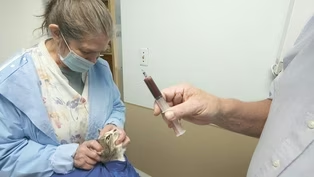
And Ling-Ling's getting her blood checked too.
- Industry has just introduced chemical after chemical and they don't provide that information to the public, so it's impossible for scientists to keep up with what's actually being used.
- Yeah.
Erika Schreder is the science director of the Seattle-based advocacy group Toxic-Free Future.
- Some unexpected chemicals have been found in people recently.
There was a compound that was found in the river water in North Carolina and then after that they tested residents and found it in 98% of the residents.
So it was a previously unheard of chemical that almost everybody in that area was being exposed to.
- The wide application of these chemicals means that you can't pinpoint the particular use that's led to your exposure very easily.
- [Tom] Carla Ng is PFAS researcher at the University of Pittsburgh who models the chemical's bio-accumulation in humans and wildlife.
- There are thousands of potential products that use these chemicals and therefore you may be exposed via your food, via your sports equipment, via your carpets, some of your electronic equipment and so pinpointing the one particular chemical that's in your blood knowing exactly where that came from becomes that much more difficult.
- I shipped a couple dozen household items to a lab at the University of Notre Dame.
There's advanced PFAS research going on there, lead by Professor Graham Peaslee.
Food packaging is a big one, parchment paper, different food wrappers from restaurants around Detroit.
That's one of the main routes of exposure.
- You know I wanna remind you that a lot of our concern about the use on food packaging is what happens before it comes to the consumer and after it comes from the consumer.
Because quite a bit of pollution in the production phase and then after you dispose of it, depending on where you live and what the facilities are, it could go to a landfill, incinerator, or compost.
And landfills are very major sources of PFAS contamination.
- It's been a couple of months, and I've now got the results for the items that I sent out to be tested for PFAS.
I was worried that there might be Scotchgard on the pre-owned, mid-century couch that Ling-Ling and I spend a lotta time on.
No sign of PFAS there, but it's in other things, things that many might not think of.
They found it in my dental floss.
There isn't a lot of research out there on whether that's a big route of exposure.
I use Oral B Glide made by Proctor and Gamble.
A company spokeswoman told me they don't use PFAS in floss, and that's where the issue gets tricky.
There are literally thousands of PFAS chemicals and sometimes disputes arise over which chemicals are PFAS, and which chemicals are not.
The tests we did show high levels of fluorine in my floss, and scientists agree, there's even a peer-reviewed study, that high levels of fluorine indicate high levels of one of the PFAS compounds.
Turned out my tap water is clean, but then the blood work came in.
Not good, they found four compounds in my blood, and three compounds in Ling-Ling's blood, at levels that are higher than U.S. medians for most of the chemicals.
One of the compounds in Ling-Ling's blood is about 13 times the median for a U.S. adult.
She's a nine-pound cat.
It's a little bit scary.
You had a chance to look at the test results?
- I sure did.
They're very interesting.
The levels the lab found in your body were similar to what's seen across the country in men.
So it doesn't look like you have any especially high exposures from say your drinking water.
But it does show that you have these levels of chemicals like PFAS that have been associated with a number of different health concerns and they range from cancer to effects on the immune system.
- [Tom] One way PFAS enters our systems is simple.
As household items slowly turn to dust, the PFAS drifts along with it.
- I mean, if I had to just hazard a guess, I'd probably say it's gonna be a combination of the diet and the dust.
- Yeah.
- Both of you.
- Yeah, yeah.
- If you're eating fish, you're getting some of these chemicals in your food.
We also find that they build up in our house dust.
And so all people are exposed to house dust.
If you're a toddler or a cat, then you spend a lot more time kind of interacting with house dust.
And cats of course also have behavior that they're licking their fur.
- Right, another thing I learned with PFAS, blood tests don't tell you everything.
- What we find with some of these compounds is that they're actually building up in different parts of our bodies.
Like there's one that's been found at higher levels in the lungs.
- Are you saying that that might not necessarily then be detected in a blood test if it's like building up in a different part of the body.
- Exactly, yeah.
- Oh, wow!
That's another frightening layer to add to this.
Well, that's me, what about my cat?
I mean, what about Ling-Ling?
She's up in the 99th percentile.
- So, the half-lives are long for some of these chemicals, but if you eliminate the exposures those concentrations will go down.
They're not gonna go down very fast, but they do go down.
- I found some studies on cats.
Cats have been studied for PFAS.
And so I just have the total PFAS levels from one study that was done in California.
They did two time frames, one was 2008 to 2010 and then one was 2012 to 2013.
Total PFAS they had in the earlier time frame was 15.8, and in the latter time frame it was 8.1, that was the mean level.
So she is above average for cats.
- Uh, huh, wow!
- California cats.
- Yeah, California cats.
- Michigan cats may have more PFAS.
- Industry has been replacing the PFAS in their products with newer versions of the chemicals that they claim are safer, though Ng and other's research are finding that they aren't.
Now there are so many different kinds of PFAS and blood testing can only find some of them, so I likely have much higher levels than the testing revealed.
Got all this good information but man, it's just raised more questions than it answered and some of these questions are impossible to answer and that's just like what's so frustrating about it.
- For the most part now we look outside, the sky looks more or less blue and we turn on our water and the water tastes fine, but we know that that's not always the case.
And many of the things that we're starting to learn now about chemical impacts on humans are about these low concentration, chronic impacts that are not going to make you fall over dead, they're not gonna make you pass out if you breathe the air, but we know that there's a cost over a long period of time.
So if we look at the burden of disease in the population, chronic disease is going up.
It's something that really stresses our medical system, and it's something that is definitely affected by our increased exposure to environmental chemicals.
- Should I be worried?
I guess lemme just ask you that.
- I mean, I'm not an anxious kinda person.
(Erika laughs) I'm not gonna tell you it should keep you up at night.
I mean, you had levels that are very typical for Americans.
Unfortunately we do see that typical levels can be can be tied to certain health issues, like reduced immunity.
So that is definitely a concern.
What you can do about that is take actions to reduce the use of PFAS in your home and support policies that stop the use in products, so we don't keep getting it in our homes.
- The National Educational Telecommunications Association recently recognized "Great Lakes Now" as the best in news and public affairs content among all the public TV stations in the United States.
Our team received this honor in the 52nd Annual Public Media Awards.
We're pretty proud.
And thank you for appreciating our work.
You can find what items in your house might contain PFAS, and learn more about all our stories at GreatLakesNow.org.
When you get there, you can follow us on social media, or subscribe to our newsletter to get updates about our work.
See you out on the lakes.
(upbeat music) - [Announcer] This program is brought to you by: The Fred A. and Barbara M. Erb Family Foundation, The Charles Stewart Mott Foundation, Laurie and Tim Wadhams.
- [Announcer] The Consumers Energy Foundation is committed to serving Michigan.
From preserving our state's natural resources and sustaining our future, to continuing business growth, academic achievement, and community involvement.
Learn more at consumersenergy.com/foundation.
- [Announcer] The Richard C. Devereaux Foundation for Energy and Environmental Programs at DPTV, the Polk Family Fund, Eve & Jerry Jung, The Brookby Foundation, Founders Brewing Company, and viewers like you.
Thank you.
(relaxing music)

Video has Closed Captions
Clip: S1 Ep22 | 14m 57s | Can a team of experts figure out who shot a home movie aboard a freighter decades ago? (14m 57s)
Video has Closed Captions
Clip: S1 Ep22 | 9m 5s | What common items in your home could be exposing you — or your children or pets — to PFAS? (9m 5s)
Providing Support for PBS.org
Learn Moreabout PBS online sponsorship
- Science and Nature

Explore scientific discoveries on television's most acclaimed science documentary series.

- Science and Nature

"Our New World" reveals Nature's astonishing adaptation abilities and how humans can help it thrive.












Support for PBS provided by:
Great Lakes Now is a local public television program presented by Detroit PBS