
Holocaust Survival Tale: Hana
Clip: Season 44 Episode 7 | 7m 51sVideo has Closed Captions
Hana Amir describes her father escaping the Holocaust through a tunnel he helped to dig.
Hana Amir describes her father escaping the Holocaust through a tunnel he helped to dig.
Problems playing video? | Closed Captioning Feedback
Problems playing video? | Closed Captioning Feedback
National Corporate funding for NOVA is provided by Carlisle Companies. Major funding for NOVA is provided by the NOVA Science Trust and PBS viewers.
Support provided by:


Holocaust Survival Tale: Hana
Clip: Season 44 Episode 7 | 7m 51sVideo has Closed Captions
Hana Amir describes her father escaping the Holocaust through a tunnel he helped to dig.
Problems playing video? | Closed Captioning Feedback
Where to Watch NOVA
NOVA is available to stream on pbs.org and the PBS app.
Buy Now
NOVA Labs
NOVA Labs is a free digital platform that engages teens and lifelong learners in games and interactives that foster authentic scientific exploration. Participants take part in real-world investigations by visualizing, analyzing, and playing with the same data that scientists use.Providing Support for PBS.org
Learn Moreabout PBS online sponsorship- They took them up and they walked them to one of the holes.
They told them to take the sand off, I think with some shovels.
I don't what he had to do it with.
And there they saw bodies, a lot, a lot of bodies.
And he said, we were all shocked.
And they told us that we need to take the bodies out and the wood that we cut, we had to put the wood and on it, the bodies.
The Nazis and the Lithuanian were talking about the schmatta.
It wasn't bodies of human beings.
It was schmatta.
Schmatta which means rags.
You wash the floor with and it meant nothing like the Jews are nothing and.
He said, we were stinking from the smell of the bodies and we ate with their hands that we worked on the bodies and like, he said, it was, we were like animals.
And my father afterwards kept on washing hands all the time.
And whenever you saw my father, wherever he went, whatever he did, first of all, he had to wash hands.
It was an obsession.
He was cleaning all the time.
He was the youngest one, my father.
There were, through the time, they came to 80 people that worked.
There were four women that were in the kitchen.
So the team of workers were 84 people in those holes.
He said you didn't have time.
You were, if you said that you feel, you don't feel good or something, they took you out and they shot you.
One was telling them he felt, he doesn't feel good.
And he was gone.
And from one side you knew you had to go on and from the other sides... Like my dad said, we didn't know about Auschwitz.
We didn't know about Majdanek.
And all we thought is that someone will survive and tell the world what's going on, what happened here.
My father said, we had to find a solution because we knew none of us will survive.
They kill us.
We'll be the next ones in the hole.
So we had to run away.
One of them, Dogam, he was an electricity technician and he said, we must build a tunnel.
That's the only way.
There were about 20, I think, between 20 to 25 people that could dig.
And when they decide on the day to run away, it was according to as much as you worked in the tunnel.
That's the way the numbers were put.
My father was number five.
He said after the whole day of burning the bodies, he said, we went into this tunnel.
There was no air at the beginning.
We were digging with the hands, with spoons we found on the bodies, with screwdrivers with found on the bodies.
He said whatever we found there.
They dig for three, between three or three and a half months.
And they waited for a night where there is no moon, full dark night.
And it was the 15, I think, the 15 in April, when there was a decision to do it.
And they told everyone, and when they went out in the other side, it was already the beginning of spring so the leaves were dry and the guards heard the steps on the leaves and that's when they start shooting.
So there survived 12.
They wanted revenge.
At least that's what my father said.
He said, we felt that we're nothing.
And the moment that we managed and we trick them and we dig the tunnel and we escaped of it.
We wanted to go to the partisans.
We wanted to fight.
We wanted to do something.
When he got to the partisans, he said, the first thing they did, they pushed us on the side and they said, take off the clothes.
They boiled water to wash us because we were stinking so much.
They burned our clothes and they give us new clothes.
My father, he met my mother and he said, no way.
I'm not staying here on this land.
No way.
And he started the runaway through, it took him about eight month and he stood on Israel earth, in the Israeli world in 10 of October, '45.
Well, I believe no one, no human being should do anything like this to another one.
There can be disagreement.
We are living in a country with a lot of disagreements but the other side is human beings and that is something we must never forget.

Video has Closed Captions
Clip: S44 Ep7 | 8m 20s | During WWII, Nazis forced Samuel Bak and his family out of their home in Vilna, Lithuania. (8m 20s)

Holocaust Escape Tunnel Prologue
Video has Closed Captions
Clip: S44 Ep7 | 2m 3s | In a forest in Lithuania, a team of scientists searches for traces of a vanished people. (2m 3s)

Holocaust Escape Tunnel Q&A with Historians and Filmmakers
Video has Closed Captions
Clip: S44 Ep7 | 2m | At ground zero for the final solution, scientists uncover a story of hope and bravery. (2m)
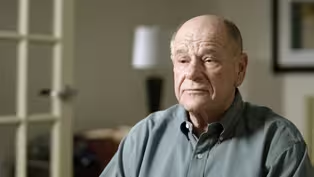
Video has Closed Captions
Clip: S44 Ep7 | 7m 23s | In Lithuania during WWII, Abe Gol’s father led Jewish prisoners in a tunnel escape. (7m 23s)

Video has Closed Captions
Clip: S44 Ep7 | 6m 21s | Esia Friedman tells the story of how her family made it through the Holocaust alive. (6m 21s)
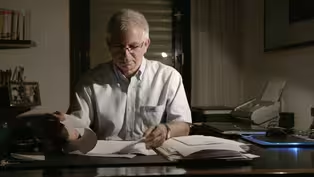
Video has Closed Captions
Clip: S44 Ep7 | 6m 35s | Zalman Matzkin narrowly escaped the Holocaust in Lithuania, managing to build a new life. (6m 35s)
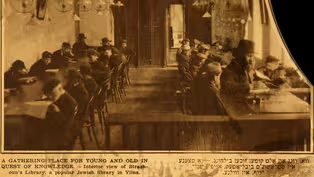
Video has Closed Captions
Clip: S44 Ep7 | 5m 21s | Jewish scholars in Lithuania risked death in WWII to save their literature from the Nazis. (5m 21s)
Providing Support for PBS.org
Learn Moreabout PBS online sponsorship













Support for PBS provided by:
National Corporate funding for NOVA is provided by Carlisle Companies. Major funding for NOVA is provided by the NOVA Science Trust and PBS viewers.