Oregon Art Beat
Homer Davenport and the Power of Political Cartoons
Clip: Season 27 Episode 6 | 6m 40sVideo has Closed Captions
Political cartoonist Homer Davenport cut to the core of hypocrisy with a single image.
From a small Oregon town comes a larger than life story about a country boy who became one of the world’s highest paid political cartoonists at the dawn of the 20th century. Homer Davenport’s wit could cut to the core of hypocrisy and injustice with a single poignant image. Some argue that one of his most famous editorial illustrations helped tip the 1904 election in favor of Theodore Roosevelt.
Problems playing video? | Closed Captioning Feedback
Problems playing video? | Closed Captioning Feedback
Oregon Art Beat is a local public television program presented by OPB
Oregon Art Beat
Homer Davenport and the Power of Political Cartoons
Clip: Season 27 Episode 6 | 6m 40sVideo has Closed Captions
From a small Oregon town comes a larger than life story about a country boy who became one of the world’s highest paid political cartoonists at the dawn of the 20th century. Homer Davenport’s wit could cut to the core of hypocrisy and injustice with a single poignant image. Some argue that one of his most famous editorial illustrations helped tip the 1904 election in favor of Theodore Roosevelt.
Problems playing video? | Closed Captioning Feedback
Where to Watch Oregon Art Beat
Oregon Art Beat is available to stream on pbs.org and the PBS app.
Providing Support for PBS.org
Learn Moreabout PBS online sponsorship(gentle music) - [Jacob] This is the story of the country boy from Silverton, Oregon, who became one of the world's highest paid political cartoonists, back in the late 1800s.
His unflinching satire and commentary was admired and feared by both sides of the political aisle.
At the height of his career, he rubbed elbows with Washington's political elite, and became an admired friend of President Theodore Roosevelt.
- People thought he was a genius.
He seemed to have this ability, with one simple cartoon, to really dig in deep to people, and tell a story.
(jaunty music) - [Jacob] I'm headed to Silverton, Oregon, where they're celebrating their favorite son with the annual Homer Days community festival.
The celebratory mood is high here in town.
(engine buzzing) (jaunty music continues) Homer Davenport's story starts in Waldo Hills, just outside Silverton, where he was born in 1867 to Timothy and Florinda Davenport.
His grandmother's house is still here, where Davenport spent much of his youth, and where his talent for drawing was ignited.
- From the time that he was born, Florinda had him practicing his art with pencil.
So Homer didn't have to do the hard work of the farm boys, and all he had to do was work on his art.
He got down to San Francisco and he got some work down there with some of the papers.
- They immediately recognized his skills in caricature, and put him to work doing that.
The following year was the presidential election between William McKinley and William Jennings Bryan.
He had focused upon McKinley's campaign manager and the head of the RNC, industrialist from Ohio, Marcus Alonzo Hanna, who Homer would depict as this kind of obese guy with a checkered suit.
And every single check in the suit was a dollar mark.
So he got the name Dollar Mark Hannah.
- The illustrations seemed to tell a story all by itself.
And that was really popular and powerful, in those days.
- The New York State Assembly, their legislature had a bill introduced on restricting portraits, or alleged portraits, no mention of cartoons.
A very short bill.
And Homer drew this cartoon that had a picture of Thomas Platt, the Republican boss at the time, next to William Tweed, who was the old, nefarious Democratic boss.
And the caption of the cartoon was, "No honest man need fear cartoons."
(laughs) And that was kind of like a winning message.
And so it died in committee.
- Cartooning provides an outlet.
It either ratifies what you think, or it challenges you to think.
- [Jacob] Jack Ohman is a renowned Pulitzer Prize winning political cartoonist published by the San Francisco Chronicle and The Sacramento Bee.
- There's so many really good political cartoonists who, they just vanished, you know.
And Davenport wasn't one of them.
The likenesses are just dead on, you know.
You can't teach that, that's a feel thing.
(upbeat music) - One of his targets was Thomas Reed, which was the speaker of the house back then.
Reed was saying, "You know, Mr.
Davenport, your cartoons are not very flattering to me, but they are awfully funny.
And if you could, could you send me the originals?
I have my secretary saving them for me."
Somewhere during this time, he and Roosevelt became very good friends.
So when Roosevelt ended up running for president in his own right, in 1904, Homer drew a cartoon of Uncle Sam with his arm on TR's shoulder.
And the caption was, "He's good enough for me."
And the Republicans mass produced this cartoon.
And Roosevelt won.
- What do you feel is the future of this medium?
- Well, it's not good.
When I started in this business, there were probably, I want to say, 250 full-time editorial cartoonists.
Now there are 25.
I mean, not even 25.
I mean salaried.
I think, I know it's under 20.
And I'm not one of them.
I think newspapers are afraid of opinion, in a lot of ways now.
And particularly, effective opinion.
One thing that I really think is interesting, that we're losing, is not just a wonderful art form, but we're losing the ability to explain to young people, and future generations, what our era was like.
What you're losing not only is humor and satire, you're losing a way to record history.
- History is not forgotten in Silverton, where the Homer Days Festival keeps Davenport's story alive and well through numerous events, including live music, plenty of food, and an annual cartoon contest.
The competitive nature of politics hasn't changed much since Davenport's time.
But the media landscape has evolved considerably.
As print media shrinks, new outlets have emerged for the next generation of political cartoonists, including blogs, web comics, and social media.
Now, millions can create and share their observations on the internet.
But at one time, it was just a boy from the Oregon country, who shone a light on some of the thorniest issues of the day.
(gentle music) - My grandfather came out here in the 1950s.
He put this place back together.
He was in his 70s, but he made it livable again.
And he put the frame around the Davenport cartoon, in those days.
I don't know if you can see that, but that's Homer.
That's his illustration of himself.
He's kneeling down and he's weeping.
And above it, in his own handwriting, signed by him, April 11th, 1904, he writes, "I want to say that from this old porch, I see my favorite view of all the earth affords.
It was the favorite of my dear mother, and her parents, and of my father.
And why shouldn't it be the same to me?
It's where my happiest hours have been spent."
Homer Davenport.
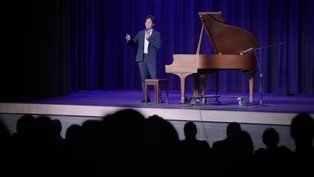
Award-winning pianist Jim-Isaac Chua brings classical music to rural Oregon and SW Washington
Video has Closed Captions
Clip: S27 Ep6 | 10m 6s | Award-winning pianist Jim-Isaac Chua brings classical music to rural Northwest. (10m 6s)
Providing Support for PBS.org
Learn Moreabout PBS online sponsorship New Episode
- Arts and Music

Innovative musicians from every genre perform live in the longest-running music series.










 New Episode


Support for PBS provided by:
Oregon Art Beat is a local public television program presented by OPB