WQED Horizons
Horizons: Bayard Rustin
Clip: Season 3 | 9m 30sVideo has Closed Captions
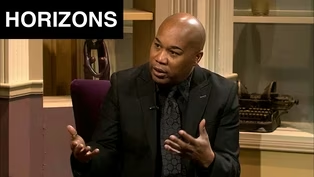
Horizons segment about Bayard Rustin’s life and legacy discussed with Rev. Deryck Tines.
This segment from Horizons includes an interview with Rev. Deryck Tines and was reported by Chris Moore. This segment describes the life and work of Bayard Rustin, a civil rights leader who was sidelined for being an openly gay man through an interview with Rev. Deryck Tines as he plans a celebration for what would have been Rustin's 100th birthday. This is from Episode 304 from October 29, 2012.
Problems playing video? | Closed Captioning Feedback
Problems playing video? | Closed Captioning Feedback
WQED Horizons is a local public television program presented by WQED
WQED Horizons
Horizons: Bayard Rustin
Clip: Season 3 | 9m 30sVideo has Closed Captions
This segment from Horizons includes an interview with Rev. Deryck Tines and was reported by Chris Moore. This segment describes the life and work of Bayard Rustin, a civil rights leader who was sidelined for being an openly gay man through an interview with Rev. Deryck Tines as he plans a celebration for what would have been Rustin's 100th birthday. This is from Episode 304 from October 29, 2012.
Problems playing video? | Closed Captioning Feedback
Where to Watch WQED Horizons
WQED Horizons is available to stream on pbs.org and the PBS app.
Providing Support for PBS.org
Learn Moreabout PBS online sponsorshipWelcome back to Horizons.
Bayard Rustin is not a name that most people are familiar with, but even if you've never heard of him, you've been impacted by his work.
Rustin was a leader in the civil rights movement in the 1940s, 50s and 60s, but the fact that he was also gay was also used against him.
And it's the reason so many people have never heard of him.
My guest this evening is one of the people hoping to write that wrong.
Joining me now is Reverend Deryck Tines from Pittsburgh's One Church.
Welcome to Horizons, I should say.
Welcome back.
How are you?
I'm good.
Okay.
I understand, Mr.
Bayard would be, 100 years old this year.
Is that correct?
So you're celebrating his centennial?
Yeah.
We, celebrated in March, 17th as his birthday.
He turned 100 years old.
And, if he was living, it would have been a big, big party.
But, now there's a national committee hosted, by his surviving partner and by Mandy Carter, who are doing celebrations all across the country.
I'm a part of that, committee.
And so it was my responsibility to plan something here in the region.
And so this week, we are going to be celebrating very best of all that Bayard Rustin as a festival and a conference.
Okay.
We'll talk about the conference and the festival and the events in just a second.
But let's talk about Bayard Rustin for a moment.
Sure.
My understanding of his history, is that he was active for a long, long time.
At one time, he was a communist.
Then he became a socialist.
He worked with the the great leader, A. Philip Randolph who was also a socialist.
And he organized Bayard Rustin, did the March on Washington, but he was the man behind the scenes who never got any credit for all that organizational ability.
And that's exactly right.
What I like to say about that is he organized that huge march without internet, without the fax machines and all the stuff that we know today, which was even a more tremendous feat, for him to have accomplished back then.
He was in the background because of his sexuality.
He was an openly gay man.
And it was just not, it was frowned upon.
And so they had to keep him to the side and not make a big fuss of him while using him to organize the march on Washington and some other things that he had organized in the 60s.
J. Edgar Hoover tried to make a big fuss about him.
He did.
Is that correct?
He did.
He did.
He tried to, He tried to suppress his work in the work of the civil rights movement by, saying they had a relationship together.
But that was just, part of the course at the time.
But it was not true.
He they did not have a relationship, but he was an openly gay man.
What was the difficulty in the 40s and 50s?
I imagine some people, could, could guess it.
But what was the difficulty of being an openly gay man and being so involved in what?
Probably, in many circles, the civil rights movement was so unpopular.
I, I really can't speak intelligently about the 40s because I didn't come into the world.
Okay.
But it basically would come to a problem that still exists today, and it we call it homophobia.
There's a lot of which is driven by the church to come out of, faith based fears.
You're a minister that says that I am a minister.
I'm a pastor.
But there are fears that drive people.
There's ignorance of that drives people to discriminate and to, stigmatize people behind their sexuality and other and other things.
Women were were stigmatized.
There's there's a whole lot of other things, but, fear, ignorance, faith, people's faith is but continues to drive it, even today.
And it's a real problem.
Has it gotten any better since being rest in time?
I would say that it has gotten better.
There are many churches, around the country that I, visit and that I travel to, that have some thriving programs and thriving congregations, that are inclusive and that are affirming and that are open, to minister and to receive people regardless of their sexual orientation.
Doctor Jeremiah Wright is one of those, people.
He has a in his church and in Chicago.
It's just phenomenal.
Our president came out of that church.
And I think it's a direct reflection of who he is.
Yet our president had to disavow Doctor Wright in so many ways because of some of those attitudes that you were just talking about before and more.
Yeah, I think that was I think that was another issue, though.
I think, Doctor Wright is very and this is not a conversation about him, but he's, you know, he's very forthright, very clear.
No, it's a conversation about the attitudes that still exist.
Is what I'm talking.
They do exist.
But I think I think in reference to that case of it's more media driven, because Dr.
Wright's messages is on point.
But he, he, he dealt with homophobia and he dealt with, a lot of these fears with his congregation, a very large, thriving congregation, and is a model for how we can, create these kind of ministries all across the country.
All right, let's get back to the festival and the conference.
Yes.
What's going to happen to celebrate Bayard Rustin here?
And I understand Bayard Rustin spent a lot of time in Pittsburgh, and you've run across a number of people who actually knew him.
I am blown away, by the number of people who, who have said to me, well, I've been organizing this festival this week.
That I knew Bayard.
I was around him.
Thank you for celebrating him.
Make sure you acknowledge, that he was a gay man.
Thank you for doing this.
So we're having a festival, and, it will kick off on Thursday at the August Wilson Center with an opening reception and film about his life.
Mandy Carter, the national co-chair, will be here, to have a panel discussion with that.
Edwin Hawkins is coming in on Friday as our guest.
We are, celebrating Love Center, which was a in the 70s.
Walter Bishop Walter Hawkins created a congregation and a church for people at any and everyone to come.
Oh.
Happy Day.
Yeah.
So, Edwin, who wrote oh, Happy Day is coming.
It will be at Ebenezer.
Friday nights, a free event.
On Saturday, we're meeting with pastors, in the morning for breakfast.
12 noon, Bev Smith is hosting a town hall meeting and Carlton Bishop Carlton Pearson will be our guests on Saturday.
And then we're moving to the conference on Saturday evening at the University of Pittsburgh in conjunction with Rainbow Alliance.
And so is that activism, then?
Bayard Rustin was part of, so many years ago, still so very important today.
It's very important.
And, and this is part of our personal agenda in doing this festival is to make sure that we continue to advocate for the causes and for people, in our region.
And, you expect attendance to be good.
I am expecting attendance to be good.
And I'm a little this this hurricane talking rain.
It's got me a little, beside myself.
But otherwise, I am expecting a good turnout this weekend.
And a good turnout in Pittsburgh.
A little different than turnouts in other places, but I am expecting a good turnout.
But you still expect to work on it.
As you have discovered Bayard Rustin in his life and times, what is the most Eye-Opening thing that you found out about the man?
The most eye opening thing for me is, his ability, to have spoken to, the what I like about him is he spoke to everybody the same.
He he was forthright.
He was direct.
He didn't bite his tongue.
He had.
He was a man of principle.
He held to it.
And, and for me, the consistency of that was the ever bitter that his, gayness was used against him.
There was some bitterness in his later years, but he he used that and he used that to help, his work at the A. Philip Randolph Center in New York.
And he did some incredible stuff in Harlem because of his, redirection.
We appreciate you being here with us.
Is there a phone number or anything for people to call?
Yes.
Yes.
It's (412) 983-8895.
Repeated one more time please.
(412) 983-8895.
It's always a pleasure.
Thank you very much, sir.
Thank you.
All right.
That's just about going to do it for us.
That's all the time that we have tonight.
We'll see you back here next Tuesday night at 7:30.
For another all new episode of Horizons.
In the meantime, for all of us here at WQED, I'm Chris Moore.
Thanks for watching.
Good night.
Video has Closed Captions
This segment explores the work of Phil Seneca and his Good Mind Seeds company. (5m 47s)
 Now Playing
Video has Closed Captions
Horizons segment about Bayard Rustin’s life and legacy discussed with Rev. Deryck Tines. (9m 30s)
Providing Support for PBS.org
Learn Moreabout PBS online sponsorship












Support for PBS provided by:
WQED Horizons is a local public television program presented by WQED