
Housing is Health
Season 18 Episode 1803 | 59m 3sVideo has Closed Captions
Exploring causes and remedies to Spokane's affordable housing crisis.
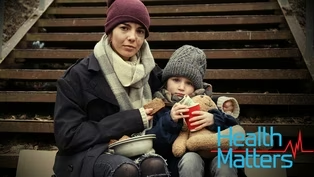
Poverty and the lack of affordable housing are major causes of homelessness in Spokane, pushing increasing numbers of women and families with children into unhealthy and unsafe living conditions. Local charity, business and community leaders discuss efforts to solve the problem and what still needs to be done.
Problems playing video? | Closed Captioning Feedback
Problems playing video? | Closed Captioning Feedback
Health Matters: Television for Life is a local public television program presented by KSPS PBS
Housing is Health
Season 18 Episode 1803 | 59m 3sVideo has Closed Captions
Poverty and the lack of affordable housing are major causes of homelessness in Spokane, pushing increasing numbers of women and families with children into unhealthy and unsafe living conditions. Local charity, business and community leaders discuss efforts to solve the problem and what still needs to be done.
Problems playing video? | Closed Captioning Feedback
How to Watch Health Matters: Television for Life
Health Matters: Television for Life is available to stream on pbs.org and the free PBS App, available on iPhone, Apple TV, Android TV, Android smartphones, Amazon Fire TV, Amazon Fire Tablet, Roku, Samsung Smart TV, and Vizio.
Providing Support for PBS.org
Learn Moreabout PBS online sponsorship(air whooshing) - [Narrator] People become homeless for a number of reasons and it can happen to anyone, at any time.
- [Angela] My husband went to jail.
I had addiction, wasn't employed, and we lost our home to foreclosure.
- [Narrator] Increasing numbers of families, women, men, and young people are being affected.
Health Matters looks at homelessness and the need for more affordable housing with local experts working to find solutions.
Housing is health, right now, on Health Matters.
- [Announcer] Health Matters is made possible with the support of WSU Health Sciences Spokane, WSU College of Medicine, and by Providence Healthcare.
- You get to give the opportunity to go to that grandchild soccer game, to go to the daughter's wedding.
It's just amazing.
I mean that to be able to be part of a team that allows someone to have an entire life back is phenomenal.
(bright instrumental music) - Good evening, and welcome to Health Matters, I'm Teresa Lukens.
The people you see panhandling on street corners or sleeping in doorways, represent only one segment of Spokane's homeless.
In fact, the people you don't see, the hidden homeless, move between temporary shelters, camp in their cars, or stay with friends and family.
The Spokane area is fortunate to have a strong group of partners and stakeholders working to find them services, living wage jobs, and safe, secure, and adequate housing.
Joining us for our discussion tonight is David Lewis.
David is the CMIS administrator for Spokane County.
The Community Management Information System supports dozens of social service agencies and hundreds of caseworkers through the assessment, eligibility determination, and referral of those seeking homeless and stabilization services in Spokane County.
Ben Stuckart is the executive director of Spokane Low-Income Housing and was recently elected chair of the Spokane City County Continuum of Care.
The Continuum of Care is the regional board mandated with coming up with the five-year plan to end homelessness.
The Low-Income Housing Consortium is involved in the production and management of housing for our community's most vulnerable citizens.
And, Robert Lippman is the current president of the Spokane Homeless Coalition, which represents 1200 Spokane community members, who mostly provide frontline services to those experiencing homelessness.
Robert is also a doctorate level student and serves as clinic manager and behavioral health support within Providence Medical Group.
Gentlemen, thank you so much for being here for this important discussion.
I wanna start tonight by talking with each of you about the work that you do, and how it fits into our discussion.
David, let's start with you.
- Sure, thanks.
So the, and I'll try to avoid the technical jargon, but the database that I administer serves as the, sort of backbone by which all homeless services through our continuum of care are referred through.
So the dozens of providers that me and my team support, they engage with those that are experiencing homelessness, seek to understand their stories, gather data, and then refer those individuals and families to the services that they need to achieve stabilization.
So in that regard, the database helps tie together all of these disparate providers in a way that seeks to facilitate faster, more efficient service delivery, and ultimately help to stabilize people faster.
- Can you also talk about what the Continuum of Care is, that group?
- Yeah, so the Continuum of Care is a body, a regional body that is comprised of a cross section of agencies and organizations that serve our vulnerable citizens in our community, including those that are experiencing homelessness.
That's city officials, local government, it's individuals like Ben Stuckart, and our service providers, even the police department is part of that group.
And they all come together to discuss where are the gaps, where the service gaps?
How can we provide services more efficiently?
And also to better understand the unique needs of those that are experiencing homelessness or housing instability, as we also certainly wanna prevent people from becoming homeless in the first place.
- So Ben, that's a tall order.
You're just elected to this new position.
Talk more about that and also your role in housing.
- So I'm grateful that I just got elected to be the chair of the Continuum of Care.
I have a steep learning curve.
I was on a call yesterday with all the leaders of our different subcommittees that are doing work in the single individuals, families, their trends, there's also diversion committee that really tries to make sure that if you just need something real quick we can get you the resources necessary, so that you're not becoming part of a system when a little solution is gonna work and whether that's a family member or a travel money.
But it's really what I've been amazed with is the cross section where you have a community group like the Homeless Coalition that sits on the Continuum of Care, but you also have the head of Workforce Development in Spokane.
And then you have the executive director, Mike Dunn, from ESD 101, who's on that board.
So it's really all these different pieces that all impact how we really from somebody getting on the street trying to prevent them for being on the streets.
But once they're on the streets, how do we get them into that continuum of care?
And then that really goes to my part-time job is as the executive director of the Low-Income Housing Consortium and supporting our developers in town that are really short on resources.
And I think our emergency services are short on resources.
And if you see David at the city working in the CHHS, Community Housing and Human Services department, that has been continually under-resourced as a department.
So it puts a lot of pressure and then you had COVID on top but I'm just grateful that I'm in a position where I can work on the continuum of care and trying to get people off the street but also on the solution end, with the low-income housing.
Because if we think of somebody that's homeless, they're without a home, and we needed to continually keep in mind that we don't have enough housing.
Regular market rate rents are skyrocketing, house prices, we don't have enough inventory and so prices are going up and then we just don't have enough low-income housing.
And so to me, it's really looking at the whole suite, and that's been really why I got into city government, eight, nine years ago, in the first place was to try to help these systems.
So I'm just grateful to have a position that can try to help and support people.
- And Robert talk about the Homeless Coalition and the work that you do going directly to homeless people and serving them.
- Yeah, definitely.
So I wanna echo kind of what Ben said, you know, there's a lot of moving pieces and a lot of different fragments in Spokane community, where we all try to connect and serve with the same common purpose in mind.
And I think with the Spokane Homeless Coalition, in particular, our advocacy is built through collaboration and providing education to frontline community partners in showing that homelessness is very relational, meaning built in impactful relationships.
The president or chair before me, Joe Ader, served his term as as head of the coalition and I'm gonna quote him, he puts it best.
He says, "The only common denominator "in all of homelessness is a loss of relationship."
Whether because of things you have done, things done to you, or just unfortunate circumstances where you have nobody left to lean on, and so you end up on the streets.
That one common denominator is always gonna be a broken relationship in some capacity.
And so with the Homeless Coalition, we've tried to basically mend those relationships through resources that are available, and we educate each other and advocate based off of that collaboration.
- So David, your department takes a close look at those numbers to define where the needs lie.
How do you even begin to define what it means to be homeless, to reach those populations?
- Yes, and I think you just asked one of the most challenging questions, at least from my perspective and my peers in the department is there is so much complexity in how it's even defined.
Even at the federal level, there are different definitions of what it means to be homeless.
HUD, for example, takes a stricter approach to define someone as homeless in the most narrow means possible, whereas the department of education is much broader.
They would consider, for example, somebody who was, couchsurfing is the common term used, that maybe found temporary housing as meeting that definition of homeless while HUD would not.
So when from the data side and from what I do is I spend all my time analyzing the data, making recommendations and helping these nonprofits better use their data to directly serve those that are experiencing homelessness, but trying to communicate outward to the public at large, this is what it means to be homeless, is very difficult to do when there's not general consensus on what that even means.
So it's yet another challenge that my department has had to try to rise to me.
And luckily we have a great group of passionate people that are committed to serving our vulnerable populations, and we try to do the best that we can in that department.
- Can you give us an example of some information that you have passed on to an agency that they've used that information then to translate into helping people?
- Sure, so I think I'm gonna use the most recent example and in my mind, it's an evolution of, I've been with the city working in as the administrator for 12 years and I'm pretty excited about the progress and how we're supporting these agencies through information technology.
Most recently, we adapted our software to help identify those that are eligible for COVID-19 vaccines or that were COVID-19 symptomatic, to try to reach those that needed healthcare or intervention sooner.
And we were able to coordinate that effort amongst our separate shelter providers using that data that was available.
So meeting those public health needs is one of the best examples, I think, when I think over what we've been able to accomplish, but moving forward, it's being able to give those that are consuming homeless services an identity through ensuring that they're not having to repeat their story over and over again, that when they go to one service provider that information is available already, and we're able to try as much as possible prevent people from falling through the cracks and we're by no means perfect, but it's something that we're always striving to improve upon.
- Spokane has a housing shortage across the board, Ben, even beginning to find affordable housing, are we so far behind the curve, it will take years to make that happen, where are we at right now?
- We're very far behind, but can I just address something David was talking about and also Robert?
Because one of the amazing things about the Homeless Coalition isn't that they're just information sharing.
There's a listserv that goes out a Google group that you get emails from and it's got 1500 people, and most of them are practitioners that are out in the community.
And so 15 to 20 times a day, somebody will send an email to this group of 1500 people and say, hey I have somebody that needs some travel vouchers, or hey, I have somebody that needs emergency services here, (coughs) excuse me.
And then you see people consistently answering on the listserv and providing those services for them.
And so it's like an emergency service system with every provider in town on this list.
And so the Homeless Coalition is more than just education and knowledge sharing.
They're actually getting resources at a real time to people every day, that individual agencies are then out there collaborating and helping each other, which is really important if you have nonprofits working in a system that they're collaborating and sharing resources.
And so the homeless coalition, I don't wanna gloss over what they do, and Robert's very modest, but it's an amazing system.
And then David, I was learning about, I used to hear that we knew how many veterans were on the streets and well, they have a by-list name of who are the chronically homeless, the 34 chronically homeless veterans in our community.
And what they've started to do once they have the list, and they get that list from the system that David is managing, because everybody's entering data at different shelters and outreach when they go out.
Now, the veterans subcommittee of the Continuum of Care takes that list, and monthly sits with a group of veterans providers and other homeless service agencies around the table.
And they can go name by name and say, what do we know about this person from the data?
What do we know from our human interactions with this person and what are the solutions?
And so the conference casing, if you're in the mental health field, you sit around a circle and do the same thing.
When you really look at a case that's really difficult.
The fire department did this at times of the Hot Spotters program, but it's amazing that they're doing it in the homeless system, because we have the names, they can create a by-list name of who's chronically homeless, and then get them individually, the services that meet their needs.
And so it's not just a matter of data, it's a matter of the systems are using that data to really get services to people.
To me, it's really amazing, and I don't think I understood how well that data is used until probably about a year ago.
We continually get better and better at using that data that David is working diligently on, and probably has not gotten the support he's needed over the years.
- And before I get back to you, Ben, on the housing piece, I wanna go to Robert.
I think people would be surprised to hear about those inner workings that are going on because the perception is we're just not doing enough.
And in fact, this is happening in Spokane on a daily basis.
- Yeah, definitely.
I mean, there's a lot of back work that happens, kind of under the radar, but we're trying to, I mean, a lot of homeless services that are out there and available, I mean, there are so many different type of community resources to capture them all.
It's daunting because there's housing community resources and there's financial assistance, there's medical support, mental health, substance use treatment, legal support, transportation, meals, employment, and so on.
I mean, there's so many different facets, and then you have to take into consideration the population groups associated with those resources too.
You have geriatric population.
You have youth, adolescents, you have families, adult men and women, domestic violence, LGBTQ community members as well.
I mean, so there's a lot of working pieces and a lot of resources that are in fragments, and each one has their own system that they operate in, and each of those systems have their own barriers that are really, really difficult expectations to have with the community members experiencing homelessness to access them.
So we use the coalition, try to again, educate each other whether that be through that email chain.
We meet once every month, the past two, we max out our Zoom meetings with a hundred participants.
And so we do our best to educate the community in regards to homelessness, in regards to the population, and what they're experiencing on the ground level.
- All right, let's get back to the housing piece.
Ben, this is a difficult struggle because it could take years to catch up if ever.
- Yeah, so take a housing provider, low-income housing provider in Spokane, and you've done everything right.
You become almost, due to circumstances, you've lost your job, you don't have anywhere to live.
You go through an intake process.
You're given temporary shelter, maybe a shelter or some transitional housing, but you're looking for a long-term solution.
Right now, the waitlist at Spokane Housing Ventures, one of our largest housing providers, they have 900 units in Spokane, is three years.
So if you do everything right, you still got to wait three years to get into permanent housing.
So a couple of years ago, I was in Copenhagen three days on a city excursion to learn about their environmentalism.
And I actually learned about housing a lot more while I was there.
I saw two homeless individuals the entire time I was there and it's a city three times the size of the Spokane.
So I started doing research on how did they get there to where there's enough housing, and they provide about 20% of the supply in Copenhagen of housing is government either subsidized through a voucher system.
And we have voucher systems, but also subsidized housing when you're building the housing so that you can charge lower rent and have buildings like Spokane Housing Ventures or Community Frameworks or Catholic Charities built permanent supportive housing.
Our percentage is actually below 10%.
So we're providing about half of the housing that's needed for a community to eliminate homelessness because housing here in the States, we don't really consider it a human right, but if we look at Maslow's hierarchy of needs, until you meet your basic needs you can't meet any of those higher needs.
And so until we provide a roof over somebody's head, they're not able to meet those other needs in their life and create those relationships that stabilize them, like Robert was talking about.
And so you lose them and it becomes a cycle.
And we need to get to the point where even if we don't consider housing a human right, that we're producing enough housing.
In 1991, the city of Spokane received $1.3 million in home funds, which are funds that localities use to build low-income housing.
In 2019, the city of Spokane received $1.2 million in home funds.
Now, that's over a 30-year period.
Inflation should have pushed that number up with building cost rising and just your regular inflationary costs to about $5 million, we should be receiving in home funds.
So we're not keeping up on federal and state dollars.
One of my jobs last year was to really press the city council to pass the housing levy which was authorized by the state legislature last year.
And they did pass that.
And it's the first time the city of Spokane will be putting money, local dollars, towards housing.
But we keep falling behind at the state and the federal level.
We have thousands of units to build, so that when somebody goes into a shelter we can have caseworkers working with them and then get them into a permanent solution.
So it's tough, and I think COVID is really, we're gonna have a tsunami on our hands with evictions.
Right now, the rate of nonpayment, 30 days are over in our bottom 10% of our housing, those low-income housing providers, is 23% representing over 3000 individuals, and those are people that if the eviction moratorium is lifted, they will be evicted.
And if you could just close your eyes and imagine 3000 more homeless people in Spokane County, we should all be pushing for rental assistance because it not only helps the renter that's behind because of the unfortunate pandemic, but it also hurts our small landlords, our big landlords, our landlords in between, our nonprofits that have low-income housing.
And if you're in a low income housing unit and you get evicted, there's nowhere else really for you to go because you've got a mark on your record and we have a lot of work to do over the next year to make sure that rental assistance is approved, federal state and that local we're getting it to the people that need it.
- David, other than housing, and that's an enormous piece to this, what are some of the other challenges facing the region when it comes to tackling the issue of homelessness?
- Well, real quick, if I could, I wanted to add something that I think drives Ben's point home and it is, you know, when we think of housing is a human right, taking just a perspective just based on what we know to be true, just on the data that's out there, the vast amount of research that's been done is, it does involve something that does have some controversy and that's the Housing First model.
And the idea that if you provide somebody housing regardless of what that upfront costs is to provide that there is a net system savings, meaning that across that system, as far as ER room costs, public safety costs, just all the costs that are incurred at the municipal federal state level, it doesn't matter where you look, it is cheaper to house somebody than it is to not house them.
So I think, there is definitely this humanity in providing somebody with housing, but it also is as far as a matter of, you know, fiscal discipline if you will, it also makes economic sense.
So, I mean, there really is no reason to not house people.
I just wanted to make that point.
- And those other challenges we're facing, David?
- Ben highlighted some of those, was just really just the sheer lack of resources that are available.
A lot of the complexity that's built into, for example, the data systems I manage, where we're assessing somebody's eligibility for services, a lot of that is because the resources that are available are so finite that we're just not able to serve everybody that needs it.
And there's unique challenges.
Again, very housing related that those on the West Coast that are facing and East Coast for that matter too, that are just not the same as other areas of the country and that's again, skyrocketing.
I mean anybody who lives in Spokane is experiencing that firsthand, which is the the vastly increasing rents and housing costs, and that'll continue.
So even with the federal programs we have they can't keep pace with, you know, being able to provide the amount of rental assistance dollars or building structures fast enough based on local needs.
I guess the other challenge I would offer is just trying to build consensus around a way of addressing the problem.
I mean, there's a lot of complexity, that complexity breeds a lot of competing ideas.
Of course, you introduce politics into that, and it's just hard to collectively work towards any one solution or even a range of solutions.
So I think that there's, that has always been and probably always will be a challenge.
But when I think of those challenges facing us, whether it's in Spokane or anywhere really, those are two that come to mind.
- And Robert, a lot of things to tackle and then we're hit with a pandemic.
How has that complicated what your group does?
- I mean, it's definitely affected a lot of things they're there in the capacity, in the medical world, you know, I've worked in a medical clinic that primarily serves homeless and it's affected that.
It's affected a lot of chase workers being able to go in outreach settings.
Outreach workers being able to go out.
It's affected this year's Point-In-Time Counts, as far as the safety measures that had guidance received in order to follow that.
I mean, the pandemic has definitely shifted everything but it's also revealed opportunities to better collaborate as well.
I mean, it's definitely shaped things upside down, but it's just something that's adjusted and we're still waiting for a lot of outreach workers to return.
When you take into consideration insurance that's going to be, there's a lot of caseworkers provided through insurance carriers where they're still kind of stuck waiting for this to be lifted.
So yeah, it's affected a lot.
- Yeah, the things that we don't even think about when we think about the homeless piece, and then again the pandemic really complicating things.
Just a few minutes left, gentlemen, can I get some final thoughts from each of you what you would like to see the community do or react, what you need right now within your groups?
And let's start with a Ben.
- Well, I guess on the housing front, I don't wanna sound like we just need low income housing though.
We've really backed ourselves into a corner in Washington State by passing the Growth Management Act that says we don't wanna sprawl out, but it assumed 20 years ago, that cities would densify and build up, and nimbyism is a really strong force in our community.
So what you end up with is a housing crisis on market rate housing.
When I was in college I could live in an apartment super cheap, in Spokane, in a market rate apartment.
We didn't need as many low-income housing, but we haven't built enough apartments in Spokane, in the market.
So prices raise and we don't have enough low-income housing, so we're at an absolute crisis point where we see more and more homeless on our street.
And so we can't just think in old terms, we need to think about zoning and really complicated regulatory issues that have arisen.
And we need to be able to challenge our assumptions about the Growth Management Act, and how does it need to develop?
And is it fair for the low-income housing providers to have strict environmental standards and that add 75% of the cost per square foot to build a low-income house.
So if you make it so that it's unaffordable to build low-income housing for nonprofits, is that really a regulatory framework?
And that might get me in trouble with a lot of environmentalist, but if you're trying to build low-income housing, you don't wanna make it so expensive.
We can't build enough and people are on the streets.
We just need to be able to challenge our assumptions moving forward in order to get big solutions.
- All right, I wanna get to David and Robert before we lose all our time, David.
- Yes, I think that there's really two things I'm looking forward to, or that I'm hoping will occur.
I mean, one, just on the funding side, I'm hoping with the new administration that there may be more investments federally because local municipal dollars, state dollars are just not enough.
And especially when you consider, again, the impact that the West-East Coast, the disproportionate impact that homelessness has had there, I think there does need to be more federal targeted investments.
And I'm also hoping to further develop our CMIS database to better serve the consumer, the individual experiencing homelessness, or that's in need, really to try to identify and connect them with services faster to build that network of providers.
Because I think the intentional application of technology is one of the best ways that we can improve our ability to serve our most vulnerable in Spokane.
- All right, and finally, Robert.
- Yeah, definitely, wanna second kind of what David said as far as producing some way to obtain quantifiable data.
I think it'd definitely help.
I think shelters would help.
I think flexibility within the city would help.
I think more wraparound services when housed would help.
I know a lot of the Housing First projects, part of the goal is to provide that wraparound support for individuals who do obtain housing because there's a lot of stuff that's not only moving in their apartment, but a lot of emotion, a lot of behavioral mental health substance use support, in those terms, medical treatment.
So there there's a lot of different components and that can definitely improve.
And I think it needs to begin from a bottom-up approach versus a top-down.
- All right, thank you all for being here tonight.
I'm sure we could go on for quite a long time but that's all the time we have for now.
Thanks for being here.
And you can look for more information about the Spokane Continuum of Care, the city of Spokane Community Management Information System, Spokane Low-Income Housing Consortium and the Spokane Homeless Coalition, on the Health Matters page at ksps.org And coming up on Health Matters, we'll hear from three Spokane organizations that provide services directly to the homeless.
But first as we've already learned, people are homeless for various reasons.
It can be unfortunate events or bad choices, and for some, it can be both.
But as one Spokane woman learned, you can fight your way back with a little help and tenacity.
- Traumatic is the perfect word.
- [Narrator] Angela Chapman has a stable job, a husband, two kids and a home, but that wasn't the case just a few years ago.
- 2012, my husband went to jail.
I had addiction, I wasn't employed and we lost our home to foreclosure, became homeless.
- [Narrator] Angela got sober, but her climb from the bottom also meant finding a home for her and her kids.
They were bouncing from one place to the next.
The houses that we stayed at there was drugs or just they weren't good places to be with your kids.
There were shelters available, but at the time, not a single one would take boys over the age of 12.
So our son had to live with family or friends.
- [Angela] My daughter would miss my son, and my son would say things like I just wanna be with you.
You know, I just want to eat dinner together.
- [Narrator] It was five months before she was able to convince the Transitional Living Center to take all three of them at first for a Spokane shelter.
It was just what they needed.
- Right away my son got back into marching band.
He went from here all the way out to Central Valley High School every morning.
So he would get up early and we would help get them off to school and help get my daughter off to school.
She'd get on the bus.
- [Narrator] Angela got a job, went back to school and now works for the program that helped her get back on her feet.
I've been employed here at Transitions for three years.
I love it.
I'm also a part of the Continuum of Care Board where I share my lived experience.
- [Narrator] Angela's climb back from her deepest point makes her keenly aware of what changes are needed, so others can make the same life-saving journey.
- We need more affordable housing, for sure, because with the rate of rent, even having an income it's so hard to make ends meet right now.
- Angela also told us that she would like to see more landlords take a chance on people that are coming out of tough situations.
She believes having stable housing would go a long way to getting people back on their feet.
And here now to talk more about the program that helped Angela is Edie Rice-Sauer, executive director for mission and services at Transitions.
Transitions is a local not-for-profit whose mission it is to end poverty and homelessness for women and children in Spokane.
Transitions does this through three housing programs, a job training program in the culinary arts, a drop-in center for women in downtown Spokane and an early learning center focused on trauma-impacted children.
Also here is Fawn Schott.
Fawn is the president, CEO of Volunteers of America Eastern Washington and Northern Idaho.
VOA focuses on ending homelessness by providing opportunities for people to rebuild their lives VOA operates Crosswalk Teen Shelter, Hope House Women's Shelter, and over 250 apartments to assist people in ending homelessness.
And Dawn Kinder is the vice-president for stabilization services at Catholic Charities Eastern Washington.
CCEW serves 13 counties in Eastern Washington providing a wide variety of services for families, individuals, children and seniors, partnering closely with parishes, community agencies and government entities.
And thank you all for being here for this discussion tonight And Edie, I wanna come to you first.
We saw Angela's story.
How typical is her story?
She really did fight her way back and she did it in a couple of ways.
She beat the addiction and then she just didn't let up.
Is that a unique piece or is she, you know, typical of someone we'd see that ends up homeless?
- I think that she is unique and amazing but I think it's that grit is what it takes to help somebody come out of that deep hole.
In her case and with many of the families that we all work with, she had two children, and I think often those children are super incentive to kind of get your act together and also, you know, you want the best for them, and she certainly did and does.
So I think the kids were also a really huge impact for her but she's got a lot of grit, but a lot of the families we work with, they have grit too.
And you know maybe don't always have the same opportunities but they sort of figure out how to climb out of that hole.
It's an amazing thing to watch, actually.
- I also found it interesting too that she mentioned that there was no housing that would take all three of them at that time.
Now, this does date back to 2012, but that her son couldn't live with her and her daughter until Transitions opened up their doors for that piece.
- Well, yeah, that's an interesting thing.
She and I were just talking about that.
So HUD had just changed the rules to allow us to take boys over 12.
Before that, in fact, they would have been separated.
And frankly, I do look at our situation kind of in a funny way because our entire staff were totally freaked out that this was going to be an awful situation.
He was going to connect with all the young moms in our building.
He was going to wreck havoc in our building and her son is this amazingly capable musician and insightful, and so he was a great first person, a first young man to have onsite because he taught us our beliefs were totally wrong and that he was such a capable young man that he really paved the way for our comfort level to change.
And so I thank him for that often, actually.
- Each of your organizations, so multifaceted.
I think people would be surprised to know how many moving parts there are when it comes to each of your nonprofits and, Dawn, Catholic Charities certainly has a lot of moving parts.
You serve a lot of people.
- We do, we're serving the entire age range from families to seniors, kind of throughout the Eastern Washington region.
And so we're just, we're lucky to have a community that works so closely together to make sure people's needs are met and that we're able to support families kind of on their journey out of whatever, you know, crisis brought them to see us.
- Talk more about some of those pieces that serve the community.
We know about some of them they're very visible but there's some also behind the scenes working to serve people.
- Yeah, so I think people most often associate House of Charity with Catholic Charities, which is the kind of the largest low barrier men's shelter in downtown Spokane, that certainly is one of our largest, if not the largest operation, but we also have a lot of new programs serving foster-involved families through our rising strong program that serves families involved in the child welfare system due to substance misuse.
We have our CAPA program that supports pregnant and parenting single moms and families, as well as things like HFCA, which is our Homeless Families Coordinated Entry System, rapid rehousing and diversion.
And then we have a huge rural presence with our smaller towns, about 13 counties, really partnering closely with parishes in those counties to ensure that our rural populations also have access to things like food, hygiene supplies, and so those support services needed in those smaller communities where large agencies just are not present.
- Yeah, so important in reaching out to those small communities, it's a piece we don't typically think of.
Fawn, VOA, certainly an organization that helps a lot of groups as well, tonight, we're gonna talk mostly about the youth piece but talk more about those services.
- Yeah, we're deeply embedded in youth services.
We run Crosswalk Teen Shelter, which is a teen shelter for young people, ages 13 to 17 as an overnight shelter, and up to 21, during the day, where we provide emergency shelter, as well as a full gamut of wraparound services, GED completion program, substance use, mental health, and we have nursing care, housing case management and also family reconciliation services so that those young people can reunite.
We also run a group maternity home for young moms under the age of 20 that can stay there for up to two years and learn how to attach and bond to their young babies and rebuild their families, and hopefully, maybe parent differently than they were parented themselves.
And that transitional program is a group home that often leads into transitional apartments for women, young men and also foster youth.
So they can stay for two years, they have their own lease.
We do all the wraparound supports and teach independent living skills, really focusing on education as an anchor so they can graduate out of homelessness and into livable wage jobs and self-sufficiency.
- What leads people in all these segments, in these populations, from families to women and children, the youth population, what leads them to the point of poverty or to homelessness?
Do we know what gets them there and how we can get them out of that by understanding that?
We'll start with Dawn?
- I think our perspective is really that there are just structural inequities that lead people to be in positions where they don't have access to the same resources that you or I might have access to, whether that's education or housing, healthcare, and even just those safety nets that we all have in terms of extended family and friend networks that we can rely on.
And that's just not true for everyone.
Sometimes that's caused just by, you know, the structural inequities that exist.
Like I mentioned, sometimes it comes through addictions and crisis moments.
We certainly see families who were doing just fine and they get one big car accident or family crisis puts them into a completely new situation financially and they're out on the street.
So I think, from a mission perspective for us, what we're really talking about what are those institutionally-caused barriers that we're putting in place for people who are coming from a position of lower income and just lack of education and access to resources.
- Edie, would you agree with that?
- Yeah, I would.
I might describe it a little differently.
I think, first, it's really important to know that each individual who finds themself in the situation or family comes to it for all kinds of different reasons.
There's no, you know, everybody happens to become homeless because of a certain thing.
The Point-in-Time Count that is run through the city.
The top two reasons somebody finds themselves homeless are a family conflict.
I think that would be especially applicable to young people and then domestic violence.
So we often don't think about those things as really exacerbating the situation.
We think about somebody maybe substance involved and that's how they found themselves here but really the top two reasons for somebody finding themselves homeless are conflict in the home.
I think I talk about it, not so much a structural but I think it's the same thing as lack of opportunity.
I think about myself and how, although I came from a lower or middle-class home, my dad was an alcoholic, I had so many opportunities in my life, to go to college and read books and, you know, have a part-time job, and I had a lot of family support for that.
And for many people, they often don't find opportunities at all in their world.
They might, you know, racism issues, lack of opportunity in terms of education and health.
I mean, we know a lot of now about health inequities.
So there's many, those lacks really precipitated into a ongoing cycle for somebody where they're in a really deep hole because of that lack of opportunity - And Fawn, the youth population that's a unique piece.
So there are some differences there.
- I would agree with both the reasons that Edie and Dawn both presented, but I would layer on it.
We see overarching trauma for our young people.
They've all experienced some level of trauma if they have landed in our shelter.
And we also know that every system that they have ever hit has failed them.
So that is two things there.
We really have rooted our work in relational and addressing trauma.
And we talk about adverse childhood experiences, which is ACEs.
And we do an assessment with our young people, the first day they come to us and the first day they walk in the door, and their average score is a 6.5 out of 11.
And that's without having any true relationship with their case manager as a trusted adult.
So we know that that number is higher for most individuals that experience homelessness and access Crosswalk Shelter.
So really it's key and for us to anchor our work with a trauma lens and knowing that each of our individuals are experiencing the world from that experience in their life, and addressing that and unpacking that with them.
- So that would be a jumping off point for them.
Where do you take it from there?
How do you get them back on their feet when they're not even adults in most cases?
- Well, yeah, developmentally, that is a challenge, right?
Young people, their brains aren't fully formatted.
I have two teenagers right now, and logic and reasoning isn't always the first anchor for them, but really when a young person comes to Crosswalk, it's a call for help and a call of hope that they really believe in themselves enough to ask for help.
So they're coming through that door and seeking trusted relationships, and so the first thing is to prove that adults can be trusted.
And how do you build healthy trusting relationships with other humans?
And what does that look like?
And then, secondly, is helping them identify what's important to them in their life and how to build a plan and practice learn and improve, and give them a safe place to fail and pick themselves back up and dust off and take the next steps forward.
So it's just really the same things that any parent would do, but also knowing that we're gonna see behaviors that come out of trauma response and knowing that you have to deal with that on the mental health level, and also substance use level - Spokane has a housing issue and we are short on housing, affordable housing, housing across the board, it will take years to catch up.
COVID has now complicated matters.
Dawn, getting people into housing, does that make a difference in changing their lives, basically, is just stable housing a big piece?
- Absolutely.
I think for us it's the most foundational piece.
If you can imagine trying to manage any of your day-to-day problems without knowing you'd have someplace to go home tonight, it's pretty impossible to think about.
And so we know that our clients have much more need than just housing, but housing is that initial foot in the door to help them stabilize and feel like they have a safe place to work on those other challenges and issues going on for them.
And so we're really looking at kind of housing as a health care delivery system within our permanent supportive housing projects, where once we have somebody stably housed, then we can start to address mental health, substance misuse, all kinds of chronic physical health conditions that we know our clients are experiencing.
And we're finding new and innovative ways to bring those services onsite to them in their unit because they are often as, Fawn said, victims of a lot of trauma.
And so the idea of going to find a new doctor, especially amidst COVID has a lot of our folks kind of paralyzed and they haven't had positive interactions with a lot of those systems.
And so we see housing as that initial necessary stabilizing factor that allows us to then work with somebody on a more intimate level to address those additional challenges they're facing whether that's an individual or a family.
And then really bringing those support services to them and walking with them on their journey so that they're not alone in that experience.
And Edie, Transitions has gone so far as to build additional housing on its own property.
- Yeah, we have a four acre campus and we had two acres that was undeveloped.
And so actually, in 2018 opened up the Home Yard Cottages.
There're 24 cottages, one, two and three bedroom, and also studio houses and then a community building.
Just as Fawn and Dawn have done, we recognize that we have to make a commitment to providing permanent supportive housing.
And what that means is not just a lease in a building or an apartment, but also support services, so case management onsite, to really provide somebody support when they either get sick or they don't know how to use the bus or they're just not eating very well or they need to see the doctor, some of those basic life skills that they might not know.
So we provide that, and as all our agencies do.
But yeah, we're very happy with the Home Yard Cottages.
We'd love to do some more.
We just got to find the land, that's often the hardest thing.
You know, many would say, why not address the addiction or the mental health piece before getting them into housing?
Why is it important to find that housing first and then move on to what got them there?
- Well, I often tell the story of my sister.
So I have a baby sister and now she's 55.
She has bipolar, but she has a home.
She has a car.
She has a really difficult time sometimes going to get the mail and sometimes opening the mail.
Imagine if she didn't have that home.
And it's hard enough for her, even when she does have a home.
I feel like it would be a lot easier to go get a six pack of beer if you didn't have any place to go and sleep at night, at least you'd feel somewhat good.
So I think if you think about our own homes and what they do for us, they provide that stability and comfort that everyone needs.
I don't know why we would think of people out on the street as any different than the rest of us.
So I think providing that basic home, just like Dawn said, you know, that's the critical first thing.
Well, that's what's called Housing First.
We all know this.
There have been many studies to look at this and we know it makes it makes a huge difference in someone's life.
- And Fawn, where do you send the youth to live?
These are people that can't rent an apartment.
How do you begin to do that?
In most cases, they can't go home to their parents because what sent them to the streets is often that's the problem, is at that home.
So where do you begin with the youth piece?
- Yeah, I mean, unfortunately there are young people that don't have safe places to go and that's where Crosswalk might be more of a long-term placement for them, where they live there and spend their time there.
Like I said earlier family reconciliation is really an anchor and key and that might look different for every young person.
What we talk about is relationships.
What relationships do you have in the community?
Whether it's a parent or a grandparent or a neighbor or a loving friend that you trust, and then how can we build on that conversation to maybe, maybe that's their permanent home.
Maybe it's not safe with mom or dad, but they have an aunt that they've always trusted and have a good relationship.
And how can we support that household to accept a teenager or a young person in and stabilize them.
Maybe it's because they just need more money for groceries but they have somewhere to put them.
We can supply groceries to a family if it keeps a kid in a safe location.
So it looks different for every young person.
But unfortunately we do have young people in our community that don't have the option for a family reconciliation or another safe placement.
And at that point in time, social service agencies like you see here, take care of them until they can move into a place of their own.
And the goal with those individuals would be that young person to give them all the skills that they need.
So on their 18th birthday, they have a transition plan and a place to go and a support system to help carry them along the way in their own apartment.
- And in fact, we have amazing agencies represented here today but then many, many more, you do work together, you do network and find those services if you can't provide them, isn't that the case, Dawn?
- Oh, yeah.
Spokane has an incredible ability, I think, to partner and collaborate.
We're just the right size of a city to be able to know each other and know what we're offering and how to connect folks if it's not the right fit for us.
And we also have very effective coordinated entry systems that a lot of cities don't have that are also able to help folks screen and assess and do place in an intervention that best meets their needs.
Fawn and Edie are people that I know well, same with, Pam, at the Housing Authority or Julie at SNAP, and it's easy to identify where folks need to check in.
The other great thing is that we all have some pretty niche services.
So we all can have competence and expertise in a lot of spaces.
But we also have a lot of agencies who have really been able to identify and master kind of the population that they serve.
And that's been great for the community as well.
So Spokane's really well positioned to handle these topics and issues.
And we have a very collaborative group of agencies that come together to figure it out.
- And, Edie, has the pandemic made those relationships even more important, layering on with that?
- Absolutely.
So, you know, I think about Rob McCann at Catholic Charities or Fawn, when we have to figure out how to do something they're my go to people.
Julie, home camp at SNAP, I call these people for advice or policies or, but during COVID, I think we've all had to learn how to communicate frequently, each other ideas on what's the best way to keep our staff motivated.
I mean, that's a huge thing and in residential programs you can't just close down and have people who work from home, they gotta be on site.
So that's been a challenge for all of us, I think.
But getting ideas from each other and also trying to be as creative, and I hate to say out of the box since I'm in a box right now, but really be out of the box and how we respond and think of new ideas.
So yeah, we're always exchanging thoughts and what worked at VOA, I might steal to use at Transition.
So, as Dawn said, it's a very collaborative place.
- As it turns out we have learned a little something here in the last year.
What do each of your agencies need?
Or even in the broader picture, what does Spokane need right now to continue the process of helping people who become homeless on the streets, or if they're bouncing from one place to the next or living in their cars, whatever the case may be, what do you need to serve those people?
Fawn.
- We really need for young people, especially, we look at young people as, we have a prevention lens.
If we wanna get ahead of homelessness in Spokane and in our community, we have to end youth homelessness, because youth who are homeless turn into chronic way homeless adults, and it becomes a lifestyle that they they get entrenched and can't get out of.
So it's really important when a young person presents to us and identifies needs, and is homeless, that we address them right now, so that we can get them out of crisis mode and get them connected to the resources we have in the community or that we have within VOA.
We also need to really invest in educational opportunities for these young people.
What we find is many of our folks have not had access to education, which is what has been partly contributing to their homelessness and poverty.
So we really need young people's journey to be embedded in education, and we need to make those educational investments along the way so that they can find livable wage jobs and sustain themselves and have the resources that they need in the community.
So that's something on the adult side.
- And, Dawn, Catholic Charities?
- I think the biggest thing and you mentioned this earlier, Teresa, but we are always at a loss for affordable housing in our community.
And as we try and especially on the single side, working with single men and women, we need additional units that can be either workforce level housing, subsidized housing or additional PSH units in our communities.
So I think the housing is always a big piece and it's, you know, we've built a lot of units over the years.
We're continuing to build units but those are construction projects take time, and we have needs today.
The other thing I think our community does need more support with is just additional resources in terms of accessing mental health and substance use appointments.
It is very difficult to access those resources for most of our clients.
And those are really key pieces to their long-term stabilization, is being able to address that mental health need.
And often those untreated mental health conditions are managed through substance use.
Just like I would probably do if I ended up homeless and had a mental health condition.
And so we need additional resources, once somebody is housed, to really be able to stabilize them and keep them in that unit and not have them end up back on the street.
- And finally, Edie, very quickly, we're running out of time but what can you believe we need?
- I agree with Dawn about access to mental health services.
I think that's huge.
I was gonna say transportation, but I think there's two big areas addressing equity and housing.
So racism issues, also the piece about recognizing the people that we serve have worth.
I mean, over the last few years, we've heard some really negative language about people who are homeless and we have to stop that.
- Very good.
Well, we could go on, but we have run short on time.
I wanna thank all three of you for being here tonight, and that will do it for this edition of Health Matters.
You'll find some helpful links on tonight's topic on the Health Matters page at ksps.org And be sure to join us on April 15th when we discuss suicide prevention.
Until next time, I'm Teresa Lukens, stay safe and good night.
- [Announcer] Health Matters is made possible with the support of WSU Health Sciences Spokane, WSU College of Medicine, and by Providence Healthcare.
- [Man] The healthcare team was an extension of your family.
They were more than just service providers.
They actually feel what you feel.
They don't just treat you.
They sort of live with you.
It was as though they were especially assigned to me.
(bright instrumental music)
Video has Closed Captions
Preview: S18 Ep1803 | 30s | Exploring causes and remedies to Spokane's affordable housing crisis. (30s)
Providing Support for PBS.org
Learn Moreabout PBS online sponsorship
- Science and Nature

Explore scientific discoveries on television's most acclaimed science documentary series.

- Science and Nature

"Our New World" reveals Nature's astonishing adaptation abilities and how humans can help it thrive.












Support for PBS provided by:
Health Matters: Television for Life is a local public television program presented by KSPS PBS