
How did this Massive Mosaic from Santa Monica End Up in the OC?
Clip: Season 9 Episode 3 | 7m 24sVideo has Closed Captions
A monumental mosaic saved from demolition and restored piece by piece.
A monumental mosaic by artist Millard Sheets was nearly lost when its building was demolished. Carefully removed and restored, the artwork was reinstalled in a new location. This segment explores the challenges of preserving large, scale public art and the effort required to protect Southern California’s architectural and artistic legacy.
Problems playing video? | Closed Captioning Feedback
Problems playing video? | Closed Captioning Feedback
Lost LA is a local public television program presented by PBS SoCal
How did this Massive Mosaic from Santa Monica End Up in the OC?
Clip: Season 9 Episode 3 | 7m 24sVideo has Closed Captions
A monumental mosaic by artist Millard Sheets was nearly lost when its building was demolished. Carefully removed and restored, the artwork was reinstalled in a new location. This segment explores the challenges of preserving large, scale public art and the effort required to protect Southern California’s architectural and artistic legacy.
Problems playing video? | Closed Captioning Feedback
Where to Watch Lost LA
Lost LA is available to stream on pbs.org and the PBS app.
Providing Support for PBS.org
Learn Moreabout PBS online sponsorship-I'm going to take you across the street here so we can get the full effect of this amazing, very large Millard Sheets glass mosaic.
-It's big.
Yes, we've got to take it all in, right?
-It owns its space, I'll tell you that.
-It does.
Scattered across Southern California, on busy boulevards and strip malls, on street corners you've passed countless times, are monumental works of public art by an artist most people can't name.
The Home Savings and Loan mosaics were commissioned by banker Howard Ahmanson, who believed that art could anchor a financial institution in its community.
The artist was Millards Sheet, the leader of a Renaissance-style workshop of designers and craftsmen whose collaborations transformed neighborhood bank branches into vivid histories of the places they served.
-Millard Sheets, he might be, at the same time, the best known but also the least known artist in Southern California.
-Correct.
-Everybody knows his work, but very few probably know his name.
-That's true.
We're doing our best to change that here at the Hilbert Museum.
We had an amazing opportunity to rescue this mosaic from its original place in Santa Monica, at the old Home Savings building there, where it was beloved for many years.
This was a building that was being repurposed.
The owner wasn't sure if he was going to tear it down or turn it into something else.
The opportunity came up for somebody to take this mosaic.
There's very few places that can really rescue.
This mosaic is 40 feet wide, 16 feet tall.
It weighs about 3 tons.
-3 tons.
I'm sure it did not travel in one piece.
-No.
If you look closely at it, you can see puzzle pieces cut through it.
It didn't come down in millions of pieces.
It came down in larger pieces, but there were still over 500 of those.
-Like jigsaw pieces.
-Jigsaw puzzle.
Many times when they're moving a mosaic, they'll cut it just in a grid.
That destroys a lot of the tiles.
These are all little glass tiles from Italy.
They're Murano glass.
Our guy, Brian Worley, who actually had worked on the original installation of this mosaic in Santa Monica as a teenager, came back in his 70s to work on the reinstallation of it here.
-Howard Ahmanson, he was the head of the Home Savings and Loan.
It was a major banking chain.
He wanted to promote public art, but it was also genius branding because now the home savings branches are instantly recognizable.
-That's what he wanted to do, was show people, we're part of your neighborhood.
If it's Fullerton or if it's Anaheim or if it's any number of places in Los Angeles, we reflect their history.
Sometimes it would be about their history.
Sometimes it'd be about what's going on today.
-The range of stories these mosaics tell is remarkable.
They are, almost without exception, celebratory ones.
At Sunset and Vine in Hollywood, Sheets woven together the romance and imagery of early filmmaking.
On Harbor Boulevard in Anaheim, he traced the city's roots in Orange Groves and Old California.
The reach of Sheets's work extends beyond Southern California entirely.
In San Francisco, his sweeping composition at Van Ness and Lombard takes in everything from the city's native roots to its modern skyline.
-This one obviously is just people having fun on the beach, which is you can't get more California than that.
It was so appropriate for Santa Monica.
Many people said this was their favorite of the mosaics that he did.
It certainly is one of the larger ones.
He thought it was a little too large for the building it used to be on.
-I read an oral history where he said this was one of his lesser favorite buildings, right?
-He thinks the people were a little stiff-looking, but also his main complaint, I think, was that it just overwhelmed the building that it was on, on Wilshire.
-We often, as shorthand, refer to these as Millard Sheets works, but there was actually this entire studio or company of artists, and artisans, and craftsmen behind this.
-Millard, in his workshop, he almost had like a Renaissance workshop of artists and designers and stained-glass designers and sculptors working with him on all of these Home Savings projects.
There were over 160 of them- -160.
--throughout California and also in other states.
He would do the designs, and then Susan Hertel or someone would actually translate it into stone, and then other people would put it together.
He was really looking at how does color play into what people are seeing and how they're taking the scene in and leading the eye around the painting.
Here, he's leading the eye really across the surface of the whole 40 feet of this mosaic from the sailboats over here to the rocks.
He's guiding your eye across it, and he was just a master at doing that.
-They all, or most of them, they told stories.
They told stories about the history of the site.
These were made in the prior century, what youngsters might call the 1900s, right?
-Yes, the 1900s, way back.
-The way we tell history has changed since then.
I wonder, are any of these becoming outmoded in the stories they tell?
-Well, I think that as a person of the mid-20th century, he was working in that mode.
Maybe today, we want to see more people of color in the mosaic, and I think an artist today would do that.
-Even while this might be a restoration success story, we could look at it as a preservation failure, right?
I mean, this came from a historically protected building, and this was a historically protected artwork.
-It was installed in Santa Monica in 1969, and unfortunately, that's around the time period where California buildings start being looked at as being old, and we got to move on.
-Art forms and styles, they have these cycles, right?
Neon arrived with this bang.
It was flashy, and everybody loved it, and then it faded into, well, general distaste among the public.
It was out of fashion.
Have you seen that same sort of cycle with the Millard Sheets works?
-The mosaics are enduring, and I think they're classic, and I think unlike things like neon is going to go in and out, I think, of fashion, but mosaics and murals endure, particularly here in Los Angeles.
We're kind of a city of murals from the Chicano murals that we have, and of course, these iconic pieces, and sometimes they're fleeting.
Sometimes they're up for 10 years, and then they get painted over, and that's unfortunately part of art history, too, is we lose them, and so we're in the business of keeping them.
-Yes, these should really be preserved in the places where Millard Sheets put them.
-In a utopian world, yes, they would be.
We were happy that we were able to step in and rescue this one.
-That backdrop that we grew up with in Southern California, future generations will also experience.
-They will experience it, and hopefully it won't disappear completely.
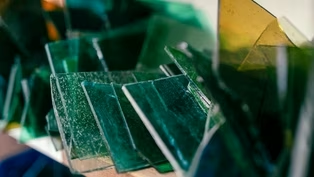
Inside Judson Studios, LA’s Historic Stained Glass Workshop
Video has Closed Captions
Clip: S9 Ep3 | 7m 42s | The stained glass studio that's infused SoCal architecture with color for 125 years. (7m 42s)
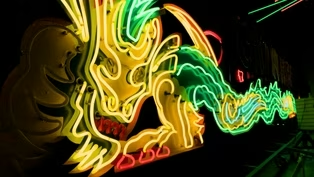
Inside the Museum Saving LA’s (Historic) Neon Signs
Video has Closed Captions
Clip: S9 Ep3 | 11m 31s | Discover how neon signs preserve LA’s cultural history. (11m 31s)
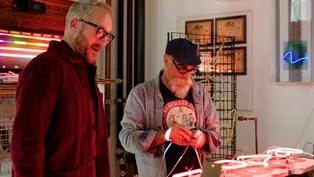
Neon, Stained Glass, Mosaics: Hidden Backdrops of SoCal
Video has Closed Captions
Preview: S9 Ep3 | 30s | Hidden in plain sight, neon, mosaics and stained-glass shaped Los Angeles’ backdrop. (30s)
Providing Support for PBS.org
Learn Moreabout PBS online sponsorship














Support for PBS provided by:
Lost LA is a local public television program presented by PBS SoCal