
Inside Judson Studios, LA’s Historic Stained Glass Workshop
Clip: Season 9 Episode 3 | 7m 42sVideo has Closed Captions
The stained glass studio that's infused SoCal architecture with color for 125 years.
For more than 125 years, Judson Studios has created stained glass for landmarks across Los Angeles. This segment explores how a family run studio continues to blend traditional craftsmanship with modern techniques, shaping the visual identity of Southern California through art, architecture, and design.
Problems playing video? | Closed Captioning Feedback
Problems playing video? | Closed Captioning Feedback
Lost LA is a local public television program presented by PBS SoCal
Inside Judson Studios, LA’s Historic Stained Glass Workshop
Clip: Season 9 Episode 3 | 7m 42sVideo has Closed Captions
For more than 125 years, Judson Studios has created stained glass for landmarks across Los Angeles. This segment explores how a family run studio continues to blend traditional craftsmanship with modern techniques, shaping the visual identity of Southern California through art, architecture, and design.
Problems playing video? | Closed Captioning Feedback
Where to Watch Lost LA
Lost LA is available to stream on pbs.org and the PBS app.
Providing Support for PBS.org
Learn Moreabout PBS online sponsorship-David, hi.
-Hey, man.
How are you?
Good to see you.
-Thanks for having me.
Good to see you.
-Thanks for coming.
-This building is amazing.
-Yes.
Thank you.
I say it's Californian.
It's a little mix of everything.
-Yes.
In the 1890s, a portrait painter and art teacher named William Lees Judson came to Southern California seeking better health and found his home.
Along the Arroyo Seco, between Los Angeles and Pasadena, a thriving community of artists and craftsmen had taken root, and Judson fit right in.
In the Arroyo adjacent village of Garvanza, now known as Highland Park, Judson helped establish USC's College of Fine Arts and served as its founding dean for more than two decades.
Judson is best remembered, though, for the stained glass studio he founded with his three sons in 1897.
When the art school relocated to USC's main campus two decades later, the glassworks moved in, and the building's been known as Judson Studios ever since.
I met up there with David Judson, the fifth-generation steward of his great-great-grandfather's legacy.
You have corporate archives here going back quite a ways.
-We moved in here in 1920, so our records are a little sketchy before 1920.
Initially, it was logbooks, and then we moved to files, late 20s, early 30s, and then after the war.
My grandfather was a very good record keeper.
These, though, are a little bit of the earlier ones.
-Wow, this looks quite old.
-Yes, and fragile.
This is the ledger.
Rather than keeping files, this is basically the accounting.
You never know what you're going to find in here.
Here you can see Grauman's Theater in July of 1923, and then right below, Grauman's Theater.
-Charles Chaplin.
Judson represents this older LA culture that, I guess, in the popular imagination, was in some ways supplanted by the arrival of the movie industry.
There's a connection here between those two.
-Absolutely.
If we go to 1925, we have Mabel Ennis from the Ennis House, the Frank Lloyd Wright Ennis House.
We have Barnsdale, which is the Hollywood account.
It's fun to be able to look through these.
-If there was some question about whether there's this piece of stained glass, or did Judson Studios do that, even if you don't have a file on it, you could actually find an entry in here and suppose, with some reasonable certainty, that, oh, you were involved with it.
-You would need to know exactly the owner, who the owner was, and what year it was.
That's when our earlier the logbooks are very specific.
It can be a little tricky to track it down.
We stumble upon these old records and find really interesting things.
-In some ways, you could say that Judson's stained glass is just hiding in plain sight all around us in Southern California.
It's not just churches.
-That's true.
-It's places where you might not expect it, like movie theaters on Broadway.
It's obviously such a visually arresting artwork.
How is it that it sometimes goes unnoticed?
-It's part of the fabric, and oftentimes, if you don't notice it, it's doing its thing.
It just feels like the aesthetic of the space that you're in.
-It's woven into the fabric of our surroundings, of the buildings that we inhabit.
-Exactly.
The idea is that it's a continuous design that blends in with all the materials of a structure, or whatever a designer was doing, or the architect.
They want that to feel like it's part of the building.
If you've lived in Los Angeles and you've seen a lot of buildings, you've definitely seen Judson Glass.
-Where else are you going to see Judson's stained glass?
-You can see it at the Natural History Museum.
There's a major dome, the library.
We did the globe that's in the Central Library downtown.
It's pretty prevalent everywhere.
-Judson Studios is part of what we might call the Arroyo culture, or I think Robert Winter called it the Arroyo set, right?
-I think the Arroyo Guild was really set up to support each other.
This idea that you could make your living by making things by hand was really still, even then, a struggle.
I think that was as a way to support each other and also live a life that they felt was representative of contributing something to the environment and to their own personal lives, and that kind of thing.
Drawing on this William Morris philosophy of that, not only should it be beautiful, but it should be practical as well.
-Do you consciously try to carry on this legacy?
-Yes.
I think that's where we're leaning into this idea that things are still made by hand here, right?
We could put you to work here and try your-- you want to try?
-I have zero experience, but please, it sounds amazing.
Thank you.
-Let's try it.
-I'm a complete novice.
I've never even really touched stained glass before.
-Cutting glass is fairly straightforward.
You're basically going to scratch the surface of the glass.
You're not cutting the glass, you're scratching it.
You just start, you want the screw facing out, and then you're just going to press down with as much pressure as you feel comfortable with, and then just pull it down all the way across the other side.
-Am I holding that correctly?
-Put it in between these two fingers.
-Like that?
-Yes.
There you go.
-This feels awkward.
-It is awkward.
It takes a long time to get used to.
-Okay, and I hold this down?
-Yes, hold that.
Hold it vertical.
-A vertical.
-Yes, and then press it down.
There now.
There it is.
Oh, that sounded good.
Whoa.
-Whoa.
It's like magic.
I love it.
-Amazing.
Well, that's a good first attempt.
-Okay.
[laughter] -Back here is where we keep all the glass.
-That's a lot of glass.
-Like I said, we have about 600 different kinds of glass that we keep in stock.
-Doesn't look brand new.
-No.
[chuckles] This window came from a church in Hawaii, believe it or not.
-Wow.
This had to travel across the Pacific to get here.
-Yes.
Exactly.
A little salty.
This is an old Belgian window.
It's a little over 100 years old.
-Okay.
When you restore it, you completely get rid of the lead.
That's actually the most important part of the restoration, right?
You're replacing the lead.
-Exactly.
Yes.
Because we don't have a drawing, we take a rubbing of it.
By taking a rubbing of it, it'll show us exactly where the lead lines are.
We annotate it, obviously, for all the sizes and that kind of thing, and any breaks.
If there's a piece of broken glass, we can address that.
We want to keep as much of the original material as possible.
-About 100 years is the lifespan of it.
Now this would be good for another 100 years in a while.
-I don't know.
Hopefully longer.
This is the oldest part of the building.
It's a good place to be in the summer because it's underground.
Now we're doing what we call cementing the window.
It's waterproofing it, and then it's also patina-ing the leads and the solder.
This is the last room.
-This is really the last step, though.
You've got to get it out of here, and you've got to get it to where you're going to install it.
-A lot of times we're doing the installation.
If we're not installing it ourselves, we're often training folks to do it.
Yes.
-Because this is very specialized knowledge.
You don't find a lot of outfits that are going to be able to do this.
-No.
Nobody wants to touch it.
In a construction site, new construction, they don't want to see us until they're basically leaving.
We're usually first ones in to get it out if it's restoration, and last ones in to install it.
-Wow.
Your trucks must have pretty good suspensions, huh?
-Yes.
-You invest in that.
-Lots of cushion on the bottom.
-Yes.
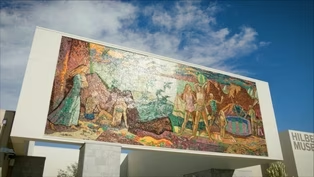
How did this Massive Mosaic from Santa Monica End Up in the OC?
Video has Closed Captions
Clip: S9 Ep3 | 7m 24s | A monumental mosaic saved from demolition and restored piece by piece. (7m 24s)
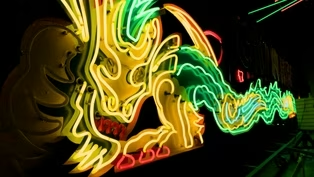
Inside the Museum Saving LA’s (Historic) Neon Signs
Video has Closed Captions
Clip: S9 Ep3 | 11m 31s | Discover how neon signs preserve LA’s cultural history. (11m 31s)
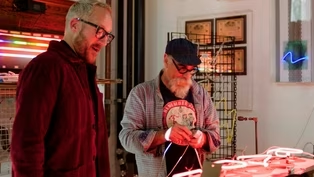
Neon, Stained Glass, Mosaics: Hidden Backdrops of SoCal
Video has Closed Captions
Preview: S9 Ep3 | 30s | Hidden in plain sight, neon, mosaics and stained-glass shaped Los Angeles’ backdrop. (30s)
Providing Support for PBS.org
Learn Moreabout PBS online sponsorship













Support for PBS provided by:
Lost LA is a local public television program presented by PBS SoCal