Oregon Art Beat
How Justin Hampton Turned ’90s Grunge Into Iconic Rock Poster Art
Clip: Season 27 Episode 3 | 9m 42sVideo has Closed Captions
Behind the art of grunge: artist Justin Hampton’s journey through Seattle's music scene.
Fresh out of art school in Seattle, Justin Hampton found himself at the heart of the ’90s grunge explosion, trading band flyers for concert tickets. When the city banned flyers on telephone poles, he helped pioneer large, screen-printed posters — launching a prolific career creating art for Soundgarden, Radiohead and more. His 444-page book Visual Feast presents it all.
Problems playing video? | Closed Captioning Feedback
Problems playing video? | Closed Captioning Feedback
Oregon Art Beat is a local public television program presented by OPB
Oregon Art Beat
How Justin Hampton Turned ’90s Grunge Into Iconic Rock Poster Art
Clip: Season 27 Episode 3 | 9m 42sVideo has Closed Captions
Fresh out of art school in Seattle, Justin Hampton found himself at the heart of the ’90s grunge explosion, trading band flyers for concert tickets. When the city banned flyers on telephone poles, he helped pioneer large, screen-printed posters — launching a prolific career creating art for Soundgarden, Radiohead and more. His 444-page book Visual Feast presents it all.
Problems playing video? | Closed Captioning Feedback
How to Watch Oregon Art Beat
Oregon Art Beat is available to stream on pbs.org and the free PBS App, available on iPhone, Apple TV, Android TV, Android smartphones, Amazon Fire TV, Amazon Fire Tablet, Roku, Samsung Smart TV, and Vizio.
Providing Support for PBS.org
Learn Moreabout PBS online sponsorship(music) (music continues) (music continues) - You know, when you're doing a poster for a band, there's a lot of expectation.
Hey, how's it going?
I don't think in terms generally of like, what's gonna sell necessarily as much as, here's what I'm feeling, here's what I wanna do.
- In fact, one of my favorites ... I started off doing screen prints for bands back in the day.
There's a lot that goes into it.
It's a very tactile, artisan kind of craft in that it's all hand-done, you know, the colors are custom mixed by hand.
(music) Everything's signed and numbered, limited editions.
This is the early stage of creating these two characters that are different, that come together as one image.
And then to further that, I just put on an overlay on tracing paper.
This is sometimes how it starts for me, and I use the light table to just kinda keep building on it.
And this is a look at the final poster, but that was a pretty fun project, and I got a copy that's signed by all the band members.
My early inspirations in small town America was basically pop culture, TV, movies, but also comic books.
As a little guy, it kind of really opened up my mind.
And I would try to copy these things, you know, as a kid.
I started sending samples to Marvel Comics, just, like, age 14.
And so by the time high school came to close, I wasn't getting the responses that I wanted.
Ya know, they were all like, "Cool, keep going, keep going", you know, "keep sending us stuff."
But I wanted to get out of Medford.
I finally decided to go to art school, 'cause I needed to do something.
(music) So, when I first moved to Seattle, I literally had no idea anything was happening, even though it was the very beginning of the grunge era, 1987, It was just a weird, like, confluence of things that brought me in that moment to just be in Seattle and experience all these local bands.
(music) In Seattle, in the early '90s, one of the main ways that bands got the word out for their shows was to put up flyers.
And, you know, 11x17 was the biggest you could get at Kinko's.
In my last quarter of school, I was asked to do this final thing for a typography class.
And I was going to a Nirvana show, and so I was like, why not just do a flyer?
I see these flyers on poles everywhere.
And I didn't get anyone's approval.
I was just like, "I'm just gonna do this thing".
So, I designed it and I put up a few.
That's literally the first flyer that I ever designed, was just my own guerrilla style Nirvana flyer.
I started getting asked to do flyers for different people that, you know, whether it was a band or a promoter or whatever, for an event.
And it was, you know, really nothing.
It was, like, 25 bucks and like, you know, some free beer that night at the show or something, you know, maybe food.
And so I never really thought of myself as becoming a poster artist.
In fact, I didn't think that it was possible to be a working poster artist and make money.
The telephone poles were getting covered with flyers, and they're bulging.
But that was the way the bands got the word out.
And then, around '93, the no poster ban went into effect in Seattle.
And so Seattle city council had decided that, basically, that flyers were not beautiful (chuckles) and that they were, like, making the city ugly.
And so they made it a law that it was illegal to put up flyers.
Promoters were deciding, okay, we need to make more impact with a single image that's only gonna be maybe in a handful of shops.
I started getting commissioned to do screenprinted posters.
(music) So, around that time, I saw the "Artrock Catalogue," which had become something that was floating around nationally.
Then I started getting in those catalogs.
And before the internet, that was the way that stuff got seen, and money made was through those catalogues.
I started getting paid decent, so that became a thing where I was like, okay, maybe I'm a poster artist, I guess.
You know what I mean?
Or at least it's one of the things I do.
(music) My 1995 PJ Harvey poster was probably the first big splash that I made in the poster scene, where I had developed that relationship with "ARTROCK."
It was that moment that really kind of put me on the map.
Vintage, this is one of my very first screenprints.
But this is, yeah, 1994.
This is the Sabertooth original.
This is the Kurt Cobain original.
This is the Royal Blood original.
The process of making a poster basically starts with a sketch.
Then you move on to the final art, which for me, is still hand drawn.
And then I scan that into the computer and build layers in Photoshop.
(music) So, each color is its own layer.
Each layer is gonna be built into something over the span of the printing process.
So, you print 100 of them one color, and then they're put on the rack to dry, and then you bring 'em back, and you put the second color, and that's put on the rack to dry.
And if it's five, six colors that goes on, it can take days.
But then the final result when the black goes down is you have this, you know, beautiful screenprint.
Around '98, I made it my mission to build a website and get my stuff up, and started talking to local printers that were like, "You can pay me on the backside after you sell the posters."
Made it viable for me to suddenly go like, okay, I can print my own posters, I can publish my own posters.
I don't need a catalog.
I can do this all myself.
And so that's when things really started clicking.
I'd say around 2002, I was really taking off in the world of becoming, like, completely self-sufficient.
It was a pretty revolutionary, it was a pretty amazing time, for sure.
(music) After I'd been in Seattle for 20 years, I saw that the change coming to Seattle was so intense and it was evolving so quickly.
I loved the late '80s through '90s Seattle, and watching it disappear was kinda hard, you know?
So, in the late 2000s, I decided to move to Portland to be closer to my family down in Medford.
I now had a kid, Miles.
It just made sense to do something different.
I've been here for now, like, 17 years.
I've had people request that I do a book for quite a long time.
And then I think I finally came to a point where I just felt like now might be the time to start putting it down on paper.
All right, let's see what we got.
It took, from starting the book to it actually being here now, six years.
And it turned into 444 pages, a huge 11x14 retrospective book.
The book basically is just my entire history as an artist, from, you know, growing up in Medford, Oregon to going to Seattle and getting started.
It's the story, as well as the art.
There's photos, there's sketches.
Lots of different tales of, you know, meeting and hanging out with different band members .
So I really kind of delved deep into the relationships that I've had with different promoters and other artists.
And it's not just a picture book.
It's definitely a storybook, too.
(people chattering) Feel free to look through the whole thing; there's a lot.
I've never had a book signing before, so that's pretty cool.
So, I've already got six set up.
I'm having three shows in Seattle.
It's definitely gonna be really cool to see a lot of old-school friends and people that will appreciate the tales, that will recognize having been there themselves.
Nice, I appreciate it, man.
I'm always seeing new talent and see people that I'm like, oh, wow, that's really good.
Whatever part I played in it, it's cool to see it continue on.
So, it'll be here long after I'm gone.
(music fades) (no sound)
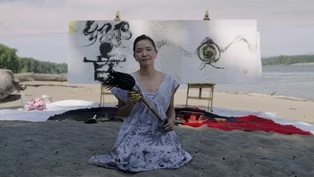
Calligrapher Sora Shodo breaks traditional Japanese rules.
Video has Closed Captions
Clip: S27 Ep3 | 10m 7s | Japanese calligraphy artist Sora Shodo breaks the rules of traditional calligraphy. (10m 7s)
Providing Support for PBS.org
Learn Moreabout PBS online sponsorship















Support for PBS provided by:
Oregon Art Beat is a local public television program presented by OPB