
How Social Media Tourism Is Changing Joshua Tree
Clip: Season 5 Episode 4 | 3m 30sVideo has Closed Captions
Social media has surged visitation numbers to Joshua Tree National Park —but at what cost?
Joshua Tree National Park is one of California’s most beloved landscapes, drawing millions of visitors each year to its distinctive rock formations and iconic Joshua trees. As visitation grows, park managers, conservationists, and local communities are working to protect the desert and ensure the park remains resilient for future generations.
Problems playing video? | Closed Captioning Feedback
Problems playing video? | Closed Captioning Feedback
Earth Focus is a local public television program presented by PBS SoCal
How Social Media Tourism Is Changing Joshua Tree
Clip: Season 5 Episode 4 | 3m 30sVideo has Closed Captions
Joshua Tree National Park is one of California’s most beloved landscapes, drawing millions of visitors each year to its distinctive rock formations and iconic Joshua trees. As visitation grows, park managers, conservationists, and local communities are working to protect the desert and ensure the park remains resilient for future generations.
Problems playing video? | Closed Captioning Feedback
Where to Watch Earth Focus
Earth Focus is available to stream on pbs.org and the PBS app.
Providing Support for PBS.org
Learn Moreabout PBS online sponsorshipWhen visitation tripled here, which happened in a really short period of time, about five years, the park and the staff here, were very much in reactive mode.
We were also seeing a real change in some of the behavior in our visitors.
You only have a few bad apples, but those bad apples can have a big impact.
I would separate that even more into those who are unintentionally damaging the park versus those who might be intentionally damaging the park.
When I started working here in the '90s, I probably talked about graffiti a handful of times.
Since 2016, we've had 880 documented incidents of graffiti in the park.
We have to give a little credit to social media because in the last 10 or 15 years, like it really has promoted this romantic image of the Joshua Tree and Joshua Tree National Park and having a desert experience.
Man, the downside is really rough to watch on places.
Five or 10 years ago, there were a string of music videos that were filmed in the desert where people would come out, even on private property, and wrap Joshua Trees up in bows or spray paint them.
Because they wanted it to look a certain way, or the music festivals that have been promoted by social media and promoted by the success of Coachella.
The music festivals have had some real impacts.
You think about what it must be like at night to be in a very dark and very quiet place for a bat or a bird, the wildlife here.
Then all of a sudden there's blaring music and bright lights.
It's disorienting for wildlife that are trying to deal with some of the effects of climate change in an already extreme environment.
In some ways, the Park Service, I think, has done well to lean into social media, and look at ways we can really provide more educational information for our visitors.
Continuing the inspiration of place is important, whoever is behind the camera.
Our challenge is to inspire the stewardship to go along with that.
I think collaborating, getting our message out there, finding some way to connect with people in a similar fashion is kind of where we're trying to thread the needle with the park service.
The desert is just absolutely beautiful and when you can capture that so easily now on a phone versus back in the day where you had film, and you came out and you shot rolls of film you didn't know what you had until you went back and developed it.
The people that it attracted, it still seemed to be that really great person.
Yes, there are some outliers.
There's going to be a party, there's going to be a wedding, there's going to be something that shouldn't be in a neighborhood.
Generally, the people that just really want to be in the desert, they just want to come out here and unwind and reconnect and then recharge.
We see these people all day every day at our store and we talk to them.
Could you stop it?
Could you stop Instagram?
Are we going to stop TikTok?
I just don't think that it's possible at this point to kill social media.
or to stop people from showing images.
I think while we cannot stop the influence of social media and influencers, I do think that we all need to be ready and hold people accountable when there's impacts that we can't tolerate.
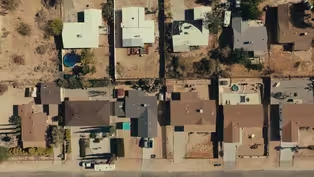
Joshua Tree: 'City Prices in a Very Small Town'
Video has Closed Captions
Clip: S5 Ep4 | 2m 44s | Vacation rentals are swallowing the housing market and displacing local residents. (2m 44s)
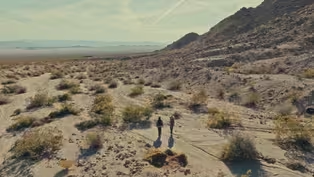
Video has Closed Captions
Preview: S5 Ep4 | 30s | Love for Joshua Tree endangers the local life—both people and ecosystems. (30s)
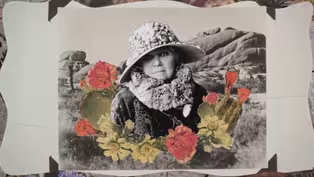
Minerva: Joshua Tree's Original Influencer
Video has Closed Captions
Clip: S5 Ep4 | 55s | Did you know desert influencers have been around long before music festivals? (55s)
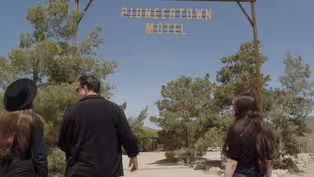
Pioneertown & Balance in the Desert
Video has Closed Captions
Clip: S5 Ep4 | 4m 59s | Gerard Noonan reflects on the freedom folks have sought in the desert and if it's sustainable. (4m 59s)
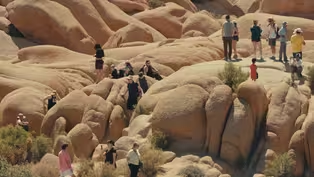
What Joshua Tree's Social Media Presence Means for Tourism
Video has Closed Captions
Clip: S5 Ep4 | 5m 40s | Joshua Tree has become a popular backdrop for social media content — at what cost? (5m 40s)
Providing Support for PBS.org
Learn Moreabout PBS online sponsorship New Season
- Drama

Hugh Bonneville stars in a crime drama inspired by one of the largest robberies in British history.
 New Season
- Drama

Benjamin Wainwright stars as Maigret in the contemporary adaptation of Georges Simenon's novels.


 New Episode




 New Season
 New Season
Support for PBS provided by:
Earth Focus is a local public television program presented by PBS SoCal