
How UofL Plans to Become a Leadership Leader
Clip: Season 5 Episode 14 | 8m 32sVideo has Closed Captions
How UofL is expanding entrepreneurship and leadership training through hands-on programs.
The University of Louisville's College of Business is helping students turn ideas into businesses through programs like Sandbox and Elevator. The initiatives bring together students from multiple disciplines to develop entrepreneurial, leadership, and problem-solving skills while supporting businesses, nonprofits, and communities across Kentucky.
Problems playing video? | Closed Captioning Feedback
Problems playing video? | Closed Captioning Feedback
Kentucky Edition is a local public television program presented by KET
How UofL Plans to Become a Leadership Leader
Clip: Season 5 Episode 14 | 8m 32sVideo has Closed Captions
The University of Louisville's College of Business is helping students turn ideas into businesses through programs like Sandbox and Elevator. The initiatives bring together students from multiple disciplines to develop entrepreneurial, leadership, and problem-solving skills while supporting businesses, nonprofits, and communities across Kentucky.
Problems playing video? | Closed Captioning Feedback
Where to Watch Kentucky Edition
Kentucky Edition is available to stream on pbs.org and the PBS app.
Providing Support for PBS.org
Learn Moreabout PBS online sponsorshipThe University of Louisville College of Business has a lot to brag about.
The Cardinals have the highest rated entrepreneur program in the state.
Number six in the South.
Along with their franchise education program, that is number one in the nation.
Those accolades come as the school has leveled up experiential learning that gives students real life business experience that can also help them transform their communities back home.
I talked with two professors at U of LS College of Business last week about how they're working to become a national leader and leadership development and training the next generation of bosses.
This is our business Beat segment.
We are delighted to be joined by doctors Nat Irvin and Raymond Green, who are at the University of Louisville College of Business, and we're going to talk about how they are shaping some young minds to pursue their dreams in the field of entrepreneurship and other business ventures.
Good to have you all.
Good to be with you in the morning.
There's great things that are happening at the University of Louisville College of Business and Doctor Irvin.
You know, many people may remember when we had talked to you years ago, the idea fest that was right at the Kentucky Center for the Arts.
That's our next door neighbor here in Louisville and always bringing together brilliant minds and thinkers.
And you're still doing that with the college population that you have.
Tell us what you're up to.
Well, you know, Renee, I love the way that you have just framed this conversation we're having here in the past with the Idea Festival, because one of the things about a university like the University of Louisville is that it teems with young people who have imagination, creativity.
You know, we think a lot of times about what an education is all about.
And the gift that we have in the students at the University of Louisville is that they have imagination, they have drive.
And in the College of Business, what we're after is how do we put some of that imagination, some of that creativity in in the context of business, developing social entrepreneurship, which is obviously something that's important for the Commonwealth of Kentucky.
And so there are a lot of great things that we're doing in the University of Louisville.
We have a sandbox program which is designed to give students a real life experience in building a business.
We have another program called elevator, which is where students come together spending time helping to advise businesses that are locally in the local, here in the university and in the city of our Louisville, or actually across the Commonwealth.
But if you just think in terms of just what the University of Louisville is doing in the College of Business, we're trying to harness the creation, harness imagination and creativity that young people have so that they can be productive citizens for the Commonwealth.
And these students are not just Louisville.
They come from all over the Commonwealth.
Talk to us about that, Doctor Greene.
Yeah.
That's right.
Our students come to us from all over the country, but especially all.
Almost all hundred and 20 counties are represented in the College of Business.
And what we have discovered, like Doctor Ervin mentioned, is that there is an untapped talent source here that wants to tell the story of business and wants to say what's happening not only in Louisville, but in Appalachia, in western Kentucky, northern Kentucky.
What is the business story that's happening from their perspective?
And so if you think about, like, Eastern Kentucky, the Appalachian region, we know that they have really been bereft with a natural disaster.
That's right.
Of course, a mono economy that is declined from the coal industry.
And if ever there was a time to kind of incubate that young talent who can bring all of that brilliance back home.
Yes, that would be wonderful.
What what are some examples of the things that these young mines are bringing to bear?
Well, Doctor Ervin mentioned the sandbox program where we have wonderful entrepreneurs and our elevator program, but we're really excited to think about, the Cardinal Content Lab, which is an opportunity for us to partner with Ket to say, how can we tell the story of business and how can we get students involved, with what's going on in business and, and see it through there.
So we're really excited to think about getting students involved in telling that story.
And in their way, in their language, to their audience.
Yeah.
And we know that they're already doing some amazing things.
Okay.
Talk to us about Lou Bru.
So you're going to do that?
I'll talk about Lou.
Okay.
So we love the name.
All right.
So that's a. Lou is an amazing opportunity that we have for students around experiential learning, where our students have built a business from scratch for the business school.
And so imagine if an engineering student went to engineering school, never got to practice engineering.
Or a music student that never got to practice engineering with Lou Bru, our students get to actually run a business, in this case a coffee business.
And so it will be housed in the College of Business.
And our students spent the entire year last year going through the entrepreneurial process of ideation, raising capital, getting the IEM established and doing all that.
What is the.
Ion?
That is our employee ID number.
Okay.
That's the Social Security number for business.
And so doing all the things, all the successes, all the failures that come with, with starting a business from scratch.
And so when these students now go into the workforce, they will have a new experience that they would not have had before, that just simply writing a paper would not do.
Right.
They know how to write a paper, but they also know how to start a business, how to.
Start a business.
And are all of these young minds, are they all business majors?
No, no, that's I think that's one.
I'm glad you raised that because we have students from engineering.
We have students from all across the disciplines of the college, not just the College of Business across the university, but they're housed within the College of Business.
So you can have within the elevator program, you can have students who form teams who have an interest because, you know, say, for example, because you are a Spanish major, a music major, or a, poly major doesn't mean that you don't have interest in being able to impact your community.
But if you can put together that desire that you have with others from other parts of the university and the business community, in the business environment, then what you can do is which is what we have happening at the College of Business.
You have students who are forming teams who can advise local businesses on how to improve, the nonprofit organizations, how to improve their business and this is the key thing here, is young people right now have these new tools which everybody talks about artificial intelligence.
Well, what we have been able to do is to harness some of the tools that they have and to be able to help them to build businesses with it, right, to be able to improve the outcomes for businesses locally.
So there are several examples, Renee, of where students have done this, but we are reaching beyond the College of Business.
But the College of Business is sort of the hub.
So you can expect students from engineering.
You can expect students from the arts and sciences, you can expect students and music.
Music is a business, right?
You know, but but even aside from business, what we're really talking about is organizations that that we have within the community.
It could be nonprofits, could be the schools, could be, you know, education on the on the secondary level.
And I will give you one final example of just how to think about this.
We've had a program with one of the local schools, Central High School, for several years and one of the programs, one of the projects that they had to work on was how do you impact the problem of homelessness in the community?
These students came up with the idea of having a 24 hour, 24 hour, daycare that is actually going to be formed, going to be developed in West Louisville.
These were students who saw the need, who helped to develop a business plan.
And now it's going to be a real.
Answering, real social, real societal concern.
Absolutely.
You know, we talking about it is we have in the Commonwealth there's no shortage of imagination.
There's no shortage of talent.
There's no shortage of drive.
You know, I think our community and I'm speaking now of the Commonwealth.
We just as we just as good as Tennessee.
We're better than Tennessee.
You know what I mean?
We're better than North Carolina.
We're better than a lot of places that sometimes are having a lot of success.
And what I think a university like ours can do is to help tap that next generation and the age of AI.
And you know, get some really good returns for our citizens.
Well, we're glad to be a part of this in some way, and to tell the stories of these wonderful young people who are doing amazing things.
Social entrepreneurship, if it will help in their communities at the same time.
Appreciate you, Doctor Irving and Doctor Green.
Thank you.
Thank you so much for the.
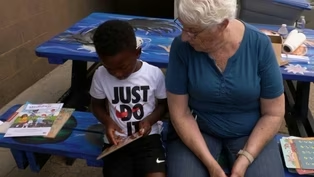
Kentucky Community Encouraging Love of Books
Video has Closed Captions
Clip: S5 Ep14 | 3m 46s | Christian County's new book trailer aims to spark a love of reading in kids. (3m 46s)
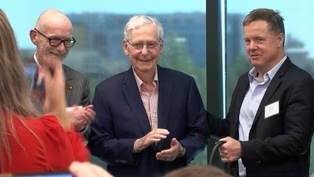
McConnell's Team Says He's Improving as Health Scrutiny Grows
Video has Closed Captions
Clip: S5 Ep14 | 1m 41s | Calls for transparency follow more than month-long stay in the hospital. (1m 41s)

Newport Ends Flock Pilot Program After Outcry
Video has Closed Captions
Clip: S5 Ep14 | 3m 35s | The city ended its automatic license plate reader program amid privacy objections. (3m 35s)
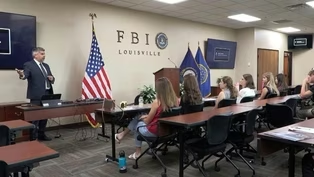
Twenty Kentucky Teens Accepted into FBI Academy
Video has Closed Captions
Clip: S5 Ep14 | 3m 59s | The program teaches young people how the FBI operates in their community. (3m 59s)
Providing Support for PBS.org
Learn Moreabout PBS online sponsorship New Episode
- News and Public Affairs

Top journalists deliver compelling original analysis of the hour's headlines.

- News and Public Affairs

Today's top journalists discuss Washington's current political events and public affairs.

 New Episode

 New Episode

 New Episode



Support for PBS provided by:
Kentucky Edition is a local public television program presented by KET