
I-80 Art Sculptures
Clip: Season 17 Episode 12 | 9m 12sVideo has Audio Description
Revisiting the story behind I-80’s iconic rest stop art.
As part of the nation’s Bicentennial, Nebraska transformed Interstate 80 rest areas into cultural gateways installing now-iconic sculptures through a partnership between the Nebraska Department of Transportation and artists. Commissioned amid a national push for public art, these large-scale works reflect the state’s landscapes, history, and identity and turn rest stops into open-air galleries.
See all videos with Audio DescriptionADProblems playing video? | Closed Captioning Feedback
Problems playing video? | Closed Captioning Feedback
Nebraska Stories is a local public television program presented by Nebraska Public Media
I-80 Art Sculptures
Clip: Season 17 Episode 12 | 9m 12sVideo has Audio Description
As part of the nation’s Bicentennial, Nebraska transformed Interstate 80 rest areas into cultural gateways installing now-iconic sculptures through a partnership between the Nebraska Department of Transportation and artists. Commissioned amid a national push for public art, these large-scale works reflect the state’s landscapes, history, and identity and turn rest stops into open-air galleries.
See all videos with Audio DescriptionADProblems playing video? | Closed Captioning Feedback
Where to Watch Nebraska Stories
Nebraska Stories is available to stream on pbs.org and the PBS app.
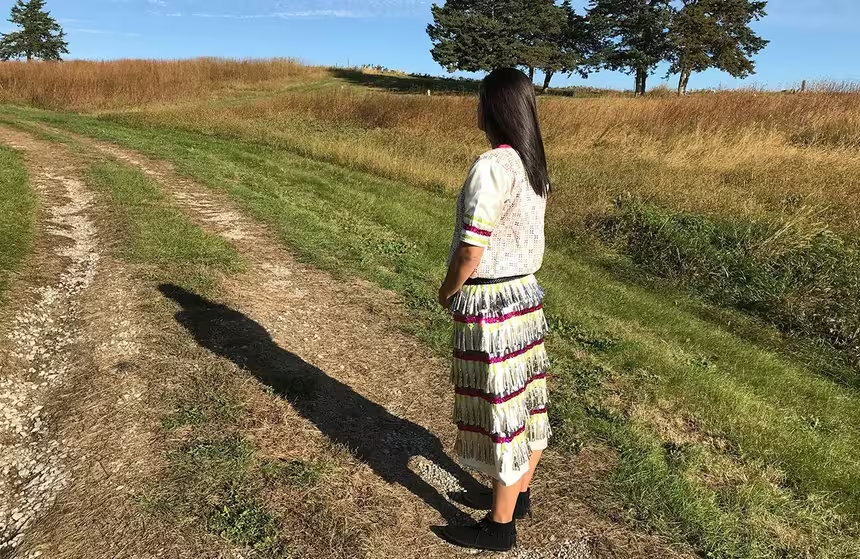
Do you have a Nebraska Story?
Do you have a story that you think should be told on Nebraska Stories? Send an email with your story idea, your name, your city and an email address and/or phone number to nebraskastories@nebraskapublicmedia.org. Or, click the link below and submit your information on nebraskastories.org.Providing Support for PBS.org
Learn Moreabout PBS online sponsorship(upbeat music) - When they heard sculpture.
So many people imagined in their own minds what it would be.
And no one could imagine what we actually came up with.
(upbeat music) - Recent history records no bigger controversy than the Great debate in 1975 on the I-80 sculpture project.
Everyone had an opinion.
(upbeat music) - What makes this project particularly unique was the expansiveness of of distance and time.
(upbeat music) - This was kind of a bold new idea, and Nebraskans tend to be a little stubborn with new ideas.
(upbeat music) - We will, in the course of these next 12 months, create a series of ten major pieces of large scale sculpture located at ten rest stops stretching across Nebraska's 455 mile span of U.S.
Interstate 80.
(upbeat music) (upbeat music) -[John] Every state was doing something for the bicentennial, not just a parade.
(upbeat music) There was enthusiasm.
(upbeat music) There was hope.
(upbeat music) There was a real pride in the country.
- It was an exciting time being in the Sheldon.
I was certainly aware of a major project that was happening under the leadership or the guidance of then director Norman Geske.
(upbeat music) -[Art] Norman had started to assemble.
I think one of the the great collections in the world of 20th century art right here in Lincoln, Nebraska.
(upbeat music) -[Karen] So people were beginning to understand the whole concept of public sculpture.
(upbeat music) - Tom Yates, who was at the time working with the Department of Economic Development and Tourism.
He came up with the idea of creating a monumental sculpture.
- His idea was to put a giant mastodon out on the interstate north of Lincoln that would draw people into Lincoln.
- Nebraska was the first state in the nation to complete the mainline interstate highway system.
- It just so happened it coincided with the bicentennial celebration planning.
So Norman got the idea of spreading it all across the state, combining it with that that new ribbon of highway.
- The federal government gave every state $100,000.
To do something.
Other people, you know, they did pageants or they did events.
- We went to the state Bicentennial Committee with the idea and asked for their financial support, and they agreed.
They thought it was a good idea.
(upbeat music) -[Santiago] More than anything in the world I wanted to do that project.
I remember when I got the telegram saying that I had been awarded the Sculpture Commission for the Grand Island location.
(upbeat music) I was just thrilled.
(upbeat music) -[Dan] It was unusual at the time to see sculpture on the interstate.
-[Art] It just so happened that the art was abstract in nature.
-[Karen] And the whole concept was not to be looking backward, but to be looking toward the next century.
- Public generally has a very strong belief on what they find aesthetically beautiful.
You're never going to get full consensus on what what is acceptable or not acceptable.
- Well, it wasn't cowboys on horseback.
I think they felt bamboozled by the fact that they weren't traditional sculptures.
-[Karen] But the other problem with this project was that there were no Nebraska or Midwest artists represented.
- The legislature decided they needed to have public hearings.
(static) -[Varner] I think it should be emphasized that this project was conceived and developed by Nebraskans, and the majority of funding is being voluntarily raised by Nebraska businessmen.
- I can't get this money straight.
Somehow I feel that it's coming out of the taxpayer's pockets.
- And just because you don't understand one of the sculptures is no reason to throw it out, because maybe someone will get it right off.
And if you don't appreciate it, nobody's going to make you sit there and look at it.
- I think the art organizations have done a real good job in representing their case, but I don't think this is a true cross section of the opinion of the citizens.
- When I get to these locations, people were either suspect of the project or angry about it.
Not everybody, but enough people to to notice.
- We thought the injustice of the whole thing was that none of our tax money was was involved in this.
(static) Therefore, it's a free gift and all we have to do is accept it or not accept it.
- These people say that we, uh, that they should have self-expression.
(static) What about the people who are against it?
How about their self-expression?
- We have to spend the year earning monies to take students on field trips to Lincoln (static) and to Omaha, and this is going to be a tremendous opportunity for my classes to have an sculpture of this nature close by.
- My question is, "Does any art object have a place on our interstate rest areas?"
- But by the time I got through with the presentation, whatever, those feelings kind of evaporated.
(upbeat music) -[John]I would fly out to meet with the engineers.
The fabrication house I was using the steel company.
We used a company called chief as a young man who owned the company, and he let me work there.
When the sculpture was completely welded, now we had to grind off all the welds because that's the way I like to finish my pieces.
(upbeat music) - Hans van de Bovenkamp's piece out in Sidney.
had one problem almost from the beginning and George Baker's piece in high winds, it got away.
It got loose and floated down to the end of the lake.
Now it's on dry dock as a result.
(upbeat music) -[Dan] Art and I basically said, you know, we have to be a little more proactive on how we start to treat these sculptures.
We need to make sure that we lay the groundwork for their care and preservation into the future.
I felt that the first step in that was to get them listed on the National Register.
-[Santiago] These are very notable artists, right?
And these works are significant works of art, and they've now become ingrained in the communities that they're a part of.
This is an assembling of significant works from this particular time, and it's here in Nebraska.
And I think that that's really incredibly important.
(upbeat music) -[John] The I-80 sculpture project was extremely, profoundly important in my career, and the people were so wonderful.
(upbeat music) I mean, Nebraska will always be (upbeat music) very, very important part of my life.
- I mean, for me, it was an incredible opportunity.
And I learned so much working with sculptors.
On the one hand, the Department of Roads, on the other hand, and golly, it really changed my life.
(upbeat music)
Video has Audio Description
Clip: S17 Ep12 | 9m 12s | Omaha's critical role in shaping Women's Pro Bowling (9m 12s)
Providing Support for PBS.org
Learn Moreabout PBS online sponsorship New Episode
- News and Public Affairs

Top journalists deliver compelling original analysis of the hour's headlines.
 New Season
- Drama

Hugh Bonneville stars in a crime drama inspired by one of the largest robberies in British history.

 New Season
 New Episode

 New Episode


 New Episode
Support for PBS provided by:
Nebraska Stories is a local public television program presented by Nebraska Public Media