Across Indiana
Indiana's Hidden Global Gallery
Season 2026 Episode 15 | 6m 51sVideo has Closed Captions
What happens when you accidentally start a museum?
If a passionate group of Hoosiers kept donating beautiful works of art & cultural items to show where their families are from, what would you do? If you’re Mary Clark & the International Marketplace Coalition, then you’d create Indy’s Global Village Museum, of course! This hidden gem in Indianapolis showcases the diversity that makes our state unique and encourages others to contribute as well.
Problems playing video? | Closed Captioning Feedback
Problems playing video? | Closed Captioning Feedback
Across Indiana is a local public television program presented by WFYI
Across Indiana
Indiana's Hidden Global Gallery
Season 2026 Episode 15 | 6m 51sVideo has Closed Captions
If a passionate group of Hoosiers kept donating beautiful works of art & cultural items to show where their families are from, what would you do? If you’re Mary Clark & the International Marketplace Coalition, then you’d create Indy’s Global Village Museum, of course! This hidden gem in Indianapolis showcases the diversity that makes our state unique and encourages others to contribute as well.
Problems playing video? | Closed Captioning Feedback
Where to Watch Across Indiana
Across Indiana is available to stream on pbs.org and the PBS app.
Providing Support for PBS.org
Learn Moreabout PBS online sponsorshipWhen it comes to starting a museum, you would think that would be something youd do on purpose.
But here on the west side of Indianapolis, that's not always the case.
that's what we called it.
We were accidental museum-ers.
We didn't know what we were doing, but it feels amazing.
Mary Clark is the executive director of Indy's Global Village Museum.
She's west side, born and raised.
Shes spent her career working in and managing a wide variety of different businesses from all around the area and she's a founding member of the International Marketplace Coalition, the local organization that promotes economic growth in this very diverse area.
let me tell you what I know.
If you spend a little time with people, just a little time talking to people, getting to know them, maybe breaking bread with them, those biases disappear.
years ago, when the coalition was still young, Mary started to notice something.
our first office was a 700 square foot office People started donating things People really love sharing and donating bits and pieces of their own culture.
pieces that showcased who they were, where they're from, and what makes that area so special.
More and more of these unique donations kept coming through the coalition's door.
we moved into a 1900 square foot office.
And that's when people really started donating things.
I mean, people were walking in our building with, statues that were tall as me, and I'm almost six feet tall.
And the more that happened, the more we realized.
Maybe we need to start looking at a place where we can show people how our differences aren't so different.
and with that inspiration, Indy's Global Village Museum was founded.
But don't just call it a history museum or just an art museum.
We're a global museum.
We're, museum that will take you around the world Today, the collection takes up over 40,000 square feet, representing over 180 different countries.
there are dolls from India a Native American headdress, clothes a Nepalese man wore to his own wedding.
and sculptures, paintings and other works of art that show slices of life from all around the world.
Mary just has one rule when you stroll through these doors.
So if you walk into one, the galleries and you don't see yourself, I get to say this to you.
It's not my fault, it's yours.
You don't see yourself because everything in this museum has been donated.
out of the entire collection, Mary estimates that 70% came from people that have spent their lives traveling the world.
People like Carol Mehra.
English is my first language.
And I do speak two dialects from India, Hindi and Konkani, And then I speak Spanish, I speak Arabic, I speak Swahili.
Carol was born in Africa.
Educated in India and then spent her nursing career traveling across the world and back.
But after all those years of work and travel and life, some downsizing was in order.
and I just didn't know what to do with it.
I didn't want to have a garage sale.
So that's why I got in contact with Mary and that was able to donate everything here.
And Carol didn't just bring 1 or 2 things.
She donated hundreds of items, So, one is the little dresser that used to be on a little landing in my house.
We would put our keys into the drawer, but that is made of wood and ivory, and it has glass.
You know that you could kind of look into it and see whether your makeup is correct.
furniture, bases and more.
All of it donated.
Just so Carol can share a little bit of herself with the world.
To me, it's just it's worth nothing because I've donated it and I can enjoy it here.
And I'm happy that other people get to enjoy it as well.
Sharing your culture doesn't always mean sharing a particular item from where you're from.
Sometimes it's about sharing a talent that you brought with you.
do what you love in your life, and you don't have to work anymore Meet Norman Norori Lopez, a woodcarver from Nicaragua.
A trait he proudly learned from his father.
He also, taught me how to do carving since I was, like, six years old.
when I was ten years old, I. I did my first carving alone, Norman caught Mary's attention with one of the first pieces he carved after moving to Indiana.
He had did a sculpture of Abe Lincoln.
and I was like, I gotta have it.
We gotta have it here in the museum.
But what I learned was that he carved this sculpture of Abe Lincoln in three days.
Three days looks just like him.
I feel very good, very good.
I don't know how to express it, but it's that feeling is, like, satisfaction to see my sculpture there.
The museum quickly commissioned him for more carvings to showcase leaders, past and present, from all across the world, From Nelson Mandela to Malala Yousafzai.
Volodymyr Zelenskyy.
Barack Obama, And yes, even Shakira.
All of it possible.
Just because of the handcrafted culture one man brought from his home.
He's such an awesome person.
I think he would give his shirt off his back if it made somebody happy.
What I love for this museum is that they are like, like a place you can visit and you are going to find something your country.
Norman.
Carol.
Mary.
Three people out of the many that have shared what makes their own small part of the world something special.
And since this is a place that runs on donations of many different forms, In this global village.
Museum is always on the lookout for support and new items to be displayed.
Ironically, there is one particular country that Mary Clark would love to see more donations from.
It is my wish, my prayer, I would love to have something from every state in the Union.
Hint, hint.
We would love to have something from every state in the Union.
Because when you're at an accidental museum that's showcasing the entire world around us, it's important for us to start showing what makes our own small part of the world something special.
created by the people.
For the people.
It is the museum of the people.
It's a museum that celebrates everybody.
To discover more stories.
Visit wfyi.org/AcrossIndiana
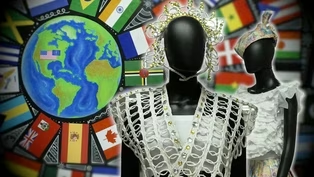
Two Minutes in Indy's Global Village Museum
Video has Closed Captions
Clip: S2026 Ep15 | 1m 56s | Can you make a dress out of toilet paper? (1m 56s)
Providing Support for PBS.org
Learn Moreabout PBS online sponsorship











Support for PBS provided by:
Across Indiana is a local public television program presented by WFYI