Prairie Yard & Garden
Inspired by Rita
Season 35 Episode 10 | 28m 45sVideo has Closed Captions
Rita Kaiser inspires people of all ages.
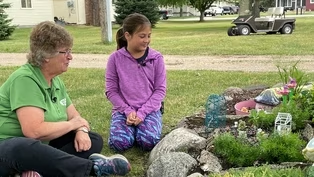
Rita Kaiser of Herman, MN has a yard that inspires people of all ages who love to drive by or stop in to visit. Her yard is decorated for each season in addition to having beautiful flower beds, pots, hanging baskets, and Fairyland for nearly 30 young people and still growing!
Problems playing video? | Closed Captioning Feedback
Problems playing video? | Closed Captioning Feedback
Prairie Yard & Garden is a local public television program presented by Pioneer PBS
Production sponsorship is provided by Shalom Hill Farm, Heartland Motor Company, North Dakota State University, Friends of Prairie Yard & Garden, and viewers like you.
Support provided by:


Prairie Yard & Garden
Inspired by Rita
Season 35 Episode 10 | 28m 45sVideo has Closed Captions
Rita Kaiser of Herman, MN has a yard that inspires people of all ages who love to drive by or stop in to visit. Her yard is decorated for each season in addition to having beautiful flower beds, pots, hanging baskets, and Fairyland for nearly 30 young people and still growing!
Problems playing video? | Closed Captioning Feedback
How to Watch Prairie Yard & Garden
Prairie Yard & Garden is available to stream on pbs.org and the free PBS App, available on iPhone, Apple TV, Android TV, Android smartphones, Amazon Fire TV, Amazon Fire Tablet, Roku, Samsung Smart TV, and Vizio.
Buy Now

Visit the Prairie Yard & Garden Website
Do you love gardening? Consider becoming a friend of Prairie Yard & Garden to support this show and receive gifts with your contribution. Visit the link below to do so or visit pioneer.org/donate.Providing Support for PBS.org
Learn Moreabout PBS online sponsorship(upbeat music) - When Tom and I had our greenhouse, we especially enjoyed having the 4-H club members come to learn about starting new plants, making terrariums, dish gardens, and planters.
After several years those kids got really good, and it was common to see a grand or reserve champion ribbon on their exhibits at the fair.
Most satisfying of all, is when those projects led to a love of gardening.
Today, we will meet someone else who inspires with plants.
Come and see what I mean.
- [Narrator] Funding for Prairie Yard & Garden is provided by Heartland Motor Company, providing service to Minnesota and the Dakotas for over 30 years in the heart of truck country.
Heartland Motor Company, we have your best interest at heart.
Farmer's Mutual Telephone Company, and Federated Telephone Cooperative, proud to be powering Acira, pioneers in bringing state-of-the-art technology to our rural communities.
Mark and Margaret Yackel-Juleen in honor of Shalom Hill Farm, a nonprofit rural education retreat center, in a beautiful prairie setting near Windom, Minnesota.
And by Friends of Prairie Yard & Garden, a community of supporters like you, who engage in the long term growth of the series.
To become a friend of Prairie Yard & Garden visit pioneer.org/pyg.
(gentle music) - [Mary] Several people told me about Rita Kaiser and her very nice yard in Herman, Minnesota.
I called Rita and went for a visit and she really does have a lovely yard.
But then, she had a young lady named Ella who was checking on her fairy garden while we were there visiting.
And between Ella and me, we convinced Rita that, yes, she should do a show with us.
Rita inspires many young people to create and enjoy their own little gardens and that is a very good story worth telling.
Thank you, Rita for letting us come to visit.
- Thank you for coming.
- Tell us, how did you get started loving plants?
- (laughs) Yeah, I think I was probably a young mom, 18 years old, and I planted a pink petunia garden.
And then in two more years I had another little girl and so I made it red and white.
Well, now you can tell, it's all colors.
(laughs) It's growing.
- [Mary] How long have you lived here?
- [Rita] We've been here for 32 years.
- [Mary] And what was the property like when you came?
- [Rita] The property was, this side was ours and then a gentleman owned this side.
The only thing that separated us and the only flower on the whole place was a huge lilac row, the whole row was lilacs.
- [Rita] How did you get started building your beds?
- [Mary] (laughs) That was the fun part.
When the lilacs were gone, the gentleman next door had asked us if we would like to purchase his property.
Why, sure, 'cause we always had a yard full of children, always.
And so we needed a bigger yard.
Well, went the lilacs.
And I said to my son, Scotty, one day, I said, "Scotty, will you go get mom some dirt?"
"What?"
And he said, "I need to make a flower garden".
And so he got rocks and rocks and he just kept bringing in more rocks.
I went out that evening and he goes, "Do you like it?"
And I looked, I said, "I love it".
"What is it mom?"
I said, "I don't know, Scotty, what is it?"
It's a Nike swish.
Nike was real popular.
And so this is my Nike swish garden.
- Well then, did he help with filling it up with plants too?
Or did you design that or how did that come about?
- I think that was kind of mine.
He was done with the dirt and the rock.
(laughs) That's where he ended.
- [Mary] He did the hard work, then.
- [Rita] He did.
- [Mary] Then did you start some of the plants yourself?
Did you buy them?
How did it get to be so beautiful?
- [Rita] It's a little bit of everybody back here.
Some is a piece of this friend.
Some is a piece from this friend.
Some friends have said, "I have some beautiful lilies.
Would you like 'em?"
I said "Yes", and so it's just growing.
- [Mary] Can we see some of your favorite plants and the inspiration behind them?
- [Rita] Sure, I'd love to show 'em to you.
(gentle music) This is the swoosh garden.
It's got a lot of stories in it.
The little yellow ones here are done blooming right now, but it's called a friendship flower.
I got it about, at least 35 years ago, from a little lady in Donnelly and she offered me a part of her plant and she brought me a little tiny milk carton, little, little pint.
And I thought, "Oh for sure, I'm gonna kill this".
But I didn't.
I love my phlox because it fills in the color.
In the spring, it's full of tulips and daisies and spring flowers.
They're gone, so we fill it with some phlox and I always put a few perennials just so it's got color.
My favorite thing in the world besides my children is color.
The little bridge here has a story.
I found it alongside the road, going to a rummage sale.
I drug it home and my husband, Pete goes, "Are you serious?"
(laughs) I said, "Yes."
So he helped me.
He is my helper.
He fixes the silly things that I drag home.
And the frogs, when they look a little sad, we get the paintbrush out and give him a little paint job.
(laughs) The cleome, when I worked in Morris with some flower people, she told me your garden is not complete until you have cleome.
- [Mary] Uh-huh.
- [Rita] She was a beautiful flower lady.
And so I always have cleome for her.
We go with all the seasons.
We start of course, with tulips and now, and then the sedum will start blooming and the mums pop through and we just love color.
- [Mary] Well, now you've got another garden that you offered to show us too.
- Sure.
(gentle music) This is my heart shaped garden and it is a memorial garden in memory of a friend.
She loved daisies and so I had lots of daisies.
But she had a lot of health problems, and so when times were tough, I'd clip a rose that I had up at the house and I'd bring it to her and we'd have a good time with the rose.
And I said to her, one day I said, "Bevvy, when you're gone, I'm gonna build you a whole rose garden."
And then I realized what my mouth just said.
And I said, "I'm so sorry."
And she laughed and she said, "That's okay."
She said, "I love it, I got something to look forward to."
So I came home, got my spade, dug out a heart shape and she got to enjoy her garden for many years.
- [Mary] Then you must have moved your roses here to this bed too.
- [Rita] I did.
- [Mary] Where do you get all of the gazing globes.
- [Rita] A little here and there.
Some garage sale, some have been Mother's Day presents.
A little bit of all.
(gentle music) - [Mary] Those chilly, autumn winds will soon give way to frigid, winter storms.
And there's nothing better to take away the cold than a good hearty soup.
And today we have a special soup for you.
One made with wild rice, harvested by the Red Lake Nation here in Minnesota.
The Red Lake Nation is the only American Indian tribe in the U.S. that grows and harvests its own wild rice on local lands.
And this wild rice is healthy.
We find ourselves in the kitchen today with our resident, chef Carole Johnson who's going to take us through a delicious recipe for wild rice soup.
Carole, how do we prepare to make this wild rice soup?
- There's always the question, the amount of liquid to the rice.
We suggest that three cups of liquid for every cup of wild rice.
- How do you know how long to cook the wild rice?
- It depends on the kind of wild rice you are using.
The quick rice will take you 25 to 30 minutes, where the longer rice will take you 45 to one hour.
- [Mary] Sounds good.
Let's get started.
And Carole, what are the ingredients?
- [Carole] The ingredients are six strips of bacon, one small onion, chopped, two cups of washed and fully cooked Red Lake Nation wild rice, three cups of chicken stock, two cans of cream of potato soup, half a cup of sliced mushrooms, two cups of half and half, two cups of shredded cheddar cheese and green onions, optional.
Fry the bacon until it's crisp, break it up.
Add the rest of the ingredients except for the half and half and the cheese.
Put it in a crock pot, a Dutch oven, a three quart sauce pan, cook it 20 to 30 minutes.
At the end of that time, add the half and half and the cheese and you will have a marvelous wild rice soup.
- To find wild rice growers in your area, go to minnesotagrown.com.
Rita, tell me about this area.
- This is the happy spot in the whole yard.
The rest of it may be beautiful, but this is the happy place.
This is what we call our fairy land.
And I started it 10 years ago with just a small area.
I had plants under here and it just wasn't happy.
And then I heard about fairy gardens from a couple friends.
Well, my little people immediately got involved and it's growing.
This year, I have 29 kids.
- [Mary] Oh my word.
So, do some of the same people come back each year?
- They really do.
Makayla was just a little girl and now she's a teenager.
So, she was only three when she started.
- How did you come up with this idea?
- I think they kind of did.
They said, can I make one?
And so they get their own little spot and it really is a children's spot.
- [Mary] Does everybody have the same spot year after year?
- [Rita] Nope, every year at the end of the year, the grandkids come and we put it all away.
They wipe it all down, it goes into the fairy shed and each year then they come one by one or two by two and they choose what they want.
First they choose their spot.
They'll tell you the whole story.
(laughs) Yeah, but they're always different.
- [Mary] Rita are these children all grandchildren that come.
- I have six of my nine grandchildren here today.
All nine of them have participated.
All nine of them have got their own spot.
The oldest being 24, (indistinct) and the rest of these are my little neighborhood kids and friends' grandchildren and we're just all one big happy fairy bunch.
- [Mary] (laughs) Well, would it be okay to visit with them individually and see their gardens?
- Absolutely, yes.
- [Mary] Tatum, tell us about your garden.
- Well, I really like to go to the lake.
I really enjoy going to the lake, so I did just a lake house on a lake with our tire swing, of course, and a little overlook of the lake.
And of course I had to put the fairy garden because we're in the fairy garden, but you gotta have a mini fairy garden in the fairy garden, of course.
- [Mary] Wow, sounds great.
Thanks for sharing.
- [Tatum] Of course.
- Ella, tell me how you made your garden here.
- Well, Didi, she needed some new bark.
So my grandma asked by my uncle's place, they had some bark, so my grandma's like, "Do you need more bark?"
So she went over and picked some and then we decided it would be really unique and different to outline it with this stuff.
- [Mary] I think that, that is just awesome.
What are some of the other things that you put in there?
- Well, my grandma had some of these pebble things, so we decided to put 'em in, to make 'em look like animals.
And we decided that there's a bunch of cute things and I wanted a forest theme.
So we decided to put these things, these little plants in, which are actually real.
So we decided that would be kind of cute for a forest theme.
- I think you did just a wonderful job and I like those ferns you put in there.
I do think they look like trees.
Thank you very, very much for showing us your garden.
- Mm-hmm, thank you.
- Kimmy, can you tell me how you decided to pick the things that you did for your garden?
- Well, I thought it'd be cute to have a little pathway from the house because it would match my rocks and I like the bridge over the pond because it looked pretty cool.
I like nature, so I put a bush in there.
- Have you done fairy gardens here before?
- No, this is my first time.
- [Mary] It is?
You did a fabulous job.
How did you pick those plants or did you get some help to do that?
- [Kimmy] I got some help.
- [Mary] Oh, well I think you did a marvelous job.
Thank you for showing it to us.
- [Kimmy] Yeah.
- Kaden, tell me about your space here.
- I actually decided to get these rocks 'cause I like white on the bottom and I just like that color.
And then I put a bridge in there and then a river.
So, 'cause it's a kind of a little campground area.
And then I actually went out and bought these succulents with me, my mom and my grandma.
And I also put a gnome up on top 'cause he's looking at everything on top and then I also put an outhouse 'cause there's no bathrooms in there.
- [Mary] (laughs) Do you like to go camping or anything?
- [Kaden] Oh yeah, I do.
- [Mary] So, would you consider yours a fairy garden or would you consider it just something else?
- [Kaden] I would consider it as kind of both.
Like it's in a fairy garden area and there's no really fairies in it.
So, it's just somewhere I'd like to go.
- Well, thank you so much for showing us your garden.
- [Kaden] Thank you.
- Izzy, how old are you?
You're four.
Did you make a garden here too?
Is this yours here?
- Yeah.
- [Mary] It's beautiful.
Did you make that by yourself or did grandma help too?
- [Izzy] Grandma helped me.
- [Mary] Do you like the color pink?
I kind of thought that 'cause it looks like you used pink in your garden, huh?
- Yeah.
- It's really, really nice.
You guys did a beautiful job.
- [Izzy] Yeah, we did.
- Thank you so much for showing it to me.
- You're welcome.
- Hailey, was this tire here when you made your garden?
- Yes, it was here before and it was a little bit more darker green, but then my grandma spray painted it, so then it kind of matched these chairs.
- [Mary] Well, that is awesome.
Do you, by any chance, like to go to the lake or anything?
- [Hailey] Yeah, I really like to go to the lake.
We go there mostly every weekend.
- [Mary] Ah, and so did that kind of inspire you to make your area?
- [Hailey] Yeah, cause it's not, the tire isn't, it doesn't make it too big, but it doesn't make it too small, So it's like perfect size.
- [Mary] I think it's wonderful.
And I just get such a kick out of the goggles (both chuckle) on these little guys.
Then do you put your name on each garden or does Rita do that or how does that happen?
- [Hailey] She did mine before, but then she wanted us all to write it, so then I wrote mine.
- Well, you did a wonderful job.
- Thank you.
- [Mary] And I really like your garden too.
- Thank you.
- Makayla, tell me about your fairy garden area.
- So I just kind of picked this area because it was just a little open spot and I liked that little tree thingy there.
So I just kind of decided I'd just go right here.
- [Mary] Did you plant these plants or were they here?
- [Makayla] These plants were here, but I had to move some of 'em, so I could put this little alligator pond here.
(both laugh) - [Mary] You had to show stuff a little.
Wow, and so then is that kind of a little trail going up to another house?
- [Makayla] Yeah, this is the walkway that goes from the house to down here and it kind of goes to the alligator pond and I just picked that color 'cause I liked how bright it was.
- [Mary] And I think it really brightens the area too.
I think you did a great job.
- Thank you.
- So do you like dragons too?
- Well, I just thought it was a little cute thing to add up to there and it kind of matches my shirt.
(both laugh) - [Mary] I love it.
Cool.
- [Makayla] Thank you.
- Anna, tell me about your fairy garden area.
- This was my great grandma's bird bath.
So I use that every year and then I always make it into a place that I would wanna go to.
- [Mary] Well, it looks like it maybe got broken so you didn't even have to throw it away.
- [Anna] Yeah.
- Oh.
Are there certain rules when it comes to fairy land?
- Yes.
There are three rules.
Number one is don't step on the rocks.
Number two is don't take anyone else's stuff and put it in yours, and number three is be happy.
- [Mary] I love those rules.
- Me too.
- [Mary] Thank you for sharing your area.
- [Anna] Thank you.
- Mine's just a little log.
It's nothing big, but it's just small and cute, I thought.
- [Mary] I think it's really nice.
Did you actually make the log?
- [Jadyn] No, I didn't, it was just laying there.
So I kind of decided to put stuff in it and do mine there.
- [Mary] So, did you pick these things yourself?
- [Jadyn] Yeah, I did.
My friend helped me.
- [Mary] I love how it matches.
- [Jadyn] Yeah, it's really nice.
- [Mary] And did you put it in that spot too?
- It was a little close.
It was like right here, so I just backed it up, 'cause then if someone wanted a space, it wouldn't be so weirdly laid out, I guess.
So yeah.
- [Mary] It looks perfect right where you put it.
- Thank you.
- [Mary] Thank for showing us.
- [Jadyn] Thanks for having me.
(gentle music) - I have a question.
Are there any carnivorous plants in Minnesota?
- There are carnivorous plants in Minnesota.
There's another group of plants that most people have no idea we have in Minnesota.
But we have quite a few species, several of them listed and so we're working on the conservation of those as well.
Carnivorous plant is a plant that eats meat and specifically that meat that it eats is not people and not even small mammals, but insects.
Like orchids, a lot of carnivorous plants are hard to find though because they're in really hard to access locations.
They're really common.
Once you get out to a place where you find some purple pitcher plants or some sundews, you'll see 'em all over the place.
But what we have here is a purple pitcher plant with a spent flower for the season.
These are very beautiful.
They're called purple because as you can see, they're turning purple for the fall.
They turn this brilliant purple color, very beautiful.
And we have sundews.
Both of these are carnivorous plants, and these are the ones that are gonna be most easily accessible to most people that want to find them out in the wild.
Pitchers collect water from the rain and insects will fall into that pitcher and essentially drown and be consumed by the plant.
And the sundews have little sticky hairs where insects get caught in the little sticky hairs and the leaves curl up around the insects and they consume, slowly consume the insect.
Don't expect them to wipe out all the insects in your home, but they will do a pretty good job.
And they don't really need much care besides watering.
- [Narrator] Ask the Arboretum Experts has been brought to you by, the Minnesota Landscape Arboretum in Chaska, dedicated to enriching lives through the appreciation and knowledge of plants.
- [Mary] Rita, I love all of the decorating that you do here in your yard.
- Thank you.
We decorate all year long.
(laughs) We decorate now for 4th of July because that was just this past weekend.
And then we'll wait until summer, we have a lot of summer things that will come out.
The 4th goes away and then we go into fall.
It turns all into harvest and thankful we go.
Then of course the fairies even get put away and it turns into pumpkin land.
- Well, I love these hanging baskets.
What are these.
- [Rita] They're weekenders, and I ordered them online.
They're called weekenders, I think, because you can water 'em.
They hold the base of water about a good two, three inches under here.
It has a piece of felt that brings the water up and it keeps your soil moist.
- [Mary] Do you do the same color scheme every year?
- [Rita] (laughs) No, I love color.
And so it's like my daughter and I, we go to the floral shop when we get started and we just put, put, put, put.
And then I get out to my shed, and again, you just put, put, put into the planters.
I love the grasses because it goes into fall.
And when these are gone, you can add some fall objects and it just kind of makes it cheerful all year long, all season.
- [Mary] We saw you had a gazebo too.
Do you use the same colors there as you do in the rest of the yard?
- [Rita] No, we really don't have a routine.
Whatever pops in, it goes.
Sometimes it's decorated like a little children's place to be.
The kids call it their dance hall and we just change it.
- [Mary] Well, when we came, I saw some other pots that were just beautiful, on the other side of the house.
Could we go see those too?
- Sure.
Now we're at the front of the house, Mary, and here's where I put my glazed pots.
That gets a lot of hot sun here.
And so I put 'em in this kind of a pot because they stay cooler, and I do use a variety and it's always different.
- [Mary] It really brightens up this corner.
I like like how it softens this too, and loads of color.
Well, I saw more when we came in.
Can we go see those too?
- [Rita] Let's do it.
- [Mary] Rita, you have so many beautiful containers.
How in the world do you move these things?
- [Rita] (laughs) You wiggle and you jiggle and you bend over and then you can slide 'em under the golf cart and away you go to the shed to get 'em cleaned up.
- [Mary] So you actually put 'em away then, for the wintertime?
- [Rita] Yes, it's good if you wash your pots out and keep 'em clean before you start again next season.
- [Mary] Okay, well between the fairy garden products and your planters, where do you put everything?
- [Rita] Well, in the back we have a shed called the put in shed, that's where we put it.
(both laugh) - [Mary] Gee, how does it get its name?
- [Rita] It natural.
- [Mary] And then you've got other pots too, all around your house.
How long does it take you to water?
- [Rita] Watering sometimes is a good thing because you actually pay attention to your plants.
You get to visit with the people driving by on the street.
That's the fun part about being in the back garden.
You're visiting with the people visiting and before you know it, your job is done.
- [Mary] Well, that's what I was gonna ask.
You inspire the children.
- [Rita] I love them.
- [Mary] You have so many beautiful planters and perennials.
Do people come and just sit in your yard or come and visit with you?
- [Rita] We do.
That is a really good question.
Because you know, we have the alley back there and just last week, a gal drove by and she accidentally had two pieces of lemon pie.
(both laugh) So we sat on the bench and had the lemon pie.
A lot of conversation, tears, laughter, sharing on the bench back there, yeah.
- [Mary] So you inspire your neighbors and a lot of people in town too.
- [Rita] They inspire me more.
(laughs) Yes.
- [Mary] I wanna thank you so much for letting us come and see your beautiful yard, see everything you do with the children, and it's just been wonderful.
- [Rita] Thank you.
Thank you so much.
I know the children enjoyed it.
I was scared, not gonna kid you, but thank you for coming.
(gentle music) - [Narrator] Funding for Prairie Yard & Garden is provided by Heartland Motor Company, providing service to Minnesota and the Dakotas for over 30 years in the heart of truck country.
Heartland Motor Company, we have your best interest at heart.
Farmer's Mutual Telephone Company and Federated Telephone Cooperative, proud to be powering Acira, pioneers in bringing state-of-the art technology to our rural communities.
Mark and Margaret Yackel-Juleen, in honor of Shalom Hill Farm, a nonprofit rural education retreat center in a beautiful prairie setting near Windom, Minnesota.
And by Friends of Prairie Yard & Garden, community of supporters like you who engage in the long term growth of the series.
To become a friend of Prairie Yard & Garden visit pioneer.org/pyg.
(gentle music)
Providing Support for PBS.org
Learn Moreabout PBS online sponsorship

- Home and How To

Hit the road in a classic car for a tour through Great Britain with two antiques experts.












Support for PBS provided by:
Prairie Yard & Garden is a local public television program presented by Pioneer PBS
Production sponsorship is provided by Shalom Hill Farm, Heartland Motor Company, North Dakota State University, Friends of Prairie Yard & Garden, and viewers like you.