
Ireland Made with Love: Shaped by Tradition
9/9/2026 | 24m 59sVideo has Closed Captions
From wool weaving to crystal engraving, Irish artisans preserve tradition that shapes their country.
In Ireland Made with Love: Shaped by Tradition, discover artisans keeping heritage alive—from weavers and hurley makers to crystal engravers. Alongside craft, taste Ireland through beer and the country’s best cuisine, shaped by land, legacy, and love.
Problems playing video? | Closed Captioning Feedback
Problems playing video? | Closed Captioning Feedback
Support provided by:

Ireland Made with Love: Shaped by Tradition
9/9/2026 | 24m 59sVideo has Closed Captions
In Ireland Made with Love: Shaped by Tradition, discover artisans keeping heritage alive—from weavers and hurley makers to crystal engravers. Alongside craft, taste Ireland through beer and the country’s best cuisine, shaped by land, legacy, and love.
Problems playing video? | Closed Captioning Feedback
Where to Watch Made With Love
Made With Love is available to stream on pbs.org and the PBS app.
Buy Now
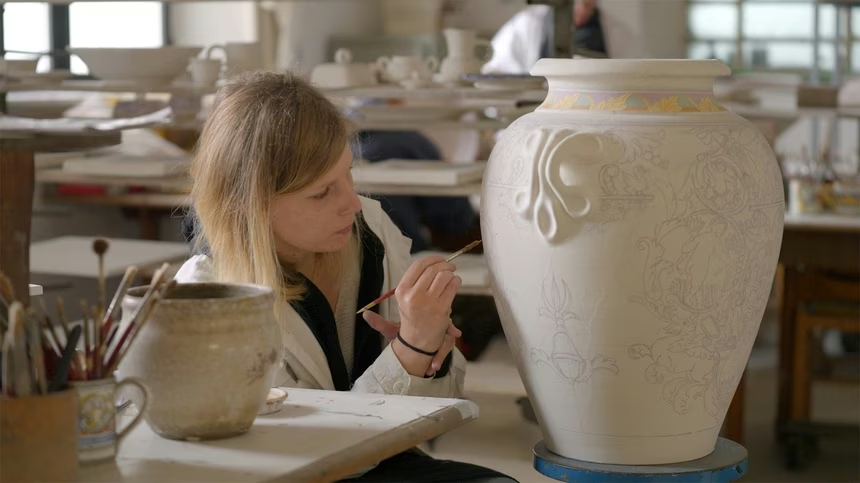
Made With Love
Made with Love celebrates the artisans keeping age-old traditions alive — an intimate journey into their workshops, kitchens, and the passionate hands behind extraordinary craft. Without them, a piece of our shared heritage would be lost.Providing Support for PBS.org
Learn Moreabout PBS online sponsorship♪ Narrator: Ireland.
It's a land of mythic beauty that shape the imaginations of artisans for generations.
From an artisan crafting ceramics with materials from the land to a sixth generation family run woolen mill, carrying on centuries-old traditions.
Woman: If we cease doing what we're doing, we lose a key part of Irish culture.
Man: It's a great place if you're creative.
Narrator: Discover the heritage of these master craftsmen and the legacy shaped with their hearts and with their hands, in "Ireland Made with Love."
there are close ties between where people live and what they create.
Nowhere is that more true than in the county of Kilkenny, which sits along the banks of the River Barrow.
It's the longest of Ireland's 3 sister rivers and winds through towns that trace their roots to medieval times, including the town of Graiguenamanagh.
Woman 4: It's a beautiful, kind of hidden, secret town.
The name itself, Graiguenamanagh, in Irish, it's Graig na Manach, which translates to "village of the monks."
Monks established the town here in 1204.
The monks, they were very religious people, but they were also very industrious.
Narrator: Cistercian monks chose this spot for its proximity to the river.
It gave them a steady water supply and the ability to trade goods with the rest of Europe.
Miriam: Ireland was known for its high-quality fleece and wool, so that was a big commodity at the time.
Narrator: Centuries later, wool and weaving are still an integral part of the local culture.
Miriam: I'm Miriam Cushen.
My name is Philip Cushen.
I'm a woolen manufacturer... From Graiguenamanagh, Ireland.
I am with my dad, the current custodian of our family business here in Graiguenamanagh.
So it's a woolen mill, and we make beautiful blankets, throws from lovely natural yarns.
Our family traces back to 1778, so I'm sixth generation of the family, but I'm the first woman at the helm.
Dad has been working in the mill since he was 16.
He took over from his father.
So Dad is still working with us, doing what he loves.
Narrator: Today, their textile mill sits on the same site where the monks had a mill and relies on the same water source... [Birds chirp] among the cleanest in Ireland.
Philip: It's ideal for dyeing.
We can get colors that most people have difficulty in getting because the quality of the water is so good.
Miriam: It's a very special part of what it is that we do.
Narrator: Their blankets start with wool from local Galway sheep, the only breed of native Irish sheep.
Miriam: We're working with amazing partner farmers that breed them, and we get to know them all very personally, visiting their farms, meeting their sheep, and collecting the fleece.
Narrator: Once the wool reaches the mill, it's hand-sorted and dyed into 13 colors.
These colors are then blended to create a range of different shades.
Miriam: So we dye it into really vibrant green, red, yellow, purple, black, and essentially that becomes our painting palette.
Narrator: The wool fibers are then put through the carding machine, where they're combed and aligned.
From there, the wool is spun into yarn at the "spinning mule," a vintage machine that pulls and twists the fibers to make them stronger.
[Clanking] This mule was built in 1890.
Philip: The mule is the oldest machine that we have.
My grandfather bought it from a mill which was closing down.
Miriam: It's a very mechanical, beautiful machine, and it's one of the last of its kind in Ireland.
When people see it, they think it's a museum piece, but it's not.
It's fully operational.
Narrator: Philip watches closely, correcting any mistakes as the mule spins and wraps the wool into yarn.
Philip: If you don't look after the little things, they become big problems, and if you don't deal with it, it will come back to haunt you.
Miriam: I love seeing and learning from my father, seeing the love that he has for what he does.
Narrator: Next comes warping.
The yarn is wound onto a large wheel, then wrapped around a warping beam.
This creates the blanket's vertical threads.
Miriam: I actually run that process.
That's one of the first stages of actually bringing it to life.
Narrator: After warping comes weaving.
Strands of wool are threaded in horizontally to finish off the fabric and make it stronger, then the newly created textile goes to the workroom, where it's carefully checked and mended to ensure the highest quality.
Miriam, voice-over: So we check for any flaws, any knots, mending all of that out.
Narrator: Over the next 4 days, the blanket goes through a finishing process that makes the fabric softer and stronger.
Miriam: And then eventually, it comes back up to the workroom, and that's where we hand-cut, hand-finish, do more quality checks.
Narrator: It can take up to 6 weeks to make a blanket, from initial design to final product, but there's no way to measure all the love and care that goes into each one.
Miriam, voice-over: For us, we've only a team of 10 here, but every member of the team touches that blanket numerous times in its journey.
So, if you have thought about it and love it yourself, then other people will see the love and the passion in what you've made.
Philip: I've always had a passion for it.
I like the machine.
I like the designing, as well.
Miriam: If we cease doing what we're doing, we lose a key part of Irish culture.
We're really passionate about sustaining those skills, sustaining that heritage.
♪ Narrator: Here in Kilkenny, few things stir passions like watching the local team play Ireland's native sport, hurling.
[Stadium announcer shouts indistinctly] Narrator: This fast-paced game looks like a mix of baseball and lacrosse.
Announcer: Here comes another goal!
Brilliant, Kilkenny!
Narrator: For some, it's more than a sport.
It's a way of life.
Narrator: Played with a ball, or sliotar, and a wooden stick with a wide oval end, called a hurl, the sport of hurling dates back some 3,000 years.
It's the oldest and fastest field sport in the world and as popular as ever in Ireland today.
Announcer: And a cranking shot!
Narrator: For brothers David and Stephen Dowling, their love of hurling and the art of making traditional wooden hurls by hand has been part of their family for 4 generations.
David: Our great-grandfather made hurls back in the early 1900s.
Narrator: Relatives on both sides of the family played here in Kilkenny, so you might say the sport is in their DNA.
It's literally-- it's kind of in your blood.
Narrator: The brothers now run a company started by their grandfather, one that makes high-quality hurls by hand.
[Scraping] Today, they're making a hurl for T.J.
Reid, one of Ireland's top players and star of their home team of Kilkenny.
Stephen: T.J.
Reid is probably one of the greatest hurlers in Ireland at the moment and, uh, probably one of Kilkenny's best ever as well.
Narrator: Like every hurl they produce, this one will be custom-made, according to the shape and weight that best suits the player.
The first step is choosing the right plank of Irish ash.
If you can imagine an ash tree standing in a-- in a forest or in a wood, we're looking for the root of the ash tree.
You're looking for this turn, so the shape of your hurl will match that.
Narrator: David selects a plank of ash with the curve at the "bas," or head, of the hurl.
♪ Next, he uses a template to trace the shape of the hurl best-suited for T.J.
Reid.
David: It's the type of hurl he wants, it's the shape, so what I'm doing is I'm marking that onto a piece of ash.
He likes it without any flexibility.
A "stiff hurl" is what we call it.
Thank you.
There it is.
All right.
Narrator: From there, their uncle Brian cuts the basic shape, making sure the arm remains perfectly straight... and checking for any flaws in the ash.
David: You could saw the hurl out, and there could end up being maybe a knot in it or something like that, so it should be a weak point.
Something like that, you could start from scratch again, really, yeah.
Narrator: The hurl is then turned on a lathe to give the handle its rounded shape.
At the heart of every handmade hurl is the process known as "spokeshaving."
Using a hand plane, the brothers make careful adjustments to each part of the hurl-- shaving, straightening, sanding, and smoothing-- until they get it just right, the same techniques and tools used by their great-grandfather back in the early 1900s.
David: I'm doing it, you know, 20 years now, so you kind of run on autopilot a little bit.
But at the start, doing this, you'd be, yeah, you'd be kinda shaking a bit, yeah.
Heh heh!
Yeah.
Narrator: Steel bands added to the rounded end or "bas" of the stick give it extra strength.
Stephen, voice-over: T.J.
likes his own shape and two bands on it and everything, so hopefully he likes it now--heh!--- but I think it should do him.
Narrator: And the Star Hurley stamp, the mark of one of the only places in Ireland that still makes hurls by hand.
For the brothers and the community, it's an enormous sense of pride.
David: You know, you're at matches and you're watching matches on TV, and he's using your hurl, you know.
It's great.
There's satisfaction in that.
That kind of thing, that'll make you very happy, making that kind of stuff, yeah.
♪ Narrator: County Waterford.
This one-time Viking outpost has often found itself on the leading edge of Irish culture.
It's home to Ireland's first city, the first place to fly the Irish tricolor flag, and the first to celebrate St.
Patrick's Day in Ireland.
It's also the home of Ireland's world-renowned hand-cut crystal.
The glass-cutting tradition here dates back to the 18th century, and for good reason.
Man: It's a beautiful area to live in.
We have the sea, we have the mountains, we have everything on our doorstep.
It's a great place if you are creative because you have everything around you to look at.
Is mise Eamonn Terry, máistir gearrthóir gloine.
Augus Cearbhall Terry, gearrthóir gloine.
Narrator: From his family-run workshop in the Waterford town of An Rinn, master glass cutter Eamonn Terry and his son, Cearbhall, create breathtaking crystal pieces.
Eamonn: What we are trying to do is tell a story with each design that we make on the piece of crystal.
So we use our language, our landscape, our history, and incorporate those into new designs.
I like doing things with my hands, and there's a great sense of satisfaction in creating something.
Narrator: Eamonn's passion for glass work started 50 years ago, when he became a glass cutter at the world-famous Waterford Crystal.
It took another 10 years of training, apprenticeships, and exams before Eamonn earned the title of "master glass cutter."
Eamonn: This is the bowl that I qualified on to become a glass cutter.
You were examined on this bowl by your peers.
If I wasn't able to do this, I wouldn't be able to create all the other things that I have.
That's a precious piece of, uh, glass, or crystal.
Narrator: Now, Eamonn is one of only a few artisans left in Ireland who still cut glass in the traditional way.
Eamonn: You probably could count them on your two hands.
Narrator: Today, he's making a crystal decanter with a modern design inspired by the letters of Ogham, an ancient Irish alphabet.
He marks the glass with the vertical lines that will guide him as he makes each cut.
Eamonn: I do more traditional-type cutting, but I also do the more contemporary-type glass now.
Narrator: At the cutting station, he uses a diamond-coated wheel to help him make smooth, precise cuts.
Eamonn: In my armory, I would have over 200 different wheels for doing different cuts on different pieces of crystal.
If you pick the wrong wheel, you're going to make a mess of the glass.
Narrator: Just as important as the wheel is the deftness of his hands.
Eamonn: It's fairly tricky cutting into a bottle like this.
I have to be very careful that I don't make the cuts too heavy or too light.
That only comes with experience.
You get the feel of what you're doing.
That's the hard part.
Narrator: Water cools the crystal to keep it from overheating and breaking.
Eamonn: We're nearly halfway around the decanter already.
My favorite part is on the cutting wheel, actually creating.
If I've made up a design, to see how it goes from the very start to the finish, and then, when I have the finished product, to see what I've achieved, there's a great sense of satisfaction.
Yeah, very happy with it.
Yup, that's ready now.
All it needs then is a good whiskey.
Heh!
Crystal is meant to be used.
Think now, the younger generation are falling in love with crystal again.
I don't consider it a job.
I would work every day because I love what I do.
Narrator: A love of crystal and a cherished Irish tradition Eamonn is passing to the next generation.
Cearbhall, voice-over: I think I was 12 years old when I cut my first piece of glass, and he gave me the apprentice entrance exam, so I'm well-trained in at this stage.
It's nice that if you create something, that it just doesn't stop with you when you are finished.
I would hope that what we've built up over the last number of years will continue.
Narrator: In northeastern Ireland lies the gentle county of Monaghan, known for its little hills, or, as we Irish call them, "drumlins."
Woman: It's Drumlin County, and it's always kind of likened to a basket of eggs.
They say it makes you curious, you know, what's over that hill?
[Laughing] Another hill, so, kind of makes curious people.
Man: We always have this saying that there was too much land in Monaghan, so they stacked it high.
I'm Seamus McMahon.
I'm a craft brewer from County Monaghan here in Ireland.
Narrator: Seamus grew up on this dairy farm, one of many that dot the agricultural region.
Seamus: My father inherited the farm from his father, who inherited from his father, so we're probably 10th-generation McMahons here.
Narrator: While drinking a craft beer for the first time with his wife Siobhan, he decided to expand the dairy farm and open a brewery.
They named their brewhouse for the medieval "Brehon Laws" that once ruled Ireland and allowed every clan to brew beer for their own family.
♪ Seamus and the team brew everything from stouts and lagers to IPAs.
Today, they're making a traditional Irish red ale called Killanny Red, named for the parish that surrounds the farm.
The process starts with crushed barley that's loaded into the hopper.
Seamus: We use barley, we use water, we use yeast, and we use a lot of time, and they're the 4 ingredients that microbreweries use.
Narrator: It's how these 4 ingredients are combined and treated that makes each of their beers unique.
The barley mixes with the water in the mash tun.
This process extracts the sugar, which is called "wort."
It is then transferred to a copper kettle for boiling.
Seamus, voice-over: And then we add the hops.
So the hops give you preservation and give you flavor.
Narrator: Once the beer is cooled and reaches the fermenter, yeast eats the sugar and converts it into alcohol.
And I suppose the magic ingredient then is time.
It's a slow process, but produced in a sustainable way.
We don't use any artificial flavors or preservatives.
We just use a lot of craft and time.
Narrator: The entire brewing process-- barley to beer-- can take up to 6 weeks.
Any extra barley, they feed to the dairy cows.
They even bottle their beer on site.
Seamus and Siobhan hope their love of craft-brewing will lead to a new family tradition.
Seamus: She has just recently got engaged to Jim.
In a roundabout way, we've dragged a brewer back to the farm, yeah.
I can do it all from the stone's throw from my house.
You know, you still have time for your family.
Have a cup of tea any time of the day, you can have a drink any time of the night.
It's quite relaxing.
It's quite an easy team.
It's how good beer should be made, I think.
[Birds chirp] Narrator: The quaint market towns of County Monaghan are home to a growing community of artisans.
They carry on age-old traditions and make the most of what the land has to offer.
I'm Brenda McGinn, and I'm a ceramicist from Monaghan, Ireland.
Narrator: From her studio in the 19th-century mill village of Glaslough, Brenda spends most of her days creating ceramic pieces that she sells in her shop, passing along her love of the craft.
Brenda: I think it's in us all to create, you know?
It's just a little bit of discipline.
Every person who makes something, they are actually making part of themselves, and it's magic.
Narrator: Brenda grew up in a family of academics and broke the mold when she wanted to study art.
She started as a painter at Ulster University in Belfast, then switched to ceramics by year two.
Brenda: The first day I went in, it was just, like, clay everywhere, kind of just grew on me.
Narrator: Pottery soon became her passion and her career.
It has challenged her to be both artistic and practical.
Brenda: No fuss, like our ancestors.
They needed the clay to do a certain job.
It didn't have to be fancy, it was just what it was, and that's kind of where I'm coming from.
I like the simplicity of it.
Narrator: Pottery in Ireland dates back over 6,000 years, but it wasn't until the 13th century that Anglo-Normans first brought over the potter's wheel.
The process and materials haven't changed much over time.
Brenda is always on the lookout for local ingredients, from the organic clay to the powder for the glaze to the hand-picked plants she uses for decoration.
She draws her inspiration from the serenity of the land.
Brenda: When I'm doing the decoration and the painting, I'll just take a whole day.
I'll go into my studio and close the door, and I don't play music and it's just quiet, and that's me in my happy place.
It's just a love affair.
It's like an indulgence.
I swear, I--I feel like there's someone giving me a chance to do all this is just a miracle.
Narrator: A love of the craft, and of clay, that might just live in each of us.
Brenda: So Patrick Kavanagh's a famous poet from Monaghan, and one of the lines in his poem is, "We are all creatures made of clay."
So I just think, yeah, clay is definitely in our DNA.
There is just a resonance that I feel when I'm in a restaurant, and it's a handmade something... and the bread is on something full of history.
You can actually feel it.
♪ Narrator: Just up the road is Castle Leslie Estate.
It's one of the last Irish castles still owned by its original family.
Over the years, this 17th-century palace has lured politicians and poets to relax and unwind.
The other reason people come here is the food.
Today, Aaron Duffy is preparing a gin-cured sea trout dish that relies on local ingredients.
Aaron: We use it for different dishes, and that just works beautifully with the light, delicate flavors of the sea trout and the mackerel.
To add that smokey flavor, we're going to just torch the skin ever so slightly, and you'll see it starting to rise.
That'll just firm up the textures of it.
Ireland is, yes, a small country in some aspects, but there are so many different producers.
We use as many local producers as we can.
Narrator: Pickled mackerel and sea vegetables from the Irish coast, herbs and flowers from their gardens, and the final touches-- avocado purée and oil infused with their own garlic.
♪ Aaron: It's all about letting everything speak for itself on the plate.
Everything's just nicely balanced and spread out.
Narrator: A culinary feast that tastes even better on one of Brenda McGinn's handmade plates.
Narrator: In Ireland.
It's the connection between the people, their land and their traditions that drives these artisans.
Miriam; We're really passionate about sustaining that heritage.
You're sending that kind of love and passion all over the world.
That passion has led to the creation of some modern masterpieces, as they share traditions of this Emerald Isle with the next generation.
♪
 New Season
 Recently Added
- Drama

Lesley Manville and Tim McMullan return in the final installment of the Susan Ryeland mysteries.

 New Episode

 New Episode






Support for PBS provided by: