
Italy Made with Love: Tuscan Traditions
6/25/2026 | 25m 41sVideo has Closed Captions
In Tuscany, generations of artisans preserve beauty through meticulous craft.
Italy Made with Love: Tuscan Traditions explores refined crafts passed through generations. In Tuscany, a pursemaker shapes fine leather, a goldsmith creates intricate works, a perfumer blends rare scents, and hatmakers weave elegant straw. Together, they reflect a balance of heritage, innovation, and enduring artistry shaped by patience, skill, and tradition.
Problems playing video? | Closed Captioning Feedback
Problems playing video? | Closed Captioning Feedback
Support provided by:

Italy Made with Love: Tuscan Traditions
6/25/2026 | 25m 41sVideo has Closed Captions
Italy Made with Love: Tuscan Traditions explores refined crafts passed through generations. In Tuscany, a pursemaker shapes fine leather, a goldsmith creates intricate works, a perfumer blends rare scents, and hatmakers weave elegant straw. Together, they reflect a balance of heritage, innovation, and enduring artistry shaped by patience, skill, and tradition.
Problems playing video? | Closed Captioning Feedback
Where to Watch Made With Love
Made With Love is available to stream on pbs.org and the PBS app.
Buy Now
Made With Love
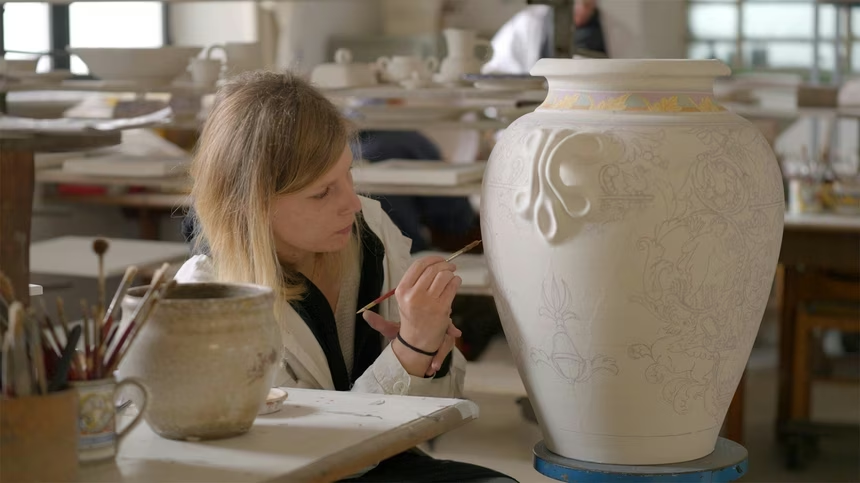
Made with Love celebrates the artisans keeping age-old traditions alive — an intimate journey into their workshops, kitchens, and the passionate hands behind extraordinary craft. Without them, a piece of our shared heritage would be lost.Providing Support for PBS.org
Learn Moreabout PBS online sponsorshipNarrator: Tuscany is known for its timeless architecture and legendary vistas but the secret behind the region's soul is in the quiet passion of its artisans.
Step inside the workshop of pursemakers carrying on a renowned Italian tradition.
And a family that's passing on hatmaking to the next generation.
Giuseppe: You don't need just years, but generations.
It's in our blood.
Narrator: From sweet smelling scents to delicate gold jewelry, learn the secrets behind Italy's master craftsmanship in "Italy Made with Love."
Narrator: For centuries, Tuscany's leather makers have worked at the crossroads of art and commerce.
Today, leather is still big business here.
While many products are now factory-made, Tuscany still has some small leather shops, bringing their artistic sensibility and personal touch to everything they create.
That includes a classic Italian accessory-- the purse.
[Woman speaking Italian] Narrator: Viviana's experience with making purses and other leather goods goes back more than 40 years.
[Filing] Narrator: Viviana works here with her husband, Francesco Venturi, who starts by cutting the leather.
Then Viviana uses a model that's built to show exactly where to fold, where to stitch, and how to put it all together.
She adds a special glue ... And uses a hammer to make sure the glue will stick.
[Tapping] It's a process that hasn't changed much since the 1920s, when her father worked in the Florence workshop of leather artisan and fashion designer Guccio Gucci.
Yes, that Gucci.
In the mid-1960s, her parents opened their own workshop in Florence, which she took over and someday hopes to pass on to her own son Leonardo.
Leonardo: I'm gonna making a strap of the bag we preparing now.
I have to cut the leather, then I have to glue it.
And then I have to paint by hand the borders.
Narrator: Leonardo uses a special paint, which is designed to adhere to leather.
It's not as easy as it looks.
He'll need to apply the glue carefully, otherwise it won't be even and smooth.
Like his mother before him, working with leather is more than a job-- it's a calling.
Leonardo: I'm proud to work here because this is my family business from 1965.
So, 55 years this company is open.
And I think it's a beautiful thing.
Narrator: The Italian tradition of purse-making goes back hundreds of years.
Modern purses were inspired by bags made as far back as the 12th century.
They were used to hold money and personal items, just like today.
[Sewing machine running] And while styles have changed over the years, one thing has stayed the same.
[Leonardo speaking Italian] Narrator: It can take up to 20 days to finish a new purse, with each one inspected and finished by hand.
[Viviana speaking Italian] Leonardo: Is a beautiful work because we use the hand, we use the heart, we use the creativity.
I made this work with love and I'm proud about this.
[Viviana speaking Italian] [Bell tolling] [Hammering] [Fire crackling] Narrator: The goldsmithing tradition in Tuscany goes back to the Etruscan Age, and it was very popular during the Renaissance.
In those days, fine pieces of jewelry were collected and highly-prized, as worthy of admiration as the works of painters, sculptors and architects.
During the Renaissance, the Medicis, who created their own bank, were avid collectors of gold pieces and even created a goldsmith and jeweler's row on the Ponte Vecchio.
[Tapping] I am Paolo Penko.
I am goldsmith in Florence.
And this is Furino.
[Paolo speaking Italian] Narrator: Paolo picked up the art of being a goldsmith from his father, but he also took his craft to the next level by studying at a local art institute.
That's when he first laid eyes on his wife and creative partner, Beatrice.
[Paolo speaking Italian] Narrator: Today, Paolo Penko is both a master artisan in his own right and a teacher for a new generation of goldsmiths.
Riccardo: It's very beautiful to work with your family, even if we sometimes don't separate the work with private life, we at least try to do our best.
Narrator: Brothers Alessandro and Riccardo have been working in the shop since they were old enough to walk, and their interest in making jewelry grew naturally out of watching their parents work.
[Speaking Italian] Narrator: Riccardo's work has gotten more polished since then.
Today, he works side by side with his parents and his brother making pieces that even the Medicis would envy.
It all starts with a base of gold, and then they add anything from diamonds to rubies, topaz to turquoise to create visions of opulence that evoke the Italy of old.
[Riccardo speaking Italian] Narrator: Today, they're working on a piece that should be familiar to art lovers everywhere ... A necklace based on "La Primavera," a painting from legendary Florentine artist Sandro Botticelli.
[Riccardo speaking Italian] Narrator: They start by heating a piece of gold plate.
They warm it up and then cool it off quickly... which makes the gold easy to shape.
[Riccardo speaking Italian] Narrator: When the gold is thin enough, they start to etch in the pattern.
[Tapping] [Sawing] Riccardo: In our shop, we realize our creation only with traditional techniques, but we also want to combine tradition with innovation.
And it's made with bullion and casella and it create a beautiful texture on our jewel.
Narrator: These thin pieces of gold can easily tear or become misshapen -- so any wrong move can mean redoing hours of work.
Next they separate the gold into different parts and hammer them out to shape them even further.
Riccardo: Last, we combine all the pieces, and we put the stone on the jewel.
And then we polish it and the jewel is finished.
Narrator: The final result is a very modern work of art, one that serves as a bridge between Tuscany's legendary past and its present.
[Speaking Italian] [Paolo speaking Italian] Narrator: The most satisfying part of the job, however, is doing it with the people they love.
Riccardo: Family is a rock, and you can always count on them.
I think to be very lucky to work with my family.
[Speaking Italian] Riccardo: Of course, I'm very proud to continue this tradition, the tradition of my father and of my great father.
And I feel very lucky to do something that I love.
Tuscany can be a feast for the senses, from the tastes of its classic dishes to the sight of its gently rolling hills, but one of the best ways to experience it... [Clink] is through your nose.
From the smell of its fresh olive oil to the salty odor of the sea breeze, scents are a direct pathway to our brains, stirring emotions like happiness or excitement, imprinting memories that last a lifetime.
It takes an elite group of artists to harness these gentle bouquets, creating aromas that empower, seduce, and transport us and capturing them in a bottle.
They are perfume makers.
Woman: I am Francesca de Massimo, the owner of Spezierie Palazzo Vecchio, and I'm responsible for the brand.
Narrator: Designing a new perfume can take weeks of trial and error.
Francesca is also trying to uncover powerful new fragrances, using dozens of ingredients, from flowery notes to earthly accents.
At times, she relies on her father Giovanni, a famous pharmacist and natural herbalist, who started this company decades ago, as well as some secret recipes.
Francesca: I'm starting a formulation of a new perfume.
I want to re-create what is in my mind, what I have written down in terms of how many drops of each ingredient I would like to be in this formula, in this perfume, this fragrance.
Narrator: Some common natural ingredients she might put into a new perfume include essential oils extracted from spices, flowers, leaves, and woods.
Francesca: When you want to create perfume, you have to study all the raw materials-- not all of them, but hundreds of them.
And you have to memorize them because to create a perfume, you need to imagine it in your mind.
And if you haven't memorized the raw materials, you cannot imagine the result.
I re-smell the raw material that I select, just to be sure that what is in my memory actually matches with what I would like to get.
I have now put together the raw material for the...head of the perfume, the part of the fragrance that you smell right away when you spray the perfume at the first time.
So now I have mixed these drops, and I put them in a bottle where I will then have my final formula.
Narrator: Francesca often looks to her own experiences to find inspiration for her artful aromas.
Francesca: Inspiration can come from so many places.
It can be nature, an emotion, a place, can be a person.
For instance, the last two perfumes that I formulated was inspired by my relationship with my daughter.
Narrator: Even though most people associate France with perfume, its origins actually lie here in Tuscany.
Catherine de Medici, whose family was nobility in this region, had her own personal perfume maker.
When she headed to France to marry the future king, she brought this alchemist with her and helped launch the world-famous French perfume industry.
Paving the way for Catherine was Italian regent Caterina Sforza, an early scientist who wrote down many of the recipes for her favorite scents in a classic book called "The Experiments."
The recipes were mostly forgotten for centuries until Francesca's father Giovanni unearthed them.
[Giovanni speaking Italian] Narrator: Giovanni then took some of these secret scents and tried to re-create them in the modern era.
Francesca: He got the inspiration for our perfume from the Renaissance period.
Narrator: Meanwhile, Francesca was off forging her own career, but she felt a calling to do something more personal.
A few years ago, she joined her father in the family business and brought with her a new focus on perfume making.
So now I'm going to work on the heart of the fragrance.
So, mixing the raw material that gives the personality to the fragrance itself.
Narrator: Francesca has to keep careful track of every drop she adds to the mixture.
If the aroma is as fresh and bright as she hopes, she'll need to remake it step by step.
And if not, she may need to start all over again.
She won't know for sure for days and sometimes weeks, as the different notes within this perfume mature and blend, slowly changing the scent.
Maybe now I am satisfied with what I have created, but I have to wait one week, and I will re-smell it and see if the result is still what I really would like to achieve, because natural raw materials changes over time.
Narrator: Today, Francesca is in charge of the company, while her 80-year-old father looks on proudly from the sidelines, offering advice only when asked.
[Giovanni speaking Italian] Francesca: I came in this company with a lot of experience in how to manage a company, but always have someone back that takes the decisions and you never own the bottom line.
Here, you own the bottom line.
And so this is something that he really helped me with.
Narrator: Someday, Francesca hopes her own daughter will take over the business.
In the meantime, she takes great pride in sharing her own signature scents with the world.
Francesca: Once you have the chance to choose what you want to do for working, you really can express the best of yourself, and this is also what I think people get when they buy our products, they feel that we do it with passion.
We love what we do, and we always try to do our best.
Narrator: Hats.
Sometimes they're just what's needed to keep our heads warm or block the sun, but they can also make a statement.
Putting on a hat can be a sign of independence and a marker of personal style, something that sets us apart and shows the world just who we really are.
There's a long tradition of hatmaking in Tuscany, one that the Grevi family knows personally, since they've been making headgear here for well over a century.
Man: Our company started in 1875.
Was my great-grandfather Atillio.
Doing what we do, it's not easy.
You don't need just years, but generations.
It's in our blood.
Narrator: Growing up in the 1970s, Giuseppe watched his father build the Grevi brand by embracing high fashion and modern manufacturing techniques.
Today, he and his two sisters, Roberta and Silvana, are trying to lead this family business into the future.
Silvana: I started making hats as a child because my grandmother used to give me tools and feathers to play with.
Done this all my life, and I still do it.
It's passion that my grandmother gave me.
Roberta: Our challenge is to make hat for everybody and for every situation.
Narrator: These siblings are the fourth generation of Grevi hatmakers, and now, they're training the fifth, Roberta's daughter, Sara.
[Roberta speaking Italian] [Sara speaking Italian] Narrator: She starts by stitching a small circle of straw.
Sewing hats like this demands steady hands and a careful eye.
As Sara builds the hat's crown, she has to watch that each new edge of the braid, called a plait, is stitched tightly and evenly.
[Sara speaking Italian] Narrator: She also has to make sure not to unravel the straw as she continues to handle it or she'll have to redo it.
The finished hat is very modern in its design.
But straw hats have a long history here in Tuscany.
In the early 18th century, an Italian hat-making pioneer named Domenico di Sebastiano Michelacci began growing a special kind of wheat.
Unlike most farmers, he wasn't planting it for food.
He cultivated this wheat in order to make straw, which he then used to create high- end, quality hats.
He revolutionized straw hats in the west, and his hats became so popular, they were in high demand all around the world.
Giuseppe: Where we are now started the tradition of the straw hat of Florence because the ground was perfect to grow the good material.
Narrator: Even today, straw hats are a local specialty.
But the Grevis make all kinds of hats, including ones made from felt.
[Man speaking Italian] Narrator: The raw fabric is steamed, then fastened to a mold and nailed into place.
Afterward, the fabric needs time to cool.
Then Alessandro takes out the nails and the template and irons the felt to make it smooth... and give the hat its final shape.
Alessandro: Finished.
Finito.
Narrator: Some of the hats are simple and ready to wear without being dressed up, while others need a bit more flair.
Silvana: In this factory, I do the design.
I take inspiration from anything--movies or pictures, and I like to copy the things that I see.
Absolutely, every hat is made with love, with a lot of love.
Roberta: The most beautiful thing is to see our hat all over the world, or actors in the movie wearing our hats.
This is important for us, and we are proud of it.
Narrator: However, the work they do here is not just about being on the cutting edge of fashion.
It's an act of love for their father.
[Giuseppe speaking Italian] Narrator: Taking inspiration from the land and those that came before them artisans in Tuscany continue to create magic with their masterpieces.
Riccardo: You must love the job, and you can do this job only with love.
Narrator: Rooted in tradition, they continue to perfect their craft guided by passion.
dedicated artisans from around the world.
[Fire burning] Honoring their work, to help preserve these traditions for generations to come.
For more information, visit... [Exhaling] ♪
 New Season
- Drama

Hugh Bonneville stars in a crime drama inspired by one of the largest robberies in British history.
 New Episode
- News and Public Affairs

Top journalists deliver compelling original analysis of the hour's headlines.

 New Season
 New Episode




 New Episode
Support for PBS provided by: