Oregon Art Beat
Ivan McClellan, Kristen Mun-Van Noy and highlights from KMHD’s 40th anniversary celebration
Season 26 Episode 7 | 26m 33sVideo has Closed Captions
Ivan McClellan, Kristen Mun-Van Noy, highlights from KMHD’s 40th anniversary celebration
Ivan McClellan, renowned photographer and founder of the 8 Seconds Juneteenth Rodeo, shares the power of Black rodeo culture. Kristen Mun-Van Noy is a fight choreographer who teaches students and actors the art of stage fighting. Hear highlights from KMHD’s 40th anniversary celebration.
Problems playing video? | Closed Captioning Feedback
Problems playing video? | Closed Captioning Feedback
Oregon Art Beat is a local public television program presented by OPB
Oregon Art Beat
Ivan McClellan, Kristen Mun-Van Noy and highlights from KMHD’s 40th anniversary celebration
Season 26 Episode 7 | 26m 33sVideo has Closed Captions
Ivan McClellan, renowned photographer and founder of the 8 Seconds Juneteenth Rodeo, shares the power of Black rodeo culture. Kristen Mun-Van Noy is a fight choreographer who teaches students and actors the art of stage fighting. Hear highlights from KMHD’s 40th anniversary celebration.
Problems playing video? | Closed Captioning Feedback
How to Watch Oregon Art Beat
Oregon Art Beat is available to stream on pbs.org and the free PBS App, available on iPhone, Apple TV, Android TV, Android smartphones, Amazon Fire TV, Amazon Fire Tablet, Roku, Samsung Smart TV, and Vizio.
Providing Support for PBS.org
Learn Moreabout PBS online sponsorshipSupport for Oregon Art Beat is provided by Jordan Schnitzer and the Harold & Arlene Schnitzer Care Foundation Endowed Fund for Excellence... and OPB members and viewers like you.
Funding for arts and culture coverage is provided by... [ ♪♪♪ ] [ ♪♪♪ ] The cowboy hat... the boots... the horse... the flag is a powerful symbol for us as Americans.
I've taken in a single photo and put all of those elements together on a Black woman.
[ ♪♪♪ ] And it's undeniable, the power of those pieces coming together in one frame.
Taking that icon and merging it with a Black man or a Black woman means something deep.
It takes a lot of the stereotypes and the prejudices that we have about a Black person, and we merge them with our most noble ideas.
And it makes you think.
Or, if you're a Black person, it gives you, you know, a sense of pride.
No, not at all.
I don't stress.
[ laughs ] No?
That's not part of my... part of my deal.
Well, it looks good in here.
I get sleepy.
When the pressure gets high, I go, like, "Whoo, I'm tired."
[ chuckles ] It looks good.
So, yeah, we're good.
Thank you.
You guys did a lot.
Thank you.
I had had the idea to do my own rodeo for about two years, and I had been talking to other cowboys and other rodeo producers about it.
A friend of mine, he's like, "You do the stuff with Black cowboys.
Why don't we bring out some Black cowboys for Juneteenth?"
Everybody in Portland and outside of Portland thought we had lost our minds.
You know, we heard people like, "Why would you do it there?"
Or, "There's no Western culture there."
I absolutely love rodeo.
I'm a tie-down calf roper and a team roper, but my passion is designing clothes.
And my company, we have a Western wear line, me being a cowboy, and then Mr. Ivan reached out to me and told me he was about to make history, and I was like, "Oh, I'm gonna go see about that.
I gotta be there."
So I have to bring the South out here to the Pacific Northwest and let y'all see what we do.
So I've been a cowboy since I was about 6, 5 years old.
I was riding horses in the backyard with my uncles and my cousins.
With bull riding, you just gotta roll with the punches.
I mean, tomorrow, the rodeo's gonna be a sold-out crowd, so sold out from back door to front door, so it's going to be good energy, live, and I can't wait.
We've hauled in truckloads and truckloads of dirt, we've got the best audio guy in the Northwest working for us, and we've got the best lighting guy in the Northwest as well.
The idea was that we would do an inclusive rodeo and we would bring out folks that just hadn't felt comfortable going to an old-fashioned rodeo, but they could come to our rodeo.
[ woman singing over PA ] I just thought, these Black cowboys here in Portland will mean so much to the people here, and it will literally change lives.
[ laughing ] The tickets sold out in a few days.
It just sort of caught fire and everything went.
People treat me like I'm the rancher.
I'm not that guy.
I don't know anything about rodeo or cowboying beyond what I've captured, and I'm definitely not a cowboy myself.
I'm an artist and I do art.
[ ♪♪♪ ] I grew up in Kansas City.
We grew up in a really interesting place, because it was urban in front of our house, but behind our house was five acres of land.
There were people back there raising cows, and it was just like sort of growing up in two worlds at the same time.
We'd watch old Westerns on TV like "Gunsmoke" and "Bonanza" and we'd watch "The Beverly Hillbillies."
For a long time, a cowboy has kind of been one thing, and that's John Wayne.
This sort of independent white man in a cowboy hat permeated American culture in a really powerful way and became this icon, this untouchable icon.
It's not true.
And when I found out that there were Black cowboys, it just like kind of shattered a lot of those images that I had seen in films, and it was like, "Wow, this culture that I love is related to this culture that I'm from" was so exciting and so compelling to see that I kept going back, because it was like living out a real Western in real life.
Black cowboy culture really is a lot like that rural/urban divide.
You'll see urban culture and country culture just smashing together: guys riding horses with no shirt and a gold chain and basketball shorts and Jordans.
Women with, you know, long acrylic nails and braids grooming horses or barrel racing.
You know, the fashion really merges with what you see in the city.
You know, people are, in cowboy culture, a little bit scrappy.
Not a little bit scrappy, they're scrappy as hell.
[ ♪♪♪ ] These are people you don't want to get in a fight with.
There's a lot of volatility in a lot of these folks' lives.
I don't take these people out of their element.
We're in people's backyards.
These are their horses, their land.
Their connections with these animals are just unreal.
I took a picture of a cowgirl named Kortnee Solomon, she said, "Hey, Mr. Ivan, just to let you know, it's going to rain in six minutes."
And I said, "Okay.
I want to lay on the ground like this and I want you to run your horse right by me."
She's 11, and she said, "No problem."
And she comes galloping on her horse, she gets right above me, I take a picture of her.
She's, you know, looking straight forward, her braids are blowing back in the wind, there's dramatic clouds going, and right after that, it started raining torrentially.
I just sort of shoot and I can feel when things are right.
And then something goes up your arm and goes up your spine and tickles your brain.
[ ♪♪♪ ] I'll shoot and then look at everything.
I don't trust the camera.
I think the important part for me is to revisit.
So every year or so, I go through everything that I've ever taken.
I go through terabytes and terabytes of images.
I see different things.
Maybe I think I discarded it because it was blurry, but now, in this space that I'm in, I really love this photo.
And then I'll pull it back out and put it out in the world.
Truth is a very difficult thing to nail down.
I've seen people go into this rodeo space and have a completely different truth than me.
Some people might go in and focus on poverty.
Somebody might focus on fashion or athleticism or something like that.
The way that I capture rodeo, the way that I capture Black cowboys is based on my experience.
I don't think anybody knows why someone gets on a bull or a bronco.
It's definitely not money.
It might be how they grew up, it might be that it just sort of simplifies things.
At least for eight seconds, like, the only thing in the world is holding on.
[ ♪♪♪ ] [ announcer speaks indistinctly over PA ] [ crowd cheering ] People were really, really excited to be there.
I've heard people say that it was a spiritual experience.
I've heard people say that it was the best live event that they've ever been to.
For Portland, there were a ton of Black people there.
There were a ton of white allies there that wanted to do something for Juneteenth.
And just sort of seeing all of these folks in a moment of absolute joy and expressing that joy in unexpected and uncontrolled ways...
I just love seeing people, like, have that experience and have that moment.
The athletes said it was the best event that they'd ever been to as well.
They keep calling me and they're like, "Is next year's event on?
I want to start planning to come up there."
Because they got that gift of energy from the crowd as well.
For it to be a place of community and to give that community a moment of joy is so satisfying and so rich.
[ grunting ] My name is Kristen Mun-Van Noy, and I am a fight choreographer.
[ grunting ] When I do stage combat, it's just so much fun, because true stage combat and, like, stage combat that actually, like, looks good is because two people trust each other, like, immensely, to do this very dangerous kind of thing.
[ grunting ] You don't have to be an athlete, you don't have to know martial arts, you don't have to have this huge skill set to do a fight scene that looks dangerous, that looks scary, that looks... [ gasps, grunting ] ...exciting or even funny.
You're telling a story that has physical language in it.
Come, my young soldier, put up your iron.
Ooh, you are well-fleshed.
When we do this catch here, I think let's have Constance try to get away...
I'm not, like, some masculine-identifying person who's, like, 6 feet tall and has, like, a large martial-arts background.
I'm just me, right?
And I can teach you how to look scary, I can teach you how to look strong, I can teach you how to, like, do this fight.
And I can also teach the other side, right?
I can teach you how to look scared, I can teach you how to look vulnerable.
Yes, that's what I want, that's what I want.
It starts from the ground up.
Dylan...
I like to know... ...here's a sword.
...what the set looks like, what are they wearing, what time period is it in.
From the jump down, please, actually.
I get to know the characters a little bit, so I read the whole script so I can know who is fighting.
Not-- Yes.
Cut down.
Spin.
Thrust.
Are they a good fighter, are they a bad fighter?
[ grunts ] Boom!
That's none of your business.
Let me read that letter.
Other-- other hand.
Other hand, there you go.
There.
There.
And... draw.
Especially for high school students, it's important to me that they own this story and they own this fight, because at the end of the day, I step away and I'm done.
Yes.
Yes, yes, yes, yes, yes.
Good, good, good.
And keep it at the sternum, keep it about there, yeah?
That's good.
That's good enough!
Trust is very important.
Actors will not know each other, and they have to, like, get into this, like, big, physical, violent scene with each other.
I have often found that, through training and through, like, doing training over and over and over again, that trust builds.
Coming in for hip.
Other hip.
Shoulder.
Bum, bum!
And then come in, J.J., and [ gasps ]....
Yes, yes!
Yes.
So croisé into a pommel into... Fight scenes are choreographed.
...a head cut here, here.
Everybody does the same move the same way every single time.
But if I am swinging a sword at you, I am not actually swinging it into your body, so that when you pull up your sword to parry or block, you're not actually stopping force coming into you.
Step back.
What that ends up meaning for the people who are fighting is that it's truly a dance at that point.
[ woman grunting ] Bam!
Step back!
Yes!
I truly love fight choreographing in the city, but I also am excited for the day that I'm not the only fight choreographer and that there's an abundance of work that is shared between many artists whose goal and commitment is to create safe spaces in theater where challenging stories can be told.
Okay, ready?
Here we go, heart.
Lift.
Heaven.
Each other.
Step back.
Everybody who you saw today is all working fight choreographers.
WOMAN: Thrust, boom!
I love messing around and I love doing theatrical things and playing with the fights, but when we're learning together, that we're all taking it seriously and we're all in it, it's just the best.
It's just the best.
I love it.
I had been a little bit obsessed with Kristen since I met her as another, like, small Asian woman, and I was so excited to hear from her again and, yeah, that's how I got into it with Kristen.
MAN: It's fun.
[ all laugh ] I mean, who doesn't want to look badass with, you know, a sword in one hand and a dagger in the other, and it's like, "Come at me!"
This also allows me to do another aspect in theater and it allows a financial and, like, tangible-- It's work, yeah.
It's work, yeah.
And it's artistic work.
Yeah.
And it's-- And now it's another skill set that I didn't have before, and now I have it.
There's so many things that I enjoy about all the skills that we've learned, and when we get together and we get to sandbox and try new things and overcome challenges.
[ grunting ] [ cries out ] KRISTEN: I love working with my husband.
When he started first training with me, we were student and teacher.
And now we're a husband-and-wife duo.
So when we walk into a room as teachers, we're co-teachers, we're co-choreographers.
It's been really lovely.
[ light pop music playing over speakers ] ADAM: Yes, the rumors are true.
[ group laughing ] I...
I, uh...
I wanted to turn our first dance into a fight.
I was like, "We have to choreograph it, we have to rehearse it."
I was like, "That sounds like a lot of work and the wedding's already a lot of work."
And it wasn't until one of, like, my very first apprentices, who was actually-- she actually married us.
She was like, "Kristen, you have told me and you say that doing a fight is the most trust that you can have with another person, so doesn't it make sense that for your wedding, you'd do a fight, because it reflects the trust that you have with your partner?"
And I was like, "Okay."
[ music playing softly ] It's so funny because I, like-- I do theater, but I'm not a performer.
And neither is he, actually.
And so I was, like, nervous about it, but it was really lovely.
And I'm so glad that we did it.
[ music continues playing ] [ guests cheering, applauding ] [ ♪♪♪ ] The thing that I hope students walk away with in fight choreography is just fun.
No!
Get some of this!
Bah!
I hope it gives you a little bit of confidence.
I hope it feels good to, like, hold that sword and then know what to do with it.
I don't look like a "normal" fight choreographer, and I think that's a good thing.
So that's the other thing that I hope students walk away with as well, is, like, art is for everyone.
MAN: Please put your hands together, big round of applause for Kassa Overall.
[ crowd cheering, applauding ] [ playing jazz tune ] Portland, Oregon!
[ crowd cheering ] [ exclaims ] [ exhaling rhythmically, recorded voice plays ] ♪ The quiet one is The one who watches ♪ ♪ That learns the lessons You teaches him ♪ ♪ The bowing butler Hears the secret ♪ ♪ Within the sound of silence ♪ [ deep voice ] ♪ Within the sound of silence ♪ ♪ Within the sound of silence ♪ [ creepy voice ] ♪ Within the sound of silence ♪ [ giggles ] [ audience laughs ] [ people whoop ] [ Kassa exclaims ] [ band resumes playing ] [ exclaims ] [ saxophone plays solo ] [ recorded sample plays ] [ man vocalizing ] ♪ Seek and ye shall find ♪ ♪ Searching for a new name ♪ ♪ It was written In your mind, heh!
♪ [ recorded sample plays ] ♪ Seek and ye shall find ♪ ♪ Searching for a new name ♪ ♪ It was written In your mind ♪ ♪ Find me, find me Find me, find me ♪ ♪ Seek and ye shall find ♪ ♪ Find me ♪ ♪ Searching for the new name ♪ ♪ It was written In your mind ♪ ♪ Hey, huh!
♪ [ saxophone playing solo ] ♪ Let's go, let's go Let's go!
♪ [ vocal sample plays ] To see more stories about Oregon artists, visit our website... And for a look at the stories we're working on right now, follow us on Facebook and Instagram.
♪ One, two... ♪ [ crowd cheering, applauding ] Thank you very much!
Support for Oregon Art Beat is provided by Jordan Schnitzer and the Harold & Arlene Schnitzer Care Foundation Endowed Fund for Excellence... and OPB members and viewers like you.
Funding for arts and culture coverage is provided by...
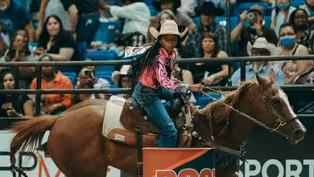
Ivan McClellan and Juneteenth Rodeo
Video has Closed Captions
Clip: S26 Ep7 | 10m 13s | Photojournalist and rodeo boss Ivan McClellan on black cowboy and cowgirl culture. (10m 13s)
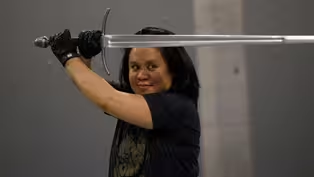
Video has Closed Captions
Clip: S26 Ep7 | 8m 41s | Fight choreographer Kristen Mun-Van Noy uses her training to teach her students confidence. (8m 41s)
Providing Support for PBS.org
Learn Moreabout PBS online sponsorship















Support for PBS provided by:
Oregon Art Beat is a local public television program presented by OPB