A Shot of AG
Jeff Waite’s Veterinary Legacy
Season 7 Episode 7 | 26m 43sVideo has Closed Captions
Fourth-generation veterinarian Jeff Waite talks animal care, rural life and mentoring.
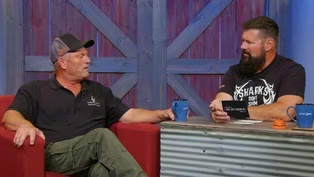
Fourth-generation veterinarian Dr. Jeff Waite joins Rob Sharkey to discuss caring for livestock and pets in rural Illinois. He shares his family’s veterinary legacy, the emotional demands of animal care and how internships help prepare the next generation. Their conversation explores the relationships that make a rural practice more than a business.
Problems playing video? | Closed Captioning Feedback
Problems playing video? | Closed Captioning Feedback
A Shot of AG is a local public television program presented by WTVP
A Shot of AG
Jeff Waite’s Veterinary Legacy
Season 7 Episode 7 | 26m 43sVideo has Closed Captions
Fourth-generation veterinarian Dr. Jeff Waite joins Rob Sharkey to discuss caring for livestock and pets in rural Illinois. He shares his family’s veterinary legacy, the emotional demands of animal care and how internships help prepare the next generation. Their conversation explores the relationships that make a rural practice more than a business.
Problems playing video? | Closed Captioning Feedback
Where to Watch A Shot of AG
A Shot of AG is available to stream on pbs.org and the PBS app.
Providing Support for PBS.org
Learn Moreabout PBS online sponsorship(whimsical music) (whimsical music swells) (mid tempo jazz music) - Welcome to "A Shot of AG".
I'm your host, Rob Sharkey.
I'm a fifth generation farmer.
And agriculture, we're pretty proud of that.
What about a fourth generation veterinarian?
Today, we're gonna be talking with Jeff Waite.
How you doing, Jeff?
- Very well.
- Four generations of veterinarians, huh?
- Yeah, it's been quite a stretch.
- Did you have a choice?
- I had a choice.
I just never thought of doing anything other than veterinary medicine, so.
- It's what you wanted to do.
- [Jeff] Yeah, it's what I wanted to do.
- Okay, well, that's a good thing.
- Yeah.
- Yeah.
You're from Milledgeville?
- Yes.
- If people don't know where that's at, where is it?
- It'd be just north and west of Sterling, Illinois, about an hour north of the Quad Cities.
- About a two hour drive to Peoria here.
- Correct.
- Okay.
Yeah, I met you at a, what county cattleman's dinner?
- It was Whiteside County Cattleman's.
- We were speaking up there.
And we did a deal where we were doing what we call a cold opening for our other show.
And we were giving away a pocket knife, old-timer pocket knife, and it was what you passed down from generation to generation.
You had a safe.
You were voluntold you had to do this, if I remember.
- Yes.
- Yeah.
And you talked about a safe you had?
- Yeah.
Back in the depression, my great-grandfather purchased the safe out of the bank and had it in our practice ever since then.
And during that timeframe, a traveling guy that was just looking for a place to sleep slept next to the potbelly stove.
And he ended up painting a picture on that of a horse.
Of course, that was a pretty prominent part of your practice.
- That's vandalism.
- Yeah.
(Rob and Jeff laugh) - And now you had that safe.
- Yes, I had that safe.
- The story of that safe got you a free pocket knife.
- Yes, and there's four generations of veterinarians on that safe.
- Okay, yes.
Let's take a look at... Here we are.
So who all do we got?
Let's start at the beginning.
- That'd be my great-grandfather, Dr.
John Turner Waite.
And he graduated from MacKillop College in Chicago.
Back in 1911 is when he graduated.
Then my grandpa, Dr.
John Russell Waite, and my dad, Dr.
Jerald Turner Waite, both graduated from Kansas State University.
I broke all that tradition and I stayed in-state.
I'm originally from Iowa.
And I went to Iowa State.
Graduated in 1990.
- So you grew up in Iowa?
- Yes, I grew up in Iowa, Northwest part of Iowa up by Algona.
- Okay, your dad went to Kansas but his practice was in Iowa?
- Yeah.
All three of them practiced back in our hometown.
- Why go to Kansas then?
- I don't really know the story of how they ended up in Kansas State versus Iowa State at that time.
- [Rob] Okay, well, I'm glad you didn't go to Kansas State because those guys have an attitude.
- Yes.
(Rob laughing) - So when you became a veterinarian, was your dad still around?
- Yes, my dad was still around.
Our practice had seen a big change in demographics to more kind of the Murphy hog setups that used more of a consultant type veterinarian.
The cattle industry was pretty tough back in the early '80s.
A lot of farmer feeders kind of left.
I wanted to do more mixed animal, cattle and hog work.
My dad was one of the original founders of the Foundation for North American Wild Sheep.
- [Rob] Oh, really?
- Him and 10 guys got together in Iowa, which it seems really weird for a wild sheep foundation to be started there.
- Yeah.
- But that's how I ended up eventually meeting my partner that was in Milledgeville, was at one of those meetings in Reno, Nevada.
- Okay, so you say you're mixed.
So what animals do you look at?
- Primarily now, I look and work on feeder cattle and cow-calf.
When I first started, I did the small animal surgeries.
I did a lot of hogs, cattle, dairy.
But as everything evolves, you grow into the passion that you love the most.
And hopefully, you have enough people around to take over and do some of the other stuff.
- Yeah.
At the cattleman's dinner, I mean, all those guys, those cattle guys, they loved you.
- Yeah.
- What's the deal?
'Cause you send 'em a bill.
- Yeah, I hope so.
I hope they pay it too.
(Rob laughing) But no, it's been real fun to work in the rural communities.
'Cause it's not just you're working for a person, a number.
You're working for families.
You know, and that's a big part of rural America.
- Cattle has been very interesting the last few years, right?
A lot of money involved.
And man oh man, if they lose a head, it's a lot of money.
- Yes, it is.
- A lot of pressure on the producer.
Is a lot of pressure on you?
- Yes, yes, to maintain the health of the herds.
You know, when a lot of these cattle are $3,000 to $4,000 a head, it can economically impact a farmer significantly.
- Well, you got me thinking now.
Like when it was less, when cattle wasn't making money, right, does it change how you view the care of 'em?
- Not really how you take care of them.
It may change a little bit of the economics of what you're willing to, how far you go with some things.
You know, broken legs and calves and stuff like that, you try a whole lot harder to fix them that are maybe questionable to how you can fix them in a rural America.
But you sure try.
And people are willing to do more exploratory surgeries and stuff to just see if you can help some of the animals.
- Yeah.
Has it been nice seeing some of those guys you've been working, and gals you've been working with for years finally making a little money?
- Yeah, it's been a really good run for the cattle producers.
- [Rob] Yeah, they're still farmers, so I doubt you ever get a tip.
- Yeah, no.
(Rob and Jeff laughing) I don't think I've gotten too many of those.
Maybe once in a while in the Small Animal Division, we'll see a tip once in a while.
- So take me through your practice.
It's not just you.
You're not the only veterinarian.
- I have a partner, Dr.
Chelsey Ramirez.
She's joined our practice back in 2010, '11.
She worked for a couple years for us.
Her husband had a job down by U of I and couldn't find something up there.
And, you know, recently married, she decided that maybe it wasn't the, you know, long-term solution for her to be with us.
And she took a job at the University of Illinois.
They wanted her back there for teaching.
And she taught there for five years and got a lot of good information, you know, was really good at her job there.
But really wanted to come back to our practice and came back and became a partner.
This history of her and what we continue to work on is with her knowledge and her connections with the University of Illinois is our internship programs.
And so it's a good leg up to have somebody that's got that information from the university side.
- Is getting into veterinarian school still as difficult as it was?
- I would say it's more difficult than it was.
- My sister wanted to be a veterinarian and didn't get in.
She became a doctor.
I mean, that's how crazy it was.
She couldn't get into vet school, but she got into med school and became a doctor.
- Yeah.
- Is it still that way?
- Yes.
- Why?
- Like for every open position in veterinary schools, it's like 400 to 800 applicants.
- [Rob] Is it just 'cause everybody wants to do it?
- Yeah, it's a good lifestyle and it's, everybody likes their animals, so.
- Why don't you quit being a veterinarian and start your own school?
Man, think of that.
- I imagine that Chelsey told me a few things of running a university that would discourage me from wanting to be in charge of that.
- It doesn't really have to be a real school.
Just like Jeff's Vet School.
- Uh-huh.
(Rob laughs) Well, and that's part of our internship program that we really pride ourselves on is trying to get the next generation in there.
And we have rotations from students all over the Midwest vet schools.
- So I think most people in this country, they think veterinarian, they think cats and dogs.
What you do, how's the numbers holding up?
Is there enough big animal vets out there?
- It's tough to keep... I mean, there's still a lot of practices looking for large animal veterinarians, mixed animal or just plain swine or cattle practices that are constantly looking for the next veterinarian.
- I know in the medical field, there's concern that people are going to rely on AI, you know, to fix everything.
Is that a discussion in veterinarian?
- I think it's an opportunity for us.
We have taken advantage of some of the new AI technologies, especially on the small animal side, for diagnostic, running tests and stuff.
It has its place.
And I think it allows us to be more efficient maybe and utilize our time better, you know, with each and every animal that we see.
- Yeah.
On average, how many hours you put in a week?
- 70, 80.
- I'd say too many.
- Too many.
- Yeah.
You've been married for what, 34 years to Dawn?
- Yes, I have.
- Where'd you meet her at?
- I met her through my secretary that worked for me before she retired.
And she went to the same church as my wife and introduced me to her at our church.
- Okay.
And so what is that like as a wife of a veterinarian?
(Rob and Jeff laughing) - They get used to the phone ringing at night.
They get used to your hours.
They take real appreciative when you do have that time off.
A lot of our vacations were scheduled around continuing education, you know, going to different places around the country and take the kids with.
And they get to go to Disneyland or something along that line so.
- How many kids?
- Three kids, one grandson.
- Boys or girls?
- Two boys and a girl.
- Okay, 'cause I always thought that'd be cool if I was a veterinarian with a girl.
And, you know, when the boyfriend comes over, you'd have like the bander out.
(Rob laughing) Didn't do that, huh?
- Didn't have to do that.
- Oh, didn't have to do that.
She could take care of herself.
- She could take care of herself.
(Rob and Jeff chuckling) - So, okay, two hour drive here, two hour drive back, you know, going out to eat and everything.
So you're throwing away a day to be here.
Can you do that as a veterinarian?
- We try to make time for all our people.
I think, you know, getting away from it is important for our people, especially our young veterinarians.
They need a break away from the hustle and bustle and the stress of.
People I don't think really realize how stressful veterinary medicine can be.
- I didn't until we started interviewing veterinarians, and then you hear their side of it.
'Cause, you know, some people are selfish.
We only think about ourselves.
But I mean, a dog gets sick.
My gosh, that is the end of the world.
I mean, "You've gotta help us, you gotta help us now."
And it doesn't matter if you've already put in 100 hours this week.
"Get here and save my dog."
- Yeah, yeah.
And it is a stressful situation for a lot of the young veterinarians, and older ones too.
I mean, it never gets, you know, easier when you're dealing with the end of life of a pet.
You know, a lot of 'em are just like their best friends, you know, their companion, their only ones that they come home to every night.
So it is a challenge.
- Let me ask you this.
So you have a situation where an animal, a pet, is going to not make it.
But you could save that animal's life but the cost is, the owner can't pay it.
Does that scenario happen?
- It does happen.
That scenario, maybe not as often as just the routine care or emergency-type thing that, you know, they maybe don't have the gold standard to go to the university to spend $10,000 on their surgery.
But there's things we can do to help them.
But the end of life ones where they're really in really tough shape and it becomes an economic decision is a hard thing for us as veterinarians to get to that next step, even recommending it.
We try to do some things that maybe will help it get through, especially on a younger animal or even an older one that can give it better life.
- But it is a business, right?
I mean, you can't- - It is a business.
- You can't just give stuff away.
- No, you try not to.
But occasionally, you do get into those situations where it is... You know, somebody brings in a stray animal off the street that's gotten hit by a car.
We do do what we can to help that animal.
So it's part of what we took an oath to do.
So we don't try to get to that level unless, you know, it really looks like there's probably no other option for the animal's wellbeing.
- So the mental health numbers, even the suicide numbers on veterinarians are shocking, really.
- Yeah, and it is a scary statistic that, you know, how many do take their lives or, you know, leave the profession because of the stress and the mental anguish that they go through.
So it is something over the last 10, 15, 20 years that we have to pay attention to more in our younger generation, and sometimes even older.
So we try to address that.
We try to keep open dialogue with our veterinarians and staff and have conversations about this and promote them and help them through rough times.
'Cause we do see that they do struggle a lot of times, you know, in those scenarios where they can't practice maybe the gold standard that they were, you know, given in school and to try.
- Well, that's got to be tough on you too as I think about it, right?
You and Chelsey own the veterinarian, and then you have how many?
- Seven other associates.
- That you're in charge of.
- In charge of.
And all the staff, the young staff that goes with it.
We have a very young staff.
- So seven veterinarians that you're in charge of, seven veterinarians that you're in charge of their mental health too.
Has that changed over the years?
- Oh yeah, most definitely.
You know, over the last five to 10 years, it's something that we focus on more and more.
- Yeah, yeah.
Boy, does that ever get to you?
I mean, they've got the pressure, but then the pressure always goes up too.
- It is a lot of pressure to try to provide that support and workplace life balance that we talk about.
- [Rob] Have you learned to shut it off?
- I think I've been very fortunate over the years to have been able to turn it off.
- Yeah, you'd have to learn it, right?
- And it takes time for a lot of people to learn how to do that, you know.
At five o'clock, to be able to turn it off when you just got done dealing with a very emotional pet owner and situation, it is hard to do.
- So the intern program that you have, are you looking mainly for the big animal vets?
- At our practice, it's been primarily on mixed animal practitioners or young students.
And that can be anywhere from a high school graduate to, you know, doing their undergraduate work to third year vet students, fourth year vet students, all the way up through that that we try to take in.
And we get a lot of those during the summer from, you know, different age groups.
But throughout the year, they'll do their internships through us from various colleges.
- So as they're coming in interning, I mean, do they think they know it all?
Is it like a learning wall, or do they kind of know what they're getting into?
- No, I would say the majority of 'em have a lot to learn and they're very appreciative to get the experience.
We put 'em up in either my wife and I's house for the two weeks.
Or sometimes, they have relatives close by.
- [Rob] Really, huh?
- So that's been really fun to have just young people in our house.
- There's got to be one that you couldn't stand.
What was their name?
- (chuckles) I can't think of anybody I couldn't stand.
- You're lying.
- There were some that were, you know, a little more reserved or quiet.
You know.
- Come on.
- But the majority of 'em have been very outstanding.
And they come up and have supper with us and watch TV.
And we take 'em to plays or whatever was going on in the community.
- Well, to them, this is a huge opportunity, right?
- [Jeff] Yes, yes.
And I think it's something that will continue to grow.
And that's part of our legacy we want to grow.
- Well, you don't have to do that.
- No, we don't have to, no.
- Why do you?
- I think it's, we've gotten most of our vet techs have stayed with us that's gone through the program.
We've also had various vet students over the years that we've hired that were first interns with us.
I would say, probably the last three or four have been interns.
- So Milledgeville, I mean, you're more in a rural area up there.
Do you enjoy that?
- Yes, I grew up in a rural area.
So we own two practices, one in Milledgeville and one in Stockton.
We've spent money, remodeled.
My partner, Dr.
Keith Collins, decided that in 2010 to stay relevant, we needed to build a new practice.
So we built a new practice with three small-animal exam rooms even though we were a one-doctor, small-animal practice at that time.
Wondered how we'd ever fill that.
Now we're busting at the seams.
And we recently remodeled the bank and built a whole new large-animal facility in Stockton with four exam rooms for the small animal.
So we're hoping for growth in the future.
- How many cattle and hogs have you posted over the years?
Autopsy.
- Autopsy.
- Necropsy.
- Necropsy, yeah.
- That's cutting 'em up after they're dead to see what happened.
- See what's going on.
And it's a valuable thing that we do for our producers to solve what may be going on.
An individual problem or is it a herd health problem?
So there's been many, many, many.
- Thousands?
- Probably.
- Yeah.
Do you pride yourself on keeping a knife sharp?
- I try to.
I'm not as good at it as I should be.
(Rob laughing) I've got to confess.
I use a scalpel blade on most of my posts.
- Oh, do you?
- Yes.
- Okay, 'cause when we were raising hogs, you know, when the vet couldn't make it out and, you know, we'll post them.
'Cause you watch enough of 'em, you can at least see something.
- Something.
- Yeah, some of the main ones.
And I'm like, "How does he do this?"
'Cause I'm sitting there hacking away with a knife.
But yeah, then he comes out and he's (pretend slicing).
(Rob chuckles) I suppose that's something you gotta teach too.
I mean, not all these young people have a strong stomach, do they?
- No, not all of 'em.
But most of 'em learn to have one.
'Cause what we deal with some days is not the best.
(Rob laughing) - So if you could go back, I mean, would you do it all over again?
Would you become a vet again?
- Yes.
- Yeah?
You love it?
- I love it.
- Just love everything about it.
- Yeah.
I wake up every day, I'm the first one to work.
I'll be there an hour before everybody else.
- [Rob] Well, that's 'cause you're old, not 'cause you're a vet.
- That's probably because (Rob and Jeff laughing) my wife kicks me out that early in the morning.
- Do you think you'll retire?
- I don't know.
- I don't think you will.
- It'd probably be my health or my physicality that will eventually make me step aside, probably.
I'm hoping for another 10 years.
That'll make it 125 years of our family.
Maybe by then, maybe my grandson or somebody will wanna be the fifth generation.
- Be the next generation, yeah.
(chuckles) Because I've seen it.
You know, a lot of veterinarians, they just keep going.
'Cause I think they're like you.
They just, I don't know, they enjoy it.
What are you gonna do, play golf or cut up dead animals?
(Rob and Jeff laughing) Do you like that Dr.
Pol guy?
- I watch it a little bit.
You know, he's got his thing.
- It's a little made for TV, isn't it?
- Yes, yeah, yeah.
Some of it's real, and some of it's a little more- - Well, what I found interesting about it is when they actually went out to the real farms.
You know, you could tell this was like one of his... Yeah, you could tell the old barns and all that.
Livestock today, from when you started, it's gotta be night and day.
- It changes periodically.
You know, back in the late '90s, 2000s, you understand what the markets can do.
And the hog market took a real tank.
We're facing a challenge right now with the plant in Joslin, Illinois closing for our local cattle producers that now we have to refigure what we're gonna do.
You know, it affects not only just Joslin, all the employees.
It's gonna affect a lot of small producers that are raising cattle that were, you know, going to Joslin or relying on Joslin to be there to bid on their cattle.
- Yeah.
I'd like to say that maybe when this airs, it'll be back open.
But I don't think so.
- I don't think so.
- Yeah, and that's a big hit.
- It's a big hit.
- Yeah, that's right in your area too.
That's probably where a lot of your cattle went.
- A lot of the cattle that... I didn't send a lot there recently, but I have sent cattle there from my own operation.
But a lot of my producers contacted me as soon as it happened and we were talking about alternatives.
You know, they're already looking at alternatives for other plants and- - Well, it just backed all those plants up too, right?
- The only good thing right now is that our numbers are tight, and a lot of other plants weren't running at capacity.
But it's just gonna be an economic hit.
- [Rob] Yeah, so you have cattle too?
- Yes.
- Okay.
So you live what you preach.
- I live what I preach.
And I think a lot of my producers appreciate me being in the industry, understanding the markets.
- Skin in the game.
- Skin in the game.
- Yeah, it's always nice.
What advice would you have for someone that is thinking about becoming a veterinarian?
- Get out there and get experience.
Go to your local veterinarians.
Do as much as you can about getting that internship, that just, you know, coming in and watching and seeing what's going on.
'Cause we see a lot of that in our interns that will come to us early, stay with us, and continue that.
And we can tell the difference between the students that come out that are engaged and go out and seek those internships.
So you know what you're getting into.
But get real life experience.
- Nothing wrong with getting an internship or shadowing and realizing, "You know, this isn't what I thought."
- No.
- Yeah.
- No, it isn't.
- Yeah.
I don't know why young people kind of got away from that.
But yeah, I'm glad you guys are doing so much of it.
If someone wanted to find you or your practice, where would they go?
- They can go to our website, northernillinoisveterinaryservi.
They can get on that website.
It'd probably be the best way.
Or they can just call and talk to our HR person and send in a resume.
- And you and your partner, Chelsey, I mean, that's just been a good fit?
- Yeah.
- Yeah.
- She does more of the personal stuff and I do more of the business, you know, the buying, the selling the stuff.
- I believe you, I believe you.
I think you're the one that wants to be out there talking with the cattle guy.
I don't know, I have that feeling.
- But she's really good with the cow-calf side and does really well there too, so.
- All right, well, Jeff, I appreciate you taking... I know what it takes for you to get here.
And I appreciate you coming and sitting down with us.
But I think a lot of people maybe that are thinking about becoming a veterinarian, it would do a lot of good for them to sit down and have a conversation with a guy like you.
So thanks for coming today.
- Appreciate it.
- Yeah, and thanks for all you do for agriculture.
- Yeah, thank you.
- Jeff Waite, thank you very much.
Everybody else, we'll catch you next time.
(upbeat ambient music) - If you enjoyed today's episode, be sure to explore more of our local content.
You can connect with us on our social media platforms, visit our website, or download and watch the free PBS app.
We can't wait to see you next time on "A Shot of AG".
(whimsical music)
 New
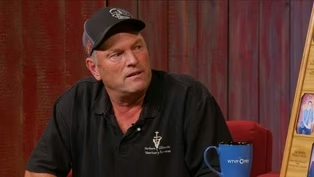
NewFour Generations of Veterinarians
Video has Closed Captions
Clip: S7 Ep7 | 26m 43s | Dr. Jeff Waite traces a family veterinary tradition that began more than a century ago. (26m 43s)
 New
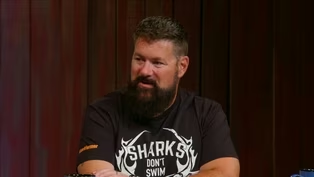
NewHow Hard Is It to Get Into Veterinary School?
Video has Closed Captions
Clip: S7 Ep7 | 51s | Dr. Jeff Waite and Rob Sharkey discuss the competition to get into veterinary school. (51s)
 New
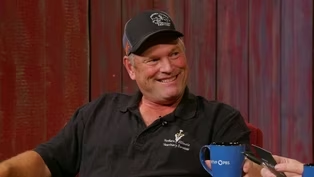
NewWhen the Cost of Animal Care Becomes a Hard Choice
Video has Closed Captions
Clip: S7 Ep7 | 1m 24s | Dr. Jeff Waite discusses the difficult balance between animal care and what owners can pay. (1m 24s)
Providing Support for PBS.org
Learn Moreabout PBS online sponsorship New Episode
- News and Public Affairs

Top journalists deliver compelling original analysis of the hour's headlines.
 New Episode
- News and Public Affairs

FRONTLINE is investigative journalism that questions, explains and changes our world.
 New Episode
 New Episode
 New Episode
 New Episode
 New Episode
 New Episode


 New Episode
 New Episode
Support for PBS provided by:
A Shot of AG is a local public television program presented by WTVP