State of Affairs with Steve Adubato
Jesse Burns; Joe Maloney; Sen. John F. McKeon (D) – NJ
Season 10 Episode 12 | 27m 58sVideo has Closed Captions
Jesse Burns; Joe Maloney; Sen. John F. McKeon (D) – NJ
Jesse Burns, Executive Director of the League of Women Voters of NJ, examines preparations for the 2030 Census. Joe Maloney, President of Sports Betting Alliance, discusses the evolution of sports betting and balancing innovation and regulation. Sen. John F. McKeon, Vice Chair of the State Government, Wagering, Tourism & Historic Preservation Committee, analyzes the rise of online sports betting.
Problems playing video? | Closed Captioning Feedback
Problems playing video? | Closed Captioning Feedback
State of Affairs with Steve Adubato is a local public television program presented by NJ PBS
State of Affairs with Steve Adubato
Jesse Burns; Joe Maloney; Sen. John F. McKeon (D) – NJ
Season 10 Episode 12 | 27m 58sVideo has Closed Captions
Jesse Burns, Executive Director of the League of Women Voters of NJ, examines preparations for the 2030 Census. Joe Maloney, President of Sports Betting Alliance, discusses the evolution of sports betting and balancing innovation and regulation. Sen. John F. McKeon, Vice Chair of the State Government, Wagering, Tourism & Historic Preservation Committee, analyzes the rise of online sports betting.
Problems playing video? | Closed Captioning Feedback
Where to Watch State of Affairs with Steve Adubato
State of Affairs with Steve Adubato is available to stream on pbs.org and the PBS app.
Providing Support for PBS.org
Learn Moreabout PBS online sponsorship- [Narrator] Funding for this edition of State of Affairs with Steve Adubato has been provided by The Fund for New Jersey.
NJM Insurance Group.
Serving New Jersey’s drivers, homeowners and business owners for more than 100 years.
New Jersey Sharing Network.
IBEW Local 102.
Lighting the path, leading the way.
Operating Engineers, Local 825.
Eastern Atlantic States Regional Council of Carpenters.
United Airlines.
Rowan University.
The fastest growing public research institution in the Northeast.
And by RWJBarnabas Health.
Learn More at RWJBH.org.
Promotional support provided by The Chamber of Commerce Southern New Jersey.
And by NJBIZ.
Providing business news for New Jersey for more than 30 years, online, in print, and in person.
[INSPRATIONAL MUSIC] - Hi everyone, Steve Adubato.
We kick off the program talking about really important issues, including the 2030 census.
We are honored to be joined by Jesse Burns, who's executive director of the League of Women Voters of New Jersey.
Jesse, great to have you with us.
- Thank you so much for having me.
- Jesse, the 2030 census, people may say, "What is it?
Why does it matter to me and what impact does it have when it comes to federal money?"
First of all, what is it?
- Sure, so the census is the counting of everybody in the country.
It's incredibly important and happens every 10 years and it determines funding, political representation, things like city planning and emergency response, as well as it's used in research and academic studies.
So it's incredibly important for us to have an understanding of what our country looks like and where our population is.
- Okay, so it's 2026 as we're taping, midway through the year, be seen a little bit later.
What kinds of things need to be done in 26, 27, 2029 to be prepared for the census?
- It's definitely not too early to start preparing for the census.
It's a huge operation and it's already happening at the federal level.
Other states like New York have undergone significant work towards a complete count already.
They fear losing a seat.
It's really important that we get started.
- One second.
I'm sorry for interrupting, Jesse.
When you say losing a seat, this is the part that is critically important.
There are obviously two houses of Congress.
United States Senate has a fixed number based on the Constitution.
Last time I checked, it's still 102 per state.
There are 435 members of the lower House, the House of Representatives.
Last time I checked, that number keeps changing and each state has a certain number of House seats dependent upon population.
So New York's concerned, pick up that may lose a seat.
Jesse.
- So last time in census 2020, New York lost a seat in the House of Representatives by a very thin margin.
Something like 89 people.
- Wow.
- In their count, led to them losing a seat in Congress in the House of Representatives specifically.
So you can see how incredibly important it is to make sure that we are investing in New Jersey and a complete count now.
Specifically, some really important work is coming up.
It sounds wonky, but I promise you it isn't.
There's something called the local update for the census addresses, otherwise known as LUCA, that is opening up soon in the spring.
What this is, is the Census Bureau sends the states and the municipalities a list of addresses and we need to make sure that those addresses are correct.
If we miss an address, we miss a person.
If we miss a person, we miss dollars and we miss political representation and we miss power.
So this kind of work needs to start happening now.
- But I'm curious about this, and you can help folks understand.
You talked about political representation.
Since Congressional/House districts are reapportioned, supposedly, every 10 years based on the census, what the heck is going on that in mid 10 year, mid in the 10 years, like five, six, seven years, whatever it is, there are certain states that are attempting, starting with Texas, I believe, starting to reapportion those districts and those who reapportion the districts could either be those who control the state legislature or some independent body, which I believe exists in New Jersey.
It's a long-winded way of getting to this.
Why the heck are states redistricting for House seats when it's supposed to be done based on the results of the 2030 census?
- So mid-cycle redistricting is unfortunate and it is something that we're seeing across the country.
As you said, this started in Texas under President Trump's urging to redistrict early to get more GOP seats.
This was ahead of the 2025 elections and then California responded.
A few other states-- - One second.
California, to be clear, California responded to get, try to get more Democratic districts, Democratic seats to make up for allegedly what they believe is going on in Texas.
And is it snowballing, Jesse?
- Yeah, that's correct.
- So after a little bit of a lull, the Supreme Court issued a devastating decision that basically renders section two of the Voting Rights Act, the Federal Voting Rights Act inoperable to challenge against racial discrimination.
So what this means is states across the South immediately started redistricting during elections to eliminate and dilute Black voting districts in the South.
So now what we have is discussions around what is the response to what is happening across the South?
And more states are considering mid-cycle redistricting ahead of the 2028 midterm elections.
- Where are we in New Jersey on that?
- There has been some conversation in New Jersey about this.
We have kind of a different timeline.
We could put this on the 2026 ballot, but I really urge against that.
That would be very rushed.
It would mean that it would have to, we'd have to call back a summer session or the legislature would have to do that during this busy budget season.
- And we're talking about, when you say calling back, you mean the state legislature?
- Yes, the state legislature to put it on the ballot.
But we caution very much against mid-cycle redistricting in New Jersey because New Jersey's a unique state.
We're very dense and we're very diverse.
That means that when you redraw the maps here, particularly without the 2030 census data, you risk diluting the very communities that are already most harmed by the gutting of the Voting Rights Act.
So it's not really the best solution if you're looking to help the people that are being harmed most by the VRA.
- 30 seconds, if you can give us a concise answer to this complex issue.
President, others, rigging of elections, particularly when the elections don't turn out the way certain people want them to.
Is there any reason that you know of at the League of Women Voters, and you and your colleagues monitor this all the time, to not trust the results of our elections?
- No.
- Particularly in Jersey.
- No, there definitely isn't.
And I can also say that New Jersey has so many layers of election security built in.
There's voting right advocates like us that run election protection work, that if things happen at the polls, voter intimidation, improper ID requests, we're able to respond in real time.
The Division of Elections, the Secretary of State, and the AG's office also run election security efforts.
And local election officials do their job well and should be trusted in our state.
- And PS, go on our website before we finish the segment, steveadubato.org for the interview we did with the Secretary of State/Lieutenant Governor, Dale Caldwell, on the issue of election security and the reasons to trust the results of elections.
Jesse Burns, Executive Director of the League of Women Voters in New Jersey doing important work every day.
Thank you, Jesse.
- Thank you for having me.
- You got to stay with us.
We'll be right back.
(grand music) - [Announcer] To see more State of Affairs with Steve Adubato programs, find us online and follow us on social media.
- We're now joined by Joe Maloney, who's the president of the Sports Betting Alliance.
Joe, good to see you.
- Thanks for having me.
- Tell everyone what the Alliance is.
We have the website up now.
- Trade advocacy organization representing the top five online sportsbooks and online casino game operators throughout the country.
We operate in 31 states.
Legal, regulated sports wagering in online casino.
Our members are bet365, Fanatics, DraftKings, FanDuel, and BetMGM.
Three core objectives for our trade advocacy organization, Steve.
We try to expand the map of legalized jurisdictions for sports wagering.
We try to expand the map of legalized jurisdictions for online casino games.
And then in jurisdictions where these products are already legal, we really try to describe the benefits of legalization and the importance of growth and innovation in these regulated frameworks.
- Let's talk about jurisdictions.
What exactly are the laws around legalized sports betting in New Jersey?
- Really the vanguard of legalized sports wagering, particularly with respect to online and digital gaming throughout the country.
State of New Jersey moved before anyone else did with online casino games back in 2013.
And it's really a credit to the elected stakeholders at that time who pursued this avenue, which was basically delivering consumer protections for New Jerseyans throughout the state as well as delivering some important tax revenue.
What happens when a jurisdiction decides to legalize online casino or then ultimately legalize sports wagering?
They're not inventing gambling, of course, Steve.
They're deciding to legalize it, to regulate it, and to tax it.
There's two really important factors into that.
One, consumer protections.
Age and identity verification, responsible gaming tools, advertising restrictions as well.
In the illegal and unregulated market, they pay no heed to those types of requirements.
They don't subscribe to any type of data privacy standards.
They don't guard any of the important information that is shared.
They don't verify age and identity, and they certainly do not comply with federal anti-money laundering regulations that exist in Washington DC.
What's important to remember as well is when you legalize and regulate a product such as gambling, as the state of New Jersey has done for many, many years now, you actually now have the opportunity to tax it and generate revenue that can go to any number of critical priorities in a given jurisdiction.
So with the- - Joe, hold on one second.
- Sure.
- Are there separate federal laws around sports betting, legalized sports betting, and different sports betting laws in 50 different states?
- There are different sports betting laws in 50 different states, and that's a result of the Federal Wire Act, which prevents interstate activity when it comes to activities such as gaming.
However, there is compliance at the federal level for anti-money laundering purposes- Which agency does that, Joe?
Sorry.
- Department of Treasury and a subset agency known as FinCEN.
So they actually ensure that anti-money laundering laws are being adhered to and provide that transparency.
So when someone commits an amount of money to wager in a casino setting or in an online gaming setting, we actually have to verify age and identity as well as the financial institution information upon where that deposit is being made from.
That is all information that's actually shared with the federal government.
- So your alliance represents the casinos as well as the five largest sports betting operations, right?
You said the casino, not casinos, but casinos who have online gambling, right?
- Yeah, the five largest legal, regulated sportsbook operators and iGaming operators.
So BetMGM is one example of an entity that is a joint venture of of a large- - Well the MGM, it's a casino.
- Of a large land-based casino, correct.
Yes.
- But here's what I'm curious about.
So when we hear about a sports betting scandal, all right, in the pros.
You know, again, look it up.
You don't need to hear it from me.
There have been scandals where athletes, sometimes coaches, folks who have information, bet themselves or give that information, particularly when it comes to these so-called prop bets, not even the outcome of a game, not even covering the spread of a game, who's favored, who's an underdog, by how many points, but whether so-and-so is going to get two hits, three hits, strikeout four times, whatever, but they have inside information.
How the heck, and what is your alliance's responsibility, if any at all, to protect against that?
- It's a great question, Steve.
And the answer to that is quite simply, you cannot police what you cannot see.
Legalization is affording collaboration and coordination with law enforcement and regulators and legal sportsbooks like never before.
So, while we read about these sports scandals and we hear about them, and the director of the FBI stands in New York with the US Attorney and announces a series of indictments against NBA coaches and players, what's important to remember is that sportsbooks are the forefront of that information sharing, of that identification of the abnormalities and the anomalies and betting patterns that actually foretell that there could be an integrity risk here.
And that's called integrity monitoring.
States like New Jersey require all licensees to commit to integrity monitoring, to sharing information around abnormalities and around anomalies that exist with betting volumes.
So the compliance steps in and says, "We are seeing an abnormal amount of activity on a specific type of prop."
That information is shared with an integrity monitor.
An integrity monitor is taking all of this data across all licensees.
They're observing these patterns in real time.
And when they see or detect an abnormality, that information is shared with the league.
- So hold on one second.
I'm going to try to break this down.
We happen to be taping this program.
It'll be seen later, right before the NBA finals.
You can see my Knick basketball, right?
So, an abnormality.
So if you see a disproportionate amount of betting on, let's say, one of the Nick players who averages 20 points a game, 15 to 20 points a game, that he would score less than six points, and you see a ton of action, as they used to say in my old neighborhood in Newark, New Jersey, betting action on that player not scoring more than six points.
Who says what to whom?
- So, all of that type of activity is captured and that's the benefit of legalization.
We can observe betting patterns.
Because nobody wants to be a victim of fraud in this instance.
So when there is significant exposure in an unexpected type of manner, these are all data patterns that can be observed.
And those data patterns not only can be observed within one regulated licensee sportsbook, but that information is required by law to be shared with integrity monitoring tools so that it can be observed across multiple licensees.
- Shared with whom?
Joe, shared with whom?
- These are companies such as Genius Sports, Sportradar, IC360.
These are specific integrity monitoring partners that in many instances the statute demands licensees work with.
Why?
Because we have official data feeds that come from league partners to ensure that there are no betting discrepancies so that we can actually police this activity.
A league would then conduct an investigation based upon the knowledge of some abnormalities.
And if they determine there to be an actual criminal wrongdoing, they call law enforcement.
And what happens after that, Steve?
Law enforcement calls the members that I represent and they collaborate and they coordinate.
So the most probably timely example we have is two years ago a very outsized bet with a new account holder was placed on a bench player on a two-way contract.
That player was Jontay Porter.
The sportsbook immediately flagged that activity, shared with the league.
The league conducts an investigation.
And then we obviously have indictments handed down and the judicial process begins.
We are in a deterrent phase.
Let me be clear, Steve.
We are in a deterrent phase right now.
There are rules, there are policies, there are systems in place now for leagues, executives, club staff, trainers, family members to be aware of.
- Wow.
- You do this and you break these rules, you will get caught.
- Hey, Joe, this is an ongoing situation.
It's complex.
It's multifaceted.
This is the first of many segments we'll be doing around sports betting and the larger implications in society and the role of government or not, et cetera, et cetera.
Joe Maloney, President of Sports Betting Alliance, we kick off that programming, which I know will make a difference.
Hey, Joe, thanks for joining us.
We appreciate, all the best.
- Please call me anytime.
Thank you to Mary as well.
- Yeah, Mary Gamba, who is our executive producer and help make this happen.
Stay with us.
We'll be right back.
(grand music) - [Announcer] To see more State of Affairs with Steve Adubato programs, find us online and follow us on social media.
- We are pleased to be joined once again by State Senator John McKeon, Vice Chair of the State Senate Government, Wagering, Tourism & Historic Preservation Committee Senator, great to have you with us.
- Great to be here, Steve, it's good to see you as well.
- You got it.
Let's talk about sports betting.
What are your greatest concerns about legalized sports betting, and what are you doing to try to deal with the negative impact of some aspects of sports betting?
- Well, Steve, on one level, we were a pioneer, right?
New Jersey was the first state in 2018 to legalize that type of betting, but now we have a track record with those number of years behind us to know what the fallout is.
And the fallout is, as a Rutgers study, almost 200,000 New Jerseyans being problem gamblers.
Now, that becomes all of our problem.
- Okay, so what the heck is the role of state government to not just regulate the industry, but to potentially, Senator, protect some of us who engage in legalized sports betting from ourselves?
- We got to start with kids, right?
Because gambling has a dopamine rush, and the younger you are, the more addictive it becomes.
So, we know that a great percentage of kids, before they're 18, will already admit, go into a high school class and say, "Have you ever made a bet?"
And no one's 18, and they'll all raise their hands if they're telling the truth.
In colleges, the number 63% of college students will tell you that they've bet.
So, first thing we need to do is to protect the young folks who are going to be more susceptible.
All the numbers we see on the gambling hotline, 277% increase between the ages of 18 to 32.
So, this is a real issue that's being imbued in our young, and we really, really need to get ahead of this.
- But Senator, how do you, quote, unquote, protect young people from the ills, if you will, or the dangers of legalized sports betting?
- Well, yeah, I mean- - How do you protect them?
- Sure, sure, so you start off from a perspective of advertising, right?
You remember the Joe Camel days where we can both picture Joe DiMaggio world, we're not that old, but sports heroes with a cigarette coming out of their mouth and they never smoked a day in their life.
Same kind of thing.
We have a piece of legislation (indistinct) committee that will study how and where the gaming houses can advertise to start with.
We also got to go with nomenclature, Steve.
They use the word gaming.
That seems like fun, right?
As opposed to gambling.
The catchphrase they have, it doesn't work.
There's studies in London saying you need to say things like, "Gambling can mess up your life," so it kind of maybe registers with some people.
So, there's a lot we could do in our messaging to protect those from having that legion of 200,000 people grow even larger.
- Senator, there's got to be a website for people who are struggling with gambling issues, correct?
- There's a Gamblers Anonymous that the state partially supplements that people often reference.
- What the heck is a self-exclusion list?
- Well, we'll think of it like a do not fly list.
So, if you know, Steve, that you keep gambling and you can't stop yourself, you're going to say, "Hey, casino, don't let me in anymore."
That's been around for a long time.
The problem with it is that there's no enforcement, meaning you can take yourself off that list in the same way you put yourself on.
So, for someone that has that kind of compulsion, unless they're the most extraordinarily strong person, they're not going to be able to help themselves.
Here's the real kicker.
What they'll do is they'll have a gambling consigliere, or whatever the name they use.
If they haven't heard from Steve Adubato who is a heavy better that hasn't bet for a week, hello, how about $1,000 we're going to stake you?
Okay, let me take myself off the list and go, so... - Because you're gonna give me $1,000 to start with.
- That's exactly it.
- And then what happens, John?
- Well, now, you're going to burn through that 1,000 and you're back in the game.
So, self-exclusion, it's great in theory, but in practice, it doesn't really work.
We need to strengthen that.
At a minimum, legislation is now out of committee.
There should be at least educational videos or otherwise that you have to go through before you take yourself off.
What I think is really important is to allow third parties to exclude a loved one.
A loved one meaning somebody like a parent who might be financially responsible, a spouse, a child who's not getting child support, to allow a third party to step in and say with a hearing that this individual shouldn't gamble and here's why.
It's a lot like the red flag laws with the guns, and it's working.
- Quick follow-up on this.
I called it prop betting.
Prop betting is betting within a game how many passes will be thrown by a New York Giant quarterback or by a Knicks.
Again, we're taping this after Knicks won the NBA Championship, but how many points Jalen Brunson will score.
A prop bet is a bet inside the game, not just on the outcome of the game with the odds being what they are or whatever it is that the point spread.
But, what the heck is microbetting?
- Well, Steve, it really just gets into sitting in real time and betting on whether or not Jalen Brunson's gonna make a foul shot or not.
A lot of times, in these games where that point of the game, the foul shots don't matter.
You'll hear people either cheer or boo based upon a player making or missing a foul shot.
- John, sorry for interrupting, Senator.
How do I do that in real... I don't want to educate people on this, but the reality is technology is a big part of this.
Is this phone and the ability to use the phone to bet on Jalen Brunson making or missing that foul shot, that could not have happened without this technology, right?
- No, of course not.
You sit there, whether it's at the arena or in front of your TV, and it's just so ridiculously convenient and almost surreal as to the psychology of that.
Steve, think about this.
There was $7 billion, in New Jersey alone, of gambling revenues just in 2025.
The profit is a record-high 1.2, almost $2 billion of profit, and it's all because of these machines, which you have for 24/7.
It's a distraction from reality.
It doesn't feel like you're spending money.
There's no social cues, like if you were sitting in a casino and someone could say, "Hey, you've had enough.
Why don't you get out of here and get some sleep?"
Nothing like that at all.
- Hey, follow up on this real quick.
You talk about addiction.
I remember years ago, before gambling was legalized, I did a series of interviews about gambling addictions.
And then I realized that one of the pushes for legalizing sports gambling/gaming is that the state, the government, is addicted to the revenue.
- Well, we did change... New Jersey has one of the lowest tax rates in the entire nation, and I get it.
In part, that's because we co-op with the brick-and-mortar Atlantic City.
That's what's keeping those 26,000 jobs in place or else they- - Down in Atlantic City.
- Yeah, that they probably close.
So, our rate is 19%, we just changed it to.
Compared to New York where it's 50%, Pennsylvania where it's 30, it's actually low in our state.
But you're right.
At the end of the day, we get used to that revenue.
And I'm not suggesting, look, it's 37 states.
The genie is out of the bottle.
I'm not suggesting that we're going to stop gaming, but now we've got a track record of knowing the kind of social ills it brings, and it's our responsibility to step in and do something about it.
Steve, you want to talk about it?
It's a DSM addiction, compulsive gambling.
The number on DSM addiction, not schizophrenia, not bipolar as it relates to suicide, is compulsive gambling.
- Gambling.
Senator John McKeon on the gambling, the legalized gambling issue.
You heard another side before this.
Not another side, a different perspective.
And now, you hear the senator who's the leading legislator dealing with these issues.
Senator, as always, thank you for joining us.
We appreciate it.
- It's a pleasure.
Continued success, Steve.
- Thanks, same to you.
I'm Steve Adubato.
That's the Senator, Senator John McKeon.
We'll see you next time.
- [Narrator] State of Affairs with Steve Adubato is a production of the Caucus Educational Corporation.
Funding has been provided by The Fund for New Jersey.
NJM Insurance Group.
New Jersey Sharing Network.
IBEW Local 102.
Operating Engineers, Local 825.
Eastern Atlantic States Regional Council of Carpenters.
United Airlines.
Rowan University.
And by RWJBarnabas Health.
Learn More at RWJBH.org.
Promotional support provided by The Chamber of Commerce Southern New Jersey.
And by NJBIZ.
- NJM Insurance Group has been serving New Jersey businesses for over a century.
As part of the Garden State, we help companies keep their vehicles on the road, employees on the job and projects on track, working to protect employees from illness and injury, to keep goods and services moving across the state.
We're proud to be part of New Jersey.
NJM, we've got New Jersey covered.
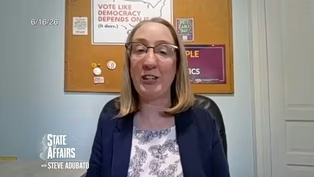
How New Jersey is preparing for the 2030 Census
Video has Closed Captions
Clip: S10 Ep12 | 9m 7s | How New Jersey is preparing for the 2030 Census (9m 7s)
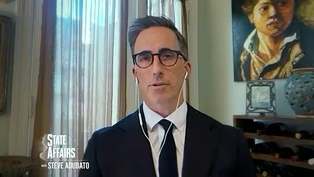
How sports betting balances innovation and regulation
Video has Closed Captions
Clip: S10 Ep12 | 10m 14s | How sports betting balances innovation and regulation (10m 14s)
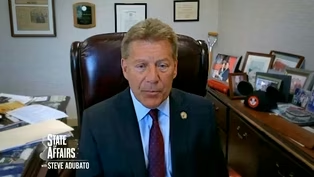
Sen. McKeon analyzes the rise and risk of online sports betting
Video has Closed Captions
Clip: S10 Ep12 | 9m 18s | Sen. McKeon analyzes the rise and risk of online sports betting (9m 18s)
Providing Support for PBS.org
Learn Moreabout PBS online sponsorship New Episode
- News and Public Affairs

Top journalists deliver compelling original analysis of the hour's headlines.
 New Episode
- News and Public Affairs

Today's top journalists discuss Washington's current political events and public affairs.


 New Episode
 New Episode
 New Episode
 New Episode
 New Episode

 New Episode
 New Episode
 New Episode
Support for PBS provided by:
State of Affairs with Steve Adubato is a local public television program presented by NJ PBS