Oregon Field Guide
John Day River Geology Tour
Clip: Season 37 Episode 8 | 12m 17sVideo has Closed Captions
Take an adventure back in time through some of the most stunning geology in the Northwest.
The scenic John Day River in north-central Oregon snakes its way through some of the most stunning geology in the Pacific Northwest. Join us for a four-day rafting adventure back in time with geologist Ian Madin as the river carves its way through one of the most diverse, scenic and ancient landscapes in Oregon.
Problems playing video? | Closed Captioning Feedback
Problems playing video? | Closed Captioning Feedback
Oregon Field Guide is a local public television program presented by OPB
Oregon Field Guide
John Day River Geology Tour
Clip: Season 37 Episode 8 | 12m 17sVideo has Closed Captions
The scenic John Day River in north-central Oregon snakes its way through some of the most stunning geology in the Pacific Northwest. Join us for a four-day rafting adventure back in time with geologist Ian Madin as the river carves its way through one of the most diverse, scenic and ancient landscapes in Oregon.
Problems playing video? | Closed Captioning Feedback
Where to Watch Oregon Field Guide
Oregon Field Guide is available to stream on pbs.org and the PBS app.
Providing Support for PBS.org
Learn Moreabout PBS online sponsorship(water flowing) - [Narrator] On this summer day in 2025, a group of self-described rock nerds has assembled on the banks of the John Day River with geologist Ian Madin.
- And I'm Ian.
- Hi Ian.
Oh, you're gonna be our guide.
Nice to meet you.
- Yeah, I am.
Well, no, they're gonna be your guides.
I'm just gonna be your entertainment.
- Oh!
- Gosh, where to start?
This is one of the more geologically unique parts of the state, this entire region.
- [Narrator] Ian spent much of his career as chief scientist at Oregon's Department of Geology and Mineral Industries, also known as DOGAMI.
- And again, so we're gonna be starting out in the Columbia River basalt.
- [Narrator] But for the next four days, he's the chief tour guide on an expedition back in time.
- Okay, let's go get wet.
- We can always switch it up.
- [Ian] So we are in the canyon of the John Day River between Service Creek and Clarno, and it's a stretch of the river that cuts through a major transition in Oregon's geologic history.
So as we proceed down the river, we cut deeper and deeper into the earth and towards the older rocks that are underneath the Columbia River basalt.
- [Narrator] If you've been almost anywhere in the northwest, you'll recognize the massive lobe-like flows and distinctive columns of Columbia River basalt.
The story of this common rock starts about 16 million years ago.
At that time, Oregon was warmer and covered with lush plant life.
And then, for about a million years, hundreds of successive flows of volcanic basalt spread across the landscape, covering everything in its path.
- [Ian] Columbia River basalt is one of the three largest volcanic eruptions known in earth history, and basalt is very fluid lava, and covered virtually all of eastern Oregon and eastern Washington with thousands of feet of black lava.
And then over time, rivers have cut through that, creating deep canyons and this layer cake effect.
I'm fascinated by the landscapes and it seems to me that that raises the obvious question of why does it look the way it does?
And geology answers that question or it leaves us a little confused about it.
But that's half the fun is trying to figure out what the story is.
- [Narrator] Brothers Ajay and Kiran Limaye grew up in Wisconsin, but now live on opposite sides of the country.
- So, I'm a geologist at the University of Virginia.
I'd heard of Eastern Oregon from my brother 20 years ago and kind of daydreamed of one day doing a trip here.
So here I am.
- As a family, we were lucky to have our mom for 80 years.
We lost her and this is a chance for us to spend time together in the natural world, and that's something she really liked.
So, it's a chance for us to be together and also have an adventure.
- [Narrator] The first day ends on a convenient beach, nestled in these familiar land forms, and a chance to cool off after a hot day on the river.
(fishing rod zipping) (birds tweeting) - And we're off.
- Another adventure.
- [Narrator] The next morning starts off with more gorgeous landscape, a few small rapids.
- Oh, Gah.
Uh oh, here comes a big one.
Oh, sideways.
Look out.
(groans) Oh, right down my shirt.
(water whooshing) - [Narrator] And then, this astonishing feature comes into view.
It's known as Byrds Point, named for early homesteader, William Byrd.
- [Ian] Byrds Point is a large body of basalt and probably flowed down a river canyon carved into the older rocks.
Those have all eroded away and have left Byrds Point standing as a great bold cliff.
- It's really interesting to just go to a different part of the world and the landscapes here in Oregon, shaped so much by volcano, just give a whole other world of opportunities to see new things happening.
- [Narrator] The timeless basalt citadels stand guard along the river, also teeming with bird life.
(birds tweeting) Including red wing blackbirds, osprey, and bald eagles.
But just a few miles downstream, the landscape shows hints of a dramatic change.
- [Ian] If you look over on the right hand side, you'll see layers of basalt that form a big curved arc forming sort of a cup.
So what you're looking at here is a place where the basalt flowed down an ancient valley, mimicking the shape of that valley.
- [Narrator] This change in the basalt structure is the first sign that more ancient landscapes are about to be revealed.
- So on the right, you can now see the transition from the white ash to the brown lava above it.
The white is volcanic ash and that is probably 30 million years old.
So we are looking now at the older landscape, just peeking out from underneath the basalt.
- [Narrator] The rocks that make up these land forms of ancient ash are known as the John Day Formation and are the result of massive explosive eruptions from super volcanoes.
Places such as the Painted Hills are classic examples of features made up entirely of ash from these large scale eruptions.
But on this part of the John Day, there was also something else going on.
- [Ian] And at the same time, there were small local volcanoes and they would produce lava flows and volcanic mud flows, and all of those would interfinger with the ash that was constantly falling from the sky that covered the entire landscape.
- [Narrator] The results of these more local events, known as the Clarno formation, are, in a word... - A mess, a very colorful mess, but a mess.
The Clarno is characterized by blocky lava flows and volcanic mud flows, which are a hodgepodge of mud and boulders that occurs when lava erupts onto ice and snow.
And then those are also often modified by hot spring solutions.
So instead of being black, might be red and white.
- [Narrator] Add to those events millennia of erosion and other land shaping forces and you get this breathtaking, if messy, scenery.
- Absolutely spectacular.
You know, that's the beautiful thing about a river trip is that you can kind of sit back and watch it unfold in front of you.
- [Narrator] Toward the end of the day, the group has settled into what's known as river time.
- This is my first rafting trip, so I wasn't totally sure what to expect, but it really definitely develops a flow after a while.
There's just a lot of time to let things go by.
I think that the pace of the travel down the river itself, you have enough time to just go at really what feels like a natural pace.
- We got some chicken stir fry tonight for dinner.
Onions and peppers.
- Okay, looks good.
- Carrots, house-made peanut sauce.
- [Group] Dinner!
- Would you like some?
- Yeah, it's funny, like when you go into a trip and you have that kind of city energy and you're like, "Oh my God, what am I doing?
It's gonna be kind of a long trip and who are these people?"
- Increased respect, you already have my respect.
- [Kiran] Then by the end you're like, "Oh, this is so great.
I could do several more days of it."
A great group of people to be with and learn what their experiences are too.
- [Narrator] Day three starts off calmly enough.
♪ Always look on the bright side of life ♪ ♪ Do do ♪ ♪ Do do do do do do ♪ - And let's go all forward.
- [Narrator] But it doesn't take long for the river to mix things up.
(water whooshing) And while the river calms, the scenery continues to dazzle, as well as puzzle.
- [Participant] Is that a landslide coming down from the top?
- No, I think it is, I've been debating this, but I think that there's a fault in here and this material has been tilted as a result of movement on that fault.
I'm working on a story.
I need a little more data.
And so here's the deal, I may not have the right answer, but I mean, that's the whole point in geology is oftentimes you don't know, you can't know, and you have to try to use your observations to piece together something that is plausible and then you test that hypothesis.
- [Narrator] By the end of day three, a familiar but much more ancient basalt land form comes into view, Cathedral Rock.
- I'm sure that you've all been wondering about this fabulous cliff and how it came to be.
So this is actually the throat of a volcano through which magma was rising to erupt at the surface.
And everything above it has long since been eroded away.
- [Narrator] Floating past the rock the next day affords a closer view of the magnificent columns.
- [Ian] This is a classic example of the columnar cooling joints that form in this basalt to make these beautiful perfect columns.
- [Narrator] As the tour winds down, the landscapes of the Clarno formation grow even more wild and impressive.
These are the result of millions of years of cataclysmic forces building, carving away, and reinventing the landscape, all of which serve as potent reminders of nature's awesome and often violent power.
- That is one of the great things about floating this river, is that it's a window into this really complicated landscape that most of the time, we're just walking around on the surface and we never get to see the third dimension.
And this gives us that view.
- Being in an experience like this that's so immersive, for me, reminds me why I live here.
I thought maybe after three days, it'd be, "That's enough."
And now, there's so much more stuff that I want to go back and learn about.
- [Ian] Two of the things that I love most in the world are floating down rivers and talking about geology.
So the opportunity to do both of those at the same time is kind of my idea of heaven.
And sometimes they don't get expressed at all because the columns .
.
.
(no audio)
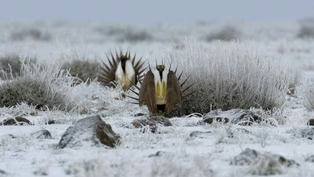
Greater Sage Grouse on the High Desert Photo Essay
Video has Closed Captions
Clip: S37 Ep8 | 1m 44s | The strange beauty of greater sage grouse in the high desert in spring. (1m 44s)
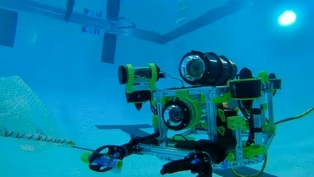
Video has Closed Captions
Clip: S37 Ep8 | 10m 43s | Students on the Oregon Coast build underwater robots that compete on the national level. (10m 43s)
Providing Support for PBS.org
Learn Moreabout PBS online sponsorship New Episode
 New Episode
- Drama

Lesley Manville and Tim McMullan return in the final installment of the Susan Ryeland mysteries.


 New Episode


 New Episode

 New Season

Support for PBS provided by:
Oregon Field Guide is a local public television program presented by OPB