Call The Doctor
Joint Replacement
Season 34 Episode 9 | 25m 20sVideo has Closed Captions
What's new in the world of joint replacement?
If you're one of the many people in this area suffering from hip or knee pain, joint replacement surgery is an option that can help alleviate that pain and get you back to your everyday activities. It's not always an easy recovery, though, and some experts say the key to a good outcome is keeping the patient moving as much as possible.
Problems playing video? | Closed Captioning Feedback
Problems playing video? | Closed Captioning Feedback
Call The Doctor is a local public television program presented by WVIA
Call The Doctor
Joint Replacement
Season 34 Episode 9 | 25m 20sVideo has Closed Captions
If you're one of the many people in this area suffering from hip or knee pain, joint replacement surgery is an option that can help alleviate that pain and get you back to your everyday activities. It's not always an easy recovery, though, and some experts say the key to a good outcome is keeping the patient moving as much as possible.
Problems playing video? | Closed Captioning Feedback
How to Watch Call The Doctor
Call The Doctor is available to stream on pbs.org and the free PBS App, available on iPhone, Apple TV, Android TV, Android smartphones, Amazon Fire TV, Amazon Fire Tablet, Roku, Samsung Smart TV, and Vizio.
Providing Support for PBS.org
Learn Moreabout PBS online sponsorship(downbeat music) - [Man] The region's premier medical information program Call the Doctor.
- [Woman] Each year in the United States, doctors do almost 800,000 total knee replacement surgeries and 450,000 hip replacement surgeries.
And that's a number that continues to grow as the population ages, those statistics from the American College of Rheumatology.
In some cases, partial joint replacement surgery can be an option as well.
But some experts will tell you that joint replacement surgery has come a long way.
In some cases requiring less recovery time than before, who's a candidate and what might they consider before the procedure even happens?
We asked the people who would know, what's new in the world of joint replacement now on Call the Doctor.
- And hello and thank you for joining us for this new episode of Call the Doctor.
I'm Julie Sidoni I'm the news director here at WVia and I'll be your moderator for this season.
As you just heard, we're talking this episode about joint replacement.
So many people in northeastern and central Pennsylvania have knee hip and shoulder pain.
When does that pain rise to the level of needing a joint replacement and what options are even out there?
What's the recovery like if you do undergo such a procedure?
We've assembled a panel of experts on this topic and happy to introduce them to you now and actually I'm gonna have you introduce yourselves if that's all right.
We'll start here.
Just tell us a little bit about who you are, where you're from and know why you're here with us today.
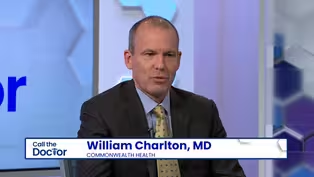
- Thank you, Julie, I'm Dr. William Charlton.
I'm employee at Orthopedic Surgeon at Commonwealth Health and I've been in the area as an orthopedic surgeon practicing since 2000.
Originally, went to medical school at Jefferson and trained at Rothman Institute for orthopedic surgery and a fellowship in California Kerlan-Jobe and have been here ever since.
- Right, welcome.
- Thanks.
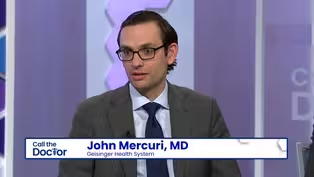
- Hi Julie, my name is Dr. John Mercuri.
I'm a adult hip and knee reconstruction surgeon at Geisinger.
I'm also from Lackawanna County natively.
I was actually born at CMC and still work at Geisinger CMC so it came full circle.
But my practice sort of focuses a lot on robotics and computer technology and augmented reality and joint replacement and I perform a lot of revision procedures on sort of problematic joint replacements.
And so that's where I spend most of my time.
- We'll get into that I'm sure.
And you sir.
- Julie Dr. Tom Meade, I'm an orthopedic surgeon with Lehigh Valley Health Network.
I'm a native of Pittston, and I guess in brief summary I left here 40 years ago after high school now I showed up 40 years later as an orthopedic surgery, orthopedic surgeon but in the meantime, I stopped at Penn State for a few years, I went there to dive and I got an education there which was good.
Then I went to what Jefferson where I went to medical school and did orthopedic training and made a quick trip to Cincinnati for a year of knee and sports medicine training.
And then I practice for a while in Allentown but my life goal was to come back to my hometown practice in Pittston, and open the practice here in 2014 on Oak Street.
And I limit my practice to knees and it's great to be in my hometown treating people that I grew up with and their families.
- You're sitting here in the Pittston area, you can't get away.
Well, thank you to all of you.
This is a topic that seems to be sort of swirling around me.
I know a lot of people recently, maybe even before COVID who have undergone replacement surgeries.
Typically I think about knee and hip, but you bring up that shoulder replacements also are happening.
I mean, tell me a little bit about that.
That's one I'm really not familiar with.
- I mean, I've been doing it since from training.
So it's pretty routine for me, but I do hip, knee and shoulder replacements and there are over 50,000 performed in the United States last year.
So it is common, depending on the surgeon and your expertise, but the quality of life, the outcome is fantastic.
It really is and recovery is actually quicker than a total knee and up there with the total hip and as we can discuss it.
I mean, the recovery is the quality of life, the patient satisfaction is very high.
- There's probably a lot of answers to this next question, but I'll let you sort of take who needs to have a joint replaced?
Is it always arthritis?
Is it always an injury?
Or is there are there a lot of different reasons where someone might have a deteriorated joint unless you'll take that too Dr. Mercuri.
- Yeah, might be hard to encapsulate, I guess, succinctly, it's to your point there can be a lot of reasons why it happens.
I mean overwhelmingly the most common reason is osteoarthritis, which would sort of be the wear and tear that happens to a joint over the span of somebody's life.
And so for the most part you generally will hear about joint replacements happening in people that are a little bit older age because they've put sort of those miles on their joint that they needed to have a joint replacement for osteoarthritis.
But there's a wide variety of other scenarios where it can happen.
Sometimes it can happen after the setting of a trauma or an accident to the joint where there can be a post traumatic arthritis, there are people where they may have autoimmune type of problems like rheumatoid arthritis.
There's young women sometimes frequently can come to my office who as a result of having hip dysplasia have sort of had their hip joint breakdown at a much younger age than it should have due to issues when they were small baby, small child.
And so there can, there can sort of be a lot of peripheral reasons for joint replacement other than just osteoarthritis.
- When does joint pain rise to the level of something that you might wanna take care of?
Or is it not quite that cut and dry?
- Well, you know these are great questions, surely, cause we hear them every day in the office.
So you sort of have to know how to answer them and people will look you in the eye and say, how do I know when I need a joint replacement?
I say well, you never really need a joint replacement.
I said the human race did very good without joint replacements for many years.
60 years ago, there were no joint replacement.
- [Julie] 60?
- 60 years ago, there were really no joint replacements to say, and what did people do, they slowed down, they used the cane and they got a walker, and they just sort of dealt with it.
But now you live longer, and we have better technology.
So it really becomes a quality of life issue.
And that becomes a very individual decision.
And patients have different degrees of pain tolerance.
There's some people that can just say well, I'm pretty happy slowing down and doing what I want.
But other people say this is not for me, I have one life to live and I would like a better quality of life.
And then we go into discussion of what the risks and rewards are and that leads to a discussion of joint replacement.
- I feel like 20, 30 years ago, you think of joint replacement as something for the older set but it seems to me and correct me if I'm wrong, it's happening earlier, what is there an age recommendation?
Or is there age that you like a patient to hit before you even talk about it?
Or is that all completely out the window now?
What do you think?
- I think there were more strict guidelines years ago and I think we were limited in outcome data.
So really, you see how do we, it's based on science.
So you do studies are based on a select group of patients and you follow those patients up at 10 years after joint replacement or 20 years.
And we had no 30 year data.
Well now we're actually getting that data back and we see that the retainment rate is actually very high.
And the quality of life as Dr. Meade mentioned is very high as well.
So now we're sort of adjusting those restrictions are, and there really isn't a restriction.
Unfortunately, there are early arthritis in some patients due to devastating trauma, devastating diseases like rheumatoid arthritis or congenital problems.
And really, these patients are at a loss, significant symptoms and disability at a very young age.
So generally the numbers have come down and 50s, no question, 40s, and I don't wanna say any specific age restrictions, but I mean, in my practice, I treat the patient, the individual patient, and age is a factor we wanna maximize non-surgical care.
But at some point surgery is an option.
- [Julie] For anyone?
- Yes.
- Who would not be a candidate for a joint replacement?
I mean, what do you if someone and I realize you're surgeons, but when someone comes to you wanting a joint replacement, are there people who you can say, I'm not sure this is right for you?
And why would you make that determination?
Anybody can take that really.
- So I think the better way to think about it is that you don't want to do surgery on somebody if they're not gonna have the great outcome that we're talking about, where they get 30 years and all this great quality of life and everything is great.
And there are aspects of a person's overall medical history and health that can make it more or less likely that somebody may need to take a period of time before having their surgery and make sure that everything is as optimized as it can be.
There are higher risks that can happen for example if people have poorly controlled diabetes, there are higher risks that can happen if people have very excessive amounts of body weight.
There's a high risk can happen if people are very heavy smokers for example.
And so these people may come to see us in the office and just an x-ray and not talking to them as a patient.
Their x-ray says oh wow you have horrible degenerative arthritis in your joint, you really would get a lot of benefit from a hip replacement or knee replacement but we need to take some time.
We need to work together, we need to work with your primary care doctor or with your endocrinologist or your whatever, to sort of make it safer for you to undergo the surgery because we don't wanna do something unsafe and actually leave you worse off.
We wanna try to make you better.
- Is it the risk though, for the surgery itself, as opposed to what would actually go into a joint?
Or is it the whole ball of wax?
- It's largely risks of complications that can happen after the surgery.
Things that we think about frequently sort of the joint replacement world is infection.
There's always a risk that can happen with the surgery and some of these things that I mentioned, can increase that risk.
And we wanna make that risk as low as possible.
Wound healing problems, blood clots, all these sorts of things are, we can't just think of the patient as only like this hip or knee that needs to be taken care of, there's sort of a whole person and gotta make sure the whole picture makes sense.
- What about a partial versus a full?
What determination goes into figuring that out?
Or is that a case by case basis depending on the amount of damage in the joint?
Tom I'll give that to you.
- So if you look at the data on joint, on partial joint replacements, and it's sort of confusing when a patient says, can I have a partial joint replacement.
So well, only if you're a candidate for that.
And if you think of the knee, don't think of the knee as one joint, we think of it as three joints.
You sort of have an inside part and outside part and the kneecap.
And so if one of those three parts is worn out, then you can have a partial knee replacement, but the real numbers are less than 5% of all the total knees in the country are partial knee replacements.
So it's not a really big number.
And of those, the inside part of the knee is probably more common, called the medial unicompartment arthroplasty.
So of those 5%, the outside of the knee is less, probably 1/10 of that percent.
And then the kneecap is another part.
But the outcomes aren't as good.
So you have to go through all of that and if you haven't confused the patient by that time you bring out a model, and you sort of show them.
And but as John and Will said, it's sort of dictated by the pathology and it's a good operation for the right problem in the right patient.
- This might be kind of a silly question but I've always wondered what is actually going into my knee or my hip or my shoulder?
What is it?
- We have our own a little explanation cause we do this every single day.
So I mean, so we have models in the office, it's actually we should have probably brought one here but, and so what I emphasize to the patient, we're not cutting the knee out, it's really recapping procedure.
So you have the end of the femur bone and the tibia with some cushion in between.
So arthritis in essence is loss of cushion.
So effectively, there's bone on bone.
So number one, the question is, oh, can you scope it?
Can you clean out the spurs?
And really you can't clean out what's not there.
So arthroscopic surgery or the tiny incisions with the camera really aren't, there's no benefit to perform that in knee arthritis.
So what you do is you actually we preserve the ligaments on the side.
So we can save the ligaments, we kind of dislocate the knee or kind of open it up and we just cut about eight to 10 millimeters off the surface of each bone and kind of recap it.
And then we have a plastic insert in between them.
It's very basic, but that's basically the concept and I call it a recapping procedure, cause it kind of, the patients can understand that a little bit more, and you think without understanding or taking the time that you're cutting the joint out, but really that's not the case.
- Yeah, Mercuri I've always wondered how that worked?
Or what was it a you know, what kind of mold is it actually around, like in the you know maybe some visual aids, we can help out there.
But that's not always it.
- The hips a little bit.
I think in patients mind, if they had to say about like literally replacing part of the joint, the hip is a little bit more in line than a knee replacement.
A hip in its basic sense is a ball in a socket and performing a hip replacement actually involves on both the socket side and the ball side replacing both of those things with prosthetic components that for the most part today are made out of titanium, and high densities plastics and ceramics.
And so the, yeah you're right we should have brought some models, but the, like we do spend a lot of time cause patients say they're curious to wanna know like what are you actually putting in me to take care of this.
- I mean, something that will then carry around the rest of their lives.
So I mean, that's that's kind of a big decision.
Or maybe it isn't if you're in that much pain.
I mean, do you see people who this is just this is a non-starter, it's gotta happen, all the time?
- Oh yeah, I like to describe it to people that you're the person who's gonna make the decision.
You're driving the bus cause nobody's really living in your life other than you are.
And a lot of times there can be some discrepancy, you may see somebody that has a horrible x-ray, and they have very minimal pain.
So you don't just wanna make decisions based on that.
But what I described to people is, you will reach a point on your personal journey with your hip or your knee or your shoulder, whatever it is, where you become emotionally exhausted of dealing with the unrelenting pain that's limiting what you have to do, what you wanna do.
And you just say, you know man, if I could go to my garage, and like take care of this myself tonight, I would really love to.
When people reach that point, it's not hard for them to make the decision, they're like I really need to do this.
- I'd like to talk a little bit about the after the surgery part.
I think there used to be a very long recovery, or at least some amount of recovery and then a lot of physical therapy.
And I've personally seen people go through this.
So, if you could talk a little bit of people want to know, they're not that far along in this decision making process yet, what awaits them after a surgery and perhaps it's different with shoulders and knees and hips, et cetera, we can kind of get into the differences if you like but this, it's pretty serious, right?
The physical therapy that takes place afterwards?
- So again, people will ask this question, they say well, what's the recovery?
How long will it take me to recover?
And I say well, what do you mean?
- That's what I say.
- And they'll look at you and they go well, you know, until when can I walk on it, well, you can walk on it today.
I can walk on it today, oh my yeah walk on it today.
I say you go home today, you go home the same day, and 95% of our new patients, and then you walk them down the road, and you say, it really, you know impacts your life for let's start with the first week and you're on crutches or a walker, the average patient can be off assistive devices after a week, we have patients driving at one to two weeks, and they're all happy, oh, I'll be back to work.
And I go, put the brakes on here.
It's still a real operation.
The biology hasn't changed in 60 years.
So our techniques have changed.
So we've learned a lot of things that can enhance your recovery.
And in general, I'll say you'll get over 70% of it at a month, maybe 90% at three months, that last 10% You'll know you've been operated on for at least a year.
And so it's a little bit of a reality check.
But I think some of the advances have been phenomenal.
If you think one of the biggest complications historically, post-op was really not what we did, but what we gave them which was narcotic analgesics.
So narcotics were responsible for 60% of our post operative why did it take us so long to figure this out?
And how could we now have half of our patients take no narcotics.
- [Julie] Nothing?
- Nothing, well they take, we have a multimodal pain approach.
So they take non-narcotic medications.
But historically, we've reduced the narcotic prescription by a 10th, or a 20th.
So it's been really an amazing change in the recovery.
So a lot of our techniques are less invasive, we don't damage the tissue as much and the patients are better educated.
So we sort of prepare them ahead of time.
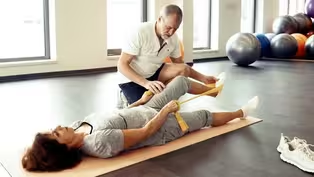
And fiscal, to all these things historically, half of our patients do physical therapy online, or do it themselves.
So I don't wanna have it done because my neighbor had it done, I had it done 10 years ago, it was terrible, I was in therapy for six months.
And I said, hold the boat here they have, I mean even Will and I trained at Rothman, they've basically all their patients do an online physical therapy program at home, it depends on the visual aids they have at home, but it's not the old hospitalization for a weak CPM machine that their leg is in this machine.
So you sort of spend a lot of time reeducating them about the evolution of all the advances.
- That's partially kind of why I wanted you here today, because I think a lot has changed and people seem very frightened of this and maybe they haven't done proper research on it.
Is it possible to describe the surgery a little bit?
And maybe I'll start with you with the shoulder.
But describe what actually happens?
I mean, I know you went through that a little bit already.
But the surgery itself, how long can people expect to be in the hospital?
Or what physically are you doing to get in there?
- Well starts as Tom said about patient expectations, so educating the patient, so they're aware of what's happening so we get appropriate testing beforehand.
Many times we'll make a visit to the hospital to see the environment so they're not intimidated on the day of surgery.
So the day of surgery comes, they're a little more at ease.
Surgery generally is not extensive, usually an hour.
And then patients were mobilized that day.
So and then, expected to go home with that day or was certainly within 24 hours.
Now in terms of the surgery with respect to the surgical approach, these surgeries are done with relatively small incisions anywhere three to five inches for hip, knee and shoulder replacements.
And we in terms of the shoulder, we go approach in the front.
And we have two different types of shoulder replacements, we've never had, for someone with a rotator cuff tear, that's the tendon that lifts your arm, we never had any good treatment for that for someone with a chronic tear or maybe an older patient who's had a tear many years ago.
And now they develop arthritis, and they had difficulty lifting their arm.
So the rotator cuff is the primary elevator of the arm.
So now we have a different type of shoulder replacement, that's, we have good 10 year follow up, it's called the reverse total shoulder.
And people can kind of, they hear that on social media, they're aware of this terminology.
So it's a different type of shoulder replacement, same type of approach but this provides the deltoid muscle, this big muscle out here will be the primary driver of the shoulder.
So we amazing function with someone with no rotator cuff and really no previous surgical option.
So in terms of the shoulders, we have two different kinds and basically it's a three inch incision in the front, an hour and you're home the same day and using a sling for a week.
Yeah and you're starting therapy and again, I have encouraged home physical therapy, no question about it.
And then high level activity, generally, all joints for me, I tell patients and we all have our own little spiel, which is interesting, because I say the same thing.
How long, what's your recovery?
I'm like, recovery is all relative, like what do you wanna do?
But generally six to 12 weeks before you're back to work out with families and friends standing all day or working.
- But are you ever playing tennis again?
- Oh yeah, definitely.
Lift weights and yeah.
- I think that's kind of what people are-- - That's why you do it.
- To get back to all those things you wanted to do all that time.
What about, I know we have just a couple of minutes left here, but I'll let you get into the hip and knee.
- Yeah so you know, for my surgeries Geisinger has made a lot of investment and a lot of the new advanced technologies.
And so, my surgery is a little bit of a different experience for the patient.
There's oftentimes preoperative CT or MRI scans, they're gonna use to create 3D models of your hip or your knee and a computer environment.
The surgery, I then basically do virtually-- - You practice it sort of?
- Yeah, to some degree, yeah and pick out what size pieces need to be, where's the position in the hip gonna be of each of these pieces and how to rebuild your hip joint exactly as we want it or in the knee joint, a lot of recent changes in the thinking about how to rebuild a knee joint in terms of the sort of angles and positions that these pieces are put in.
And then there's sort of a whole variety of different ways to take that plan and then make it happen during the surgery.
So I'd say about half of my surgeries right now we're using robotic assistants in the operating room to help take this plan into reality.
I'd say the other half of the surgeries are using a lot of sort of custom made instrumentation for the patients based off those plans and the newest thing that Geisinger is investing in right now that we're working on them doing tomorrow actually is starting to incorporate augmented reality or virtual reality into the operating room to help take that plan and put it into action during real surgery.
So that side of it's kind of evolving in the technology realm pretty rapidly right now.
- It's another example of how far this is coming.
And I guess the last question to you, is there any misconceptions that we haven't gone over already today?
What's the message that you would like people to take from this panel?
- We could have a whole show on misconceptions Julie and dogmas, the things that people commit and ask questions about and I think that 50% of the people put off having joint replacements because of fear.
And so you spent half of the time trying to talk them through the fear and probably the biggest advance has been pain management.
How can we go from keeping people in hospital for seven days and then two weeks and rehab and having epidural catheters and nausea and vomiting, to waking up literally in a recliner chair, walking, going to the bathroom, having coffee and juice and going home that morning.
And really the prosthesis hasn't changed that much in 30 years.
And really our surgery is still to make a hole in the body and put some plastic and metal in we're a little better at it for sure to do that.
But really the big differences we figured out a lot of the pain management and how different medications work at different parts of the, so one of the biggest misconceptions is how painful this is and and how immobile and tied up they will be in their life postoperatively.
- Thank you to all of you, very much appreciated we're really glad you've joined us for this episode of Call the Doctor.
For all of us here at WVia, we'll see you next time.
(downbeat music)
Preview: S34 Ep9 | 30s | Airs Wednesday, April 27th at 7pm on WVIA TV (30s)

Providing Support for PBS.org
Learn Moreabout PBS online sponsorship
- Science and Nature

Explore scientific discoveries on television's most acclaimed science documentary series.

- Science and Nature

Capturing the splendor of the natural world, from the African plains to the Antarctic ice.












Support for PBS provided by:
Call The Doctor is a local public television program presented by WVIA