
Junk in the Trunk 8
Season 22 Episode 26 | 52m 50sVideo has Closed Captions
Experience all-new and previously unaired Season 22 appraisals
Experience all-new and previously unaired Season 22 appraisals, including a 1962 and 1963 Mercury Atlas #8 & #9 archive, a Rasht horse cover made around 1875, and a purple sapphire ring. Which is appraised for $60,000-$120,000?
Problems playing video? | Closed Captioning Feedback
Problems playing video? | Closed Captioning Feedback
Funding for ANTIQUES ROADSHOW is provided by American Cruise Lines and Ancestry. Additional funding is provided by public television viewers.
Support provided by:


Junk in the Trunk 8
Season 22 Episode 26 | 52m 50sVideo has Closed Captions
Experience all-new and previously unaired Season 22 appraisals, including a 1962 and 1963 Mercury Atlas #8 & #9 archive, a Rasht horse cover made around 1875, and a purple sapphire ring. Which is appraised for $60,000-$120,000?
Problems playing video? | Closed Captioning Feedback
Where to Watch Antiques Roadshow
Antiques Roadshow is available to stream on pbs.org and the PBS app.
Buy Now

ANTIQUES ROADSHOW's 2026 Production Tour
Enter now for a chance to win a pair of free tickets to one of the three stops on ANTIQUES ROADSHOW's 2026 Tour. Sweepstakes entry deadline is April 6.Providing Support for PBS.org
Learn Moreabout PBS online sponsorshipMore from This Collection
Check out all of our Junk in the Trunk specials!
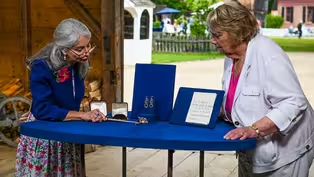
Video has Closed Captions
Travel to all five cities of ROADSHOW's Season 28 Tour for never-before-seen appraisals! (52m 25s)
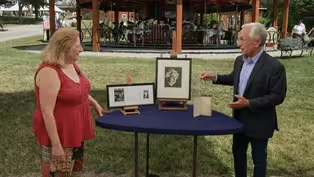
Video has Closed Captions
Catch a trunkful of never-before-seen treasures from ROADSHOW's season 27 tour. (52m 26s)
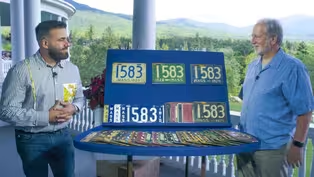
Video has Closed Captions
Discover all new appraisals from ROADSHOW’s Season 26 tour, like a find of up to $75,000! (52m 27s)
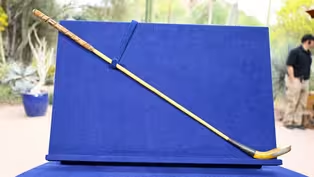
Video has Closed Captions
Discover never-before-seen surprises from our Season 24 tour. One is worth up to $100K! (52m 45s)
Video has Closed Captions
Discover never-before-seen appraisals from all Season 23 cities, like a $40K-$60K find! (52m 29s)
Video has Closed Captions
ROADSHOW’s bigger-than-ever 2014 season includes a second hour of junk! (53m 10s)
Providing Support for PBS.org
Learn Moreabout PBS online sponsorshipMARK WALBERG: "Antiques Roadshow's" treasure hunt from our 22nd season continues, with even more valuable objects to share.
Wow.
(laughs) WALBERG: See all that extra-special stuff right now on "Antiques Roadshow: Junk in the Trunk."
♪ ♪ WALBERG: "Roadshow" launched the 2017 tour in Harrisburg, Pennsylvania.
Thousands of folks got news about their objects, including an impromptu appraisal of one of our experts' recent buys.
On the drive down, I stopped at an antiques mall, and I actually needed this one thing to complete my outfit today, and it's my first watch fob, and I don't know what it's worth.
It looks very much like it could be 1885, 1890.
Right on!
Did you pay more than $350, $400 for it?
No, sir, I actually paid a lot less than that.
Really, what'd you pay?
Got it for $112.50 plus tax.
APPRAISER: I would think that these were from the late 19th century.
The carving is really pretty good.
But on the other hand, there's damage to both of these.
The pair are probably worth somewhere around $150 because of the damage.
If they weren't damaged, the value would maybe double.
APPRAISER: I love how wonderful the engraving is and how it's been flashed in this marigold color, which is very pretty.
Value in today's market at auction would probably be about $100 to $150.
Okay.
I bought this clock when I was 12 years old.
My great-aunt and her husband had owned a store, and he died unexpectedly, and she just closed the store.
Within a few years later, she decided she wanted to sell it, but the guy that wanted to buy it said, "I don't want all that junk that's in that store."
Yeah, yeah.
So she hired me at 50 cents an hour to get rid of all the junk.
I went up and ask her if I could have the clock, and she said, "Do you really want that?"
I said, "Yes, I do."
And she said, "Well, if you give me two dollars, you can have the clock."
I gave her two dollars and took the clock home on the handlebars of my bicycle.
And what year was this?
Oh, this was about '56, '57.
That was a lot of money.
That was a lot of money.
To a 12-year-old kid.
Well, it was a half a day's pay.
Tell me what you know about the clock.
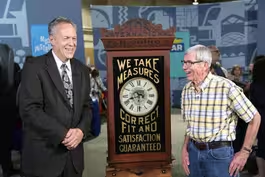
They said it was an advertising clock, that if you sold so many suits of clothes they would give you a clock.
First of all, I've never seen this model of clock before.
I know who made the clock movement-- it was made by New Haven Clock Company in New Haven, Connecticut.
And I can tell that just from the dial itself.
And undoubtedly, this International Tailoring Company provided clocks to general stores.
Have you ever had any restoration work done on the clock?
Yes, I did.
The black had started to peel off.
Some of the gold was touched up when I took it for restoration.
Well, that's good-- it shows very well.
So often we see these patent timepieces or banjo clocks with these églomisé or reverse-painted glasses that have been restored.
Really hurts the value.
In this case, I don't think it's hurt it at all.
I love the clock-- I love the size.
Not having ever seen it, I'm comparing it to other advertising clocks, and I would probably appraise this clock in the $2,200 to $2,500 range.
That's a lot better than two dollars that I paid for it.
My grandfather went to Germany for the reconstruction after World War II, and he was with the American Occupation movement.
He was there for several years and he picked up different various things, and these are two of the prints that he picked up and brought back to us.
He was there for about, I guess, several years.
Your grandfather and your grandmother?
Yes, both of them were there.
They were together?
And my grandmother, especially, was moved by the struggle in Germany.
They said the destruction was amazing, and that the people were... A lot of suffering was going on.
And so this really reflected what she thought she had seen.
And she was seeing this after the Second World War.
Yes.
Presumably in the 1950s?
Late '40s and early '50s, yes.
Late '40s and early '50s.
And do you know who they're by?
I know that it's a Kollwitz?
Yes.
But I don't know anything else about them.
Her full name is Käthe Kollwitz.
She is undoubtedly the most important female artist in Germany in the 20th century.
Her father was a Social Democrat and sort of a union man.
And he noticed that she had a proclivity for drawing early on, and she would basically, as a teenager, draw the workers that came by to his meeting house.
He was a home builder, and sort of a union boss, if you will.
So early on, she was introduced to the plight of the working person.
She was drawn to these figures, particularly a figure like this working woman, because of their beauty initially.
Wow.
And not because she was trying to triumph the working class and the plight of them.
Yeah.
And this is just called "A Working Woman in Profile to the Left."
Okay.
And it's this very humble, beautiful, haunting image.
Yeah, it is.
A woman lit from underneath and just very... Very singular and quiet.
Sort of a heroic image of a working person.
It does, it does.
And you like this one a lot, you were saying.
I love that one a lot, yeah.
And this is great for showing the... I mean, she has these farmers hooked up to a plow.
Yeah, yeah.
And just the plight of the worker, and the toil, and the hardship.
Yeah, right.
That really encapsulates all that.
You've got an etching by Kollwitz closest to you, and a lithograph.
And they're both from the early part of the 1900s.
You can see it's signed down here in pencil.
As is this one.
Yes.
And then on this, you can see the publisher... Right there.
Okay.
And the little text right here?
Uh-huh.
Just saying that it's etched by Kollwitz.
This print here made around 1906.
When it was finally ready for publication, that didn't occur until 1921.
And at that point, the publisher's name, Emil Richter-- who was actually based in Dresden while she was making this in Berlin... I see.
Published the etching.
And this one here from around 1903.
Wow, okay.
So from over a hundred years ago, surviving through the two wars... Her work was actually confiscated and burned during the Second World War, and she was investigated by the Nazis.
By that point, she had already become such a national figure that she escaped any harm.
This was made in an edition of about 150.
Okay.
And this is a much more scarce lithograph.
I see, oh, okay.
Closest to me.
Have you ever had them valued?
What would your guess be?
Oh, I don't know, since I'm on the "Antiques Roadshow," I guess it's maybe $1,000, $2,000, or... $1,000 for each?
Yeah, let's throw that one, yeah.
Well, the one closest to you, the etching of the men pulling the plow, I'd put a replacement value on that of around $4,000.
Oh, wow, okay.
Great!
And on this beautiful lithograph... Yeah.
I would put a replacement value of around $6,000.
So combined, about $10,000.
Wow!
Whoa!
That's really good.
Yeah.
And I love them, on top of it all.
Well, about three years ago, in western New York, there was a tribal auction of tribal artifacts, and this was one of the items that was listed.
I really liked the lines and the angles of it and paid $85 for it.
Tried to do a little bit of research on it.
I'm thinking it could be from Western Africa, I'm not sure.
First of all, I want to tell you that authenticators are a little strange.
Okay.
When we look at an object, we don't look at it and say, "Why is this object real?"
We say, "Why is this object wrong?
", and we need to answer those questions.
First of all, the overall surface you see up here on the nose, the forehead, down here on the breast, it's rubbed, the belly button, the end of the arms, down here on the legs.
And then we see also, we've got the nose and the hole there.
And also the hole here on the side.
You got two holes in either of the pigtails that come down.
One of the questions I had is, it was a little bit sharp on those holes.
Because it would have had some red cloth or some metal rings and then red cloth in the ears.
Okay.
So that is something that we want to answer.
You have, again, more wear down here, exactly where you'd expect it, on the base.
So we have a couple of small questions on the holes, and we're gonna think about that.
This is supposed to come from the Bamana tribe, and the name of the piece is "Dyonyeni," D-Y-O-N-Y-E-N-I.
The Bamana tribe is in Mali, West Africa.
When you look at this object and you see the kind of wear, I feel very, very good about this being late 19th or early 20th century.
This is the appropriate wood.
What specifically the kind of wood is, I don't know-- we'd have to get it tested.
And it's an object that's danced at the end of initiation ceremonies where the dancer holds it and then he puts it in the center of a circle, and it celebrates the end of the initiation.
Okay.
So now, does that make sense with the way it's handled?
In fact, it does.
The way the arms are worn, and the face, and again the breasts, so that makes sense.
There's a couple of stylistic aberrations that we want to address, as well.
The nose is a bit long.
That can be answered by the fact that the neighboring tribe is Malinke, and Malinke have longer noses.
Some of the "Dyonyeni" pieces have no eyes.
This does have eyes.
So that's an issue.
Maybe it's a problem.
Some of the pieces are female, which this is.
Some are hermaphroditic, which would be both genders.
Now, as an authenticator, I want to be exactly sure.
So what I'm going to do is, I'm going to give you a value... which-- I believe this to be absolutely authentic.
This piece at auction or for a good insurance value is going to be $30,000 to $40,000.
Wow-- fantastic!
Unbelievable.
You didn't expect that, did you?
Wow, no, I did not.
I think this piece needs more work, and I'd want to really be able to have an authenticator study it.
In the event it turns out not to be authentic, I think it's still an absolutely extraordinary figure and very beautiful.
I would put $800 to $1,200 as an insurance value.
Uh-huh.
♪ ♪ WALBERG: "Roadshow" touched down in the football-focused city of Green Bay, Wisconsin, where many folks seeking a winning appraisal got some good news from our experts.
This was commissioned by my grandfather.
We think he had it painted in the 1930s to have it displayed over, like, when you take animals to the county fair.
What they'd do is, they'd make a big mold-- usually out of plaster or something like that-- and just spray the expanding foam inside.
Yep.
And they did a great job of painting with the enamel, airbrushing on the face.
I'd give an easy auction estimate of $200 to $350.
Perfect.
It's very striking.
This is actually a pencil.
Very cool.
It might be worth $100, in a retail setting.
It's obviously Batman, Joker, and Robin.
I got it when I was a kid.
Okay.
In high school, we were at a... I don't know, party, gathering.
There was someone there selling a couple of posters that we thought at the time, and I wound up paying $50 for this one.
So, this is more than a poster.
This is an art proof by Bob Kane.
Now, Bob Kane is a DC legend.
He was the co-creator of Batman, with Bill Finger, for DC in 1939.
Okay, all right.
And see, "Artist: Kane."
Sure.
And when you see this code "L-8800," that was the production code for when they were going through the printing.
It's a great work of art for DC.
It doesn't get better.
Joker playing with Batman and Robin like puppets.
Dude, I love it!
You're looking at a piece like this, for a proof, $1,500 to $2,500 at auction.
Yeah, really?
Any day of the week, oh, yeah.
Wow.
I can't even believe it, dude-- that's awesome, man.
No problem.
Thank you.
Thank you.
WOMAN: A few years ago, my husband and I bought a house with the contents, and this was up in the attic.
It's an oil on board by Alfred Sessler.
He was a Wisconsin artist, born in Milwaukee, and ended up at the University of Madison as an art professor.
This was done in 1950.
He was an art student during the Depression, and that really affected his work.
As you can see here, he's depicting a worker, and he was often depicting the common man or the struggle of the laborer class.
He was a muralist.
He worked for the federal works projects, and did a lot of prints with the WPA.
I would say at auction, this one would be about $2,000 to $3,000, very conservatively.
Alone, a Heydenryk frame would be in the several hundred-dollar range, so added to the value of the painting, you're looking more at about $2,500 to $3,500.
(laughs): That's fantastic.
Well, in the early 1930s, my father went to Persia to teach for three years, and he bought many items-- rugs, and amber, and this horse blanket.
Supposedly, when he bought it in the 1930s, it was a hundred years old already.
He supposedly paid about $100 for it, and that's really about all I know about it.
Yes, it is from the 19th century, so it was old.
It may not have been a hundred years old at the time... Okay.
But it definitely was made in the 19th century, probably in the range of 1870 to 1880.
This would have fit over the horse, so this section would have been in the back, over the rump.
It's called a Rasht horse cover.
Rasht is a city in Northwest Persia that borders the Caspian Sea.
And it was known as the gateway to Europe-- there was a major trade center with Russia and Caucasia and Iran.
They were known for beautiful needlework.
And this piece is representative of the height of some of the most beautiful Qajar-era work.
Really.
Which, and the Qajar era was from the late 1700s until the early 1900s.
And this most likely was a dowry piece that was made by the bride's family.
And it could have been for a wedding ceremony or something else like that.
And it wouldn't have been used more than a few times before it was put away, which is why it's in such wonderful condition.
The technique itself is a combination of mosaic work, where they're taking pieces of broad cloth and working them in with each other.
And then appliqué, which is shown in these flowers where they've taken a small piece of another cloth and sewn it on top.
And then on top of the whole piece, they've done this incredible embroidery in silk.
So this was all done by hand.
It was all done by hand.
Wow.
And a real labor of love.
Wow.
And it's one of these most beautiful ones I've ever seen.
Wow.
From a standpoint of color, magnificent colors.
The green in this border... Usually, when you see green in old textiles, it's faded to sort of a blue-green, because oftentimes, the yellow fades, so the green is really beautiful.
The designs at the bottom are recognizable to many people as paisley.
But in this culture, they're referred to as boteh.
And this is a design that's been around for centuries, and it's so beautifully represented in this border.
I would say you would have to insure this for $15,000.
Okay.
Wow.
It's one of the nicest I've ever seen.
WALBERG: Thousands of collectors met "Roadshow" in St.
Louis for a full day of surprises.
APPRAISER: There's two ways they built these bodies.
One is that they welded the top to the back to the sides.
This is a process almost like making tin cans.
It's a rolled edge.
The welded-edge ones are really more desirable, but these are really fun to see.
It's got a great look to it.
It was made exclusively for the American market to export to America.
Oh, really?
Because it shows a scene from the Revolutionary War.
It was, like, a dime store thing.
So is it worth four dollars?
Sure.
Maybe ten or $15, you know?
It's a genuine antique, but not great quality.
Okay.
APPRAISER: It's like they used every single different type of pattern that they could get.
It has some wear issues, and it's not in perfect condition.
I would probably value it somewhere in the $400 to $600 price range.
Awesome, thank you!
In 2003, I went to a bachelor farmer's estate auction in northeast Iowa.
He had about 25 years of early-century "National Geographics," which I collected.
When the "National Geographics" came up, it was between me and another guy, and I think we both wanted the "National Geographics," but they had thrown a whole bunch of other boxes and mostly paper things together.
In 2003, for $117-- I remember because I had $125, and I thought, "That's all I can go"-- I got the "National Geographics."
But in the boxes, looking through, I got about 20 posters.
And this is one of them.
They've been kind of in my closet since then.
It is a World War II poster, and it was designed in 1942 by Karl Koehler and Victor Ancona.
And in the sort of pantheon of imagery from Second World War images, this one is really one of the more haunting.
They're trying to vilify the enemy, and the psychological concept behind that is, the more that we hate the enemy, the more willing we are to enlist and fight in the war.
And so they say, "This is the Enemy," and they depict this weasel-like Nazi officer with his beaky nose, and in his very Germanic monocle, you see a man hanging from the gallows.
Everything about it exudes nastiness, and yet it does it in a compelling way.
Right.
And it really does impress upon us the fact that this man is not a nice man.
It's such a wonderful way to do a horrible image.
It resonates for that.
And when I say that it resonates, it doesn't just resonate with me.
This image was entered into a very prominent national poster competition in 1942, sponsored by the Museum of Modern Art in New York.
So not a fly-by-night institution, by any means.
Sure, sure.
And this was the winning entry.
Now, when the government printed posters for the war effort, they printed tens of thousands of images to distribute all around the country.
When the museum printed these, or when they were printed after the competition, we don't know how many were printed, but intuitively, it was a lot less.
So this is much scarcer... Okay.
...than other World War II posters.
When this comes up at auction-- not in a military sale-- but when this comes up for auction in a poster auction, or in a graphic design auction-- which it does fairly frequently... Okay.
...it sells for between $4,000 and $6,000.
Okay, oh, wow.
In fact, the high-water mark for this piece is $8,400, which it sold for in 2009.
WOMAN: I purchased it in 2012 at an online auction, but it was located in St.
Louis.
The home where the auction was located was beautiful.
It was a Victorian old home in... North of the Central West End in St.
Louis.
So, first things first, so, where is it from?
It's English.
Okay.
And it's made of mahogany.
The border is a burl maple or a burl yew wood.
Made in England around about 1830 to 1840.
Okay.
And there's a couple of interesting components to it.
So we have this leather in-set top, so it's like a writing table.
But as I'm sure you know, we can lift this up here, and you've got this interior.
It's got these notches here all around, and so it would have had a divided interior, or compartmentalized.
And that would have been for dressing accessories.
And then here, it's also missing something.
So what do we think that was?
A mirror.
A mirror, exactly.
Okay.
So this is a gentleman's dressing table.
The question would be, how do we know it's English?
Well, the first thing, we look and we have the lock, which is stamped "J. Bramah," which is for Joseph Bramah, and he was an English lock maker that started in the 18th century and continued to do business through the 19th century.
And it's stamped, "J. Bramah patent," and then with the royal crown on there, as well.
Moving down, you've got these wonderful masks.
These are Egyptian-style.
At the end of the 18th century, the beginning of the 19th century, Napoleon did an expedition to Egypt, brought back all of these artifacts, and thus spawned this whole idea of Egyptomania.
People became obsessed with everything Egyptian.
And it moves down to this lovely tapered leg with this inlay.
You see, on each side, there's actually little marks.
Oh, yes.
And there used to be rails on three sides.
There wasn't a rail on the front side because you had to be able to pull a chair under it.
But it's really a lovely piece.
So you purchased it in 2012.
Yes.
How much did you pay for it?
I paid $650, which was a lot.
I mean, I was bidding online, and more than I wanted to spend, but I loved it, and... Okay, it could use a little restoration.
If you replace the mirror plate, maybe added the divided slots back in.
I think, if you were to sell this in a well-publicized auction, I think an estimate of around about $1,000 to $1,500 would be appropriate.
Okay.
Very good.
All right?
That's wonderful.
Thank you.
MAN: My wife's grandfather was a employee of U.S.
Steel and a diplomat for the United States after World War II.
They were world travelers, and they acquired it either in the 1920s or in the 1940s.
What do you know about it?
I think it's a 19th-century vase, cloisonné from China.
It was appraised in the 1970s by a local St.
Louis appraisal house.
And they gave it a value of $350.
Beyond that, not too much, other than the fact that at that point, they stopped putting umbrellas into it.
I can see how an appraiser might think that it's Chinese, because there's an oxblood red color, which you can see in a lot of Chinese 19th-century and earlier porcelain vases, and of course the dragon symbol.
Yes.
But actually, it's Japanese.
Okay, good.
And it's made during the Meiji period, when Japan just became open to the West.
Okay.
The dragon is a symbol of an imperial authority.
It's beautifully done.
Things like this were actually made by highly skilled artisans who made other things before the Meiji period, who were now employed in making art for the West.
What attracted me to this piece was the color, the design, which Japanese art was really known for in that period, and what attracted Western collectors.
You're right, I think this was done around 1890 to 1910.
Okay.
Not by a particularly known factory, but beautifully designed.
There are a few flaws in around the dragon's nostrils here and in the back.
Okay.
Round in here.
Okay.
Where the piece has been just a little bit beaten up.
But by and large, it's in great condition.
$300, hm?
$350.
$350.
In 1970 dollars.
In 1970.
Well, in today's auction market, this piece would be estimated at about $2,500 to $4,000.
Great, good-- I'm glad.
The Japanese market has softened up a little bit over the last 20 years.
If you had brought this into the Roadshow 20 years ago, I probably would have said $6,000 to $10,000.
Okay.
WALBERG: Next stop, the Big Easy, New Orleans, where it wasn't hard to find a wide variety of treasures from all over the... globe.
That's a nice globe.
Do you know anything about that globe?
Nothing.
Well, that's why you come to the Roadshow.
That's right.
Find more about it.
APPRAISER: You have an old mine-cut diamond, and then you have little rose cuts around in this scroll frame.
Okay.
And calibré rubies there.
I think this is probably Edwardian Belle Époque, which is really, starts in 1895 and it goes on to 1915.
MAN: It's a piece of advertising memorabilia from George Ohr, the Mad Potter of Biloxi, Mississippi.
And when you hold it up to the light, there's a great lithophane with his photograph and his handlebar mustache, and it says, "Georgie Ohr, art and novelty potter, Biloxi, Mississippi."
So I can see it through here with some difficulty-- it's really tiny.
Today at auction, I think the value of this piece, easily between $2,000 and $3,000.
I wouldn't be surprised if it brought more because it's so rare and such a really cool piece.
This hard hat belonged to my uncle.
He worked for Mobil Oil Company, and back in the late '60s, early 1970s, he was sent to Nigeria.
He helped the Nigerian oil companies develop their oil fields.
In conjunction with his time spent in Nigeria, he received this hard hat.
Is that the name on the front of the hard hat?
Yes, it is, Oliver Rufus Malone.
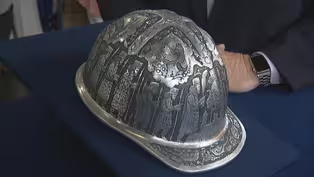
There are other hard hats like this that are decorated with all this carving, and they're always aluminum.
These are American hard hats.
This one, if you turn it over and look at the lip, there's the name of the company that manufactures the hard hats for the American firms that sent them over.
These guys would have them decorated up like this, and I've seen probably a half a dozen in galleries and just scattered around the country.
These figures appear to be Coptic Christian marchers going around.
Okay.
And they're not of the era.
Every so often, you'll see them that have oil derricks on them and that sort of thing.
Right, right, right.
But this is sort of the high art of the oil fields.
And I've never seen anything else like it that comes out of the oil field.
Yeah.
Every so often, you'll see a painted one.
These things are the coolest of the cool.
Yep.
There's animals carved into the top.
It is a wonderful piece of art.
Yeah.
They're all over the place price-wise.
Being very conservative, if this came up for sale, I would expect it to be $600 to $800 in an auction.
Very good.
In a gallery, I would think it would be $800 to $1,200.
They're just fabulous things.
WOMAN: I brought in my collection of 13 miniature clocks.
My mother and my father were clock collectors.
My dad would buy hanging clocks, and my mom would buy little clocks.
And the first one she ever found was this one.
And over the years, it grew to 13, and they all were lined up on our mantel.
Do you have a favorite?
I think this one's really special with the little spot.
My favorite color is green, so I love the green one.
My mother's favorite was this one and the blue one, because blue was her favorite color.
Okay.
But this one has the stones in it.
And this she always said was the most valuable.
I don't know.
Well, these are all what are called subminiature carriage clocks.
These clocks were all of Swiss manufacture.
They were made between 1900 and roughly 1925.
And they were sold as sort of little tchotchkes when you traveled over in Europe.
You'd buy them in finer jewelry stores or in clock shops.
It's a nice representation of what types of things were available, the styles of cases that were available in this type of grouping, if you will.
They are very, very colorful.
Yes.
You have this wonderful little turquoise, and the pink, and this one sort of an alabaster, almost a pearl color.
Swiss movements, designed to run eight days.
They're almost like miniature watches in clock cases.
In clocks-- eight days, I never knew that part.
They all had little leather cases and they were pretty torn up.
I have the cases, don't know where they are, but I didn't discard them.
Yeah.
Protective cases usually for travel.
Yes.
And they wouldn't be as colorful in them, so most people did put them in a different location.
Right.
It's unusual to see so many.
As a grouping, we have a nice variation of values.
The first two, this little pendulette here.
Yes.
The first two are the more basic models.
And these would have a retail value of somewhere in the $400 price range.
Okay.
The next grouping, probably closer to $600 to $800 each.
Okay.
So there's four represented there.
And then these next really nice enamel clocks.
If you look very closely at this one, it has a guilloché engine-turned design.
Ah, yeah.
Which is a turned enamel, and they put a cover over it to make it jump out a little bit more.
And it does jump out.
And these would be in the probably $1,000 price range each.
Okay.
The last enamel one is a little bit more interesting in its case design, and as a result, I think today, you probably could get a little bit more money for it.
Probably has a retail value of closer to $1,200 to $1,400.
And the last one, you mentioned the sapphires.
Yes, are they sapphires?
They are sapphires.
They're calibré sapphires, which means they're actually cut specifically to fit in the round.
Fit in the round, okay.
Yeah.
So very nice decorative detail on that.
That one there probably has a value of closer to $1,500 to $1,800.
Wow.
So with 13 clocks, you're looking at somewhere between $10,000 and $12,000.
Wow.
I had no idea what... these were worth.
None!
WOMAN: They were obtained by my father when he was an Army prefecture commander in Himeji, Japan, during the occupation.
He brought these back with him.
APPRAISER: He evidently had somebody pointing him in the right direction, because they're both very nice images, but neither of them are Japanese.
Okay.
Yeah, they're both Chinese.
The one over here, this image here, is an image of the historical Buddha, Shakyamuni Buddha, and this is a very, very early piece.
It's from the Wei period in China.
And the Wei period is 386 to 535.
(laughs): Okay.
That's amazing.
And you have the little stand that's underneath it, was probably put on in China in the 19th century to sell it, and it's just very, very elegant image.
This image here is from the period called the Sui.
And the Sui were the third period of unified China.
And they lasted a very short period of time, but they set the groundwork for the Tang dynasty.
And the Sui reigned only from 581 to 619, with only two emperors.
And the style changes surprisingly quickly into a Tang style... Okay.
...that isn't like this.
But this is an image of Buddha of the future, Maitreya.
Mon... Maitreya.
Maitreya.
Maitreya.
And it has a face in one hand, and then a willow branch in the other.
These images, though they look like women, were actually men.
Mm-hmm.
And they dressed in the style of Indian princes.
So that's why you see the jewels, and the earrings, and everything like that.
Okay.
But now, the stand with this one may not have started life with the figure that's there.
All right.
However, the stand was made at the same period of time.
Both these figures are gilt bronze.
Okay.
And the bronze basically in this is fire-gilt, where they take the actual gold and mix it with mercury and then fire it off, leaving the gold on the surface that they chase.
The corrosion that's on this one is just the copper deteriorating.
They're lost-wax castings.
They'd make a wax model, a container for it, and then pour the bronze in, and get rid of the wax and then they'd be left with the image.
There were probably hundreds of thousands of them originally.
Really?
But very few of them have survived.
These would have been personal items of Buddhist worship.
It would have been inside of someone's house, set up on a little altar with little flower vases, an incense burner, and used as an object of veneration within Buddhism.
This one here, the Wei period, is, it's kind of plainer images, and it isn't that popular because it's a little plain.
But still, at auction, that image would be, like, $5,000 to $7,000.
Okay.
This image being high-style Sui, and the gilding is in very, very good condition, this image here would be probably $10,000 to $12,000.
Fascinating.
So the gilding is... adds to it.
Oh, it does, yeah, yeah.
And usually, they're found scoured.
Okay.
Without a trace of gilding.
So don't touch it.
No, no.
Leave the corrosion, everything that's on it.
Okay.
Don't clean it up.
All right, that's amazing.
But they're wonderful images.
I love them-- thank you so much.
WALBERG: Curiosity about heirlooms, collectibles, and works of art drew a sold-out crowd in Portland, Oregon.
Family photo albums would often have political figures in them so the family could identify itself with its alliance during the Civil War.
So the very first image in your album is a photograph of General Grant.
The panel is from something else, and they've, you know, fashioned this box around it.
The panel is kind of folk country carving.
It's probably 1840, 1850 vintage.
Older than I thought, yeah.
And then the box itself is 20th-century, but it's a sweet little thing.
APPRAISER: This is the kind of thing that could have even been made around there, in Tennessee.
Normally, a pair of these would not sell for more than $50 or $100, but I bet you because of... because of the hardware, and the provenance, and where it came from, those are probably worth $300 or $400.
Oh, wow, cool.
I love them.
We paid $40 at a thrift store for it.
WOMAN: My mom was in France last year and was spending about a month there, and one of the things she wanted to do was visit several of the flea markets.
And so she found the large one at one flea market, and then the other two at a different flea market while she was there.
She used to be a florist, so she really is drawn to flowers.
And kind of goes in with the rest of her theme at home, and just really liked the flowers, so she came home with them.
Well, I'm so impressed with that.
Did she explain to you what she paid for these?
She did.
The big one was $180, and then the small purple vase was $75, and the cracker barrel was $65.
And that was at two different Paris flea markets.
Paris flea markets, correct.
Well, I kind of guessed that she probably liked flowers, and now you tell me she was a florist.
Florist, yeah.
So that makes some sense.
Yeah.
These happen to be from the late 19th century into the early 20th century.
Okay.
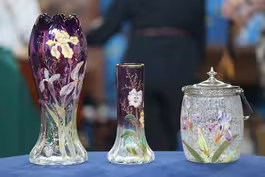
And they're Mont Joye.
Okay.
And that's a French company, actually Paris, France.
A lot of Mont Joye is signed.
These pieces are almost as much as not signed.
These do have little remnants on the bottom of a little marking, but nothing we can read.
This is all enamel work on very, very fine glass.
They used beautiful glass.
So it's enamel, not painted then?
Well, enamel is a painted process.
Is paint, okay.
And then it has this nice ruffled... Almost, if you looked at the top of that, you would think of a rose bowl-type top.
That's very unusual.
Most of them are made with just a straight chop-off across the top.
Okay.
So this makes this one much more rare, and that's a 12-inch.
This one's about eight-inch, a little more common, with pansies.
These are irises, we decided.
Yeah.
And same type of glass.
You can see the carry-through of the beautiful colors.
Then we go on to the biscuit jar.
Very unusual to have a wonderful biscuit jar like this, with this background of these leaves.
Yeah.
That's all enamel, again, irises.
This is a pewter top right now, but it should be re-plated, silver-plated.
Okay.
You can see it's a little worn, but the outside should be this way.
Should be shiny like that.
So it'd be nice and shiny.
She bought it at a flea market.
Correct.
We get asked all the time, "Where do you buy some things where you can maybe make a little bit of profit?"
I think Mom might have done okay.
So this particular piece, again, was... $180.
$180?
Because of this top and because of the size of this, for insurance, this would be about $700 to $800.
Oh, wow.
She did do well.
She did do well.
This one would be probably $200 to $400.
Okay.
Then you come to the little rare biscuit jar.
And this could entertain a price in the $500 or $600 range.
Nice.
WOMAN: It belonged to my grandfather on my dad's side of the family.
My dad was the eldest and it was passed onto him at some point, and then I think my father thought that I might be musically inclined, as a child, and that's how I came into possession of it.
And unfortunately, I've never learned to play it.
I played on it when I was about five, but never knew how to play it.
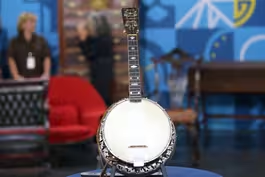
It's a banjo ukulele.
It was made in 1927, which was pretty much the peak of the ukulele craze.
All right.
And Bacon & Day, the company that made it, was one of the premier manufacturers of Jazz Age banjos during the 1920s and '30s.
Bacon & Day was in Groton, Connecticut.
A lot of people would say, "What's a ukulele banjo?"
But it served a real purpose, because ukuleles are wonderful, but they're not very loud.
So if you wanted to play a ukulele and you needed to be heard in an outdoor setting or with louder instruments, like horns or guitars and pianos and things, making it into a banjo was the perfect solution.
This was a ukulele you could hear across the auditorium, not just across the room.
This is one of the highest-quality ones.
It's not highly decorated, but it's made just like their tenor Bacon & Day Silver Bell banjos, which were world-famous at the time.
And it has all the same features that those Jazz Age four-string banjos had.
So for instance, it has, inside the head, there's a special spun tone ring, which was their patented Silver Bell tone ring.
And then the resonator flange, with the little F-hole-shaped... Right.
Everything about it is scaled down to this ukulele size, so that instead of being a 12-inch head or 11-inch head with a larger resonator, everything was made in miniature.
And it could be used with either gut strings or steel strings.
Okay.
Which was another advantage over ukuleles, which could only be strung with gut.
This is a Number 3.
Okay.
So it's kind of in the middle of the range of the Silver Bell ukulele banjos that they did.
But it's really professional-grade instrument.
It was expensive at the time, and they're highly desirable now for people that take banjo ukulele seriously.
Huh!
And in a specialty shop that deals with vintage instruments of this type, it would fetch about $2,500.
That's surprising to me.
I think I thought it might be around $500.
But I never dreamed... it could be that much.
A big part of it is that all of its original parts are there, including the original hard shell case.
Okay.
So it has the original geared, geared tuners.
And it doesn't seem like anything's been lost or altered in any way.
It has some wear.
Right.
But it's what we call honest wear.
Yeah.
That people expect to see.
MAN: Well, this ring belonged to my grandmother, and she purchased it from one Emilie von Blenkendorff in 1935 for $500.
And the idea was, Emilie had fallen on hard times, and she needed some money, and my grandmother was able to help her out, with the idea that she could buy the ring back when she got back on her feet again.
Eventually, I found a letter that said, "My star has fallen and it will never happen.
So the ring is yours to keep for good."
The story I heard was, Emilie was the niece of the ambassador to tsarist Russia, and the ring was a gift from the tsar and his wife.
It's an American setting.
Okay.
1935, it's still hard in the Depression, even though we're climbing out of it-- we're climbing out of it very slowly.
Really, it's the Second World War that brings us out of the Depression, right?
The industrialization leading to the Second World War.
That being said, this is one heck of a stone.
$500 would be cheap even then.
Yeah.
And it's possible that it was from Russian jewels re-set here in America.
You had another appraisal perhaps done on this afterwards, just to ascertain that it's a sapphire?
Yes, and we also had one of the little diamonds on the side replaced-- it had gone missing.
Sapphires are heavy.
They're 15% heavier than diamonds.
I took a good close look at it, it has a formula-- considering the fact that it bulges in the back, I'm seeing something in the 12- to 13-carat range on this.
Oh, my.
I'm seeing also evidence that it has not been heated.
There's a secondary silt growth within it.
So that makes this pretty important.
Hm.
I would still suggest we get a lab report on it.
A 13-carat, untreated, potentially-- I mean strongly potentially-- untreated purple sapphire, of this quality of cut, this quality of clarity, as a retail price, this piece of jewelry can be worth between $60,000 and $120,000.
My goodness!
♪ ♪ WALBERG: Our last tour stop was also our first event of its kind, held in a historic location-- Rosecliff Mansion, in Newport, Rhode Island.
Hurricane José brought the wind and rain, but that didn't stop "Roadshow" fans from bringing their favorite treasures.
APPRAISER: Most of them sell for probably less than $15.
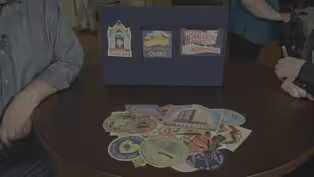
These are probably some of your better pieces just because they're really fantastic graphics.
I would expect a grouping like this to bring anywhere between $1,500 and $2,000.
Wow.
Excellent.
APPRAISER: His stuff is exceedingly rare.
What did you pay for it?
MAN: $195.
If I took this in at $3,000 to $5,000, that seem like a fair value?
Seems good to me.
WOMAN: My grandfather was president of the Wright Corporation, that made engines, and he built the engine for Lindbergh's flights, a lot of his trips.
He built the engine for the trip to Paris.
That was the trans-Atlantic flight.
Yes, yes.
And how did your grandfather get these pieces?
Was it sent to him, they were mailed?
I don't really know.
Okay, you can see on the top, it says, "We carried this flag from New York to Paris," and the date, which was the trans-Atlantic flight, and signed Charles A. Lindbergh.
And it's interesting, because "We" was the title of one of the books that Lindbergh did about his trip.
That's right.
And then down here, you have a second Lindbergh signature.
And this is something he wrote out, it says, "Carried from New York to Paris," and then here's an envelope where it was sent to the Wright Corporation.
So it all ties the whole package in.
This was an iconic flight, keeping in mind that nobody had flown across the... Atlantic before.
...Atlantic before.
As a collection, I would probably put the auction estimate somewhere between $6,000 and $9,000.
(laughing) With the bulk of the value being the flag and the two Lindbergh autographs.
Wow, thank you.
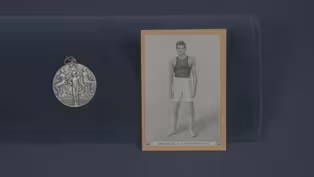
MAN: The pendant is actually an Olympic medal that I got from my grandfather, who won a silver medal, as this is, in the 200 meters in 1912 in Stockholm.
And this is a chewing tobacco card representing him in some facsimile.
He was a bronze medalist in the 100, and he set the world record in the 100.
So your grandfather sets the record in a heat of the 100, but then he wins the bronze.
Now he runs the 200... Yep.
And he ends up winning the silver, this medal... Yeah.
in the 200.
And he loses them both to Ralph Craig.
He was taken from UPenn as a freshman.
Yeah, 18-year-old.
He finished Penn.
Now, it's a shame that your grandfather wasn't able to participate at the height of his powers in 1916, because of the onset of World War I. Definitely.
Well, let's talk about the medal.
You see that it has a bail here.
Now, I believe it was probably added after the fact.
The other thing I noticed with this is that there's some wear there.
Yeah.
And I think that's because he wore it.
The wear might have been, he wore it like a pocket chain watch... Oh!
...and he rubbed it for good luck.
I don't know how much it brought, but... (chuckling): Wore this down a little bit.
What's great about this is that you have, also have the original box of this, and you also have the participation medal.
Yeah.
Which is good, but the main part is that you have the provenance.
Oh, yeah, yeah.
You know where it came from, it's your grandfather, and that means a lot in terms of value.
Yeah, yeah.
If I were going to place an auction estimate on this, it would be $10,000 to $12,000.
Oh, great.
Phenomenal.
WOMAN: It was presented to my father in, I think, October of 1963.
He was coming out of the 14th Naval district in Hawaii, Honolulu, Hawaii, and he was in charge of picking up two of the Mercury astronauts.
He was in charge of making sure they got safely onto the Kearsarge, and back to Pearl Harbor, and safe.
Well, your father, Rear Admiral Buchanan had a rather storied career.
He was in the Navy during World War II, saw action in Iwo Jima, and at Okinawa.
Okinawa.
And then after the war, he was commandant at Annapolis and a few other jobs.
Yeah.
But this was really the crowning achievement, and he retired not long after this.
Right.
What we have here is this seemingly simple plaque with two little aluminum tubes.
Well, these were the recovery antennas from the Mercury capsules.
And you can see one right here at the very, very top.
And these are from two separate missions, Mercury-Atlas 8 and Atlas 9.
These were the last two Mercury flights.
What would happen is, the capsule would come down, it would deploy a parachute, deploy the homing beacon, and that antenna would come up, sending a signal that would allow them to triangulate where the capsule was going to land in the Pacific Ocean.
And well, it'd land in the ocean, and they'd use a crane to hoist it on top of the Kearsarge.
The Kearsarge was used for the recovery of both of the last Mercury missions.
Right over here, we've got a great picture of your father... My dad.
...standing back in his whites.
And do you recognize this little face back here?
John Glenn!
Wonderful.
And then we have Wally Schirra up here.
And what we have here is Wally Schirra, you can see getting out right here.
Right.
The fact that it comes from the family makes it terribly important, because space collectors are very concerned about provenance, especially pieces that have been in outer space.
Yeah.
Anything space-flown raises the value tremendously.
Really?
Especially early Mercury items.
Really?
As a conservative auction estimate for the entire archive, I would put $60,000 to $90,000.
(gasps) Okay.
Wow.
(laughs) Wow!
I had no idea.
No idea whatsoever.
That's amazing, absolutely amazing.
Well, it'll stay in the family, I can tell you that.
Thank you so much!
You're welcome.
That's absolutely amazing.
WALBERG: We hope you've enjoyed this season's "Junk in the Trunk."
But wait, there's more!
Stay tuned for the Feedback Booth right after this.
And now, it's time for the "Roadshow" Feedback Booth.
We brought this wonderful Ming dynasty bench.
Well, it's definitely from China, but it's not a Ming, and it was worth $90.
Yesterday, I tried to find something to bring to "Antiques Roadshow," and I found this bowl under the basement steps.
Found out that it was made by the Tesuque Indians in Santa Fe, New Mexico, around 1900, and it's worth $300 to $500.
And this is my Salvador Dalí etching, and I bought it for five dollars, and it's worth $1,000, so I'm really, really happy.
This is our family heirloom, over 150 years old.
25 bucks.
Woo-hoo!
Thanks, "Antiques Roadshow."
I brought my great-grandmother's antique Winchester rifle.
She was a sharpshooter in a Wild West show, and the value on this was $2,000.
And we brought this ratty old rug that we didn't really think was worth anything.
Yeah.
Turned out it is Navajo, from 1902, and worth as much as $800.
Yay!
Grandmother's candlestick has a Dutch scene on it, and apparently the Dutch are not so popular.
It's gone down in value.
So we can go back in time, it's worth $200, but today about $100.
But we had a great time at the Roadshow!
WALBERG: I'm Mark Walberg.
Thanks for watching this special episode of "Junk in the Trunk."
See you next time on "Antiques Roadshow."
Appraisal: 1912 Stockholm Olympic Medal & Card
Video has Closed Captions
Clip: S22 Ep26 | 1m 42s | Appraisal: 1912 Stockholm Olympic medal & card from Junk in the Trunk 8. (1m 42s)
Appraisal: 1927 Bacon & Day "Silver Bell" Banjo-ukulele
Video has Closed Captions
Clip: S22 Ep26 | 3m 5s | Appraisal: 1927 Bacon & Day "Silver Bell" Banjo-ukulele from Junk in the Trunk 8. (3m 5s)
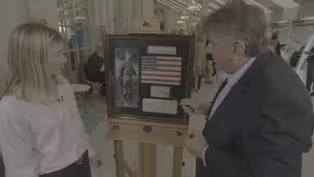
Appraisal: 1927 Charles Lindbergh Flag & Signatures
Video has Closed Captions
Clip: S22 Ep26 | 1m 16s | Appraisal: 1927 Charles Lindbergh Flag & Signatures from Junk in the Trunk 8. (1m 16s)

Appraisal: 1942 Koehler & Ancona "This is the Enemy" Poster
Video has Closed Captions
Clip: S22 Ep26 | 2m 34s | Appraisal: 1942 Koehler & Ancona "This is the enemy" Poster, from Junk in the Trunk 8. (2m 34s)
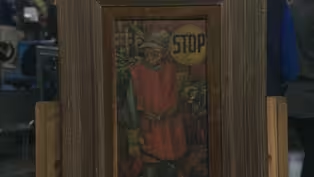
Appraisal: 1950 Alfred Sessler Oil with Heydenryk Frame
Video has Closed Captions
Clip: S22 Ep26 | 1m 9s | Appraisal: 1950 Alfred Sessler Oil with Heydenryk Frame from Junk in the Trunk 8. (1m 9s)
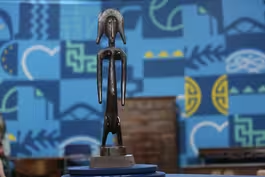
Appraisal: Bamana Dyoyeni Figure, ca. 1900
Video has Closed Captions
Clip: S22 Ep26 | 3m 43s | Appraisal: Bamana Dyonyeni Figure, ca. 1900, from Junk in the Trunk 8. (3m 43s)
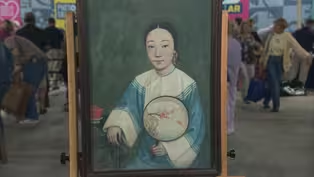
Appraisal: Chinese- export Gouache, ca.1910
Video has Closed Captions
Clip: S22 Ep26 | 1m | Appraisal: Chinese- export Gouache, ca. 1910, from Junk in the Trunk 8. (1m)
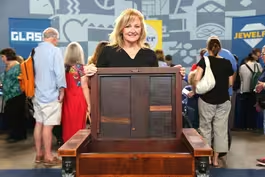
Appraisal: English Men's Dressing Table, ca. 1835
Video has Closed Captions
Clip: S22 Ep26 | 2m 27s | Appraisal: English Men's Dressing Table, ca. 1835, from Junk in the Trunk 8. (2m 27s)
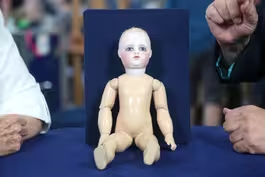
Appraisal: François Gaultier Doll, ca. 1880
Video has Closed Captions
Clip: S22 Ep26 | 32s | Appraisal: François Gaultier doll, ca. 1880, from Junk in the Trunk 8. (32s)
Appraisal: George Ohr Pottery Advertisement Jug, ca. 1900
Video has Closed Captions
Clip: S22 Ep26 | 34s | Appraisal: George Ohr Pottery Advertisement Jug, ca. 1900, from Junk in the Trunk 8. (34s)
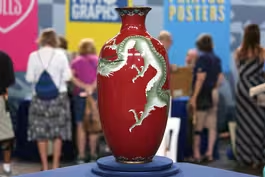
Appraisal: Japanese Cloisonné Vase, ca. 1900
Video has Closed Captions
Clip: S22 Ep26 | 2m 26s | Appraisal: Japanese Cloisonné Vase, ca. 1900, from Junk in the Trunk 8. (2m 26s)

Appraisal: Käthe Kollwitz Etching & Lithograph, ca. 1905
Video has Closed Captions
Clip: S22 Ep26 | 4m 13s | Appraisal: Käthe Kollwitz Etching & Lithograph, ca. 1905, from Junk in the Trunk 8. (4m 13s)
Appraisal: Luggage Labels, ca. 1940
Video has Closed Captions
Clip: S22 Ep26 | 17s | Appraisal: Luggage Labels from Junk in the Trunk 8. (17s)
Appraisal: Mont Joye Glass Collection, ca. 1900
Video has Closed Captions
Clip: S22 Ep26 | 3m 10s | Appraisal: Mont Joye Glass Collection, ca. 1900, from Junk in the Trunk 8. (3m 10s)
Appraisal: New Haven Clock Co. Advertising Clock, ca. 1900
Video has Closed Captions
Clip: S22 Ep26 | 2m 10s | Appraisal: New Haven Clock Co. Advertising Clock, ca. 1900, from Junk in the Trunk 8. (2m 10s)
Appraisal: Presentation Aluminum Hard Hat, ca. 1970
Video has Closed Captions
Clip: S22 Ep26 | 1m 53s | Appraisal: Presentation Aluminum Hard Hat, ca.1970, from Junk in the Trunk 8. (1m 53s)
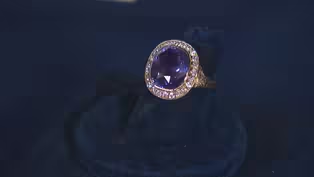
Appraisal: Purple Sapphire Ring, ca. 1935
Video has Closed Captions
Clip: S22 Ep26 | 2m 19s | Appraisal: Purple Sapphire Ring, ca. 1935 from Junk in the Trunk 8. (2m 19s)
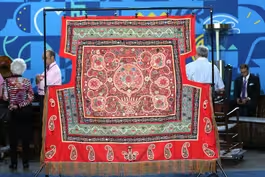
Appraisal: Rasht Horse Cover, ca. 1875
Video has Closed Captions
Clip: S22 Ep26 | 2m 44s | Appraisal: Rasht Horse Cover, ca. 1875, from Junk in the Trunk 8. (2m 44s)
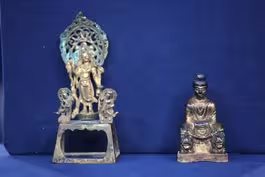
Appraisal: Sui & Wei Dynasty Chinese Altar Figures
Video has Closed Captions
Clip: S22 Ep26 | 3m 25s | Appraisal: Sui & Wei Dynasty Chinese Altar Figures from Junk in the Trunk 8. (3m 25s)
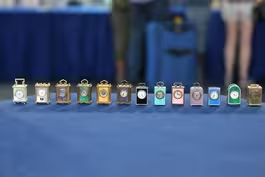
Appraisal: Swiss Sub-miniature Carriage Clocks, ca. 1920
Video has Closed Captions
Clip: S22 Ep26 | 3m 27s | Appraisal: Swiss Sub-miniature Carriage Clocks, ca. 1920, from Junk in the Trunk 8. (3m 27s)
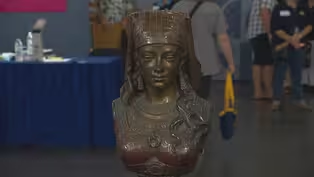
Appraisal: Zacharie Rimbez Bronze, ca. 1865
Video has Closed Captions
Clip: S22 Ep26 | 1m 2s | Appraisal: Zacharie Rimbez Bronze, ca. 1865, from Junk in the Trunk 8. (1m 2s)
Providing Support for PBS.org
Learn Moreabout PBS online sponsorship New Episode
- Home and How To

Hit the road in a classic car for a tour through Great Britain with two antiques experts.
 New Episode
 New Episode

 New Episode







Support for PBS provided by:
Funding for ANTIQUES ROADSHOW is provided by American Cruise Lines and Ancestry. Additional funding is provided by public television viewers.