
Keeping California Wild
Season 8 Episode 4 | 27m 2sVideo has Closed Captions
The continuing struggle to keep California’s deserts, rivers, and forests wild.
California’s deserts, rivers and forests are increasingly under assault from development, invasive species and climate change. From the mountains to the Mojave, we meet the people protecting and restoring the wild places of the Golden State.
Problems playing video? | Closed Captioning Feedback
Problems playing video? | Closed Captioning Feedback
Earth Focus is a local public television program presented by PBS SoCal
Keeping California Wild
Season 8 Episode 4 | 27m 2sVideo has Closed Captions
California’s deserts, rivers and forests are increasingly under assault from development, invasive species and climate change. From the mountains to the Mojave, we meet the people protecting and restoring the wild places of the Golden State.
Problems playing video? | Closed Captioning Feedback
Where to Watch Earth Focus
Earth Focus is available to stream on pbs.org and the PBS app.
Providing Support for PBS.org
Learn Moreabout PBS online sponsorshipWhen it comes to its landscapes and habitats for plants and wildlife, California is one of the most diverse places on Earth, a mosaic of rugged coastlines, towering mountains, and vast deserts, but how do we protect these natural riches for future generations?
Conservation is rarely simple.
There are many conflicting ideas over how best to protect natural resources and whether people's needs should take precedence over preservation.
This program was made possible in part by a grant from Anne Ray Foundation, a Margaret A. Cargill Philanthropy.
[music] Kern River Conservancy's mission is really about helping and supporting recreation management here on the Kern River.
The Kern River is Southern California and Central California's only wild and scenic river.
It is very accessible to areas like Bakersfield and Los Angeles, so we see very, very high numbers of tourism, up to and a little over a million people every summer here.
It is as wild as it can get.
It has wild and native rainbow trout in here.
It is the only river in California that flows north to south, as most rivers either flow west to east or east to west.
Besides that it's wild, beautiful, and scenic, it's amazing.
Hands down, it's up there with Yosemite and other places as far as scenery, as far as remoteness, as far as beauty, nothing gets better than that.
Yes, see, you got it.
Trout Fest is one of our flagship events that we put on every single year.
It's an event where we have all these organizations that are both environmental and fishing, and we all get together and we promote responsible and conservation of fishing.
You're going to wrap the thread around the shank of the hook.
We want people to understand how important it is to conserve our fish.
If there's no fish in the river, that is an indicator that the river is not healthy.
It's real important that you get your hands wet before you grab this fish, because these fish, the only protection they have is a slime layer.
If you touch it with dry hands, it'll get a disease and its mom won't let it go to school.
Go ahead and get your hands wet, and then you can just take them and dump them in.
[indistinct chatter] My name's Randy.
Randy.
Just Randy.
Everybody knows me as just Randy.
Everybody on this river knows Randy.
The campgrounds are full because of the fishing.
The stores are full because of the fishing.
The restaurants are full in the summertime because of the fishing.
All we're trying to do is basically build a bridge between the community and fishing.
We want all these kids to learn to fish.
We want the community to understand how much money is brought in because of the fishing and how we need to protect it, protect this river.
[indistinct chatter] We're a cold water conservation organization that focuses on salmon and trout.
The Kern is really unique in that it supports three endemic--, meaning that they only live in one place, natively in the world.
Yes, three different endemic species, the Little Kern Golden Trout, California Golden Trout, and Kern River Rainbow Trout.
They only live in the headwaters of the Kern.
They've had 90% decline in their population over the last 100 years.
Why?
It's mostly as a result of legacy actions such as mining, grazing, logging, just habitat degradation.
The hatchery is a beacon for the Kern River Rainbow Trout Program.
Unfortunately, it's been closed nearly 10 years now, and we have no idea when it's going to reopen.
Currently, the fish are being trucked in from the San Joaquin Hatchery out in Fresno.
Every single week, Fish & Wildlife will bring trout in instead of having trout being raised here at the Kern River Hatchery.
That's wild, man.
It's definitely a challenge because the hatchery here is not in operation.
It's been closed for a long time.
The Kern is one of the most accessible rivers in California.
The entire stretch from the lower river all the way to the upper river is completely accessible.
You can just park on the side road and walk 10 feet and you're already on the river.
Because of that, that allows access for anyone.
That also includes the campers, anglers, kayakers, boaters.
Everybody can access this river.
It's a great thing to have a lot of access where everybody can enjoy the river, but at the same time, there's the impact, right?
There's impacts of a lot of use of people coming here.
What we see is people are leaving their trash behind.
They're leaving their waste behind sometimes.
That's a combination of just lazy visitors and not having the amenities at each location.
I think the biggest threat to us here on the Kern River is overuse of recreation and tourism that is severely impacting the river.
People.
People.
At the end of the day, it's people, yes.
[music] Behind me, you can see the Kern River.
As you can see, we don't have any water.
It's completely dry.
It's been this way for decades.
It's not because of the drought.
It's not because there's not enough water.
It's dry because of the way the water is being managed and because of the decisions that are being made about around that water.
It's terrible.
It's terrible.
It's terrible for the community.
It's depressing.
You can see all this trash out here.
It's heartbreaking to-- This literally goes to the middle of town.
This is the heart of our town.
It's just completely been devastated.
Although there's no water in the river, it's still full of life.
There's little kit boxes and all kinds of crazy stuff out here.
It's a beautiful place.
It has its own charms.
You just got to give it some time for it to grow on you a little bit.
As much as you like it, would you want to see water in it?
I would love to see water in it, yes.
Yes, I would love to see water in it.
That would make it even that much better.
Water brings life to everything.
Why is the river dry?
In the most essential terms, the river is dry because of the way the water is being managed right now.
The water is just being completely diverted before it ever gets through town.
Some of it is for the city of Bakersfield for drinking water.
That's probably the smallest portion that's being used.
Then the rest of it is for agriculture.
Bakersfield is very much an ag city, and we're very pro-ag organization.
Everyone here really supports agriculture.
We're not here to take away anyone's water or to criticize how anyone uses that water to make a living.
What we're saying is that the water needs to run through the town first.
You need to give the environment and the people in the community an opportunity to enjoy that water before it gets diverted to be put to use.
The Kern River, what I like to tell people is it is the most important and interesting river in California that no one has ever really heard of.
[chuckles] Because the Kern River, back in the 1880s, set California water law.
It's been litigated over since settlers first came here in the 1800s.
In the 1880s, it went to the Supreme Court, the state Supreme Court, and it set California water law.
Right now, there is a lawsuit that is headed to the Supreme Court.
The state Supreme Court has granted review that could have major implications for not just this river but also river watersheds throughout California.
Our organization is arguing that there is a law on the California books called Fish and Game Code 5937, which states that when there is a river, the fish have to be kept in good condition.
You can look out at this river and you can see that the fish are not being kept in good condition because it is completely dry.
We're arguing that this is an objective law and that you need to follow the law in California.
We have sued the city because they're in violation of that law.
For me, that's what success looks like, is water in the river, but also a different form of decision-making and a different culture around this river.
My take has always been that they should make a deal.
The city, the river interests, the plaintiffs, they're the ones that know this river the best, better than me, better than anybody, the people that are operating this river.
It would be great if they could make a deal for the public and for agriculture.
I think the Kern River should be allowed to flow this entire pathway all the way to Bakersfield.
The people of Bakersfield deserve to see a river down there, but you have to change the culture of the people in Bakersfield.
Bakersfield is very pro-water and ag, but it's for the farms.
We get it, yes, the farms, but we're not asking to cut off the farms.
We're asking for the water to be designated for the river as well.
There is a river.
The river should be going through, and the people of Bakersfield deserve a river.
For many people, California's deserts are associated with barren and inhospitable landscapes, but if you know where and how to look, desert lands are filled with an abundance of beauty, plants, and animals.
There's a committed community of environmentalists and scientists dedicated to protecting the desert's diversity.
[music] We've got our bags ready, and start collecting.
Yes.
Great.
Yes, let's do it.
We are at the northern end of the Sheep Hole Mountains in the Mojave Trails National Preserve.
We've recently acquired this.
We're conserving it for long-term preservation of this intact ecosystem and also using it as a resource for our seed conservation and restoration efforts.
These are all flowers that have now turned into seed pods.
This species has seed pods that are dehiscent, meaning they open out and let the seeds explode out of them.
Today we're collecting seeds to go into the Mojave Desert Seed Bank.
If we get a large enough collection, we'll store some of them for long-term conservation just in case there's a need for reintroduction.
Then if we get a large enough collection, we'll have some for restoration work.
When we collect seed, we don't collect more than 10% of the population because we want to ensure that there's enough for critters that rely on the seed and also that there's enough seed that goes back into the soil seed bank for the years that follow.
Why collect only 10% again?
Because we want to ensure that we're not taking away from the seed bank that's in the soil.
These plants will make seed, they're going to fall onto the ground, and we call that the soil seed bank, so that in future years that's what comes up.
10% is a scientifically determined amount that will not have any negative impacts on the environment in this way.
I wish people knew how much life there is in the desert.
I think a lot of us have grown up with, maybe it's from cartoons or different TV shows that we watched as kids, but you have this idea of the wild west and these open deserts where there's nothing but a couple of tumbleweeds rolling by.
There's tons of life out here.
There's tons of diversity, whether it's the plants that we work together directly in my position to conserve, or it's the bugs or the reptiles that are supported by these plants.
There's an incredible diversity of life out here.
You just have to look for it a little bit harder and take the time.
I'm going to call [?].
There's probably a couple hundred species of plants that you see right within here.
We have foothills and then the bare bedrock of the mountain, so we get a really good diversity of plants that are protected here, as well as the wildlife.
We have tortoises here, there's bighorn sheep in these mountains, and all of the common desert rodents that live out here.
I'm Corina.
I'm the collections manager here.
What I do is I oversee the seed collections themselves, which are stored here in our fridges, our three fridges, or what we call our seed vaults.
Within this fridge, what you're looking at is close to millions of seeds.
What that means is the potential for millions of plants.
These seeds can go back into the land, and we're just helping facilitate their intermediary time, just keeping them safe and alive, because they're alive.
We're just keeping them until they're needed.
The Mojave Desert Land Trust is a nonprofit land conservancy based in Joshua Tree, California.
We do a lot of things to protect the California desert region, which is a quarter of the state of California.
We do everything we can to maintain a living, thriving, interconnected landscape across the desert.
The desert holds some of the highest biodiversity of anywhere on the planet.
There's more than 2,500 species of flowering plants here, for example, hundreds of species of mammals and birds, thousands and thousands of species of insects.
A lot of the life here, I think it's about a third of the species here, live in the desert and nowhere else, and are so adapted to that hot, dry ecosystem that they can't live anywhere else.
What does this machine do, again?
It separates the large chaff, not seed material, that's larger than the seed.
It separates out the small chaff material that's smaller than the seed, and then it uses this blower to separate out the heavier seed, which falls down below, from the lighter seed that blows out top.
This is fairly clean seed.
What we're seeing is a fairly high proportion of what we collected is probably seed material.
This is thousands of seeds there, and we've got many, many, many times that, so we really get that full genetic diversity that's captured in this large collection.
Making sure that no seeds are left on here.
The end point is getting them back on the landscape in a way that fulfills their ecological value.
We're not a museum.
We're not trying to take these collections from the land and just store them indefinitely.
Really what we're trying to do is take these collections from the land, care for them under our artificial conditions for a certain amount of time, making sure that they retain their viability, they're still strong living organisms, and then get them back on the landscape, either through seed-based restoration, which is just broadcasting seeds on the landscape, or growing plants and transplanting those out into the landscape.
The most existential threat of all, of course, is climate change.
The Mojave Desert region has already warmed by 3 degrees Fahrenheit over the last 100 years.
We're seeing real threats to our Joshua trees here.
By the end of this century, we're predicting that more than 90% of Western Joshua trees' suitable habitat will be lost due to the shifting climate.
That's the hard part.
I still don't really know how to tell those two [indistinct talk].
Yes, each one is really distinct.
What's the satisfaction you personally get?
Oh my God.
Wow.
That's a great question.
To me, I feel very satisfied to be able to do work that I feel makes a difference, that makes the world a little bit of a better place than it was when I came here, and that will preserve-- These lands, which are lands that I love a lot and that we all love, that we share together, that I get to have a little part in preserving them for the next generation, it's just really rewarding.
It's really fulfilling to me.
The Mojave Desert Land Trust is really working to think about what does this place need in 500 years?
What are the pieces we can put in place right now that will have a lasting effect on this place?
Because we know we're all just here for this tiny little piece of history, right?
It's an interesting business to be protecting something in perpetuity.
You can't even comprehend that.
Something we're really thinking about is how do we ensure that both this desert ecosystem, all the plants and animals, and the people who live here are all thriving for that 500-year view into the future?
Just how wild and untouched should California's wild places be, especially the millions of acres of land that are administered by the federal government?
As the Trump administration dismantles restrictions on how public lands are used, some argue it's time to open more wilderness areas to other uses, like drilling and logging, while opponents say that would cause irreparable harm to places that should be protected for future generations.
Right now in particular is probably unlike any time in recent history where we're facing a bombardment of attacks on public land protections in general.
It's a part of this administration's deregulatory agenda explicitly to open up public lands for things like more mining and more logging.
That is the agenda of this administration.
There are a whole host of things that are happening on a week-to-week, if not a day-to-day basis, to accomplish that.
We're freeing up our forests.
We're going to be able to take down trees.
Right now, we're so restricted environmentally, we're going to be freeing it up with an emergency order.
We have an emergency order.
We've been part of public land debates for over 40 years.
We've seen the priorities shift time and time again.
They shift with different political administrations.
Of course, that's happened with this one.
The things that we see that are happening with the current administration that we like is that they are actually wanting to actively manage our public lands.
We generally like more management.
You usually get a better recreation experience out of actively managed public lands than you do out of the burn scar from a high-severity catastrophic wildfire.
This is the Los Padres National Forest.
The Los Padres National Forest is one of California's biggest national forests.
It's huge.
It's all the way from Big Sur in Monterey County through San Luis Obispo, Santa Barbara, Ventura, and even out to Kern County.
It's massive.
ForestWatch is a nonprofit environmental organization.
We work to protect wildlife, wilderness, water, and sustainable access in the Los Padres National Forest and surrounding public lands.
We use education, outreach, and when necessary, we use legal tools that are available to do that work.
There have been things like eliminating the Roadless Rule, obviously.
The Roadless Rule is basically a policy.
It was adopted in 2001 with enormous bipartisan support.
It prevents the construction of new permanent roads in national forests, and it prevents the most extreme forms of commercial logging.
That's it.
It's in forests here, or has been in Los Padres.
There's over 600,000 acres of designated roadless area in the Los Padres National Forest.
This is the key point, is that these lands that the Roadless Rule protects are literally the gateway to America's backcountry.
There's not a lack of access in these lands.
Rather, the Roadless Rule is what keeps these areas still relatively intact.
What we don't want to see is these places become further carved up by roads and commercial logging operations.
That's what this is about.
It's not about lack of access.
It's not about anything else.
This is about removing protections to allow industrial commercial logging in America's national forests, in some of the last remaining protected, relatively intact places.
The BlueRibbon Coalition, we've been around since 1987.
We've been fighting for all those years to keep public lands open for the public to come and enjoy them, to keep public lands open for all forms of outdoor recreation.
The things that we see that are happening with the current administration that we like is that they are actually wanting to actively manage our public lands.
That's where you're seeing the conflict, is how much should these agencies be doing work to manage these public lands?
We generally like more management.
Traveling through the Los Padres Forest, there's definitely excessive fuel loads.
We have seen in the Palisades, in the Thomas Fire, in the Dolan Fire, which happened further up the coast in the Los Padres National Forest, that this exact ecosystem will burn.
It will burn catastrophically.
To you, repealing the Roadless Rule is a way to grapple with that problem?
Yes, because roads enable that active management.
When people hear roads, they sometimes think we're building big paved highways through the forest.
That's, in most cases, not the case.
We're talking about very primitive dirt roads that still give access to firefighters.
Roads are management tools.
Once they're done with the treatments, then the roads can be used for recreation, which is why we, as a recreation group, have always supported these.
Getting rid of the Roadless Rule isn't so the average American can get out and go hunt or fish or hike.
It's to create permanent roads so logging companies can access the last few remaining old-growth forests.
That's what this is about, and I'll tell you exactly why.
You can already do fuel reduction projects in roadless areas.
Roadless protections don't prevent fuel reduction.
It doesn't even prevent certain forms of commercial logging.
For proof of that, again, you can just look to the Los Padres National Forest.
We have three, four, five different fuel reduction/fire mitigation projects currently in various stages of proposal or being actively implemented in the Los Padres.
That includes projects where they're removing merchantable timber.
Now, what the Roadless Rule does do is it prevents those projects from turning into the most intensive forms of commercial logging.
It's basically keeping these areas from turning into the equivalent of private tree plantations.
That's what it does.
It doesn't prevent fuel mitigation.
That's a myth.
That's a lie.
I know it's easy to demonize commercial interest in public land, but land is always the basis of all commercial activity and economic activity.
It's why America is such a hugely successful country, is because we've been finding innovative ways to use our natural resource base for hundreds of years now, and we'll keep doing that.
If you're going to keep portions of public land public, you then have to make sure that communities have ways to thrive and also be strong economic communities around the public lands, and that's a balance you have to strike.
Should that even be a conflict?
I don't think it should.
I want people to come have valuable experiences that make them better humans and make them better members of the ecological community.
Like, if all I do is sit and look at this as a picture on my phone in my apartment, I'm not getting the same experience.
In my mind, more access means more people getting these benefits, meaning more people are better people.
We hear very regularly from people who are frustrated that they can't get to certain places in the forest, but it's not for a lack of roads.
It's because the roads that we already have in place are in disrepair and they're closed because the US Forest Service doesn't have a budget to adequately maintain the roads that we already have.
What's the nightmare scenario for you?
The worst case is we lose some of the very things that are most precious to us as a country.
This is where people come to connect with the land.
It's part of our natural heritage.
This is the land that we're going to pass on to future generations, and it took decades and decades to secure many of the protections that we have in place.
Once you whittle away at those things, it's really hard to get those things back in the places themselves, once we impact them, a lot of these resources are gone forever.
They're not recoverable.
For generations, California's wilderness areas have meant different things to different people.
Are they a resource to exploit or a treasure to protect?
At the heart of the debate are questions of what we owe nature and what we owe each other.
The choices we make today will determine what Californians will inherit for generations to come.
[music] This program was made possible in part by a grant from Anne Ray Foundation, a Margaret A. Cargill Philanthropy.
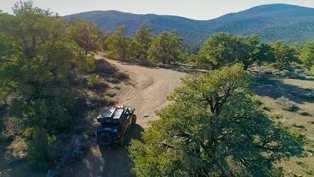
Do Roads Protect Forests or Endanger Them?
Video has Closed Captions
Clip: S8 Ep4 | 4m 22s | The debate over protecting roadless areas in the Los Padres National Forest. (4m 22s)
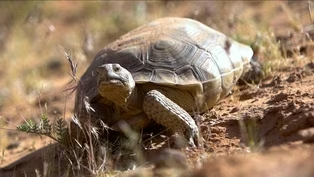
Keeping California Wild (Preview)
Preview: S8 Ep4 | 30s | The continuing struggle to keep California’s deserts, rivers, and forests wild. (30s)
Providing Support for PBS.org
Learn Moreabout PBS online sponsorship New Episode
 New Episode
- Drama

Lesley Manville and Tim McMullan return in the final installment of the Susan Ryeland mysteries.

 New Episode
 New Episode
 New Episode



 New Season

Support for PBS provided by:
Earth Focus is a local public television program presented by PBS SoCal