
April 7, 2026
Season 4 Episode 359 | 26m 32sVideo has Closed Captions
Sen. Mitch McConnell on President Trump's threat to destroy "a whole civilization" in Iran.
U.S. Senator Mitch McConnell reacts to President Donald Trump’s warning that ‘a whole civilization will die tonight’ unless Iran reaches a deal, the Kentucky Democratic Party calls for an investigation into a Republican state senator, and the support Morehead State University students are providing to the historic Artemis II mission.
Problems playing video? | Closed Captioning Feedback
Problems playing video? | Closed Captioning Feedback
Kentucky Edition is a local public television program presented by KET
April 7, 2026
Season 4 Episode 359 | 26m 32sVideo has Closed Captions
U.S. Senator Mitch McConnell reacts to President Donald Trump’s warning that ‘a whole civilization will die tonight’ unless Iran reaches a deal, the Kentucky Democratic Party calls for an investigation into a Republican state senator, and the support Morehead State University students are providing to the historic Artemis II mission.
Problems playing video? | Closed Captioning Feedback
How to Watch Kentucky Edition
Kentucky Edition is available to stream on pbs.org and the free PBS App, available on iPhone, Apple TV, Android TV, Android smartphones, Amazon Fire TV, Amazon Fire Tablet, Roku, Samsung Smart TV, LG TV, and Vizio.
Providing Support for PBS.org
Learn Moreabout PBS online sponsorshiphappens next?
>> What Senator Mitch McConnell is saying about President Donald Trump's words and actions regarding Iran.
[MUSIC] >> That event really showed us that we're not a city.
We're not a county.
We're Frankfort.
>> A look back one year ago to some of the worst flooding and Frankfort history.
[MUSIC] >> This is humanity's first return to the moon in 54 years.
It's pretty, pretty incredible for us to be a small part of it.
>> Kentucky students are assisting NASA on the historic Artemis two mission.
>> Production of Kentucky edition is made possible in part by the KET Millennium Fund.
>> Good evening and welcome to Kentucky edition on this Tuesday, April the 7th.
I'm Renee Shaw, thank you so much for spending some of your Tuesday night with us.
President Donald Trump says a civilization might die tonight without a deal from Iran as he threatens a massive attack.
U.S.
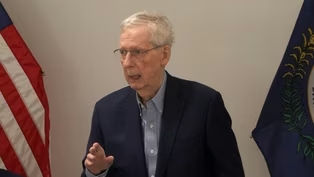
Senator Mitch McConnell of Kentucky reacted to that today while he was in northern Kentucky is our Emily Sisk reports.
The longtime senator said he believes time is up for Iran.
>> U.S.
Senator Mitch McConnell was asked about the war in Iran today during a visit to Kenton County.
He was specifically asked about President Donald Trump's threats that, quote, A whole civilization will die unless Iran agrees to a deal tonight.
McConnell responded, saying he fully backs the president.
>> Let me tell you why.
They've been at war for us, with us for 47 years.
They've killed Americans.
They've killed Israelis, they've killed throughout the Middle East.
Our Sunni Arab allies like Jordan, Egypt, Saudi Arabia, they were bad guys.
Unfortunately, they have some allies.
And the bad countries are now communicating with Iran, Russia, China, North Korea.
I certainly don't think turning the other cheek and trying to do another deal with Iran makes any sense.
The critics have said, well, what happens They've been significantly diminished.
>> McConnell was also asked about gas prices, which are on the rise.
He said no one's happy about the price of fuel, but he believes a resolution will come soon.
>> The opportunity to see them go down again is there, and I'm assuming as part of any cease fire or settlement of some sort, the Americans, the Israelis are going to insist that that's straight, be open for business as it always was.
>> Also on the topic of Iran, McConnell said he's advocating for more defense spending.
He feels the current budget is not adequate for Kentucky addition.
I'm Emily Sisk.
>> Thank you so much.
Emily.
We'll have more on Senator McConnell's visit to Northern Kentucky tomorrow night on Kentucky Edition as he touts federal funding for the region.
Emily Sisk will have more on that tomorrow on Kentucky Edition.
In other news, the chair of the Kentucky Democratic Party wants an investigation into state Senator Julie Raque Adams, a Republican from Louisville.
Adams is president of a political nonprofit called Kentucky Strong Incorporated.
Democratic Chair Coleman Eldridge cites a report from the Kentucky Lantern saying Kentucky strong has received all its money in recent years by interest, that lobbied the Kentucky General Assembly and that the nonprofit's only expenses are payments of $80,000 to Adams.
Eldridge wants an investigation by the state attorney general and the Legislative Ethics Commission.
Adams told the Lexington Herald-Leader she had received, quote, nominal compensation as head of the nonprofit.
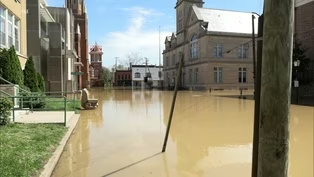
It's been one year since Kentucky was hit with one of its most destructive weather events on record, a severe storm outbreak that spawned eight tornadoes and historic flooding at the epicenter of the flooding.
The capital city of Frankfurt, where days of rain pushed the Kentucky River to the second highest crest in the city's history.
Tonight, a look back at the disaster and how far the city has come along its road to recovery.
>> It was our second worst flood to 1938 was the worst, and it only missed it by about an inch.
Very devastating.
Over 500 homes affected and businesses.
So it was a lot to kind of wrap your head around as we were going through it as a community.
>> Most people had never seen anything like it.
And in some areas of town, the residents are convinced that this was the largest, biggest flood we've ever seen in terms of the size and the scope we had over in the city limits, over 200 properties that were affected, either with minor damage or major damage.
We're expecting this to easily surpass over $100 million in damage, and we had hundreds of people that were affected or displaced, and that was what we were focused on in the immediate aftermath.
Life safety was number one.
Property safety was important as well, but also making sure that people were fed, people had utilities and people had a place to live.
>> The areas that were hit the hardest were those in southern part of the county that were, you know, obviously along the river, you know, Big Eddy areas, the most popular, you know, and then in the city, Bell Point and Paul Sawyer drive, I think we're very fortunate being in Franklin County, because we do have state government here.
I mean, within no time, the governor was calling.
What can we do?
What do you need help?
Do you need National Guard?
You know, when things change in the middle of the night, the floods changed.
Everyone thought they were going to be okay.
And then, like, two in the morning, all the charts from FEMA changed.
And then we deployed the National Guard.
They knocked on doors, they evacuated people.
One of the things we're looking at doing is to make stringent guidelines on setbacks for anybody that's in a floodway or floodplain.
So, you know, right now, you know, people have tendency to build up against riverbanks or the Elkhorn Creek because they want to see the waterways.
So we're trying to really change that.
And so we will probably be the first county that puts stricter rules in how things can be built or not built in those areas.
So we're we're looking forward to that because I think it's going to help generations down the road.
The river's going to flood again.
It's not you know, if it's when.
So I think the more things we can do now to prepare for the future, the better off we'll all be.
>> Communication matters.
I think having clear, concise, trustworthy information in times of crisis, it matters.
And that's where the county judge executive and I decided early on to put out multiple reports a day.
>> We brought people up to speed on what was going on.
We gave information about, you know, where food was being served, where housing was, and it was just a great way to communicate with everybody.
So I was proud that we could come together and do that.
>> We persevered.
I think the way the community came together right after the flood, a lot of that has stayed with us over the last 12 months, so it really brought the community together.
But there are those that are still vulnerable, that are not in their homes.
And I think it's a, you know, recovery is it's personal and it's uneven in terms of whether people had resources or support and some people had private insurance, those homeowners have gotten back into their homes a lot faster than those who who waited on FEMA.
But FEMA did come through for a lot of those folks.
But that doesn't make people whole.
We learned that this is not as rare of an occurrence as it has been in the past, and we need to be more prepared.
And so our efforts going forward are not just to maintain what we have, but to make Frankfort a more resilient, more prepared city in the future.
>> That event really showed us that we're not a city, we're not a county, we're Frankfort people came together.
I mean, still today, people are helping each other, you know, they're rebuilding.
And it's really overwhelming to see the community come together and work together as one.
And it's not about any race or nationality or religion.
It's about helping your neighbor.
>> Some good looking after photos there.
There is a flood relief fund that was created shortly after that historical event, with nearly $400,000 that was raised.
The money says there is still money available to residents who may need it.
Students and teachers are increasingly using artificial intelligence in the classroom.
Pew research indicates more than half of U.S.
teens use AI chat bots for help with their schoolwork.
Students at Bowling Green High School are using it to research, study and prepare for exams.
Teachers use it to help with grading and lesson plans.
Our Laura Rogers shares more from Warren County.
>> 1910.
>> Blake teaches history at Bowling Green High School, but he's also focused on the future.
>> I've always been someone that's very big into like gadgets and tech.
>> That made him an early adopter of AI and the classroom.
>> I kind of played around with some of the new tools and kind of figured out what would work for me and what I could use day to day in my classroom.
Coming back from World War One.
>> He says, AI tools like notebook L M can work as a personalized tutor, and he can make sure the information students access is credible and safe.
>> It's not pulling data and information from the entire internet.
It's only pulling from the sources of information you provided.
>> You can input up to 50 sources like PDFs and textbook chapters to help students study and complete assignments in his AP history courses.
>> I feed in our college textbook, I feed in our review textbook that we use.
I feed in primary sources.
I feed in videos from YouTube that correspond to the content.
>> Says it can also help them study for advanced placement exams without having to purchase extra materials.
>> I can create podcasts for them.
I can create videos, I can create slides, mind maps, I can create all these great study tools, flashcards, quiz questions.
>> Our teachers are using it in a lot of different ways in the classroom.
>> Megan Markham is the school district's digital learning coach.
>> I sort of broke onto the scene, sort of like an explosion with absolutely no warning.
>> She advises teachers on meaningful integration of technology in their classrooms.
>> We sort of had to scramble to figure out what this was going to look like and the potential pitfalls and opportunities it provided.
Now, I think we're turning that corner of really seeing the potential behind AI in the classroom.
>> And Melanie Dickinson's English classes.
Students are using Magic School to research conspiracies and mysteries with her guidance on using AI as a tool, not a shortcut.
>> When you have an assistant that can deliver instruction and give immediate feedback and guide the student on a personalized learning path, that's what we want for every student.
AI makes that possible.
AI makes that even easy.
>> It can also make some things easier for teachers, like grading and giving feedback on hundreds of assignments.
>> Grading is just very grueling, and giving that high quality feedback to every single student, whether you have 75 students or 150 students or 200 students, we're human.
So somewhere in that stack of papers, you're going to fatigue, whereas AI does not settle.
>> Both acknowledge concerns over artificial intelligence in schools specifically if it helps students cheat.
>> We had the same concerns with calculators.
We had the same concerns with Google.
The old theory you can really unlock a great potential for students and their personalized learning if you start using.
>> It, she says.
Some assignments may need to be redesigned, but also there needs to be honest conversations with students about how to appropriately use AI.
>> What's acceptable and what's not acceptable.
You know, using AI to help you brainstorm is acceptable.
Maybe using AI to write your entire essay for you is not acceptable.
>> We're never going to put the genie back in the bottle.
The genie is out.
Kentucky plays a huge role.
You just have to find ways that it can enhance what you do in the classroom, and it can enhance what students are able to do in terms of preparation, in terms of deeper learning.
>> Much of that learning useful for building the skills they need for college and career.
>> What's known.
>> As four KET.
I'm Laura Rogers.
>> Thank you.
Laura.
Artificial intelligence in the classroom was the focus of last night's Education Matters program that aired at 8:00 eastern last night, and you can see it online on demand.
It's streaming there at KET dot o r g. The stars turned out for a garden dedication in Maysville, Kentucky, and we have the latest on a former sheriff accused of killing a judge.
Our Toby Gibbs has more in this.
Look at headlines around Kentucky.
>> Nikki Stein's.
The former Letcher County sheriff is officially asking for a special judge in his murder trial.
Stein's is accused of killing Judge Kevin Mullins in his chambers in 2024.
As we've reported, Stein's believes Mullins has past ties to the judge in the case.
Chris Koren.
Stein's defense team asked Koren to recuse himself, but Koren declined.
Now, W EKU radio reports, Stein's team has submitted an affidavit asking for a special judge.
[MUSIC] UPS and the Teamsters union have reached an agreement over proposed driver buyout plan.
UPS announced plans to reduce its workforce in January, but the union opposed the plan, saying workers had to give up too much in exchange for a lump sum payment.
According to The Courier Journal, UPS has agreed to limit the buyout to 7500 workers all across the country.
More than 25,000 UPS workers work in the Louisville metro area.
[MUSIC] The Tribune Courier says U.S.
Forest Service crews were able to contain the 450 acre Cassidy fire in the land between the lakes.
Turkey hunters spotted the fire March 29th.
In 12 hours, it went from 30 acres to 450 acres in size.
It's being called the biggest fire in the land between the lakes in ten years.
Investigators are now looking for the cause.
[MUSIC] Some big names turned out in Maysville for the dedication of the gardens at Saint Patrick.
A new display from the Catholic Diocese of Covington, the Kentucky Lantern reports.
Former president Bill Clinton, coach John Calipari and Cardinal Timothy Dolan of New York were there for the dedication, along with former state Representative Jerry Lundergan Lundergan is from Maysville.
The garden is a reproduction of the Garden of Gethsemane near Jerusalem, where the New Testament says Jesus prayed the night before his crucifixion.
Londergan says he hopes people of all faiths will come there to reflect and pray.
[MUSIC] With headlines around Kentucky.
I'm Toby Gibbs.
>> Now to some news that's out of this world.
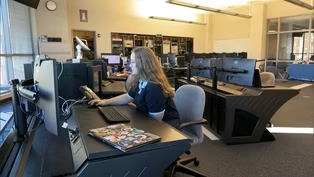
The astronauts on NASA's Artemis two mission are currently making their way back to earth from the first crewed trip to the moon in over 50 years, currently, tracking the spacecraft's location and velocity is the ground station team at Morehead State University Space Science Center.
The school's nine story tall antenna makes it one of the only stations in the world capable of tracking a deep space mission.
NASA is using the data gathered by faculty and students to see how non NASA operated stations can be used to track future deep space missions.
>> It's huge for us to have been selected by NASA to support the Artemis two mission.
We're the only non NASA owned node on the Deep Space Network, and we primarily support NASA's lunar missions.
When you fly spacecraft beyond low earth orbit, you're well above the GPS constellation.
So how do you know where you are and how you're moving?
And we do that through a process called tracking, which the spacecraft sends a signal out and we collect and analyze the signal.
>> This is live telemetry for, sorry, live flow from the capsule.
We're able to pull it down, record it, and process it in order to get the Doppler data that they're asking for.
So if this wasn't pointed at a spacecraft, it would look pretty much just like a big square.
There would be no any bumps or ridges.
It would just be a straight, flat wedge.
>> NASA's running kind of an experiment this time to see who around the world that's not a NASA ground station can provide the best radiometric data for their navigation teams.
>> When I found out we were going to be tracking Artemis two, I was really, really excited.
I've been a ground station operator here for a few years now, but being like first, like hands on during a real life human spacecraft mission has been really cool to do.
During the mission, I've really been monitoring our systems as we track the Orion spacecraft.
So I'll monitor our dish, make sure nothing goes wrong, and if something does go wrong, troubleshoot as it comes up.
>> NASA confirmed that these measurements are asked to use as we'd like in the future, so we're going to surely include some of these into classroom and homework activities so that students can get experience with real data.
I can foresee students using them in radio frequency classes, satellite communications, ground station operations, Astrodynamics classes.
It's, you know, I think it's a treasure to have for us to teach students with this.
>> Aerospace is the number one industry in Kentucky.
And most people don't really realize that there are companies all over the state that are providing mission support activities and technologies that collectively make up about a $14 billion industry in the state.
And so we've created this ecosystem in Kentucky, where we can produce graduates at the universities that don't have to go to Colorado or Texas to get jobs anymore.
They can stay here in Kentucky.
>> I feel like this mission specifically is like telling, you know, this is what we're doing here in Morehead.
We are, in fact, having an impact on the space world, and we're going to probably keep having an impact on throughout different Artemis missions.
So it's, it's really cool to, to tell students like that, that we are doing that here.
>> Those pictures certainly are worth more than a thousand words every year.
The University of Louisville awards, the prestigious Grawemeyer Scholar Awards to ten students from across Kentucky who have a plan to change the world in the areas of music, education, psychology, religion or world order.
Our Kelsey Starks spoke to some of those students about their big ideas and how they're making them happen.
>> The Grammy scholars carry on the legacy of Charles Grawemeyer.
These are all Kentucky students awarded scholarships to pursue their ideas that will one day maybe change the world.
So we want to say thank you so much for our students for being here today.
I want to start with you, Sarah, since you graduated last year, but because of this scholarship, you're now pursuing your PhD.
And tell us about the the passion that you have for research when it comes to health disparities in rural communities.
>> Yes.
So the incredible thing about the scholar program is that like the awards, they also value the power of ideas.
So I'm from a community in Eastern Kentucky and didn't have necessarily the traditional research experience, but the Gromeier Scholars Awards take into account students lived experiences and what they've done with that.
And with that, they saw potential for someone to have a career in research.
And because of that, I knew that I wanted to go into medicine and be a physician.
But I also learned that I have a passion for research and using that to serve my community and other underserved communities with health disparities.
And so from that, I've now in the MD, PhD program at the University of Louisville, which is where I get both my medical degree and get to do research in it based on population health.
And so much of that is because of the opportunities afforded to me through Grawemeyer.
>> Wow.
And I want to know about you too, because you're graduating early this year.
Tell us about your research and how this scholarship impacted your studies.
>> Yeah, so my research is on spinal cord injuries and understanding the role of the cell called microglia in spinal cord injury response.
And so the scholarship has allowed me to carry the money that I would have gotten from my fourth year of undergrad into medical school, which will be really helpful with how expensive medical school is.
>> Yes, absolutely.
And Adnan, your research is also health focused and two different projects that you've worked on.
So tell us about those one involving vaccines and one particular to athletes.
>> Yep.
That's correct.
So my previous research was with athletes, especially when they get injured, doctors have to assess whether they're able to return to play, get back on the field, etc.
But it's kind of an objective perspective to it.
You know, we kind of look and just say, oh, I think it's okay.
I think it should be fine.
Let's let him play.
But what we do is we actually use a motion capturing system to see the joint flexion, how much it's able to move.
And we compare it to the like the normal knee, foot, hip.
And we use those angles to determine whether they're actually able to play or not.
And currently, right now I'm working in a vaccine study, which is for pneumonia, which is a very common disease.
And essentially what we do is we work for Pfizer and we go to the hospitals, collect data on a new virus that they're testing for elderly above the age of 65.
And we collect that data afterwards, send it to Pfizer.
Hopefully that way we can have a new vaccine that works for the public.
>> Wow, really cool projects.
I think I want to know though, like your hope and your vision for how the research that you're doing right now and the projects that you're working on right now, what how do you plan to move that into the real world and really make change like you in your home area, right?
>> Yes.
So my most current research has been on cardiovascular disparities, looking at urban and rural areas.
And so with that, I've got to go to national conferences and even present in Frankfurt to legislators about the research that I've been doing to try to get some things, people looking at it for policy and just making people more aware of health disparities and how they can help in my region and others like it.
>> And so from that, you hope that to close some of that gap between urban and rural communities, I would assume.
>> Yes, definitely.
>> And Sirisha, tell me your vision for how how your your research may change the world one day.
>> Yeah.
Spinal cord injuries are like a really big problem.
And there hasn't been much advancement on like getting people to help recover from them.
So I hope like with my research, I can start to like bring a little bit of an advancement to that.
>> Yeah.
>> Adnan I think for me personally, one of the things that I hope is just to more so outside of the like specific impact, it's kind of the broad impact of letting people understand that research isn't something where it is something that has to be significant change.
It is small steps towards the advancement of humanity that make research, research.
So that's kind of like the main goal that I want to show others is obviously the work that I'm doing is great in itself, but it, it takes small changes to make that happen.
So that's the main thing I'd like to get across.
>> Yeah.
Which that kind of goes back to the legacy of Grönemeyer, right?
That one simple idea can in fact change the world.
What do you want people to know about students in your generation and how you all view what you're doing and your how how things are rapidly changing with how technology is advancing and how what you're doing now is hoping to have an impact on the world.
>> Well, you can hear that answer and learn more about the scholars and the prestigious Grammy Awards that are given to recipients from all across the world who've already created change in their communities.
Kelsey Starks explores the legacy of the Grammy Awards on the next inside Louisville that comes on Sunday at 12 noon eastern, 11 a.m.
central right here on KET.
Learning is on the docket and one courtroom.
We head to Jessamine County tomorrow with some high school.
Law school students argue their cases in a mock trial with a real judge.
Go to court with us tomorrow, Wednesday on Kentucky edition, which we hope we'll see you right back here again for at 630 eastern, 530 central, where we inform, connect and inspire.
We hope that you'll connect with us all the way as you see on your screen, the social media channels, Facebook and Instagram.
You can get download us on the PBS app and of course stream great content online on demand at KET dot o r g. I'm Renee Shaw, thanks for being with us tonight.
I'll see you tomorrow night.
[MUSIC] Have a good night.
Frankfort on Road to Recovery after Historic Flood
Video has Closed Captions
Clip: S4 Ep359 | 4m 49s | Frankfort road to recovery one year after historic flooding. (4m 49s)
Kentucky Students Assist NASA on Historic Artemis II Mission
Video has Closed Captions
Clip: S4 Ep359 | 3m 45s | Morehead State University providing support for NASA's Artemis II mission. (3m 45s)
McConnell Reacts to Trump’s Threat Toward Iran
Video has Closed Captions
Clip: S4 Ep359 | 2m 30s | Sen. Mitch McConnell on President Trump's threat to destroy "a whole civilization" in Iran. (2m 30s)
Providing Support for PBS.org
Learn Moreabout PBS online sponsorship
- News and Public Affairs

Top journalists deliver compelling original analysis of the hour's headlines.

- News and Public Affairs

Today's top journalists discuss Washington's current political events and public affairs.












Support for PBS provided by:
Kentucky Edition is a local public television program presented by KET