
October 2, 2026
Season 5 Episode 68 | 26m 30sVideo has Closed Captions
A grand jury indicts the man accused of killing a Kentucky State trooper.
The man accused of killing a Kentucky State trooper is indicted by a grand jury. The push to relieve the financial strain jails are putting on city and county budgets. Kentuckians take to the state capital to let lawmakers know how they feel about data centers. How one farm is offering a unique option for those with red meat allergies.
Problems playing video? | Closed Captioning Feedback
Problems playing video? | Closed Captioning Feedback
Kentucky Edition is a local public television program presented by KET
October 2, 2026
Season 5 Episode 68 | 26m 30sVideo has Closed Captions
The man accused of killing a Kentucky State trooper is indicted by a grand jury. The push to relieve the financial strain jails are putting on city and county budgets. Kentuckians take to the state capital to let lawmakers know how they feel about data centers. How one farm is offering a unique option for those with red meat allergies.
Problems playing video? | Closed Captioning Feedback
Where to Watch Kentucky Edition
Kentucky Edition is available to stream on pbs.org and the PBS app.
Providing Support for PBS.org
Learn Moreabout PBS online sponsorship[music] I'm here to let you know that Kentuckians are watching.
I can't remember the last time an issue brought so many different people together.
[MUSIC] >> Kentuckians take to the Capitol to share how they feel about data centers.
[MUSIC] He's accused of killing a state trooper.
The latest step in the case against him, Monte Branch.
[MUSIC] >> It's just like beef.
Looks like beef.
Cooks like beef.
It's really a direct replacement.
>> An ostrich farm in Kentucky produces a unique meat option for people with Alpha-gal syndrome.
All over the country.
>> Production of Kentucky Edition is made possible in part by the KET Millennium Fund.
[MUSIC] >> Good evening and welcome to Kentucky Edition for Friday, October 2nd.
I'm Marvin Bartlett.
Thank you for joining us.
We're learning more about the case against Emani branch, the man accused of shooting and killing State Trooper Hayden Phillips in Warren County Monday.
This is video of branch in court Tuesday.
During his arraignment.
A grand jury has now indicted branch.
He's accused of murder of a first responder.
It's a capital offense, meaning he could face life in prison without parole or the death penalty.
Police say he used a handgun.
He also accused of possession of a handgun by a felon.
Branch is 51 years old and is from Portland, Tennessee.
Trooper Phillips visitation is set for tomorrow from 10 to 6 central time at living Hope Baptist Church in Bowling Green.
And the funeral will be Sunday at noon Central Time at Diddle Arena on the Western Kentucky University campus.
The cost to house, feed and provide medical care to inmates has gone up.
That's draining local and city coffers.
State leaders have known of this funding issue for many years.
But as our June Leffler reports, the push continues to overhaul how jails are funded.
>> The Kentucky Association of Counties, or Kaco, has led the call to reform jail funding.
>> Counties are now putting in.
As you can see in this slide, about $170 million of county tax dollars in the funding of the local jails.
And so this really set the stage for us again, a year or so ago.
>> The cost of incarceration is shared by the state and localities.
Kaco says the state reimburses local jails at a per diem rate that is nearly half the cost to actually house someone.
And right now, county jails are on the hook for housing and paying for inmates before they are sentenced.
>> So now let's talk about pretrial detainees.
And this is something that has been very important to me.
Senator Wheeler, you and I have both filed bills on this issue in the past.
So here's here's how the process works right now, an inmate is arrested for a felony offense.
They're arraigned.
They have a grand jury indictment.
They sit in the county jail without bond or without the ability to bond out for a period of.
Time, time.
Then there's a trial or a plea agreement and a verdict.
After that, there's a sentencing.
The State per diem takes part, takes place after that sentencing takes place.
>> State Representative Michael Meredith proposes something different.
>> Again, why I say that is such an important portion of this bill would be some form of reimbursement on those credits for time served.
Is it affects every one of those counties, whether you're a county that's in a regional jail authority, whether you're a county that has an open jail, or whether you're a county that has a closed jail.
>> Meredith proposed jail funding reform this year, though it failed in Frankfort, a lawmaker who leads budget negotiations says local police, prosecutors and courts ultimately decide how long someone stays in jail.
Pretrial.
>> At no point do we have anybody at the state level, unless it was KSP, that was the investigating agency that has any control or say so over what happens and how long that process takes.
Someone will figure this out.
Cleaned up our streets and hey, we can always do credit for time served and the state still picks it up.
>> County jails can balance their budget by taking federal prisoners who have a per diem rate, more than double what the state pays.
That's in part why several county jails are holding immigration detainees for the federal government, despite overcrowding and other concerns from activists for Kentucky edition.
I'm Jim Loeffler.
>> Hyperscale data centers.
They've been the topic of discussion across the Commonwealth as many communities push back against their development.
This week, Kentuckians brought their concerns about data centers to the state Capitol for a legislative listening session hosted by state Representative Adam More.
Here's more from Kentucky.
Éditions Clayton Dalton.
>> The whole United States and the world is watching how we do this, how we destroy our communities and our land.
Thank you.
>> Janet Garrison, a Mason County resident, dumped out a folder filled with letters of support written from people across the country to Mason County residents who won't sell their land for data center development.
In a packed room in the state Capitol Annex.
Other Kentuckians from Owensboro to Pikeville shared their concerns about data centers.
Lindsey Gray, a Jefferson County resident, said she doesn't want Kentucky to roll out the red carpet for data center projects.
>> Right now, Big Tech is spending trillions of dollars building these massive data centers.
They consume enormous amounts of water and electricity, generate constant industrial noise, and create, as one person said, shockingly fewer few permanent jobs.
And they're looking for places to build places with cheap land, cheap power, and weak regulations.
Let's not let Kentucky be that place.
>> Multiple speakers said that getting information about proposed data center projects in their communities is too difficult, and they want to see state action.
>> For nearly ten months, ordinary people in Mercer County have had to become researchers, investigators.
Zoning experts and utility watchdogs because the systems meant to protect us weren't ready.
Kentucky recruited it, and now Kentucky has a responsibility to regulate it.
>> We shouldn't have to be the watchdogs.
We elect people to look out for us.
And you are not doing your jobs, not at any level.
Federal, state or local.
And please don't give all the control back to local because there's too much money involved in this.
>> There was one speaker, a retired software engineer from Fayette County, who said he supports data centers.
>> So I am totally sold on AI and I want to see it come in faster.
To me, data centers are infrastructure.
And in this way I view it no differently than than dams on waterways.
>> He also said he's skeptical of regulations being drafted by state legislators.
>> I cannot believe that there is not existing legislation that cover businesses like this, and thus, you know, give it to the experts, to people that are employed, 365 days a year, rather than part time legislators.
>> After almost two hours of speaking, Democrat State Representative Joshua Watkins, the House minority whip, said it's time for the state legislature to do something.
>> We've heard moratoriums, as we've heard, for environmental protections, ratepayer protections.
I think all of those things are on the table for us.
We definitely need to give some parameters so that the public, like we heard today and some of us legislators can get this right.
>> State Representative Vanessa Grossell was the only Republican in attendance in 2025.
She voted for House Bill 775, which offers tax breaks to hyperscale data centers.
She said she wishes she could take that vote back.
>> I've heard several of my colleagues in the majority say that it's something that will likely revisit in 27 when we get back in session, and so I look forward to the opportunity after having community conversations.
>> Although people share different stories, frustrations, fears and grievances, the common theme for most speakers was that something needs to be done.
>> I'm here to let you know that Kentuckians are watching.
I can't remember the last time an issue brought so many different people together, and they're all watching.
Their old and young of every race and background, and they're all watching how you handle this issue.
>> For Kentucky Edition, I'm Clayton Dalton.
>> To have these data centers.
>> Some counties across Kentucky have passed moratoriums on hyperscale data centers, and Woodford County recently became the first to pass an outright ban with high diesel costs hurting Kentucky farmers, agriculture Minister Jonathan Shell is asking for loosened restrictions on the use of dye diesel.
Dyed diesel is tax exempt.
It's similar to regular diesel but isn't allowed to be used on public roads.
Shell wants the governor and the attorney general to suspend that rule during the fall harvest.
In a letter, he said, quote, record diesel prices are cutting deep into already tight farm margins at the worst possible time.
Farmers are in the middle of harvest and need relief now.
>> We have made it to Friday, so that means it's time to go inside Kentucky politics.
I'm Emily Prince and I am joined by Doctor Stephen Voss, political science professor at the University of Kentucky.
Thank you for making the trip over here to our studio.
>> Thanks for having me here.
>> Yeah, we're glad to.
So we're going to jump into the midterm elections.
First, I want to kind of give the peg that Emerson College put out a poll just last week talking about a national kind of look at how things are going.
And their poll.
They said that nationally, again, congressional Democrats are expected to have about an 11 point advantage.
So let's take this national poll and bring it down and translate it to Kentucky.
How does it translate and what are we seeing?
You know, when we look at polls, how do we know which ones we can trust?
>> So that's what's called the generic ballot poll.
People aren't being asked, are you voting for this person or that person?
They're asked, going into the congressional elections, would you rather vote for a Democrat or a Republican?
So what that poll is giving you is the overall national mood.
Now, some of those voters who said they wanted to vote for a Democrat may not even have a Democrat on the ballot.
Right.
And same thing with the Republicans.
So you have to take the generic ballot with a grain of salt.
It's it's going to be smoothed out over the whole country.
It's not specific, say, to the second District of Kentucky.
Right.
On the other hand, that generic ballot is a pretty good predictor of how congressional elections go later on.
All the signs right now, although it could change, are that the Republicans could be headed to a bloodbath.
Now, having said that, the electorate isn't as responsive as it used to be.
More and more congressional districts are lopsided, very Democratic or very Republican.
Fewer ones are competitive.
We're unlikely to see the sorts of huge swings in which party controls the House of Representatives, the way we used to.
>> Okay, now, something else that came out of that poll I thought was pretty interesting is that they asked voters to rank issues as far as how impactful they would be to their vote.
There were several things that were listed, but some of the top concerns the war in Iran.
Jobs, tariffs, gas prices, even immigration.
Those are just a few of the top ones.
So again, to take us from a national scale to back down to Kentucky, do you feel that those issues carry the same weight for Kentuckians?
But along with that, for people who are on the ballot in Kentucky, are we hearing them talk about these types of issues?
>> So the main thing that determines people's vote is their party.
Most people are Democrats, whether they admit it or not, or Republicans, whether they admit it or not.
And they vote that way in most elections.
But when you talk about the people who move, the economy is almost always the main thing that drives them.
And this is why Donald Trump should be worried and why the Republicans should be worried, because as that poll told you, everybody's focused on the economy and they're unhappy.
They're unhappy about gas prices.
They're unhappy about prices in the grocery, even, you know, the Iran war could actually be economic because some people, people have a sense that that war is partly why gas prices are up.
>> You know, I'm going to throw a curveball.
But when we think about people, again, who are on the ballot, we think about, you know, in the U.S.
Senate race, Charles Booker and Andy Barr, we've heard some folks say, well, maybe it actually benefits Andy Barr to not give as much of an opinion about some of these issues, because he does seem to be far further ahead in the polls.
Do we feel like that the candidates are actually talking about the issues, or is it being more party based?
>> The more a campaign seems lopsided, the more it seems as though one candidate is is almost a sure victor, the less they're going to engage in the issues, engaging in the issues just means they risk saying something that goes viral that people don't like.
It really.
A candidate who feels comfortable ahead tends to focus on upbeat messages, broad based messages, and they don't get down into the weeds.
>> That kind of brings me to my next point that I wanted to ask you your opinion.
And from a political science perspective about debates.
So we know that, again, in the U.S.
Senate race, there is, I one debate expected where we will see Charles Booker and Andy Barr at the podium together in the sixth district race with Zach Dembo and Ralph Alvarado.
There is nothing confirmed.
What we will see them at the same time.
So there does seem to be less of an appetite, especially this, you know, this time around with the midterms to see people actually debate one another, talk about why is that.
>> So for a long time, it was hard to get the front runner to debate because, you know, as I said before, that just represents a risk.
They could say something that could hurt their lead by appearing on the same stage, in the same conditions as the person that they're on track to trounce.
It sort of raises that person up, gives them credibility.
It's a little less it would have been in the past, a little less common to see a case like the Alvarado Dembo race struggle to get debates, because that is a race that we don't have a lot of information about, as far as we know, could be quite close, but there's a second reason candidates don't want to debate that might apply here, which is very few of the people who are going to sit around and watch a candidate debate are politically unaware.
People trying to decide how to vote.
The vast bulk of that audience are people who are dyed in the wool.
It's like a sporting event.
They're either wearing the red jersey or the blue jersey.
They're not.
There's not really a lot of votes up for grabs with the direct audience of a debate.
>> Of course, we like to see from our perspective, right?
We like to see people come in debate because we want to put the information out there to the voters.
But yes.
>> We find it interesting because that's what we do.
That's our industry.
Yeah.
Yes.
And also, you know, people who are more politically active tend to think voters process things the way they do, weighing the issues, weighing the, you know, most voters are trying to find shortcuts to get that homework done as fast as they can so they can go do things they enjoy.
>> More Fair points, fair points.
Okay, I want to switch topics real quick to one more thing.
Governor Andy Beshear, he's in the midst of a national book tour.
He's promoting his book.
Go and Do likewise.
I wanted to ask you your opinion about something he said specifically when he was in Bowling Green.
He's told the story many times, but he told about how after he won reelection for governor, he looked at his wife and said, we'll never have to do another campaign run for another election again.
And he looked at the crowd in Bowling Green and said, now, I'm not so sure if that's true.
So he kind of keeps teasing what might be next for him based on what we've seen in in past circumstances, when do you think we might see an actual confirmation of is he running for president, yes or no?
>> Andy Beshear is doing all the things one does to run for president, including releasing a book outlining your vision, the national travel with a bit of international travel.
Everything Andy Beshear is doing sets up a presidential run.
But you know, people test the waters and there there's a decent number of politicians who do the things Beshear has done, and they end up not running.
They end up not pulling the trigger if they feel like they're not going to get traction.
So, you know, I don't know when or if Governor Beshear will ever fully launch a presidential campaign, but he sure gearing up for one.
>> Dropping the breadcrumbs right.
Bringing us along a little bit.
>> Pretty, pretty big chunks of bread.
>> Absolutely.
So, Doctor Voss, thank you so much for coming to break all this down for us.
And I'm sure many more things will happen before we get to Election Day.
But thank you for stopping in here.
>> To see you again, Emily.
>> Thank you.
Thank you.
>> Alpha Gal Syndrome is a unique food allergy spread by ticks, AGS causes sensitivity to meat from mammals, resulting in hives, vomiting, or even anaphylaxis.
It's commonly called the red meat allergy, but there is a type of red meat that those with AGS can eat.
Ostrich Mackenzie Spink takes us to an ostrich farm in Danville, where demand is growing for this popular meat alternative.
To those with Alpha-gal syndrome.
>> When w d King was laid off in 2022, he was looking for a next move that could combine his lifelong cattle experience and his poultry nutrition career.
>> Britt, my now partner, asked, hey, what are you going to do?
And say, well, I think I might just raise ostriches and started laughing.
And he looked at me and said, if you're serious, then I'm in.
And eight months later, we bought our first ostriches.
>> Brant Williams was diagnosed with Alpha Gal Syndrome in 2019, but he says he remembers the first time he ever had a reaction.
Three years before he got a formal diagnosis.
>> I watched hives come up my arms and down my entire body.
>> Williams has an especially sensitive form of Alpha-gal syndrome.
Even cooking fumes from red meat on a grill will trigger a reaction.
>> It's manageable, but it's overwhelming in the beginning, it's still overwhelming now, and I'm year 7 or 8 or however many it is.
>> Williams is also a cattleman by trade, and he knew he wanted to play a part in making life easier for those with Alpha-gal syndrome.
>> And I kept thinking that this is something.
How I can help because there's more people out there that miss that red meat, not just me.
And that's what really got me thinking about it.
>> King says.
Raising ostrich is unlike any other livestock he's worked with.
>> It's the hardest thing I've ever done, you know, you go into it, I've got a extensive poultry background and extensive beef background and really thought it was going to fall somewhere between.
But there's just a lot of idiosyncrasies.
You got to learn digestively they actually digest like a horse.
Their hind gut fermenters.
>> So they're not a cow.
>> Or they're not a cow or a chicken.
>> The farm planned to have just a handful of ostriches at the beginning, but this year they hatched over 400 birds.
One reason for the expansion is so their local processor has enough meat to dedicate a whole day just to processing the ostrich.
>> We need to have enough bulk go through at processing time so that we can make sure we have isolation of ostrich meat from other red meats.
>> Although ostriches are birds, they are technically red meat, not poultry.
Importantly, the meat does not have the alpha-gal carbohydrate present in mammals.
>> The primary meat that we're getting is from the leg, so there are a variety of leg steaks.
As those different muscles go through from the thigh down the leg.
And so the steaks are cut from there.
And then we also offer things like necrosis.
So that's a great braising cut that you can do.
It's one of my favorite dishes is to braise that and shred it and make tacos out of it.
>> Part of the business is educating customers on how to cook their ostrich products.
They say when done right, an ostrich steak is almost indecipherable from a beef steak.
>> Because it is extremely lean cooking.
It past medium is not recommended.
It's more rare to medium rare that 135 temperature is the goal, which can look a little scary to people.
And if they're associating it with poultry, poultry, you must cook much longer than that.
>> King says.
Ostrich is also a unique financial solution to preserving Kentucky farmland.
>> For our farming operation.
I think it makes us more stable.
That being said, it's not a tremendously large margin, but at least we can say this is what it costs.
Instead of taking the cows to stockyards and getting what someone else says, it's worth.
So it's a security for the family, security for the farm.
>> Foremost farms receives calls and emails every week from customers who say their lives have been changed by its products.
Williams says he got an email this week that moved him.
>> I've had an ostrich burger.
It's the first time I've had anything similar to beef in five or 6 or 7 years, he said.
I cried and he said, I can't wait to try a steak and I can't wait to try something else.
And I mean, that made me feel good.
It was very obvious that it was life changing for him.
>> Alpha farms originally planned to be a solely online business, but it now has several partnerships with brick and mortar retailers in the state and its ostrich burgers were available at a concession stand at this year's State Fair for Kentucky edition.
I'm McKenzie Spink.
>> The National Institute for health found that diagnoses of Alpha gal syndrome in America increased over 5,000% from 2005 to 2025.
It also found that racially diverse adults over 40 years old are diagnosed at higher rates.
[MUSIC] It is in February, but it's still a good time to be thinking Lincoln.
Our Toby Gibbs has that and more in this.
Look at what's up around the Commonwealth.
>> At this event, getting the wool pulled over your eyes is all part of the fun.
The Kentucky Wool Festival returns to Falmouth with sheep shearing demonstrations, a petting zoo for the kids, live music pioneer demonstration, and more than 100 arts and crafts vendors.
Artists are taking their work to the streets literally in Louisville.
[MUSIC] The Saint James Court Art show marks its 70th year, with more than 600 artists from across the country.
The juried fine arts and Contemporary Craft show covers four square blocks among the Victorian homes of Old Louisville.
Madisonville is making hay throughout the month of October, as the Hay Bale Trail returns to Marr Park Arboretum.
Take a stroll or drive around and view more than 80 decorated hay bale displays along the trail, each featuring a different theme.
History is getting the presidential treatment in LaRue County this weekend at Lincoln Days.
The event recognizes Abraham Lincoln's Kentucky birthplace and his connection to the Hodgenville area.
The weekend includes pioneer Games, concert and art and quilt show, a parade and Lincoln look alike contests.
Other activities include road races, antique tractors, a classic car show, and an ice cream eating contest.
Harrodsburg is jazzing up its weekend with everything from small combos to big bands.
The Kentucky Heritage Jazz Festival brings 12 jazz ensembles to Old Fort Harrod State Park.
Saturday focuses on smaller jazz groups, while Sunday features big band performances, a Taste of New Orleans kick off on Main Street also includes New Orleans style jazz and food.
The good times are rolling this Saturday in Richmond as the city hosts the Millstone Festival.
The annual event features live music, a car show and local craft vendors.
The day also includes food trucks, a petting zoo, train rides and inflatable activities.
[MUSIC] The battle lines are being drawn in Mount Sterling at the back porch.
Battle of the bands.
The competition, presented by the Gateway Regional Arts Center.
>> Features.
>> Local and regional musicians in two audience voted competitions.
There will also be food and local vendors, along with an array of performer and band merchandise to pick up.
The battle takes place Saturday and that's a look at what's happening around the Commonwealth this week.
I'm Toby Gibbs.
>> We're about a month away from the midterm elections.
Bill Bryant and a panel of Kentucky reporters will bring us up to date on comment on Kentucky coming up at 8:00 eastern, 7:00 central tonight here on KET.
New rules for the Supplemental Nutrition Assistance Program, or Snap, are now in effect across the U.S.
>> Our biggest worry is that this takes some of our most vulnerable citizens and puts them in an even more vulnerable position.
>> Coming up Monday on Kentucky Edition, the head of Kentucky's Cabinet for Health and Family Services talks about the impact snap changes are already having on Kentuckians and what the state is doing to keep people from falling through the cracks.
Join us again Monday night at this time for Kentucky Edition, where we inform, connect and inspire.
[MUSIC] Subscribe to our Kentucky Edition email newsletters and watch full episodes and clips at ket.org.
[MUSIC] You can also send us a story idea at Public Affairs on ket.org.
[MUSIC] [MUSIC] Until then, thanks for watching and have a good weekend.
[MUSIC]
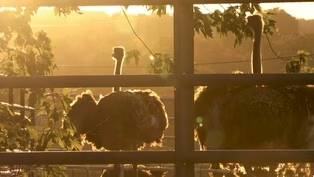
Danville Ostrich Farm Offering Options for Alpha-Gal Patients
Video has Closed Captions
Clip: S5 Ep68 | 5m 16s | Kentucky ostrich farm giving Alpha-gal patients a red meat alternative. (5m 16s)
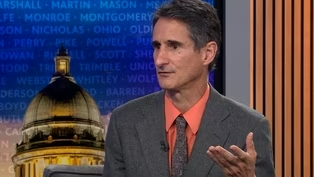
Video has Closed Captions
Clip: S5 Ep68 | 7m 22s | Inside Kentucky Politics with D. Stephen Voss. (7m 22s)
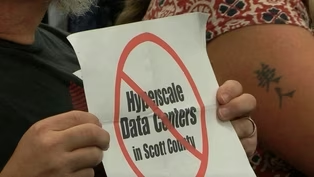
Kentuckians Voice Data Center Concerns in Frankfort
Video has Closed Captions
Clip: S5 Ep68 | 4m 20s | Residents bring data center concerns to lawmakers in Frankfort. (4m 20s)
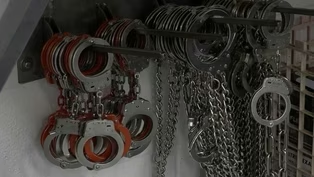
Kentucky Leaders Continue Push to Reform Jail Funding
Video has Closed Captions
Clip: S5 Ep68 | 2m 47s | Rising inmate costs renew effort to overhaul how Kentucky jails are funded. (2m 47s)
Providing Support for PBS.org
Learn Moreabout PBS online sponsorship New Episode
- News and Public Affairs

Top journalists deliver compelling original analysis of the hour's headlines.
 New Episode
- News and Public Affairs

FRONTLINE is investigative journalism that questions, explains and changes our world.

 New Episode
 New Episode
 New Episode
 New Episode
 New Episode
 New Episode
 New Episode
 New Episode
Support for PBS provided by:
Kentucky Edition is a local public television program presented by KET