
May 6, 2026
Season 4 Episode 380 | 26m 30sVideo has Closed Captions
Gov. Beshear signs an order to temporarily suspend Kentucky's gas tax.
Gov. Beshear signs an order to suspend Kentucky's gas tax. A judge rules the state's ban on camping in public spaces is unconstitutional. UK's decision to end a contract leads to 900 layoffs. An international conference focused on coal ash comes to the commonwealth.
Problems playing video? | Closed Captioning Feedback
Problems playing video? | Closed Captioning Feedback
Kentucky Edition is a local public television program presented by KET
May 6, 2026
Season 4 Episode 380 | 26m 30sVideo has Closed Captions
Gov. Beshear signs an order to suspend Kentucky's gas tax. A judge rules the state's ban on camping in public spaces is unconstitutional. UK's decision to end a contract leads to 900 layoffs. An international conference focused on coal ash comes to the commonwealth.
Problems playing video? | Closed Captioning Feedback
How to Watch Kentucky Edition
Kentucky Edition is available to stream on pbs.org and the free PBS App, available on iPhone, Apple TV, Android TV, Android smartphones, Amazon Fire TV, Amazon Fire Tablet, Roku, Samsung Smart TV, LG TV, and Vizio.
Providing Support for PBS.org
Learn Moreabout PBS online sponsorship[music] >> What would a small cut in Kentucky's gas tax mean?
As the state pays for road repairs?
>> I think it's unhealthy for one person, even the president of the United States, to have so much sway over elections when people are choosing their representatives to Congress.
[MUSIC] >> Veteran Kentucky reporter Al Cross reflects on the 2026 Kentucky primary.
[MUSIC] >> Kentucky is a major coal producing state.
[MUSIC] >> We catch up with experts gathering to learn more about the byproducts of burning coal.
[MUSIC] >> The higher your exposure, the higher your risk.
>> And as the Supreme Court debates the future of some pesticides, how do those chemicals affect your health?
[MUSIC] >> Production of Kentucky Edition is made possible in part by the KET Millennium Fund.
[MUSIC] >> Good evening and welcome to Kentucky Edition for this Wednesday, May the 6th.
I'm Renee Shaw, and we thank you for winding down your Wednesday with us.
It looks like Kentucky drivers will get some relief at the gas pump.
As we reported yesterday, Governor Andy Beshear signed an executive order suspending the state gas tax temporarily.
That emergency order required the attorney general's approval, and he signed off on it.
This means the price of gas could go down by $0.10 Monday.
Yesterday, a reporter asked Governor Beshear how long the emergency tax cut could last and how the drop in tax revenue could affect Kentucky's road fund and road projects.
>> The state of emergency under the new statutes lasts for 30 days and then can be re-upped by county judges and mayors and their region for 30 days.
And so we'll work through this month by month.
And obviously it will have an impact, but we'll have a chance next session beginning next year to potentially backfill some of that money.
What we'll do right now is look for projects that maybe weren't ready to go, that are in the road plan.
Will will look for different ways to save on resurfacing where the road is in decent shape, but may have been scheduled and we can just push it back a little bit.
I mean, that's a small price to pay for families that can't afford groceries and medication to be able to make it through the next month.
That's what an emergency is.
Our families are certainly feeling that emergency.
>> Now here's a look at the gas price picture in Kentucky.
According to triple A, the average price of gas in Kentucky is $4.31 for a gallon of regular unleaded.
A week ago, the average was 407.
A year ago, the average was $2.84.
The national average right now is $4.54.
A judge says Kentucky's ban on camping in public spaces is unconstitutional.
The ruling was issued this week by Jefferson County District Court Judge Stephanie Burke.
According to Louisville Public Media, Judge Burke said the law, quote, effectively punishes the status of being homeless and is a violation of the Eighth Amendment, which prohibits the imposition of cruel and unusual punishment.
The state's ban on camping in public spaces was part of House Bill five.
That was called the Safer Kentucky Act that was passed by the Kentucky General Assembly back in 2024.
The bill became law after the Republican supermajority in the state legislature voted to override Governor Andy Beshear?
S veto of it.
A spokesperson for the Kentucky attorney general's office told L. P m Louisville Public Media that a different district judge in Louisville recently upheld the law's provision on unlawful camping.
They added, quote, while we respectfully disagree with this judge's ruling, our office is working to determine next steps.
Now going to Washington, lawmakers there are hearing from the U.S.
Secretary of Commerce Howard Lutnick, about his connections to Jeffrey Epstein, the financier convicted of soliciting prostitution from an underage girl in Florida in 2008.
Lutnick is testifying to the House Oversight Committee that's led by Kentucky Congressman James Comer of the first Congressional District.
Today, before the hearing, reporters asked comer about inconsistencies in his testimony in the past about Jeffrey Epstein.
>> Secretary credibility undermined for having said publicly cut ties with Joseph, five and Epstein Barr.
I'll show that as recently as 2018, he was in email correspondence with Epstein.
>> What I've seen.
We're going to ask him all these questions, and we'll let the American people judge whether the credibility was damaged or not.
At the end of the day, I haven't seen wrongdoing in the email correspondence, but he wasn't 100% truthful with whether or not he had been on the island.
So we'll see.
And we'll obviously release the transcripts and everyone can can see for themselves.
>> Today's testimony is not being videotaped.
Comer says a transcript of the hearing will be released.
The committee is also scheduled to hear testimony on May 29th from Pam Bondi, who was fired as attorney general last month.
Epstein died in a New York jail cell in 2019 while awaiting trial on sex trafficking charges.
Now, more news from Washington, D.C.
U.S.
Senator Rand Paul of Kentucky says Anthony Fauci should be indicted in the next five days.
Fauci, as you'll recall, is the former director of the National Institute of Allergy and Infectious Diseases.
Paul claims Fauci lied under oath in testimony to Congress about the Covid outbreak.
Fauci testified in 2021, and the five year statute of limitations expires on May 11th, which is next Monday.
Paul is a longtime critic of Doctor Fauci, and Paul claims new information is on the way.
He posted this to social media, quote, next week I'll be holding a hearing featuring a whistleblower who will testify publicly about the Covid Cover-Up.
Make sure to mark your calendars for Wednesday, May 13th at 10 a.m.
We're committed to uncovering the truth, end quote.
[MUSIC] Time now for a mid-week check in Inside Kentucky politics with veteran journalist Al Cross, who knows Kentucky politics better than most and most of us included.
Thank you for being with us.
Appreciate it.
>> Glad to be here.
>> Let's talk about the fourth Congressional District.
This is the one that's getting a lot of national attention.
The primary, the GOP primary Republican Thomas Massie, incumbent Ed Gallrein been a lot of hay made about who would appear with whom, when and all of that.
And now there are AI ads.
Tell us about this race and why President Trump is so involved and has a lot at stake, perhaps.
>> Well, President Trump and Congressman Massie have had a history of back and forth.
Massie says he was actually vetted for Secretary of Agriculture after he endorsed Trump late in the 2024 campaign.
But we don't know if that was really serious.
I think the break really came when Massie co-sponsored the Epstein Transparency Act with Representative Ro Khanna of California.
He had gotten crosswise with Trump on Iran and the initial attacks on the nuclear facilities.
But.
And Trump said he would work hard against him.
But I think the Epstein file law really sealed the deal.
>> And the big, beautiful bill, right?
He didn't vote.
>> For that.
But that was to be expected because he's such a deficit hawk.
Right.
In this case, you know, you're going right after Trump's ego, which is all that really counts for Trump.
And Trump is on kind of rocky ground these days because his approval ratings are the lowest ever.
And he wants to maintain some measure of control over Republicans in Congress.
And if Massie was to overcome the onslaught that he is facing from Trump and his allies, then that would be a signal that you can incur Donald Trump's wrath and survive.
>> And survive.
Right.
Well, even Thomas Massie said here Monday night, and perhaps that wasn't on air, but he said he's, you know, single digits, low single digit lead over Gallrein.
He seemed to be tempered in that, but still confident that he would come out.
Do you expect there to be a different result?
>> Well, I think the involvement of these outside groups might wind up doing Massie in.
You've got the committee that's associated with the American Israel Political Action Committee doing an ad that has massive voting with two of those wild woman liberals of color, and that punches a lot of buttons.
But I think that Massie has developed and maintained such a folk hero kind of following in his district over 13.5 years that, you know, he's a pretty tough nut to crack.
Yeah.
And he made the point on your show the other night.
Trump's after me because he wants to keep all the other congressmen in line.
And I think there's a certain flinty independence about Kentucky voters.
They don't want their representatives to be a rubber stamp.
And even though Trump clearly has control of the Republican Party, it's anybody's guess who's going to turn out in these elections.
The Indiana elections where he got involved in those legislative races, he clearly drove up turnout.
Right.
And it remains to be seen if he can do that in a congressional race against a well known figure.
A lot of these state legislators aren't really well known.
>> Right.
So speaking of endorsements, we know and we've talked about this perhaps on comment last Friday about, of course, the president also gave Andy Barr and Ralph Alvarado the sixth Congressional District.
Alvarado is running to to replace Andy Barr, who's wanting to get into the Senate.
So if Trump if Alvarado and Barr were to win and Gallrein Knott, does that show an erosion of Trump's power and influence, or is it.
>> Yeah, the Barr Alvarado endorsements do not count for very much at all, because they were probably going to win anyway.
And, you know, it's been Trump's routine to endorse winners so he can run up his winning record with Massey.
You know, his influence is at risk.
Yeah.
So he can win those other two.
But if he loses Massey it's a big hit for him.
>> Let's talk about the U.S.
Senate and not necessarily so much about Barr and Daniel Cameron, but about Amy McGrath Charles Booker today.
You were just saying that Amy McGrath is up on air with a pretty good ad, but it may be too, too little, too late.
>> Yeah, she has had a very hard time getting people to give her a third look.
You know, she ran strongly against Barr in 2018 in the sixth district.
Raised a record amount of money, more money than Mitch McConnell to run against him, because after all, he's the national punching bag for Democrats.
And she slipped coming out of the gate and the Covid pandemic and Booker's late surge complicated that.
And, you know, she just never really, Jasper, as they say, and suffered a crushing defeat.
And I think a lot of Democrats just wrote her off after that.
And it's it's hard to get a third look from people.
But I wrote a few weeks ago that she was probably the Democrat who would have the best chance, and even that would be a long shot.
Dale Romans ran some ads for a while, and, you know, he was campaigning as Kentucky's version of Joe Manchin, Wright, which has some appeal in the state.
But I don't see him on the air now.
And my guess is that Booker is the clear favorite.
>> Yeah.
Going to the Republican primary.
What do you think with this contest?
Is Andy Barr now the foregone conclusive winner here.
Or does Daniel Cameron who struggled with his fundraising but is doing this you know, multi-city stop for the next few days.
Do you think that would be impactful at all?
>> Well, it's hard to imagine a scenario in which Cameron beats Barr, but he is getting a good deal of support from the liberty side of the Republican Party.
The more libertarian side, you know, the Rand Paul, Jay Williams crowd and some of the people in the state House.
But I think that's still a minority of the Republican Party turnout.
>> What do you think turnout will be?
>> You know, I really don't know.
There aren't many local elections out there or not as many as usual, and certainly not many in the Democratic primary.
There will be a lot of counties where there's a pretty good Republican turnout, but there will be some where it's not much at all.
And I would say it'll be somewhere south of 20%.
>> Yeah.
Any other words of wisdom you want to share with us about this primary season?
If you had to do a narrative about this whole primary contest, what would it be overall?
>> Well, from a personal point of view, I think it's unhealthy for one person, even the president of the United States, to have so much sway over elections when people are choosing their representatives to Congress.
You know, it it undermines the whole checks and balances on which our government is based.
So I can only hope that the Republican voters will exhibit their independent streak and make a judgment based on something other than a presidential endorsement.
>> Good words to end on.
Thank you.
I'll cross.
[MUSIC] The University of Kentucky is ending its partnership with Aramark, the company that provides food and concessions services on campus.
The move means more than 900 jobs are being eliminated.
Aramark confirmed the news through a Warn notice.
The federal Warn act requires, under certain conditions, that an employer notify the government ahead of mass layoffs.
In the letter, Aramark says it only recently learned of UK.
S decision, adding that its contract with UK will end June 30th.
A spokesperson for the university told KET that Aramark was given six months notice, as is required by their contract.
The move is part of a larger plan by the University of Kentucky, the state's flagship university says it's exploring an enterprise services partnership to better serve more students, patients and communities.
Reviewing how services are provided, including food and concessions, custodial services, custodial services and maintenance is now underway.
UK says it's still working to find a company to take Aramark's place.
It hopes to have a contract in place by July, and does not expect a gap in services.
Coal ash the byproduct of burning coal, is the focus of an international conference bringing researchers, engineers and other experts together to discuss sustainability benefits and the science behind it.
>> Kentucky is a major coal producing state, and because of that, we have a large coal based electricity that's provided and a lot of waste product in coal ash.
So we spend a great deal of time exploring how to use coal ash in research and in products.
>> We decided in 2005 to join together with with the University of Kentucky, to put together a show that would take the entire chain from the researchers that are doing things in the laboratories to investigate coal ash and its performance to the other end of the chain, where we have contractors putting these materials in place in various applications in, around the country.
When when a when a power plant burns coal to generate electricity, not all of that coal is going up in combustion.
Some of it is left behind as the noncombustible portion of coal.
And that noncombustible material has to be managed.
It's a very fine material that's collected called fly ash.
And there's some heavier particles called bottom ash.
Coal ash is a valuable tool to help with your sustainability profile when you're looking at construction, simply because we've got the material already.
It's coming out of power plants directly and going to to concrete plants.
It's also being taken out of storage and disposal units, whether it be landfills or ponds and processed and being put into construction projects.
So it's really a very valuable tool from an environmental standpoint and from an economic standpoint.
If we take our infrastructure and get more service life out of those dollars, it lowers our net cost over time.
Kentucky has has the same interest that most of the other U.S.
states do.
Right now, it's two things.
It's number one, making better performance out of concrete and other construction materials, but especially concrete, making it more durable so that we get more performance out of the out of the concrete used in our roads and bridges and, and, and buildings.
And secondly, the industry is making a major effort to lower its carbon footprint.
>> Having a conference of this magnitude, even in the beginning when it was small, you know, having that out there and having a forum for, for networking and the people that are working in this industry, you then become a focal point as the, the experts in this area.
And so at least for the University of Kentucky, it has brought new contacts, new people looking to do research in this area.
It really has provided a lot of research revenue and work for for at least for my team working at the university.
>> Last month, the U.S.
Environmental Protection Agency proposed amending current federal regulations regarding disposal and the beneficial use of coal combustion residuals.
[MUSIC] Parkinson's disease is the fastest growing neurological disease in the world, and scientists are working to understand why.
A growing body of research shows long term exposure to certain pesticides and herbicides correlates to an increased risk of Parkinson's.
Our Kristy Dutton spoke to her neurologist about what the research shows and some early warning signs of the disease.
More about this in today's medical news.
>> Doctor Justin Phillips from Norton Neuroscience Institute is here with us.
Thanks for being with us.
>> My pleasure.
>> What does the current medical research tell us about the link between Parkinson's disease and pesticide use?
>> So more and more of the literature suggests that there's a clear link between pesticide exposure and the development of Parkinson's disease.
In 2024, the New England Journal of Medicine actually invited a review to kind of look at these facts.
And it showed as much as a 40% increase in Parkinson's risk for certain pesticides that are in use and or being phased out.
>> Okay.
What are the certain chemicals that from pesticides, herbicides that Kentuckians might encounter?
>> So there's probably the biggest culprit.
The highest risk is an herbicide called paraquat.
And the EPA is currently reviewing that, but it's still in use in a number of places.
At the commercial level.
And we also know that a slightly lesser risk but still a reasonable risk is a chemical called two four D, which can really be purchased at your local store to use in your own home lawn.
>> Really like a major retail outlet, Walmart, Lowes, you know, any of those Home Depot.
Okay.
>> A lot of the weed killers that you might buy in the little pump can may contain the chemical.
>> Okay.
Where do we find that chemical on the packaging.
>> So they should have listed on there what the active ingredients in that are.
And so that would be one that you may want to look for and avoid.
>> Okay.
What does it do to the brain?
>> So depending on which chemical it is, it can do a number of things to the brain.
It can cause inflammation, oxidative stress.
And commonly these things are implicated in mitochondrial dysfunction, which has a specific risk towards Parkinson's because of how it affects the dopaminergic neurons in the brain.
>> Okay.
Who is most at risk for developing Parkinson's from this risk of pesticide use?
>> So there's definitely a link between the amount of exposure you have as well.
And so if you think about the amount of exposure, you might have, someone who's working with these chemicals on a daily basis, or maybe someone who lives in the vicinity of a place where these chemicals are used regularly.
The higher your exposure, the higher your risk of developing Parkinson's disease.
>> So somebody who lives in a vicinity of give some examples.
>> So if you live next to a large farm that may use the commercial, you know, the paraquat.
And these things can also potentially leach into groundwater.
And so it may affect, you know, for instance, if you grew up on a farm, we know being exposed to or using well water as an increased risk.
So these may be ways that patients or the patients have been exposed to that, as well as just people who maybe work on farms.
And actually, you know, using these types of things on the farms themselves.
>> Okay.
So what sort of symptoms might give us a clue that there is some damage from pesticides, some neurological damage?
>> Well, specific to Parkinson's disease, we diagnose it based on motor symptoms.
These are things like slowness of movement or difficulty initiating movement called bradykinesia rigidity, or a type of muscle stiffness and tremor.
But we know that patients with Parkinson's disease may have pre-motor symptoms that may be present a decade or more before, and things like loss of sense of smell, dream enactment behavior.
So when you're having a dream, instead of being only rapid eye movement, they may act out those dreams and shout and kick and punch and those sorts of things in their sleep.
These can all be evidence of early Parkinson's, even before it's diagnosable in the clinic.
>> Okay.
What is one thing that you wish everybody knew about that link between Parkinson's and pesticides or even early intervention?
>> So I think prevention is going to be a key for Parkinson's disease as we learn more and more about that.
And so I think being aware of the risks and benefits of those exposures, you know, we know it's more complex than just saying, well, you shouldn't ever use herbicides because they're bad for you.
We know that, you know, things like food scarcity are important things to our, you know, Kentuckians as well.
And so but knowing the risks and benefits and the risks to farmers, if we were to ban these things and how we can support them and still support our, you know, our population to prevent things like Parkinson's disease.
>> Yeah, that's a lot to think about.
Well, Doctor Phillips, thank you so much for being here.
>> My pleasure.
>> And thank you, Christie.
There is currently no cure for Parkinson's, but early diagnosis, advances in technology and new treatment options can improve outcomes for some patients.
[MUSIC] Big news today in the horse racing world, Derby winner Golden Tempo will not run in the Preakness, so there will not be a Triple Crown winner in 2026.
And Saturday's running of the Kentucky Derby had the highest TV ratings in the race's history.
More about this in tonight's look at sports news.
NBC says viewership peaked at more than 24 million people from 7 to 7:15 p.m.
as the race took place.
That's about 2 million more than last year, which also set a record.
This was the first Kentucky Derby to air in prime time.
The Oaks run on Friday also aired on NBC and had more than 2 million viewers, which also broke a record.
800 jobs are headed to Bowling Green as a company from Uzbekistan opens its first factory ever in the United States, and we're there for tomorrow's groundbreaking.
More on that company and what it does on Kentucky Edition tomorrow, Thursday, right here at 630 eastern, 530 central, where we inform, connect and inspire.
We hope that you'll connect with us all the ways you see on your screen.
You can stream content online on demand@ket.org.
Look for us on the PBS app that you can download on your smart devices.
Send us a story idea by email to Public affairs@ket.org.
And of course, you can follow us on the social media channels.
Facebook X, formerly known as Twitter and Instagram to stay in the loop.
We've got a lot of great stories coming your way tomorrow, including an interview with Michael Collins, who is a white House, has been a white House correspondent, now a national correspondent for USA today, grew up in Whitesburg, Kentucky, and now he's in the Beltway.
He'll tell us all about that experience tomorrow on Kentucky edition.
Thanks for watching.
I'm Renee Shaw and have a great night.
 New
NewConference Explores Ways to Put Coal Ash to Use
Video has Closed Captions
Clip: S4 Ep380 | 3m 18s | Kentucky hosts international conference to share ways to reuse coal ash. (3m 18s)
 New
NewVideo has Closed Captions
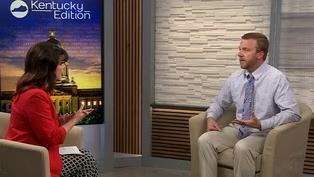
Clip: S4 Ep380 | 8m 11s | Inside Kentucky Politics with veteran journalist Al Cross. (8m 11s)
 New
NewPesticides and Parkinson's Disease
Video has Closed Captions
Clip: S4 Ep380 | 5m 9s | Neurologist shares research on connection between Parkinson's Disease and pesticides. (5m 9s)
Providing Support for PBS.org
Learn Moreabout PBS online sponsorship
- News and Public Affairs

Top journalists deliver compelling original analysis of the hour's headlines.

- News and Public Affairs

Today's top journalists discuss Washington's current political events and public affairs.












Support for PBS provided by:
Kentucky Edition is a local public television program presented by KET