
March 25, 2026
Season 4 Episode 350 | 26m 30sVideo has Closed Captions
Lawmakers advance legislation aimed at strengthening Kentucky State University.
Lawmakers advance legislation aimed at strengthening the state's only publicly-funded HBCU. A bill limiting how an administration spends and hires in the days before new officers take over clears a committee. Ignoring a school bus stop arm could soon come with a $300 penalty. A local program is keeping the tradition of Kentucky Country Ham alive.
Problems playing video? | Closed Captioning Feedback
Problems playing video? | Closed Captioning Feedback
Kentucky Edition is a local public television program presented by KET
March 25, 2026
Season 4 Episode 350 | 26m 30sVideo has Closed Captions
Lawmakers advance legislation aimed at strengthening the state's only publicly-funded HBCU. A bill limiting how an administration spends and hires in the days before new officers take over clears a committee. Ignoring a school bus stop arm could soon come with a $300 penalty. A local program is keeping the tradition of Kentucky Country Ham alive.
Problems playing video? | Closed Captioning Feedback
How to Watch Kentucky Edition
Kentucky Edition is available to stream on pbs.org and the free PBS App, available on iPhone, Apple TV, Android TV, Android smartphones, Amazon Fire TV, Amazon Fire Tablet, Roku, Samsung Smart TV, LG TV, and Vizio.
Providing Support for PBS.org
Learn Moreabout PBS online sponsorshipmusic >> With normal hands, obviously, you can just pick up anything and do anything so we don't have that luxury.
So the luxury of extra things would be quite beneficial.
>> Prosthetic limbs aren't always covered by insurance and Kentucky.
A proposed bill in Frankfort would change that.
[MUSIC] A big University of Kentucky donor calls Mitch Barnhart's future UK job a, quote slap in the face.
Why one football fan is blowing the whistle.
[MUSIC] >> If everybody does what they do and we do it right.
[MUSIC] That ham that you're working on could very well be at your Christmas dinner.
[MUSIC] >> And in this class, it's all hands on deck.
>> Production of Kentucky edition is made possible in part by the KET Millennium Fund.
[MUSIC] >> Good evening and welcome to Kentucky edition for this Wednesday.
It's March 25th.
I'm Renee Shaw, and we thank you for winding down your Wednesday with us.
Kentucky.
Republicans in the state legislature are advancing new rules as new governors and other constitutional officers enter office.
House Bill ten would limit how one administration spends and hires in the days before the new officers take over.
As our June Leffler reports, some Democrats say this adds undue scrutiny.
For career public servants.
[MUSIC] >> House Bill ten is designed to limit hard to reverse actions before new constitutional officers arrive.
>> And it attempts to free the.
The transition period from politics and possible real or perceived wrongdoing.
>> Changes in House Bill ten would largely apply to the last six months of a sitting governor's term.
The bill would require large pending settlements to go through the Attorney General's office.
It limits noncompetitive contracts and mandates more records be preserved.
It also changes the hiring or promotion of state workers, anyone that holds a political appointment and then moves into a protected civil service position in a governor's last 18 months in office, would have to be under probation for two years.
The bill also adds more Senate confirmations for the heads of state agencies and boards.
>> There is a need to keep these boards very focused.
We asked them to do a professional jobs that have technical understanding and technical requirements, and I think the people that we put on those boards need to be vetted.
>> Mr.
chair, I'm going to vote no.
I am concerned that some of the confirmation provisions go a little too far in stepping on the power of the executive branch, and would tie the hands of the executive branch in carrying out its duties.
>> The Senate, State and Local Government Committee advanced House Bill ten with two nay votes from Democrats and now heads to the full Senate.
The committee also approved an elections omnibus bill.
House Bill 139 soared through the House with one nay vote.
It now contains a bulk of House Bill 534, which Democrats opposed, saying it may throw some eligible voters off voting rolls.
>> So my understanding of the bill is that it requires us to give some of our voter information to the federal government, which will then run it through a database to check for citizenship status.
What do we know about false positives from other places?
>> Doesn't actually require that data to be given at this point.
It simply authorizes the state Board of Elections to work to reach memorandums of agreement with the federal agencies, and the data that it would be giving is limited to name, date of birth and last four social security number.
As far as false positives go, I've heard many different estimates on this.
I've heard 12%, over 25%.
I've heard 2%.
So it's really hard to nail that down.
I will tell you that, especially given that we've lengthened the effective date to January 2028.
We are working closely with both the county clerks and the Board of Elections to do everything we can to cleanse our roles at the state level before we even involve ourselves with the federal level.
>> An earlier version called for changes before this year's primaries in May, which the county clerk's association opposed.
Kentucky's leading elections official, the secretary of State supports the bill in an 8 to 2 vote.
House Bill 139 now heads to the full Senate for Kentucky additions.
I'm June Leffler.
>> Thank you so much.
June.
Now today marks day 53 of the 60 day lawmaking session.
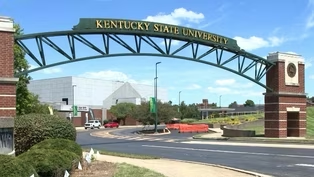
Also today, state lawmakers acknowledged there had been serious conversations about the closure of Kentucky State University.
That's the state's only publicly funded, historically black college and university, or HBCU.
It's been in existence since 1886.
KSU has been mired in persistent financial missteps and debts in recent years, but some lawmakers have expressed confidence in the current administration, with Kofi Akakpo as president of K-State since 2023 and turning the institution around today, the Senate Appropriations and Revenue Committee advanced legislation aimed at strengthening KSU.
Among the provisions in Senate Bill 185, KSU would transition toward a polytechnical model, meaning it will focus on degree programs related to applied sciences.
State Senator Christian McDaniel, who is chair of the Senate Budget Committee, outlined other aspects of the bill.
>> Kentucky State will transition to a polytechnic mission and become a polytechnic university over the next five years.
As Doctor Thompson has alluded to, there will still be liberal arts offerings on campus as well as online.
Relative to that.
Exigency is declared and any employment provisions are suspended.
Employment status will be determined by the president.
The minimum GPA for admission will be raised to a 2.5 with an 18 on the Act.
No student with over $1,000 in debt shall be enrolled beyond 30 days of the date the amount is due.
All fraternities and sororities must re-apply for their charters.
Any person knowing Kentucky State money shall have a tax return.
Return intercepted by the Department of Revenue.
And we're directing the Department of Revenue to work with the federal Government to do the same for those out of state who owe Kentucky state money.
Any liberal arts degrees will largely be moved to an expanded online offering, with the exception of education.
Only polytechnic and Stem and education degrees are in person.
The president will have the sole discretion as to the re-admittance of students.
Funding will be held constant at the base.
There will be no cuts made in the biennium to the budget of Kentucky State University.
CEP.
CPE will continue to provide oversight of university operations, with Monthly reporting to CPE from Kentucky, State and then quarterly to the General Assembly.
All financial transactions are transferred to the EMR system.
Any person, person, corporation or officer currently engaged in a P3 with Kentucky State University will no longer be eligible to transact business with the Commonwealth or any of its political subdivisions.
There is an asset preservation request currently being reviewed of up to $50 million.
They will receive $2 million for expanded online offerings.
Although that is not part of this bill, it will be part of a future appropriations bill.
I should add, reviewing the $3 million request for polytechnic transition, also not as part of this bill, but as part of a separate will be $50 million in year two for the Health Sciences building, pending participation in Ima's in a clean financial review.
>> Senate Minority Leader Democrat Gerald Neal of Louisville said there were several changes he'd like to see in the bill, but he did vote for it in committee, calling this moment, quote, a huge opportunity.
Senate Bill 185 advanced out of the committee, and it now awaits action by the full Senate for further consideration.
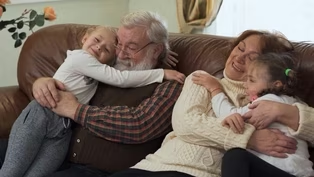
How do the courts determine when to award visitation rights to grandparents?
And should public infrastructure workers be held civilly liable for crashes and injuries?
These are questions addressed by two pieces of legislation heard today in Frankfort.
Our Emily Sisk was following them and explains what you need to know.
>> The House Judiciary Committee considered a bill related to grandparents visitation rights today.
Senate Bill 281 looks to update Kentucky law to determine how and when grandparents may be granted court ordered visitation.
The courts would need to see clear and convincing evidence that visits with grandparents would be in the child's best interest.
Bill sponsor Senator Rick Girdler explained his intent behind the legislation.
>> We're not trying to take the place of a parent.
The parent has full custody and and full say so of the child.
>> Rick Girdler said he wanted to see updates so that if a parent's custody rights were terminated or if a parent died, grandparents would still have access to the children.
>> Do you know how often that there are issues with visitation of grandchildren, with grandparents, that does this occur very often that it could be a problem?
Or do you not?
>> It's people my age.
I hear it all the time now.
I'm just under the impression, you know, I haven't took numbers, but I do know it's a great concern, whether it's 1 or 100.
And my concern is, is basically I want to see my grandkids.
I want to be a part of their life.
I want them to be a part of my life.
And some people don't get to do that.
>> In Eastern Kentucky, Republican said he appreciated the clear and convincing evidence standard, as not all grandparents are fit to be in their grandchildren's lives.
>> I have, in my practice as a lawyer, seen the downside of having this presumption in the instance of a death of a parent.
You're.
I'm sure you're a great Grant your great grandparent.
Not all grandparents are great grandparents, and I think this clear and convincing evidence standard helps weed that out.
>> Senate Bill 281 advanced out of committee, with one Democrat passing on the vote.
The lawmakers also heard Senator Craig Richardson's Senate Bill 195, which clarifies when contractors can be held civilly liable for work done on public roads and bridges.
>> Senate Bill 195 is about aligning liability with responsibility.
This helps ensure that each party is held accountable for the role they actually played.
No more, no less.
>> The legislation says that once a contractor completes their work, according to the plans given to them, they cannot be held liable for property damage or personal injury.
There is an exception in the bill explaining when workers could be held liable.
>> If they've had a role in the design process.
If they've made decisions outside of those plans or acting negligently in any way, they are still held liable.
>> Senate Bill 195 passed unanimously out of the House Judiciary Committee and advances on to the full House for Kentucky edition.
I'm Emily Sisk.
>> Thank you.
Emily.
The House judiciary panel also passed Senate Bill 66, which expands the list of controlled substances that can lead to a DUI charge to include fentanyl.
Passing the full House today, Senate Bill 59, a bill that increases the penalties for using public resources to speak out or against, for or against political issues.
The legislation was proposed after many school educators and administrators publicly opposed Constitutional Amendment number two back in 2024, which would have allowed the Kentucky General Assembly to allocate public dollars to private schools under the bill, anyone found guilty of using public resources on political issues could face a $500 fine or a class A misdemeanor for a third offense.
Now, over in the Senate today, lawmakers advanced a bill that would allow school districts to add cameras to school bus stop arms.
Supporters cited a study in Kentucky that found drivers ignoring stop arms 1300 times a day.
House Bill seven would allow law enforcement to issue a $300 fine to drivers caught passing a school bus stop with a deployed stop arm.
A second violation would cost $500.
Speaking on the Senate floor today, Senator Greg Elkins of Winchester explained how that money would be used.
>> If that fine is not contested or if that fine is not paid or contested within 60 days, the transportation cabinet could move to suspend your registration.
The monies that are given all funds would go towards the school district where the violation occurred, except for in cases where the penalty goes to the sheriff's office, he can extract $25 for his time to to oversee that.
The rest of it would be going to the school system in a restricted fund.
That is only to pay for the stop arms on the busses.
As we know, a lot of our school districts just can't afford these additional cameras on their on their school bus.
>> House Bill seven passed the full Senate today with just one no vote.
A minor change was made to the bill in a Senate committee, meaning it will have to go back to the House for them to approve or reject.
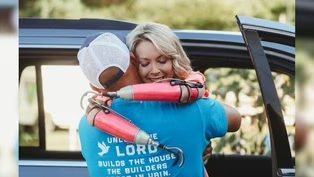
The use of our arms and legs may be something that many of us just take for granted, but for those with amputations or other limb differences, access to the proper prosthesis is critical for daily living.
Senate Bill 97 would require all health insurance plans to cover any prosthesis prescribed by a licensed, licensed physician.
As our Mackenzie Spink tells us, Kentuckians with limb differences say this change in the law would help them to excel.
>> Cindy Mullins became a quadruple amputee three years ago after complications from an infected kidney stone.
She says arm and leg prosthetics aren't necessarily multi-use.
>> So different legs qualify for different things.
I have on a power knee right now and you wouldn't take that in the shower.
So having just extra shower legs to shower in daily is a big deal.
Or just everyday activities.
Maybe the hand that I would use to work in the kitchen would not be the hand that I would use to put on my makeup or other daily activities.
So just one prosthetic, for one thing, may not qualify with normal hands.
Obviously you can just pick up anything and do anything so we don't have that luxury.
>> Nora Rowling had a partial amputation of her right leg when she was born, but her family says that hasn't stopped her from living life to the fullest.
>> She's been wearing a prosthetic now for about two years and is absolutely thriving.
She is our most athletic child and absolutely loves sports.
Her favorite sports are.
>> Basketball, golf and football.
>> She's broken every prosthetic she's ever been given.
It's forced her prosthetic to to come up with a new standard.
They call it Nora proof.
She breaks her prosthetic because she uses it beyond it's it's what it's designed for.
It's designed for walking.
And she runs and she climbs and plays all the sports.
Having a second device would allow her to excel in those athletic activities, while protecting this one for her critical day to day activities.
>> Senate Bill 97 would require all health benefit plans, including student and state employee plans, to cover up to three prostheses for each affected limb in a three year period.
It also includes repairs and replacements under certain conditions.
Vice chair Representative Saj Pollock has a personal connection to the bill.
>> My cousin was born without a hand.
My uncle lost his leg in a farming accident, got his leg caught up in a PTO while they were unloading silage.
So I want to obviously thank the insurance industry for stepping in and bringing this and again, having this conversation.
It's a good day.
And this is one of those feel good bills that we do get to pass up here.
And so I am a proud yes for my uncle and for my cousin and for you all, everybody involved.
Thank you, Mr.
Chairman.
>> Senate Bill 97 passed the House Banking and Insurance Committee unanimously.
It will now head to the full House for consideration there.
There are four days left in the legislative session before the General Assembly adjourns for the veto period for Kentucky edition.
I'm Mackenzie Spink.
>> Thank you.
Mackenzie.
When Senate Bill 97 was heard in the upper chamber, which is the Senate, it passed that body unanimously.
[MUSIC] Mitch Barnhart will step down as the University of Kentucky's athletics director at the end of June.
And not everyone likes his new $950,000 a year job with the UK Sport and Workforce Initiative.
The critics include a big UK booster.
Details about this in tonight's look at sports news.
Brett Setser is a UK graduate and a businessman involved in real estate and construction.
He's a longtime UK football supporter.
He says he's pledged at least $3 million to the program.
Setser calls the university's plans for Barnhart, quote, deeply misguided.
The Lexington Herald-Leader reports that Setser sent UK a letter on Monday.
In that letter, he called Barnhart's future salary quote, astonishing.
Here's more of that letter, he says.
Barnhart's new role is, quote, a slap in the face to donors who are constantly told that the program always comes first, and it sends a troubling message to the rest of the UK community and Big Blue Nation administrators.
First priority is to take care of themselves using other people's money, end quote, UK spokesperson Jay Blanton told the Lexington Herald-Leader that UK respects Mr.
Setser as a valued supporter, and the university hopes to meet with him to further understand his concerns.
[MUSIC] Back before refrigerators ever existed.
If you can imagine, if you wanted to preserve meats, you had to salt and cure them.
Well, that's where the tradition of Kentucky country ham started.
Our Chip Polston takes a look at a program that keeps this tradition alive, and this Kentucky Life extra.
>> Thanks so much and it's good to be with you again.
If you have a country ham today, odds are pretty good.
It was produced by a commercial operation.
The tradition of hand rubbing a spice blend on a ham and then hanging it in a barn started to decline more than 100 years ago.
But two men in Lexington are aiming to keep the tradition alive, teaching 100 or so folks every year how to do it.
It truly is an operation that requires, as the name says, all hands on deck.
[MUSIC] Even before Kentucky was a State settlers who came here from Virginia brought along the tradition of salt curing hams.
It was the only way they had to preserve meat, especially pork.
But as with many traditions, industrialization took over and the practice slowly began to disappear.
That's where Stephen Clem and John McDonald, the fourth come in hand, cured Ham was a tradition in their families, and they wanted to keep that alive.
[MUSIC] That's why they started the all hands on deck program.
[MUSIC] It's a chance for people to create their own ham that they can then age for a year or two.
It all kicks off in January, Stephen says.
That's the one month out of the year when ham prices are usually at their lowest 100 or so people gather at Clem's Refrigerated Meats and Lexington to start the process.
It begins with a simple mix of kosher salt, brown sugar and potassium nitrate.
Everybody gets a ham, some gloves and then the work begins.
>> We have a cure mixture from it, and when he says, you work the hams, you're basically taking that cure and rubbing it into the ham.
So it is a it's a manual labor job.
From there, we put them into our ham tubs and take them back to our cooler.
And then we come back ten days later and do the exact same process again.
Again, that's what we call our insurance.
Step up to make sure that it is fully cured and that that cure gets down to the bone because it's pulling out moisture from the cure.
And then we come back a month later and that's when the pillowcase happens.
We put some brown paper sacks over them, put them in a pillowcase, and then it finds a home in a barn or a garage or an attic or something like that.
It's going to hang for at least a year or two.
So we want that to be a as safe as it can be from all, any pests.
>> So two years from now, when I unwrapped this, how different is this going to look?
>> Well, you're at probably 20 pounds right now, right.
And next year it'll probably go down to about 16 pounds.
In two years it'll probably be down to about 13 or 14 pounds.
Oh wow.
So it will continue to purge moisture right through that whole time.
>> If everybody does what they do and we do it right, that ham that you're working on could very well be at your Christmas dinner.
So to put the extra effort into it and we do it right, and you'll get to enjoy and brag about the the finished product when you get done.
>> The way you finish the product depends on how long you age it.
After two years, like the ham Stephen brought for us to try, you can cut away the skin and the fat cap and eat it right away.
So this is two year Kentucky ham that looks like a prosciutto.
It really does.
Gentlemen.
So we got.
That's really good.
>> Very good.
>> That does really taste like prosciutto.
Now full disclosure, I am not a big ham fan, but I loved this.
It really did taste like prosciutto I'd had in Spain.
You can also eat the ham after just one year, but that requires more work.
Like what Carrie Richardson did after she participated in the all hands on deck program in 2023.
After a year, Carrie washed and soaked her ham in water for several hours to dry out some of the salt, and then cooked it at a low temperature for several hours.
She and her family were very pleased with the results.
Tell me how you got into this.
How did you first become a ham fan?
>> I grew up in Kentucky.
That's how I became a ham fan.
I just have strong memories of eating it a lot.
When I was growing up, my grandma would make big ham steaks for Christmas morning breakfast, you know, on the skillet, in the skillet, on the stove.
And my mom would fix it and leave some out for my dad, who worked late.
And more often than not, I would eat all of the ham before he got home.
>> For more than 100 years, there's been a meat sciences program at the University of Kentucky.
That's where we found Doctor Gregg Rentfrow.
He says he sees young people in particular, becoming more interested in foods enjoyed by past generations.
>> You need to learn your heritage.
You need to learn your food heritage as well.
You know, and I think again, Kentucky country ham, they go hand in hand.
And I think we're getting into a generation that's wanting to learn more about where they come from, learn more about what their culture is here in the southeast, learn more about what their culture is here in Kentucky.
>> And so it is on a few winter Saturday mornings, people come together to practice an art their ancestors had to do out of necessity.
It's a throwback to a time before modern conveniences when feeding your family didn't mean jumping in your car to go to a local restaurant or store.
>> It's not another trip to the grocery store.
This is something that that you work on year round.
And back in the day, it was how you it's how you fed your family.
You had to find a way to cure your meat for the summertime, to preserve it.
So you had something to eat.
And I kind of look at it that way.
It's kind of like growing a vegetable garden.
A lot of people don't do that anymore.
They go to the farmer's market or they go to the grocery store.
And this is something that that, that I hope the generations pick up on.
>> If we don't make a concerted effort to remember and preserve those, they disappear.
I don't know what else.
We've already disappeared from our Kentucky history of food waste, but I know there are some things that are probably gone already.
So even though I didn't grow up producing this, if I can be part of, you know, retelling the story, I want to be able to do that.
>> Great stories like this one come your way on our show each Saturday night at eight eastern, seven central right here on k e t as we continue to cherish this great Kentucky Life back to you.
>> Thank you Chip.
Now I think I want ham for dinner.
Well, that will do it for us on Kentucky edition.
We hope to see you again tomorrow night at 630 eastern 530 central, where we inform, connect and inspire.
We hope that you'll connect with us all the ways you see on your screen.
The social media channels, Facebook, X and Instagram.
We encourage you to send us a story idea by email at Public Affairs at ket.org, and look for us on the PBS app that you can download on all your smart devices and stream content anytime, anywhere, online on demand at k e t dot o r g. I'm Renee Shaw, thanks for being with us tonight and hope to see you right back here again tomorrow night.
Take really good care.
Have a great night.
[MUSIC]
Bill Considers Grandparents' Visitation Rights
Video has Closed Captions
Clip: S4 Ep350 | 3m 29s | Measure updates Kentucky law on granting grandparents court-ordered visitation. (3m 29s)
Bill Would Restrict Outgoing Administration’s Hiring, Spending
Video has Closed Captions
Clip: S4 Ep350 | 3m 31s | Bill limits how an administration spends and hires in days before new officers take over. (3m 31s)
Proposed Measure Aims to Strengthen KSU
Video has Closed Captions
Clip: S4 Ep350 | 3m 22s | Lawmakers advance legislation aimed at strengthening Kentucky's only publicly-funded HBCU. (3m 22s)
Prosthetics Covered by Insurance Under Bill
Video has Closed Captions
Clip: S4 Ep350 | 3m 44s | Proposed bill to require prosthetic limbs be covered by insurance in Kentucky. (3m 44s)
Providing Support for PBS.org
Learn Moreabout PBS online sponsorship
- News and Public Affairs

Top journalists deliver compelling original analysis of the hour's headlines.

- News and Public Affairs

FRONTLINE is investigative journalism that questions, explains and changes our world.












Support for PBS provided by:
Kentucky Edition is a local public television program presented by KET