
March 16, 2026
Season 4 Episode 343 | 26m 30sVideo has Closed Captions
A second soldier from Kentucky dies supporting Operation Epic Fury.
A second soldier from Kentucky dies in Operation Epic Fury. A Fayette Circuit Judge testifies in her impeachment hearing. A mother asks state lawmakers to consider a change to Medicaid waivers. The House votes to override another of the governor's vetoes. March is full of madness in both sports and weather.
Problems playing video? | Closed Captioning Feedback
Problems playing video? | Closed Captioning Feedback
Kentucky Edition is a local public television program presented by KET
March 16, 2026
Season 4 Episode 343 | 26m 30sVideo has Closed Captions
A second soldier from Kentucky dies in Operation Epic Fury. A Fayette Circuit Judge testifies in her impeachment hearing. A mother asks state lawmakers to consider a change to Medicaid waivers. The House votes to override another of the governor's vetoes. March is full of madness in both sports and weather.
Problems playing video? | Closed Captioning Feedback
How to Watch Kentucky Edition
Kentucky Edition is available to stream on pbs.org and the free PBS App, available on iPhone, Apple TV, Android TV, Android smartphones, Amazon Fire TV, Amazon Fire Tablet, Roku, Samsung Smart TV, LG TV, and Vizio.
Providing Support for PBS.org
Learn Moreabout PBS online sponsorship[MUSIC] [MUSIC] The war in Iran hits home again.
[MUSIC] What we're learning about the second Kentucky soldier killed in Operation Epic Fury.
[MUSIC] >> The ultimate end goal is that I think she's violated her duties and the trust enough that she no longer needs to sit on the bench.
>> Courtroom drama heads to Frankfurt today.
This time, the judge is the defendant.
[MUSIC] >> For a person who is deafblind, the world is full of information they cannot see and cannot hear.
[MUSIC] >> And a Kentucky mother urges the Kentucky General Assembly to help her son and others like him.
>> Production of Kentucky edition is made possible in part by the KET Millennium Fund.
>> Good evening and welcome to Kentucky edition for this Monday, March the 16th.
I'm Renee Shaw.
We thank you for kicking off a brand new week with us.
Two weeks at war with Iran and a second soldier from Kentucky has died, the Defense Department says Tech Sergeant Ashley Pruitt of Bardstown was killed last week.
She was one of six Air Force airmen aboard a KC 135 refueling aircraft that went down in Iraq while supporting Operation Epic Fury, Pruitt was assigned to the Sixth Air Refueling Wing at MacDill Air Force Base in Florida.
The 34 year old joined the Air Force back in 2017.
A fundraiser online says she leaves behind a husband, their three year old daughter and a stepson.
State Senator Jimmy Higdon and state Representative Candi Maceroni, who both represent Nelson County, released a joint statement following the news.
Quote, the people of Bardstown, Nelson County and Kentucky are blessed to call her one of our own.
Our hearts go out to her family and friends as we celebrate a life that was dedicated to serving our nation.
End quote.
The death of Tech Sergeant Pruitt follows the loss of Sergeant Benjamin Pennington.
The Hardin County native died a week after he was injured in an Iranian attack on a base in Saudi Arabia.
His funeral arrangements are pending.
A former state representative and a Commonwealth prosecutor want a judge removed from the bench.
Fayette Circuit Judge Julie Muth Goodman testified in Frankfurt today to a committee of lawmakers who will decide whether to impeach her on grounds she abused her position in ruling on criminal cases.
Our June Leffler explains.
>> Goodman, a former prosecutor and Biglaw litigator, has spent 18 years as a judge.
Her current term ends in 2031.
A petition for lawmakers to impeach her and potentially remove her from elected office cites her conduct.
In six cases.
>> I could not be run by how the public would feel or how you all would feel.
I had to do what was right legally.
>> The petition mentions.
When an appeals court has not only overturned her rulings, but wrote of possible abuses in its opinion.
>> The allegations that she usurped the power of the grand jury, usurped the power of the petit jury, usurped the power of the prosecutor, became her own witness, did her own investigation.
>> A former Republican state lawmaker, Killian Timoney, who is running again after suffering defeat in 2024, filed the petition against Goodman.
He claims she disregarded or violated the law in several rulings.
Goodman then sued him and state lawmakers for proceeding with impeachment hearings.
Her lawyers say the proceedings infringe on her due process rights.
>> She cannot confront her accuser in violation of her due process rights, because we don't know who it is.
Because Mr.
Timoney did not verify his petition by means of an affidavit.
And if we cannot cross-examine the witnesses, she has no right of confrontation there either.
>> Timoney did not testify today.
Instead, a Commonwealth prosecutor spoke up.
>> The ultimate end goal is that I think she's violated her duties and the trust enough that she no longer needs to sit on the bench.
>> She says.
Goodman has a bias against her office and rules more often for defense attorneys.
>> We have to talk to victims about what to expect from her and any ruling that may come up, which usually will be against us, and we try to resolve those cases to take away as many rulings from her as we can.
>> One example of this, Kimberly Baird, presented findings that Goodman rules to suppress evidence much more often than her fellow Fayette County judges.
>> The four courtrooms other than Judge Goodman's courtroom, the defendant success rate changes ranges between 12 and 32%.
Is that correct?
Yes.
And Judge Goodman courtroom, the defendants were successful 80% of the time.
>> That is correct.
>> So I'm trying to understand why this discrepancy here is so large.
>> Goodman's counsel reminds the committee that prosecutors, not defense attorneys, carry the burden of proof to convict.
>> The fact that you lose now and then is just part of the deal.
And the fact that a judge is tough on you is just the way it is, because judges are holding the government to the highest possible standards.
A judge that isn't doing that isn't doing their job.
>> Impeachment proceedings are initiated in the House, where, if carried through, would prompt a trial in the Senate, where conviction must be secured, with two thirds of the senators present for Kentucky edition.
I'm June Leffler.
>> Thank you.
June.
Now, in a different legal matter, a judge has been asked to consider holding former Kentucky governor Republican Matt Bevin in contempt of court.
The request comes from lawyers from Bevin's adopted son, Jonah, according to the Kentucky Lantern.
Last week, a family court judge gave Matt Bevin and his ex-wife Glenna 48 hours to turn over financial documents regarding their divorce.
Jonah's lawyers say Matt Bevin has so far only provided incomplete or redacted info.
Jonah is seeking child support from his parents.
He who he says abandoned him in an abusive reform school in Jamaica that has since been shut down.
Today's filing asks for a hearing on the contempt charge.
It's unclear if the judge will grant a hearing.
There was powerful testimony in Frankfurt today from a mother whose son is both blind and deaf.
She's advocating for a change to Medicaid waivers, which would help her son and others like him.
Our Emily Sisk explains that and more as we begin tonight's legislative update.
>> A Kentucky mother wants Medicaid waiver coverage to extend to community intervenors people who help those with disabilities process what's going on around them.
She spoke to the Medicaid Oversight and Advisory Board today, joined by her son, who is both deaf and blind.
>> For a person who is deaf blind, the world is full of information they cannot see and cannot hear without someone trained to bridge that gap.
Everyday life becomes confusing, isolating and sometimes dangerous.
A community intervener is the person who makes the world accessible.
>> Senate Bill 345.
Sponsored by Senator Julie Adams, would require the waiver program to cover community intervener services.
The Kentucky mother explained why those services are so vital to someone like her son.
>> If someone who can help him understand what's happening around him, it's someone who can break down the noise, describe the environment and help him navigate safely.
It's someone who can make sure he isn't just present.
He's participating.
>> Members of the Medicaid Oversight and Advisory Board expressed support for the bill, which has yet to be heard in a standing committee.
>> We know this is why the Medicaid program exists, and it's to help individuals access those health care services to improve their lives and make them more, more integrated into society.
>> The board also discussed House Bill 169, sponsored by Representative Ken Fleming, which has to do with insurance coverage for eating disorders.
The legislation says insurance companies cannot deny or limit coverage based on standards like ideal body weight or body mass index.
>> Eating disorders basically is, to my opinion, based on my experience and talking to other folks.
It's a mental health wellness issue.
And so we want to ensure that insurance coverage continues despite meeting the BMI, that insurance contingency coverage.
>> A fellow board member said this legislation could help save lives.
>> Eating disorders have been the most overlooked, misunderstood, untreated, and they very often result in death.
So this is incredibly important.
>> House Bill 169 passed out of the House in early February.
It awaits a committee assignment in the Senate for Kentucky edition.
I'm Emily Sisk.
>> Thank you, Emily.
And Medicaid reform is our topic this evening on Kentucky.
Tonight, our panel includes three lawmakers, all from the Medicaid Oversight and Advisory Board.
An insightful conversation about Medicaid in Kentucky that's coming at you at eight eastern, seven central right here on KET.
The Kentucky House made quick work to override Governor Andy Beshear latest veto.
The governor vetoed House Bill one on Friday.
The bill would have allowed Kentucky to take advantage of a federal scholarship tax credit initiative made possible by the so-called one big, beautiful bill that was approved by Congress last year.
Money from the tax credit could be used to support a variety of educational expenses, not just tuition, for students in both private and public schools.
In his veto message, Governor Beshear said supporters of House Bill one are, quote, wanting to use a federal tax credit to divert public dollars to private schools.
End quote.
Today, the House voted to override the veto by a vote of 77 to 14.
The Senate is expected to do the same.
State Senate President Pro Tem David Givens said this, quote, this legislation does not spend a single dollar on Kentucky of Kentucky tax revenue does not reduce SEEK funding and does not divert state education dollars.
It simply allows Kentucky to participate in a federal program so that charitable donations, supported by a federal tax credit can benefit Kentucky students instead of students in other states.
End quote.
Governor Andy Beshear is pushing back on State Auditor Alison Ball's latest report showing that 269 Kentucky kids ended up staying in office buildings during a 22 month period as part of the state's nontraditional placement, or n p program.
The report criticized what it called systemic failures by the cabinet for Health and Family Services, including a lack of transparency and unreliable tracking of the care children received last week, the governor talked about another report from the finance cabinet inspector general that points to progress in helping Kentucky's foster children.
>> In contrast to the other recent reports, these findings confirmed that nontraditional placements are rare in Kentucky and only account for 1 to 2% of cases.
For the few children who are placed in a nontraditional setting, the stays are short just over two days on average, but in more than 50% of cases, the length of stay was 24 hours or less.
The inspector general's report found that when kids are placed outside of the home, the Department of Community based Services works really hard to keep them as comfortable and as safe as possible.
There are two supervising staff members and one security guard for every youth, meaning children are never left alone.
Every child is provided a clean, furnished bedroom with a bed, bedding, nightstand, a desk and study area, a television and technology access.
They've got food and clothing on site as well as hygiene products and facilities, medical services, transportation to school if they are enrolled, recreational activity and time for visits.
>> The governor said.
The auditor's office didn't give the agency's being audited a chance to comment.
He says the report contains mistakes that could have been cleared up through interviews.
Or, he says, even Google searches.
[MUSIC] Data centers have been billed as the next revolution in the digital information age, as proponents envision sizable economic development gains from their expansion in pockets of the state.
Deep pocketed tech firms are attracted to Kentucky for its cost friendly land, electricity and water face opposition from those fearful.
The hardware installations will raise energy prices for ratepayers.
And part two of my conversation with Public Service Commission Chair Angie Hatton, we discussed the impacts of data centers and who should bear the cost load.
There's a lot of conversation in Frankfort to about data centers, about regulation, and about if they if they are putting a lot of demands on the power grid, that they absorb it, right?
And not the homeowner, the consumer, the business, etc.
Where is the public Service Commission in this conversation about the expansion of data centers?
And is there any kind of guidance you can give lawmakers and what they're considering?
>> So Kentucky is a little later to the game than some other states.
There's some places like Northern Virginia where their data center capital, there's a data center corridor in Northern Virginia, and it has been an intense negative effect in that area because I guess regulators and the utility companies and definitely the local officials and state officials did not understand the impact it was going to have on bills.
So in Kentucky, we're coming a little bit later to it and learned.
Advantage Wright is in this case, we've learned from the mistakes of other states so that our goal is the goal of a lot of these bills and the goal, the goal of a lot of tariffs that have already been filed by Kentucky utility companies is to make sure that the data center covers its own cost.
So you saw recently the the five largest hyperscalers in the country made a pledge to the president that they would make every effort to absorb their own costs and not spread the cost of expanding infrastructure to cover data centers across the other rate classes and customer classes.
So I think that that is the goal of the E h extreme high load factor tariffs that have been filed by all of our utilities have different versions.
And then there's some bills and no one has already passed.
The House representative Bray Civil.
And that seems to be the goal of that bill as well, right.
To make sure that if a data center is needed and they're needed in the country with Kentucky doesn't have to have them, but they are definitely needed in the country to power the increased need for streaming services for AI.
You know, when you get on your phone and search for something on Google, it uses way less electricity than if you use AI to do that same search.
Exponentially more power.
So if I'm up at 4:00 in the morning googling something that's on my mind, like, why would a chicken lay an egg every day?
That's on my mind.
I'm just it doesn't make sense to me that a chicken would want to lay an egg every single day.
And why is that something that nature developed?
So I googled that.
But if I Google it through AI, I'm using a ton of electricity.
And if I want to make my neighbor be in a silly disco dance or something like that, and use AI to do it, or make my new profile picture, it uses a ton of electricity.
And so we have to have data centers to house the infrastructure to actually create and channel that power.
>> Yeah.
And can our utility companies keep up with the increased demand of power?
And are we diversifying our energy portfolio enough?
>> These are all very good questions.
So it takes a lot longer to build a new power generation plant than it does to build a data center.
So that is that is really the issue when we created monopoly territories for, for our utilities, they are required to serve anyone who comes to their territory.
So if a data center which needs 250MW of power, say, comes to their territory, they're required to serve them.
So luckily, we do have the e f the extreme high load factor tariffs in place for all of our major utilities now either already approved or pending, so that when a data center comes, they can either bring their own generation B, Y, O, g, Wright or they can absorb the cost of whatever new infrastructure has to build, whether it's transformers and transmission or whether it's a whole new plant.
>> Yeah, there is a lot of conversation, as there usually is during the legislative session, about coal and the importance of coal to electric generation in Kentucky and the relatively lower or low.
I don't know how you want to characterize it.
Energy rates during normal times, maybe not during high usage times.
Is that a conversation that the PSC has about what Kentucky's energy portfolio should look like?
>> Well, we don't set it.
We don't set policy.
We carry out the policy that's set by the legislature or to some extent, the Kentucky Office of Energy Policy.
So the legislature created the Energy Planning and Inventory Commission a couple of years ago to look at our resource mix.
In general, Kentucky is better off than a lot of states because of our mix we have in our state still.
Let's see, I think it's about 60%, 69% coal, 25% natural gas, and then about 5% hydro and then 1%, all others.
Right.
So their solar did double last year.
We doubled the capacity for solar in the state last year, but still only a little over 1%.
>> Right.
And there's a conversation about nuclear energy, right.
And we know that Senator Danny Carroll and the western part of the state in Paducah has really been a part of this effort for really ten years.
Yes.
And we know the moratorium was lifted a few years ago.
So that's going to be another source.
And will the PSC have regulatory control and authority in that particular field?
>> We will.
We were mandated by CR 140, I believe, in.
>> Senate Joint Resolution.
140.
Yes.
>> Thank you.
That came out last year that mandated the PSC study nuclear so that we could get ready to regulate it if it happens.
So we've done that.
We've educated ourselves about other states policies.
We've joined first movers Group with the National Association of Regulatory Utility Commissioners and National Association of State Energy Officials Organization.
The National Governors Association has done a nuclear push, and we're co-chairs of that.
Our state is we've toured nuclear facilities in North Carolina and Oak Ridge in Tennessee.
We have done a series of public comment hearings.
The first was in Moorhead, and the next one is going to be in Louisville.
And then we're going to have four more across the state to take in information and provide what information we can on a neutral basis to just educate people about nuclear.
Right.
And then Senator Carroll's bill will provide incentives for $25 million for each of three new potential early site developments permits.
And they're supposed to be geographically diverse.
So it's supposed to be spread out across the the country and or, excuse me, across the state.
And then he also has, I believe it's his bill that creates the nuclear ready communities.
But in general, nuclear sort of checks all the boxes when we talk about the resource mix that it's reliable.
It has a 90% capacity factor, which means that it is operating efficiently at all times, 24/7, except for when it has to go down to, to change the fuel cartridges that look like little ping pong balls in the, in some of the facilities.
And so that is a higher capacity factor than any other fuel source for producing power.
Right?
So it's reliable and it's completely green energy.
There are no emissions.
>> What a difference a day can make when it comes to Kentucky weather.
You know that yesterday we were in the upper 70s across much of the state, and today a four letter word we don't like so much this time of year.
Snow.
This was the scene in Bowling Green with snow showers on and off all day today.
And there were snow covered fields in Somerset as captured here by the Kentucky Mesonet.
The snow comes less than 24 hours after severe storms ripped across the Commonwealth, with winds as high as 68mph.
Nearly 40,000 customers were without power last night.
Tonight, that's down to roughly 8000, with the most outages being in Grayson County.
[MUSIC] And sports news, the brackets are set.
So let the madness begin.
Louisville and Kentucky are both going dancing and this year's NCAA tournament.
The Cardinals are a six seed in the East Region and will take on South Florida on Thursday.
In Buffalo.
The cats are a seven seed in the Midwest region.
They'll face Santa Clara on Friday in Saint Louis.
In the women's tournament, both UofL and UK are seeded higher.
UofL is a third seed and will play their first game in Louisville against Vermont.
UK is a five seed and will take on James Madison in Morgantown, West Virginia.
And a big shout out to the young women at George Rogers Clark.
The Lady Cardinals won this year's K h s double A girls basketball state championship.
It's their first sweet 16 championship in school history and we say hooray to them.
Now speaking of sports, do you know about a certain Kentuckian who won six Olympic medals?
And we have interesting details about Kentucky State song and the founding of a major Kentucky university.
Our Toby Gibbs has more in this.
Look at this week in Kentucky history.
>> The Transylvania Company bought 20 million acres of land from the Cherokees on March 17th, 1775 in what's considered the biggest private land transaction in American history.
The land includes most of present day Kentucky and part of Tennessee.
Ralph Waldo Rose was born March 17th, 1884, in Louisville.
He was a six time Olympic medalist in throwing events in 1904, 1908 and 1912.
He was the first shot putter to break 50ft.
Diane Sawyer of Glasgow, won the Kentucky Junior Miss pageant on March 16th, 1963.
She went on to win the American Junior Miss Pageant and became a prominent television journalist, most notably for ABC news.
The University of Kentucky won its fourth NCAA tournament title, beating Seattle 84 to 72 on March 22nd, 1958.
My Old Kentucky Home, written by Stephen Foster, became the official Kentucky State song on March 19th, 1928.
Foster was not from Kentucky.
It's believed the song was partially inspired by Federal Hill, a home in Bardstown owned by Foster's cousins.
Kentucky's General Assembly legalized liquor sales in Kentucky on March 14th, 1934, several months after the end of prohibition nationally.
On March 21st, 1906, the Kentucky General Assembly passed legislation creating the Eastern Kentucky State Normal School.
It would later be renamed Eastern Kentucky University.
[MUSIC] And that's a look back at the big events this week in Kentucky history.
I'm Toby Gibbs.
>> Thank you as always.
Toby Gibbs.
That'll do it for us tonight, but we sure hope to see you again tomorrow night at 630 eastern, 530 central on Kentucky edition, where we inform, connect and inspire.
We hope that you'll connect with us all the ways you see on your screen.
You can see us online on demand anytime at KET dot o r g. Look for us on the PBS app that you can download on your smart devices.
Send us an email, a story idea at public affairs@ket.org.
And we're there for you on the social media channels that you see on your screen.
I'll see you again at 8:00 for Kentucky tonight.
Until then, have a good one.
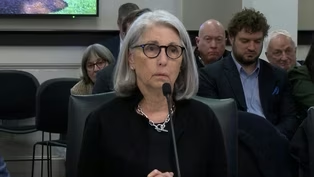
Fayette Judge Testifies In Her Impeachment Hearing
Video has Closed Captions
Clip: S4 Ep343 | 3m 32s | Lawmakers will decide whether to impeach the judge over abuse of power claims. (3m 32s)
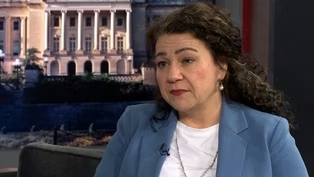
How Data Centers Impact Energy Prices
Video has Closed Captions
Clip: S4 Ep343 | 8m 44s | Renee Shaw talks with PSC Chair Angie Hatton. (8m 44s)

Mother Pushes for Change to Medicaid Waivers
Video has Closed Captions
Clip: S4 Ep343 | 2m 52s | The Kentucky mother wants Medicaid to cover community interveners. (2m 52s)

Second Kentucky Soldier Killed in Operation Epic Fury
Video has Closed Captions
Clip: S4 Ep343 | 1m 15s | Tech Sgt. Ashley Pruitt was from Bardstown. (1m 15s)
Providing Support for PBS.org
Learn Moreabout PBS online sponsorship
- News and Public Affairs

Top journalists deliver compelling original analysis of the hour's headlines.

- News and Public Affairs

Today's top journalists discuss Washington's current political events and public affairs.












Support for PBS provided by:
Kentucky Edition is a local public television program presented by KET