
April 6, 2026
Season 4 Episode 358 | 26m 30sVideo has Closed Captions
Kentucky Supreme Court orders lawmakers to stop impeachment proceedings against circuit judge.
The Kentucky Supreme Court blocks the General Assembly from continuing its impeachment proceedings against a Fayette County circuit judge, Kentucky political leaders react to the firing of Attorney General Pam Bondi, a look back at one of the most destructive spring weather events in Kentucky’s history, and meet the only ATF accelerant detection K-9 in the state of Kentucky.
Problems playing video? | Closed Captioning Feedback
Problems playing video? | Closed Captioning Feedback
Kentucky Edition is a local public television program presented by KET
April 6, 2026
Season 4 Episode 358 | 26m 30sVideo has Closed Captions
The Kentucky Supreme Court blocks the General Assembly from continuing its impeachment proceedings against a Fayette County circuit judge, Kentucky political leaders react to the firing of Attorney General Pam Bondi, a look back at one of the most destructive spring weather events in Kentucky’s history, and meet the only ATF accelerant detection K-9 in the state of Kentucky.
Problems playing video? | Closed Captioning Feedback
How to Watch Kentucky Edition
Kentucky Edition is available to stream on pbs.org and the free PBS App, available on iPhone, Apple TV, Android TV, Android smartphones, Amazon Fire TV, Amazon Fire Tablet, Roku, Samsung Smart TV, LG TV, and Vizio.
Providing Support for PBS.org
Learn Moreabout PBS online sponsorshipmusic >> Somebody got to Pam Bondi and said, it's your job to cover this up.
>> A Kentucky congressman talks about the Epstein files and the now ex attorney general.
>> We're looking at a historical flood here.
That's it hasn't been this bad in a long, long time.
[MUSIC] >> Record flooding and tornadoes.
A look back at one of the most destructive weather events in Kentucky's history.
[MUSIC] >> To her, it's a game.
It's all fun.
[MUSIC] >> But her work is serious.
Helping investigators get to the bottom of dangerous situations.
[MUSIC] >> It's like, makes me feel good to know that I'm like part of the race and that somebody has, like, a bed to sleep on right now.
>> And at this school, they're making beds, literally.
[MUSIC] Production of Kentucky.
>> Edition is made possible in part by the KET Millennium Fund.
[MUSIC] >> Good evening and welcome to Kentucky edition for this Monday, April the 6th.
I'm Christie Dutton in our Louisville studio in for Renee Shaw this evening.
Thank you so much for joining us.
The Kentucky Supreme Court has blocked the impeachment case against Judge Julie Goodman, a Fayette County circuit judge.
The court voted 5 to 1 with one justice recusing herself, the opinion said the impeachment effort violated Goodman's due process rights.
The court said the alleged offenses were not impeachable and that the General Assembly was not the proper venue.
The House had voted to impeach Goodman, with critics saying she had abused her office.
The Senate planned to try her now that the House has acted.
But in the court's ruling, it said state lawmakers cannot proceed.
More on this, including reaction coming up tomorrow on Kentucky edition.
The U.S.
has a new leadership at the Justice Department after President Donald Trump fired Attorney General Pam Bondi last week.
Kentucky political leaders are reacting to the move, including Congressman Thomas Massie, a Republican from Kentucky's fourth district.
He's been a longtime advocate for releasing the Jeffrey Epstein Files.
In an interview with the BBC before the president fired Bondi, Congressman Massie complained about the lack of action on the Epstein files and discussed why so much information hasn't been released.
>> I'm not satisfied until the survivors are satisfied.
That's my benchmark.
And obviously, you know, in my floor speech here in the House of Representatives, I said men need to be perp walked in handcuffs to the jail.
And until we see that here in this country, we've seen some of that in other countries.
But until we see that here in this country, we don't have a system of justice that's working.
>> Are you confident you will see that?
>> I don't know if we're going to see it in this administration.
>> I mean, why do you say that?
>> Because Pam Bondi has you know, she's been so against this, I would say from the beginning.
But in the beginning, I think she earnestly was ready to release files.
And then I think she wasn't in on the joke when they gave her those binders that had nothing in it.
Then she found out she looked like a joke, and she shot off the angry letter to the FBI.
But at some point, somebody got to Pam Bondi and said, it's your job to cover this up.
>> President Trump fired Bondi last Thursday as Governor Andy Beshear took questions during his weekly news conference.
A reporter asked the governor about his opinion of Bondi and the reports of her dismissal.
>> The United States should have an attorney general that is independent, that runs the Department of Justice, that is not partizan, that treats everybody with respect to their rights.
I knew Pam Bondi before this.
I had high hopes because she was an attorney general.
I thought she went about her work as a state attorney general.
Well, but I've been incredibly disappointed in her tenure.
I've never seen another attorney general that has lacked this level of independence.
So if if that's accurate.
While I considered her a colleague at one point, I think it would be the right decision, but only if the next person who comes in is both qualified and runs a Department of Justice the way that it's supposed to be run, and that it's that it's always been run.
>> President Trump named Todd Blanch, his former personal attorney, to serve as interim attorney general.
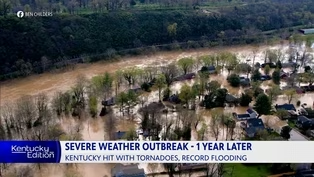
Well, it has been one year since Kentucky endured one of its most destructive spring weather events on record.
Over four days, waves of heavy rain and severe storms swept across the state, triggering flash floods, record river flooding and a rare overnight tornado outbreak.
Our Toby Gibbs has a look back.
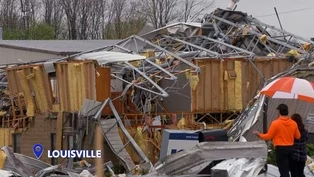
>> Eight tornadoes touched down across several counties between April 2nd and third, the most destructive an EF three that tore through an industrial corridor in Jeffersontown before moving into nearby subdivisions.
Dozens of businesses and homes were destroyed.
The storm system lingered for days, dumping nearly a foot of rain across parts of the state.
The downpours triggered widespread flooding that claimed seven lives.
>> We're looking at a historical flood here.
That's.
It hasn't been this bad in a long, long time.
>> The Kentucky River surged to record levels at Camp Nelson and reached the second highest crest in history.
In Frankfurt, the capital city became the epicenter of the disaster.
>> Quite a few, you know, homes that water six, seven feet inside the homes and, you know, a lot of the areas are still inaccessible because of the high water across the roads.
>> Streets and neighborhoods disappeared under flood waters in other Central Kentucky communities as the Kentucky River continued to rise, forcing hundreds from their homes and causing widespread damage.
>> We prepped as much as we could in the week coming up to this when we heard all this was coming.
There's only so much that can help us.
Even stacking everything in the house knee high up, it wasn't good enough because it's waist high.
>> In western Kentucky, many families were also forced to evacuate as the Ohio and salt rivers spilled over their banks.
>> I was talking to my daughter and then I started hearing stuff, you know, turn over, and I got up and I was in like knee deep water.
The fire department got me out in a boat.
>> Across the state, major highways and roads were covered, temporarily cutting off access to some communities.
>> Our generator went out on us yesterday, so I had to carry it out on a kayak and carry it back on a kayak.
Gasoline every day, propane every day.
This is my property right here as well.
And then I got one down the street just all the way underwater.
>> Finally, the rivers and the flood waters began to recede and the cleanup and recovery began.
>> People are just anxious to get back into their homes, to see what they have to do to get on the road to recovery.
>> I think we're good for now.
Thank you.
>> We know this is a devastation, but you still have your life and you still have your home, and it will take a while to get it all back together, but it'll come together.
>> For Kentucky edition.
I'm Toby Gibbs.
>> The severe storms prompted the Storm Prediction Center to issue a rare high risk designation for part of the state, the greatest threat level issued by the National Weather Service.
I spoke with Michael SEEK with the National Weather Service in Louisville about the storm and what made it different from the other severe weather systems that have hit the state.
Michael, from the National Weather Service in Louisville is here with us.
So, Mike, you were talking about how this was a high risk event, and we knew it was because the Storm Prediction Center sent out a high risk for starters, just for the storms.
That could be severe.
Right?
>> Absolutely.
So the night of April 2nd, 2025, there was high risk in the western part of the state for severe weather, but there was also high risk later on through this event, later after April 2nd for rainfall.
So you had a lot of flooding rains.
You also had a lot of severe weather too.
>> Yeah.
Well, let's talk about the tornadoes.
1st April second, we had an EF three tornado in Louisville in the part of town we call J-town or Jeffersontown.
Talk about that tornado.
And, and you know why we sort of got lucky with it.
>> So that tornado was over nine miles long.
So not the whole thing was F3, but there was a spot in J-town right around the business park that it really intensified 145 mile an hour.
Winds were estimated there.
Extensive damage to the whole business park there.
And we got super lucky because it came through at night and there was nobody there that night.
So luckily no injuries to report, no fatalities, but still a very dangerous storm.
>> Absolutely.
And we had other F2 f one, several F1 tornadoes across the state.
But shortly after those strong storms came through, that rain started and it seemed like it just didn't let up for days.
We had historic flooding.
Talk about what we saw during that time.
>> When it rained cats and dogs.
We literally meant it.
I mean, several places had double digit of rainfall and it caused flooding all over the place.
But especially for Louisville too.
It was the eighth highest crest all time at the McAlpin Lock and Dam there, and just flooding all over the place.
Places that didn't typically flood flooded in that event.
>> Absolutely.
And even canceled Thunder over Louisville for the first time ever.
We had the highest record crest there along the Kentucky River near Camp Nelson, second highest in Frankfort.
And unfortunately, we had some deaths around the state from that flooding.
This was a multi-hazard event.
We had the severe storms, tornadoes first and then the flooding.
Are we seeing more of those multi-hazard thunderstorm events?
>> If you look at the period of record that we keep track of, we have normals every 30 years or so, and when you compare the previous normals of 30 year averages to the current ones that we're looking at now, Kentucky is getting warmer and wetter on average.
So with that, you see a lot more storms that are stronger, heavier rains, more wind, more lightning with them.
So just more severe all around.
So it's super important that you have a hazardous weather plan in place at home for multiple hazards when you're talking about wind and flooding.
>> That is great advice.
Michael from the National Weather Service in Louisville, thank you so much for your time.
>> Thanks, Kristy.
>> Tomorrow on Kentucky Edition, we continue our coverage of last April's severe weather outbreak with a look at the impact it had on Frankfort and how far the city has come in its recovery.
Well, now to artificial intelligence and how it's changing everyday life, including for students tonight on KET.
You're not going to want to miss this.
It's a discussion concerning AI in the classroom.
We'll take a look at how Bowling Green High School is using it to help students with tutoring and research.
The school district's digital learning coach says it's important to guide students on the proper way to use AI.
It should be a tool and not a shortcut.
Some teachers are using it to create study materials like podcasts, video slides and flash cards.
It can also make life easier for faculty who can use AI for grading and feedback on instruction, like writing assignments.
>> Pulling small groups, revising their writing, making it better.
That's where the real impact is when you don't have that data, or it takes so long to get that data, or a human has to try to aggregate that data, what mistakes did we make?
It becomes a lot more difficult to get them to fix things and improve their their writing is.
>> Well, you all tell me, do you know what anarchism means?
>> Bowling Green high counts AI models and assistants like Gemini Copilot enlighten AI and Magic School as helpful for classwork.
And.
For more on all of this, join host Kelsey Starks and a panel of experts as they talk about the role AI will play in schools, AI in the classroom.
Education matters is tonight at eight eastern, seven central right here on KET.
[MUSIC] Major changes are underway at the Kentucky Expo Center.
It is in the middle of the biggest expansion and renovation in its history, the Expo Center and the Kentucky International Convention Center are some of the biggest drivers of tourism dollars in the state.
On the recent inside, Louisville, Kelsey Starks sat down with Kentucky Venues CEO David Beck to learn more about what's ahead.
>> We had a shared vision.
What can we do to get these facilities ready for the next generation?
That's been our focus and the General Assembly has been so supportive.
We compete for business all around the world.
Some of the largest trade shows, events in the world are held in our facilities, and the General Assembly saw the opportunity for us to do that.
They paved the way.
They changed the law to allow us more flexibility so we can compete with the private sector around the world, around the country, and also provide the revenue to make the investments.
As a taxpayer, I'm very pleased they didn't just didn't just write a check.
We presented a business plan and the leadership of the General Assembly Appropriations Committee, they went through it line by line, and they saw a return on investment.
So they decided out of two budget sessions to fund phase one and phase two.
So we could really make a difference for the future.
And that excites me to see that happening.
You've got to take care of those facilities and they've made an investment to do that.
I believe we're showing the results of that too.
We're growing the business.
Last year, we had 64 new clients at the Kentucky International Center downtown.
They broke records two months out of the year.
We've broken records at the Kentucky Exposition Center out by the airport.
In fact, the KEC was named the busiest convention center in North America in 2025.
So who would have thought that here in Kentucky, in Louisville, Kentucky, we've been recognized as having the busiest convention center of anyone else?
All the large ones around the country.
Kentucky stacks up.
We can compete.
>> Yeah.
I don't think a lot of people realize that to the types of the cities we're competing with for some of these conventions, what do you think we can offer here in Louisville that helps us compete with some of those other markets and who are our biggest competition?
>> Well, I look at where we are geographically around the country, easy to get in and out.
We've got a great airport driving distance in many parts of the major cities that we try to serve.
I remember being in Chicago in a meeting room of a hotel with a site selection committee.
It was down to two locations, New Orleans and Louisville, Kentucky, and I'm so proud of our team.
We got the business.
We've gotten business from other cities.
We've had clients that have moved here from other cities.
We don't bat a thousand.
We we lose them occasionally, but the new facility is going to help us keep the business we now have and grow it.
Last year we had well over 80 different countries represented on our property.
We know of year before that about 110.
We have every state in the nation come to our facilities.
The.
That's pretty impressive when you see that we can serve every county, every state in the nation and a good part of the world here.
So it's economic development.
Many people.
Their first time to Louisville, Kentucky, the first time in Commonwealth Kentucky may be attending an event here.
I tell you, you don't do it by yourself.
We've got a wonderful staff, team, people with experience.
We have a lot of new people with new ideas and a vision.
We have a lot of tenured people, well, a lot of institutional knowledge.
To me, that's a great that's a great blend to try to solve problems and prepare for the future.
[MUSIC] >> Learn more about the other changes happening at the Kentucky Expo Center on Inside Louisville, streaming now at ket.org.
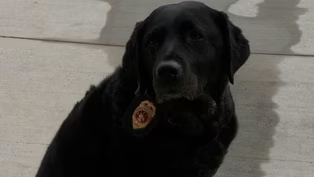
[MUSIC] She's among one fire department's most valuable assets, but she doesn't wield a water hose or drive a truck.
She does, however, follow her nose to help investigators determine what started the fire.
Laura Rogers introduces us to Millie the Fire Dog.
>> Captain Michael Cornwell has spent more than a quarter century in emergency services ten and law enforcement.
Before joining the Bowling Green Fire Department.
>> I kind of marry both my love of the law enforcement and the fire side together and absolutely love what I do.
>> A lot of that love comes from working with Millie, who plays a crucial role in determining the cause of a fire.
>> When I got the opportunity to have a dog to work with me all the time, it's been a joy for sure.
>> Good girl.
>> A joy and an advantage in fire investigations.
>> Millie is the only ATF accelerant detection canine in the state of Kentucky.
>> That means she's sniffing out things like gasoline, diesel fuel and lighter fluid, which may have played a role in how a fire started.
>> She comes in with her nose and lets us know exactly where the ignitable liquid is, and then it's my job to determine why that ignitable liquid is there.
>> She's also helped alert authorities to fires that have been set deliberately.
>> Millie has definitely helped us identify evidence to help in an arson investigation.
Everything that Millie alerts on, we will collect and send to the Kentucky State Police Crime Lab.
She has saved us so much time and accuracy.
>> The K-9 learned her craft in a six week training with the Bureau of Alcohol, tobacco, Firearms and Explosives.
She's a food reward dog, meaning she's doing exercises like this one, 3 or 4 times a day, seven days a week.
>> She has never had a bowl of food like your pet at home.
Everything Millie has eaten has come out of my hand.
Once I put that food pouch on, that's her sign that it's time to work.
So once she sees that she is energetic, she's ready to go and she absolutely loves working.
To her, it's a game.
It's all fun.
>> There's time for fun as well.
Captain Cornwell says Millie's favorite toy is a tennis ball.
>> Millie does a lot of things here at the fire department.
>> That includes public education, visiting places like schools to teach kids fire safety.
>> We will do a demonstration for the kids to show what Millie can do, and while we have their attention, we'll hit them with the fire safety message when you bring a dog in.
Also, it just ups that excitement and and really draws that attention in, which gives us a better chance to reach them and, and actually get our message across.
>> Millie and Captain Cornwell will soon hang up their hats or helmets, so to speak.
Millie turns ten in May, and that means retirement.
>> Millie and I both wanted to retire together, so Millie and I, both on July 31st, are going to retire together and lay up in a hammock together somewhere.
>> As long as tennis balls are involved.
Millie is good with that game plan for Kentucky edition.
I'm Laura Rogers.
>> Well, Millie has been with the Bowling Green Fire Department for eight years.
She's assigned to the ATF Louisville Field Division, which covers Kentucky, West Virginia and part of Southern Indiana.
Well, a good night's sleep is good for everyone.
Helping children sleep better.
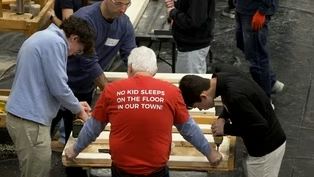
That's the goal of Sleep in Heavenly Peace, a nonprofit that partnered with the students at Lexington Christian Academy for their service project last week, where they worked to make 60 beds for kids.
Without them.
>> We get to provide a need for families here in immediate need.
Now, kids that were not sleeping in beds, now they have an opportunity to have a bed and so sleep in heavenly peace will take it.
They will install it.
They get the whole bed and the mattress, all the bedding, everything.
And so I think when we found out their mission that they are trying to have no kids sleep on the floor in their town, we said, you know what?
That's something we want to be a part of.
>> Boundlessness is, is a community issue.
I mean, it's a it's a kind of a made up word, but it's a real problem.
And what we love about our organization and these students make a prime example of this.
We love the fact that it's a community problem, but we're bringing community together to solve that problem.
So we just, we just love the fact that that these kids are also interested.
It's, it's a testament to Elsie and the values that are helping to instill in these kids.
>> It feels like refreshing to like, help out others who don't have the privileges and the blessings that we have.
And I wish that we could just help out and do more stuff like this.
>> When she was talking about how some kids don't have beds and stuff, it kind of just it really hurt me.
Like I've always had like a bed to sleep on.
So I didn't really know, like how it would feel to not have a bed to sleep on.
And I think that it's going to be like, will be the hands of feet, hands and feet of Jesus.
>> What they get to do is they get to do something tangible with their hands.
That goes directly serving people in our community, showing that love.
But as far as the skills that they learn, they're learning how to sand wood.
And so they have power.
Sanders and they're taking them to the wood.
And that's, that's been fun to watch.
They're drilling, you know, they're pre drilling the holes that will help assemble the bed when they put the nuts and bolts together at the actual location.
>> We are staining the headboards for the beds for the kids to sleep on.
And once we're done staining them, then they'll, they're going to dry and then they're going to go over there and be put together.
>> There's been tons of studies with with kids and how much from a learning standpoint, how much, how much more they're able to learn.
When they're well-rested, they're able to pay more attention in class.
They their development, just their physical development.
Sleep is a very important part of how our bodies, our bodies heal and grow.
So it's super important for that.
>> I'm hoping that like the bed says that there's still people in like the world looking out for them and they're not all alone because like, you know, when she was talking about how the beds can help with like physical, emotional, I want it to help with their like soul and like their mind thinking that there are still people who love them and want the best for them.
And that's why they're getting this bed.
>> Man, what a great project.
Well, in January, LCA raised $15,000 to buy the wood and mattresses for the beds, and students donated mattress protectors, comforters and pillows.
[MUSIC] Did you know English writer Charles Dickens visited Kentucky?
And we observe the birthday of one of Kentucky's most famous citizens as our Toby Gibbs takes a look back at this Week in Kentucky history.
>> Henry Clay was born April 12th, 1777, in Hanover County, Virginia.
He would begin a law career in Lexington in 1797.
[MUSIC] Clay went on to be a state legislator, U.S.
House member, House speaker, U.S.
senator, Secretary of state, and a three time presidential candidate.
Kentucky's first high school opened in Louisville on April 7th, 1856.
The school would eventually adopt the name Louisville Male.
[MUSIC] Thousands died during the Civil War battle of Shiloh, Tennessee, on April 6th, 1862.
Among the dead, Confederate General Albert Sidney Johnston, a native of Mason County, Kentucky, and the highest ranking officer killed during the war on either side.
On April 6th, 1842, writer Charles Dickens stopped in Louisville by steamboat and spent the night at the Galt House, all part of his tour of the United States and Canada.
From January to June of that year.
The racehorse citation was born April 11th, 1945, on Lexington's Calumet Farm in 1948.
Citation would win Racing's Triple Crown, the eighth horse to do so.
On April 10th, 1961, Governor Bert T Combs authorized $50,000 to create a floral clock on the Kentucky Capitol grounds after he had seen a similar clock in Scotland.
Some made fun of him, but the finished clock became a popular tourist attraction.
Those are some of the highlights this week in Kentucky history.
I'm Toby Gibbs.
>> As the Artemis two gets closer and closer to the moon, there's a team on the ground in Kentucky helping with the historic mission.
>> We track lots of satellite missions going out to the moon, but we've never tracked like a mission with real life people.
>> Students at Morehead State University are gathering real time data from the Artemis spacecraft as it completes its trip around the moon.
We'll tell you more about the school's important role in the Artemis mission tomorrow on Kentucky edition, and we hope that you'll join us again tomorrow night at 630 eastern, 530 central for Kentucky edition, where we inform, connect and inspire.
Subscribe to our Kentucky Edition email newsletter and watch full episodes and clips at KET dot.
That's all the time we have for tonight.
Have a wonderful evening.
[MUSIC]
Canine Follows Her Nose to Detect How Fire Starts
Video has Closed Captions
Clip: S4 Ep358 | 3m 10s | Meet the only ATF accelerant detection K-9 in the state of Kentucky. (3m 10s)
One Year After Severe Weather Outbreak
Video has Closed Captions
Clip: S4 Ep358 | 2m 46s | A look back at one of the most destructive spring weather events in Kentucky’s history. (2m 46s)
Program Gives Children a Place to Rest Their Heads
Video has Closed Captions
Clip: S4 Ep358 | 3m 11s | Student help build beds for children in need. (3m 11s)
What Made Last April’s High‑Risk Storm Unusual for Kentucky
Video has Closed Captions
Clip: S4 Ep358 | 3m 18s | NWS explains why last April’s storm stood apart from other severe systems. (3m 18s)
Providing Support for PBS.org
Learn Moreabout PBS online sponsorship
- News and Public Affairs

Top journalists deliver compelling original analysis of the hour's headlines.

- News and Public Affairs

Today's top journalists discuss Washington's current political events and public affairs.










 New Season
Support for PBS provided by:
Kentucky Edition is a local public television program presented by KET