
May 7, 2026
Season 4 Episode 381 | 26m 31sVideo has Closed Captions
Gov. Beshear launches a Pre-K for All pilot program.
Gov. Beshear launches a Pre-K for All pilot program, renewed calls for State Rep. Grossberg to resign, Sen. Paul weighs in on the race to replace Sen. McConnell, a record amount of unclaimed property is returned to Kentuckians, and a conversation with Kentucky-born journalist Michael Collins.
Problems playing video? | Closed Captioning Feedback
Problems playing video? | Closed Captioning Feedback
Kentucky Edition is a local public television program presented by KET
May 7, 2026
Season 4 Episode 381 | 26m 31sVideo has Closed Captions
Gov. Beshear launches a Pre-K for All pilot program, renewed calls for State Rep. Grossberg to resign, Sen. Paul weighs in on the race to replace Sen. McConnell, a record amount of unclaimed property is returned to Kentuckians, and a conversation with Kentucky-born journalist Michael Collins.
Problems playing video? | Closed Captioning Feedback
How to Watch Kentucky Edition
Kentucky Edition is available to stream on pbs.org and the free PBS App, available on iPhone, Apple TV, Android TV, Android smartphones, Amazon Fire TV, Amazon Fire Tablet, Roku, Samsung Smart TV, LG TV, and Vizio.
Providing Support for PBS.org
Learn Moreabout PBS online sponsorship[music] >> Today I'm signing an executive order launching the team Kentucky pre-K for all pilot programs in Robertson and Rockcastle counties.
>> The governor says he's not waiting for state lawmakers to act on universal pre-K.
[MUSIC] >> Hoping that one of the candidates in the Senate race will talk about what they're for and what their agenda is.
[MUSIC] >> So who does he think is doing that most effectively?
[MUSIC] >> It's money that belongs to the people of Kentucky.
>> And you █may own something valuable without even knowing it.
[MUSIC] >> Production of Kentucky edition is made possible in part by the KET Millennium Fund.
[MUSIC] >> Good evening and welcome to Kentucky Edition for this Thursday, May the 7th.
I'm Renee Shaw, and we thank you so much for spending some of your Thursday evening with us, Kentucky Governor Andy Beshear and Republican Supermajorities in the Kentucky General Assembly disagree about state backed universal pre-K.
Now the governor is moving forward on his own.
Here is Governor Beshear this morning during a press conference.
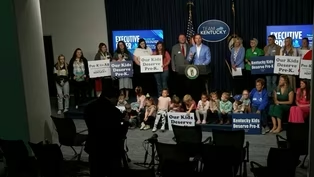
>> Today, I'm signing an executive order launching the Team Kentucky pre-K for all pilot programs in Robertson and Rockcastle counties.
These pilots serve as the first step in a phased, responsible path towards every child having pre-K access.
And the kids you see here today are from Robertson County.
They'll be some of Kentucky's first kids experiencing the benefits of all day pre-K, which every child deserves.
We're starting in two counties, and we're going to grow from there, with the goal of eventually delivering pre-K to every community across Kentucky.
>> The governor also awarded $850,000 to expand daycare services in Davis County.
He says that move and the pre-K pilot program will mean expanded early education and child care for nearly 700 Kentucky children.
Governor Beshear will be in Cincinnati tomorrow, joining U.S.
Senator Mitch McConnell, governor Mike DeWine of Ohio and others for the groundbreaking of the Brant Spence Bridge corridor.
It's a project costing more than $3 billion.
That includes the building of a companion bridge to the Brant Spence Bridge, which links northern Kentucky to Cincinnati.
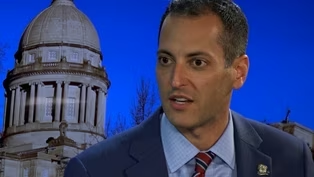
There are renewed calls tonight for State Representative Daniel Grossberg of Louisville to quit the Kentucky General Assembly.
He is a Democratic lawmaker from Louisville already accused of inappropriate behavior with women.
The Lexington Herald-Leader reports.
A college classmate says Grossberg sexually assaulted her back in 2005 at a college in Iowa when she was a freshman and he was a senior.
She says she turned down his request for sex, and he grabbed her arm and tried to prevent her from leaving the dorm room.
State Senator Keturah Herron, a Democrat from Louisville, put out a statement saying, quote, As the state senator who represents 41% of his House district, I am calling on Representative Grossberg to withdraw his bid for reelection and resign from his seat immediately, end quote.
The state Democratic Party also put out a statement renewing its call for Grossberg to resign.
The Kentucky transpark in Bowling Green is growing.
A groundbreaking was held on site today for a new manufacturing facility for aluminum solutions is based in Central Asia, and this is their first location in the U.S.
the facility will employ more than 300 people supplying materials for construction, transportation and renewable energy across the world.
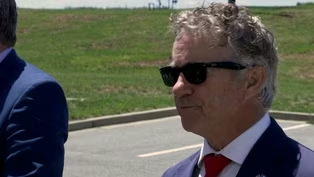
Senator Rand Paul was among the elected officials who spoke.
We asked Paul about the Republican race for Senator Mitch McConnell's seat.
With just days to go before the primary.
>> You know, I've been looking at the different candidates and hoping that one of the candidates in the Senate race will talk about what their for and what their agenda is.
Are they going to send more money to Ukraine?
Are they for keeping the money at home?
Are they more foreign aid?
And I think the one that's best articulated that message has been Daniel Cameron.
>> Paul stands firm.
And his support for Congressman Thomas Massie, up for reelection in the fourth congressional House district.
And he supports an indictment against Doctor Anthony Fauci before the statute of limitations expires in four days.
It's in relation to actions taken during the Covid 19 pandemic.
One of Fauci's advisers was recently indicted on conspiracy.
>> We think that there is evidence that Doctor Fauci broke several laws, one lying to Congress, which is a felony but also destroying records, destroying emails and advising others to destroy emails.
We have referred him to the Department of Justice.
I can't indict people.
I don't have the power to indict people.
But I recommended first to President Biden's DOJ to do it, and now President Trump's DOJ.
I can't control what they do.
But yes, I have recommended and I do think there's ample evidence that he should be indicted.
Now, you know, it's complicated because he was given a pardon.
We've never ever seen a pardon though for unknown crimes for a ten year period.
It seems bizarre to most people that you could be pardoned for some unspecified crime over a period of ten years.
So whether or not the pardon will hold up, you will only know if you take it to court.
I think it's worth taking the court.
I think what happened during the pandemic and the cover up of the origins of the pandemic, which most of us now believe it came from the lab in Wuhan.
I think that was a crime.
And really, there should be repercussions for what Anthony Fauci did.
>> Senator Paul posted to X that he'll hold a hearing next Wednesday with a whistleblower who will testify about what Paul calls the Covid coverup.
The state treasurer's office says it's uncovered a record amount of unclaimed property to go back into Kentuckians wallets, and they want citizens to know their name could be on the list.
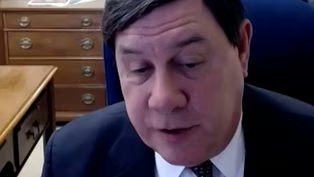
Our Emily Sisk sat down with the Kentucky State Treasurer, Mark Metcalf, earlier today to learn more.
>> Joining us now is Kentucky State Treasurer Mark Metcalf.
Thank you so much for being with us.
>> It's an honor.
Thanks for having me.
>> Certainly.
So we want to start off with the big news.
Late last month, you announced a historic milestone when it comes to unclaimed property being returned back to the citizens of Kentucky.
Tell us about that news.
>> Well, first of all, it's a huge milestone for the Treasury and for the state.
In only two years, three months and 17 days, we returned over $100 million to Kentuckians.
And it's not a tax refund.
It's not money that was discovered someplace, and we just decided to put a label on it and say it belongs to a random individual.
It's money that belongs to the people of Kentucky.
And what we did at the beginning of this administration was find the best ways to get money back to people, the most efficient means available to us.
So we purchased new technology.
We developed strategies within the Treasury itself with our employees who've been here, some for more than 20 years, and determined the best way to reach Kentuckians.
>> And for people who might not be familiar.
What is the state's unclaimed property division?
How might property end up there, and what kind of assets could that include?
>> Unclaimed property is the deposit your college student forgot to collect when they graduated.
It's a safe deposit box that a parent or a grandparent may have forgotten to mention in a will.
It's a security deposit on a utility bill.
It's a lot of things.
It could be, in fact, unclaimed property associated with an insurance policy, such as overpayments and premiums or death benefits that were not claimed at the time an estate was settled.
>> I see.
So if, for example, someone had a deceased relative who lived in Kentucky, maybe they live in another state, but their relative was in Kentucky and there were accounts that they didn't know about.
Those are kind of things that would be included in this.
>> That's a very good example.
And we've had $1.7 million returned to a family outside of Kentucky when their loved one died.
But that money was here in Kentucky.
They were Kentuckians by birth, and we returned the money to them.
>> And for people who are who are watching, how might they know if they can benefit from this?
Is there a way that they can see if they have unclaimed property?
>> Well, the best way to do it is to access our website.
That's treasury.ky.gov, and look for on the page Unclaimed property.
Strike that icon or click the icon and it will take you to a page where you can actually put down the name of the loved one, or your own name, or your wife or husband's name, and that will lead you to a site that says there is property in their name or there is not.
It's wise of us to remember that there is over $1 billion in unclaimed property that can be accessed by Kentuckians.
In fact, $1.1 billion by last count.
>> And if someone, you know, checked that site and saw that they had things to claim, is it do they continue through the website or how would they go about that?
>> Yeah.
By step process outlined on the website itself.
Contact the Treasury, tell them about your claim.
And we can generally process in less than 30 days most claims.
>> Well, Treasurer Metcalfe, thank you so much for telling us about this development.
We hope that folks can take advantage of it, but thank you for sharing about it.
>> It's an honor to be here.
Thanks for having me.
>> The state's second largest public school district is cutting or reducing more than 100 positions.
The Lexington Herald leader says that update from the Fayette County Public Schools was shared in a statement last night.
The statement did not identify which positions were impacted.
Superintendent Demetrius Liggins has previously said the number of teachers and paraeducators would not change.
The downsizing follows news in recent weeks that the district's finances have been misrepresented for more than a decade.
The school board is considering a $110 million short term loan to help manage immediate financial needs.
Renewed interest in nuclear energy means a greater focus on the potential for earthquakes in Western Kentucky.
Our Toby Gibbs explains.
And that story and more in tonight's look at headlines around Kentucky.
>> Two companies, General Matter and Global Laser enrichment, are looking to start uranium enrichment operations on or near the Paducah Gaseous Diffusion Plant, with the area part of the New Madrid Seismic Zone.
Scientists are stepping up their work to track earthquake activity.
WKMS reports.
[MUSIC] Scientists with the Kentucky Geological Survey have installed 25 seismic nodes at the diffusion plant site.
They will collect information so engineers can use it as they plan construction projects.
[MUSIC] The number of Kentucky children receiving mental health care is going up.
The Paducah Sun looked at state data that show 112,000 Kentuckians received mental health care so far in fiscal year 2026, and 34% of those were under the age of 18.
Michelle Hawkins of the Child Watch Counseling and Advocacy Center, says social media is a factor in the increase, with 48% of teenagers saying social media is causing more depression and anxiety.
[MUSIC] From the Courier-Journal, a Louisville woman is warning pet owners to be aware of blue algae in water.
She says her own dog was playing near Beckley Creek, became sick and later died.
Tests showed blue algae caused the dog's death.
It contains a neurotoxin that can be fatal in pets.
Doctors say pet owners need to be aware of water that appears blue, bright green, brown, red or white and contains what looks like spilled paint.
Political junkies you can buy memorabilia from the estate of Senator Wendell Ford.
WKU Public Radio says the estate sale in Owensboro will continue through Saturday.
The sale includes pictures, campaign posters, buttons, cufflinks, books, paintings, antiques, jewelry, and more.
[MUSIC] Ford served as governor from 1971 to 1974, and was then a U.S.
senator until 1999.
He died in 2015.
[MUSIC] And those are tonight's headlines around Kentucky.
I'm Toby Gibbs.
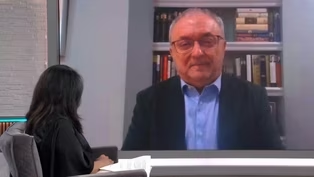
>> From the mountains to the Beltway that describes the path of Kentucky born journalist Michael Collins, who hails from Whitesburg in eastern Kentucky.
Over his decades long career, he's covered the white House and some of the nation's most historical and memorable events.
For a long time, viewers of KET, you may remember him as a frequent guest on our Friday Night Journalism Roundtable program, Comment on Kentucky.
I caught up with him yesterday to talk more about his career path and notable assignments.
That is tonight's reporter's Notebook.
[MUSIC] You've been a Washington based reporter for more than 20 years.
You've covered the white House.
You're now a national correspondent for USA today.
Talk to us about your journalism journey.
>> Well, as you said, I started working for the Kentucky Post in Covington, Kentucky, covered various things, city Hall, etc.
eventually moved to Frankfort as the Frankfort bureau chief, covering the governor and the legislature.
I was there during the patent years and after a number of years, six years, I believe it was.
I moved to Washington to become the Washington correspondent for the Cincinnati Post and its sister paper, which was the Kentucky Post.
And then ten years ago, I moved to USA today, and I've done various things with USA today.
I spent six years as a white House correspondent.
I covered Donald Trump's first term in office and all four years of Joe Biden's term in the white House.
And I'm now a national correspondent on the paper's investigations and storytelling team.
And what that means is that we are able to take various issues and look at them very in depth, you know, explore various angles.
And the stories that we do tend to take a little bit longer than the kinds of pieces that I did when I was covering the white House and, you know, had to write multiple stories a day.
So it's kind of a welcome break.
>> I was going to ask, which do you prefer?
Do you prefer the more long format, in-depth pieces, investigatory in nature, or having to do the daily grind of writing 3 or 4 or maybe more stories a day?
>> I think I prefer what I'm doing now, but, you know, I have to say, sometimes when there is, you know, a breaking news event and, and people are, you know, out there in the thick of it.
I sometimes I find myself kind of missing that.
>> Missing that pace.
Certainly.
Well, talk to us about maybe some of the, your most, I don't want to say favorite, but the kinds of things that you're getting really to probe deeper now and why you think it's important to really settle in and do that kind of work.
That does require more time.
It does require more skill, more tenacity.
And perhaps when you're up against some friction to still keep going at it.
>> Well, I think it's important because, you know, in this day and age, you know, everything seems to be sound bites.
We seem to live in a soundbite culture where, you know, the, you know, the 32nd clips that are going to make, you know, the national news.
And it's those are important.
But I think it's really important sometimes to step back and take a look at an issue, why something is happening, you know, what is being done about it, what it means, etc.
And in terms of the kinds of stories that I've done, a couple come to mind.
Last year I did a piece on a soldier from Ukraine who had lost his leg, one of his legs in the war in Ukraine, and he came to New York to be fitted with a prosthetic.
He was here for a number of weeks.
I think it was six weeks.
It might have been even longer.
But anyway, I, I interviewed him and part of his stay here was to not only be fitted with a prosthetic leg, but he had to go to physical therapy because he had to.
It was a, you know, a very high, high tech, computerized kind of prosthetic.
And he had to get used to using it.
So I, you know, I followed him to the physical therapy one day I sat down and did a long interview with him about his life and, you know, the war and, you know, the loss of the leg and what it means for him.
He had been a soldier for he'd been in the military for all of his adult life.
And so now he's facing the possibility that that career is over.
So he's not only dealing with the loss of his, you know, his leg.
He's having to figure out what comes next in his life.
Another story that I did last year, I spent five days in Montreal working on some pieces about tensions between the U.S.
and Canada over President Trump's tariffs.
And, you know, his suggestion that Canada should become the 21st state.
I was actually there on Canada Day, which is the day that Canadians celebrate the birth of their country.
So I went to multiple Canada Day events, and then later I talked to a number of business owners about how these tariffs are affecting them.
And one of the really fun stories I did, and this is actually one with a Kentucky angle.
We discovered that bars and restaurants in Canada have decided to fight back against the president's tariffs and what they're doing.
They have removed any U.S.
made food products, whether it's fruits, vegetables or whatever, from from their shelves.
And they've also removed Kentucky US based US made wines and spirits like Kentucky bourbon.
Now, what's interesting about that is it's affecting the way that bars are making cocktails.
For example, if you're making an old fashioned, which is typically made with bourbon or rye, and you can't use Kentucky bourbon, then you've got to figure out something else to put in it.
And so they're using Canadian whiskey.
So what we what we did, we went to multiple bars in Montreal and had them make us an old fashioned, each one with a different Canadian whiskey.
And then we compared them to, to, to see what the taste was like.
So that was a fun way to tell a very serious story.
>> Yeah.
That's not a bad gig to get, Michael.
I tell you.
>> It was tough.
But, you know, sometimes you just have to buckle down into it.
>> A sign of a good journalist.
I'll have more with Michael Collins tomorrow as he discusses the recent white House Correspondents Dinner and how his colleagues in attendance reacted.
We'll have that tomorrow night on Kentucky edition.
[MUSIC] The city of Louisville got some major wins from this year's Kentucky General Assembly session.
On the next inside Louisville, our Kelsey Starks sits down with the leaders of one Louisville, the city's new Chamber of Commerce model that has merged with the Economic Development Alliance.
[MUSIC] >> And one of the pillars of what you all do now is working with Frankfort and Advocacy.
We just are coming off of the General Assembly.
What were you all able to accomplish and what do you all hope to accomplish in the future?
>> Very supportive of what the mayor's asks were, and we're very happy with what's ultimately going to be coming back to Louisville after session, the types of development that we're going to be able to do, because Frankfort is believing in this administration and believing in this business community.
I'm excited about, you know, what the legislature was thinking around talent, specifically retention.
I want to keep more grads here in Louisville, not just for a few years.
I want them to get a job here and then see themselves in their bosses shoes and that boss's shoes.
And I think we we've traditionally had talent programs, but they've been a bit fragmented or they haven't always worked together.
This is a big moment where we will have resources from the state to perhaps all work together, not just in Louisville, but even Lexington and Covington and, you know, be able to do some of the things that I've seen across the country that have really worked, everything from, you know, what is going on in Oklahoma with Tulsa Remote to to some of the things our northern Midwestern neighbors have done to attract folks.
So lots to be excited about after session.
>> What are some of those cities that you all have studied, or are there similar organizations to one Louisville that helped create this yes.
Idea?
>> Yeah.
Nashville Nashville has a great model.
Tulsa and Oklahoma City have great models.
Indianapolis has a has a decent model.
And you know what that allows them to do is create a centralized fundraising platform to go after longer strategic initiatives, whether that's an infrastructure play, getting a team, whatever it is, but then also the efficiencies by having back office for one org versus two allows you to put more money into into external tools, customer tools, and create some longevity for some of these, you know, these programs that are giving grants, they're not out there just to make a return.
They're out there to sort of stimulate and create the conditions for the metrics we want to see around quality of life, which isn't always easy to track.
And so that's where I think we learn the most in terms of actually, I just had a call today with Tulsa talking about what they did to sort of create those efficiencies and then where they place their money once they did.
>> Yeah.
Well, a lot of those cities that you mentioned, Nashville, Indianapolis are cities that a lot of people around here say, why are they exploding?
And Louisville never did.
What is your perspective on a lot of people saying we're behind the ball from similar cities?
>> Yeah.
>> It's easy to compare yourself to others and have envy.
I think, you know, if if we do what we're supposed to do, Louisville will develop its own swagger.
It will be unique from Nashville.
It'll be unique from all of these other hot spots, but it will build on areas that we, you know, not only have a right to right to play, but a right to win.
You know, Trevor already mentioned logistics, supply, manufacturing, health care.
You know, all of those things are there for the taking.
We just have to believe in ourselves and stop comparing ourselves to others, but others.
But the fact is, you know, we have a population problem.
We need to grow our population.
We need to build more jobs.
We need to invest more capital.
We need a stronger venture community.
But it all gets started with realizing that you need to do those things, and then focusing on where you think you can win.
And I think that we're set up well to do that.
>> I agree.
I mean, look, pure cities aren't tattoos.
I mean, we could keep comparing ourselves to Nashville year after year after year, but how interesting is that?
I think we should be looking at some of the fast risers around us, like Chattanooga and Richmond and some of these others.
You know, I believe that there's a lot of things that we can mimic.
There's a lot of things that we can avoid, but I don't I don't view our competitors as solely competitors.
I view them as as playbooks, scoreboards.
There's all different.
And, you know, the fact that we are having more conversations with our Metro's asking not only how did you do things, but for some of the larger Mid-Atlantic problems or opportunities, how can we work together?
Maybe it's to get more money from the federal government.
Maybe it's something else.
It's a whole new world.
And I think this organizational structure allows us to better compete in it.
>> You can learn more about the one Louisville organization and what other cities can learn from its model on the next.
Inside Louisville with Kelsey Starks.
[MUSIC] That's this Sunday at 12 noon, 11 a.m.
central, right here on KET.
It's not just the U.S.
Senate and U.S.
House.
There are some interesting Kentucky General Assembly races on the ballot May 19th among the Republican primary in the state Senate district number 30 in eastern Kentucky, as incumbent Brandon Smith battles challenger Bill Wesley, who currently serves in the state House.
Well, we'll discuss that race tomorrow on Kentucky edition, which we hope that you'll tune in again for at 630 eastern, 530 central, where we inform, connect and inspire.
We hope that you'll connect with us all the ways you see on your screen.
Stream our content on demand at KET dot g. Look for us on the PBS app that you can download on your smart devices.
Send us a story idea by email to Public affairs@ket.org.
And of course, we're on the social media channels, Facebook and Instagram.
Tomorrow is Friday and we hope to see you right back here again to start off the weekend.
Until then, have a great evening.
See you tomorrow.
Beshear Launches Pre-K for All Pilot Program
Video has Closed Captions
Clip: S4 Ep381 | 1m 8s | Gov. Beshear launches a Pre-K for All pilot program in two Kentucky counties. (1m 8s)
Kentucky-born Journalist Talks Career Path
Video has Closed Captions
Clip: S4 Ep381 | 6m 43s | Renee Shaw sits down with journalist Michael Collins. (6m 43s)
Record Amount of Unclaimed Property Uncovered
Video has Closed Captions
Clip: S4 Ep381 | 4m 23s | Kentucky's Treasurer has a message for Kentuckians. (4m 23s)
Renewed Calls for State Rep. Grossberg to Resign
Video has Closed Captions
Clip: S4 Ep381 | 55s | A woman says the Louisville Democrat sexually assaulted her in 2005. (55s)
Sen. Paul Discusses U.S. Senate Race
Video has Closed Captions
Clip: S4 Ep381 | 2m 35s | Paul said Daniel Cameron has "best articulated" a message that he can support. (2m 35s)
Providing Support for PBS.org
Learn Moreabout PBS online sponsorship New Episode
- News and Public Affairs

Top journalists deliver compelling original analysis of the hour's headlines.

- News and Public Affairs

FRONTLINE is investigative journalism that questions, explains and changes our world.

 New Episode
 New Episode
 New Episode


 New Episode
 New Season
 New Episode
Support for PBS provided by:
Kentucky Edition is a local public television program presented by KET