
April 13, 2026
Season 4 Episode 363 | 26m 30sVideo has Closed Captions
Sen. Paul discusses the Iran war and federal hemp guidelines.
Sen. Paul discusses the war in Iran and President Trump's comments about the Pope. Kentucky's Auditor is headed to Washington, D.C. Gov. Beshear drops another hint about a potential presidential campaign. A look at NASA's historic Artemis II mission.
Problems playing video? | Closed Captioning Feedback
Problems playing video? | Closed Captioning Feedback
Kentucky Edition is a local public television program presented by KET
April 13, 2026
Season 4 Episode 363 | 26m 30sVideo has Closed Captions
Sen. Paul discusses the war in Iran and President Trump's comments about the Pope. Kentucky's Auditor is headed to Washington, D.C. Gov. Beshear drops another hint about a potential presidential campaign. A look at NASA's historic Artemis II mission.
Problems playing video? | Closed Captioning Feedback
How to Watch Kentucky Edition
Kentucky Edition is available to stream on pbs.org and the free PBS App, available on iPhone, Apple TV, Android TV, Android smartphones, Amazon Fire TV, Amazon Fire Tablet, Roku, Samsung Smart TV, LG TV, and Vizio.
Providing Support for PBS.org
Learn Moreabout PBS online sponsorshipmusic >> I think attacking the Pope >> I think attacking the Pope is a mistake.
[MUSIC] >> U.S.
Senator Rand Paul on Trump's feud with the pope, the war in Iran, plus other matters as Congress gavels back in.
[MUSIC] >> I will not leave a broken country to my kids or anyone else's kids or grandkids.
>> Why?
Kentucky Governor Andy Beshear says his 2023 reelection campaign may not have been his last.
[MUSIC] >> It takes a lot to get to the moon.
This isn't some small achievement.
>> Kentucky's NASA ambassador on the Artemis two mission and what's next for space exploration?
>> You literally changing someone's life.
You're giving them a second chance at life.
>> The life changing impact of becoming a living kidney donor and what it takes to do it.
[MUSIC] >> Production of Kentucky edition is made possible in part by the KET Millennium Fund.
[MUSIC] >> Good evening and welcome to Kentucky edition on this brand new week.
It is Monday, April the 13th.
I'm Renee Shaw, we hope you had a great weekend and we thank you for spending some of your Monday night with us.
The US military says it will begin blocking ports in Iran tonight to pressure the country into reopening the Strait of Hormuz.
Today's move comes after ceasefire talks between the two countries failed.
Speaking to reporters today in Elizabethtown, Kentucky, U.S.
Senator Rand Paul of Kentucky discussed the ongoing war and other issues he hopes to address when Congress returns to session this week.
Our June Leffler has the details.
>> The war in Iran continues.
The Republican senator who proposed a war powers resolution weeks ago, says Congress should still weigh in on the military operation.
>> Some of the people here may have had kids who are fighting in the war.
Some of the people here may have fought in the war.
Some of them are retired military in this area that we owe it to them.
When someone gives the ultimate sacrifice to have a full, thorough debate and have Congress vote on it, so I will continue to push for that.
>> Democrats are planning another war powers vote.
The Pentagon is asking Congress for an additional $700 billion, 200 specifically for emergency funding for the war.
>> So my first question would be, where does the money come from?
It's going to have to be borrowed.
So even though I'm for a strong national defense, I think borrowing more money makes us weaker and it impacts our national security in a negative way.
So I think we really need to.
I mean, surely there's a lot of money we ought to be able to, you know, live with a trillion.
And so I'm not for adding or increasing the spending at this point.
>> Other international news Paul responds to President Donald Trump's jabs at the Pope.
Trump called him a liberal and, quote, weak on crime.
>> I find nothing in his comments about the pope that is admirable.
2,030% of the country is Catholic, and if you appear to attack their religion, I would think it could affect people's vote.
But it's just not the kind of thing that the president should be doing.
I mean, really, look, popes have a variety of political opinions.
And, you know, people can have an opinion on what they say.
But I think attacking the Pope is a mistake.
>> On to Kentucky farmers.
Paul says he is still working to dull the brunt of Mitch McConnell's rule to ban many hemp products.
That's set to go into effect in November.
>> My idea for correction is to leave McConnell's language in there, but say that if a state already has made its own regulatory framework, that they would be exempt from the federal framework.
Kentucky studied the issue for six months or a year.
Kentucky regulates it like alcohol.
The drinks are sold in a liquor store only to people of age.
So I think Kentucky made some of the right decisions.
It didn't get in the spending bill.
Our second choice is the farm bill.
Farm bill is a must pass piece of legislation.
It always passes.
It's passed a House committee.
Without this, my amendment in it.
I'm working with Amy Klobuchar, who's a Democrat on the farm.
She's on the agriculture committee we are hoping to offer as an amendment onto the farm bill.
If it were to pass, then there would be a chance.
>> Paul spoke to reporters today after a tour of AGC Automotive Americas in Elizabethtown.
The company makes windshields and windows for several car manufacturers, including Toyota, Honda and Tesla.
For Kentucky Edition, I'm June Leffler.
>> Thank you.
June.
Senator Paul says the automotive glass making company he toured today is faring well under a 2020 trade treaty between the US, Mexico and Canada that has safeguarded against Trump's tariffs.
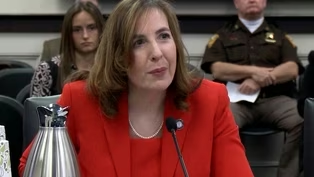
Now state and national politics collide as Kentucky auditor Alison Ball is set to testify in Washington DC this week.
The Republican is scheduled to appear before the U.S.
House of Representatives subcommittee on Government Operations on Wednesday.
The hearing will focus on fraud and federally funded programs run by state's auditor, ball told The Courier Journal, quote, as state auditor, I've uncovered more than $1 billion worth of waste, fraud and abuse within Kentucky's administration of federal programs.
It's an honor to be recognized as a leading voice on this topic nationally, and I look forward to testifying about how my team has been so effective at increasing government accountability in the Commonwealth.
End quote.
Last month, ball's office released a report critical of Kentucky's executive branch, citing more than $1 billion worth of financial reporting mistakes and $33 Million in Overcharged Taxes.
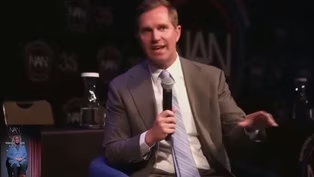
Kentucky Governor Andy Beshear continues to drop hints about a possible presidential run.
He was a guest speaker at the National Action Network event over the weekend in New York City.
Speaking with the civil rights organization's founder, the Reverend Al Sharpton.
Beshear said he isn't ruling out another tough campaign.
>> I walked off the stage in 2023, having won reelection by five points in Kentucky, which is like winning by 30 anywhere else.
And I looked at my wife and I said, who will never have to run a campaign again?
And I'm not sure that's true today.
I don't have I don't have any announcement, but I will not leave a broken country to my kids or anyone else's kids or grandkids.
This is not this is not the United States of America.
I grew up in and I admit, the United States of America hasn't been perfect.
And it's actually been been tough for a lot of people.
But what we are seeing right now, a president that threatens to end another civilization is anti American.
It's also anti-Christian.
>> We've heard those comments similarly from the governor several times when he's been asked about his presidential aspirations.
Several Democrats, considering a 2028 bid for the white House, attended the same convention, including former Vice President Kamala Harris, Pennsylvania Governor Josh Shapiro and former Transportation Secretary Pete Buttigieg.
After the event, the Reverend Al Sharpton told The New York Times that Bashir was one of the speakers that stood out to him.
He also said the audience appreciated Bashir's southern roots and his message of his faith.
Turning now to state politics, the Kentucky General Assembly's veto period ends this week as state lawmakers return to Frankfort tomorrow for two days to consider overriding bills vetoed by the governor and even passing some more.
Today, the governor has vetoed at least 15 bills.
That includes four that have already been overridden.
On Friday night's comment on Kentucky, right here on KET, host Bill Bryant and his guests talked about that and a constitutional amendment that will be on the ballot in November.
>> One is on the ballot, for sure.
That would curtail the governor's ability to issue pardons very late in their terms.
>> Senate Bill ten Senator Chris McDaniel filed that again this year.
I think this was the seventh year, maybe sixth year.
He's tried to get that through.
And and it finally went through for him.
Persistence pays.
Right.
But that bill creates a window around the gubernatorial election during which the governor cannot issue pardons.
And it's a response to former Governor Bevin's pardons and also some that former President Joe Biden made late in his term as well.
>> And in this last couple of days, other constitutional amendments could be added.
Yes, I know there's been some momentum for ballot summaries to appear.
>> Yeah.
There's one.
It's Senate Bill 262 that passed the Senate.
The House hasn't taken it up yet, though, which is interesting.
That would allow summaries of ballot language to appear, summaries of the amendment language.
I'm sorry, to appear on the ballot rather than the verbatim language as is required now.
And there's a lot of opposition to that because, as we all know as writers, there can be a lot of nuances and meaning drafted into something that's that's more extensive than a summary.
>> All right.
So we'll be watching Frankfort very, very closely.
>> It's interesting, real quick to note to the governor cannot veto amendments bills.
>> Right.
>> That is correct.
The governor cannot override or veto constitutional amendments.
Now, with the session winding down, we'll look back at the bills that passed and the ones that possibly didn't and even still could tonight on Kentucky.
Tonight, we have got the Republican and Democratic leaderships of both chambers.
They will be joining us.
And we certainly want to take your questions and comments.
So we hope you'll tune in tonight at eight eastern, seven central right here on KET for Kentucky tonight.
We could see record breaking high temperatures across parts of Kentucky this week.
But in Lexington, city leaders are still thinking about winter.
Today, Mayor Linda Gorton announced she's asking the Urban County Council to approve agreements with eight contractors to help beef up the city's winter weather response.
Mayor Gordon has been criticized for how the city handled two recent snow and ice storms, including one that led to Fayette County Public Schools canceling in-person classes for two straight weeks.
Today, the mayor also released details of the city's after action review.
It outlines six findings that need attention, including the lack of a strategy that differs between snow and ice events, and not enough staff to work through long lasting events.
>> If this is about responding to an emergency in our city and we are always trying to do better with whatever it is in government, and this this is very important that it go forward so that the team can continue working on this.
>> The mayor will deliver her plan to the Urban County Council tomorrow, when she will also present her proposed budget for the 20 2627 fiscal year.
>> Splashdown confirmed at 7:07 p.m.
Central Time.
5:07 p.m.
Pacific Time.
From the pages of Jules Verne to a modern day mission to the moon, a new chapter of the exploration of our celestial neighbor is complete.
Integrity's astronauts back on earth.
>> I don't know about you, but that gave me chills watching that Friday night.
And as you just heard, that was the four member crew of integrity returning to earth after a ten day record setting mission aboard the Artemis two test flight.
The mission marked the first human journey beyond Earth's orbit since Apollo 17 over 50 years ago.
Their flyby of the moon took them farther than any humans have ever traveled before.
We spoke to Kentucky's JPL NASA ambassador about the historic mission and what it means for the future of space exploration.
>> It takes a lot to get to the moon.
This isn't some small achievement.
There are many, including myself, who believe that landing on the moon to begin with is one of the greatest achievements in the history of humankind, if not the greatest.
And to show that that capability, again, it's just it's just awesome.
The Artemis two mission really demonstrates our capability to return to the moon, to return human beings to the moon and do that safely when we actually start landing humans on the moon and do so in a sustainable fashion, where we're going to have a long term presence on the moon that gets us ready to move further out into the solar system, out onto Mars.
Well, we're really looking for places on the moon where we can find water and other resources that we can use to establish bases not only on the moon, but out further into the solar system as well, and kind of refining our detection methods for determining what sort of resources are available.
The most important, of course, is water, not only for astronauts to drink, but we can make rocket fuel out of that because water is made of hydrogen and oxygen, and half of the mixture of the fuel that propelled the astronauts to the moon was oxygen.
So you need that combustion material in order to make that happen.
We've conducted experiments on Mars that allow us to actually extract oxygen from the tenuous Martian atmosphere using electrolysis, which is pretty amazing to be able to produce that and in effect, give our astronauts the opportunity to return and make fuel on Mars.
So it's that same sort of idea that we have when we're looking for we call it in-situ resource utilization.
We're just looking for different materials that we can use that we don't have to bring with us.
It's been pretty exciting to see people's reaction to the launch.
You know, a lot of people are jaded these days.
They see money going to things that they don't.
They don't think it should be going to.
But even a lot of those skeptical people, and that includes some close friends of mine who were not excited about the launch even a week before, were texting and calling, you know, in the days and the hours leading up to the launch expressing their excitement for it.
>> We caught a view of earth in window one, and now we're completely distracted for a little bit.
>> Even with people that don't follow space exploration closely, it's still an inspiring mission, and it's still sparks at least some curiosity.
So it's kind of easier to draw people in from that perspective.
They're already interested, they're already curious.
But in terms of actually communicating the significance or why this is important for humanity or why this is important for us to do, it's it's pretty simple.
You know, again, this is a mission of hope, much like Apollo was, again, geopolitical implications aside, this showcases humanity.
It showcases the best of what we can do.
And it helps to inspire people and to make people feel better about not only themselves, but about our species as a whole.
>> Hear, hear to that and those Fantastic Four crew members, they are so inspiring.
Artemis three, which will be a test flight to evaluate how the Orion spacecraft can dock with the lunar lander, is scheduled for next year.
A mission to land astronauts back on the moon is scheduled for 2028.
It'll be here before you know it well.
Checkmate.
Students in third through fifth grades learn some new skills over spring break, including how to play chess.
It's one way Jefferson County Public Schools is working to keep students engaged in reading more about this in tonight's Education Matters segment.
[MUSIC] >> It was started as a way to improve access and increase access for students who needed some summer camp enrichment, some learning, some things to do over the summer.
And we thought as JCPS were responsible for literacy.
Anyway, let's combine literacy with a fun activity to make sure kids are engaged and have something fun to do.
There's a book that has a main character, the subject of the thing they are learning, and they read that and they understand what the character is going through, what the challenges are that the character may experience.
The character may not be experiencing trouble with the activity.
They might be experiencing something with their life.
But the thing that their outlet is, is the chest.
It is the bowling.
It is the hip hop.
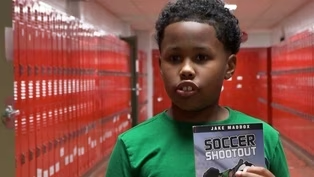
>> During the week, we got to read a book that I'm holding right now.
It's called Soccer Shootout, and it was about this kid named Burke and his friend named Peter.
And they had to overcome challenges.
And there was also a new kid named Ryan.
And I thought that was a really cool book.
And then we also got to play a little bit of soccer with our vendor, and the vendor taught us how to dribble with the ball and like, learn how to actually control the ball and actually control the ball and not like look at other people and worry about other stuff to actually like, look at the ball and try to score.
Well, we did was we learned how to play chess.
We compared and contrast a book and a movie.
At first I didn't know how to play chess, but fondly, like on.
Yesterday, I knew how to play a little because I, I still like at first I didn't know the names at all.
So at first when I saw.
I either call it a horse, a castle.
And then the rest, the Queen and King.
But then that's on Tuesday, and then on Wednesday I knew all the names.
I know what moves they make.
The chess teacher, he taught me more, more skills about chess and like more, I don't know, soccer helped me learn about literacy because we had to comprehend this book and we had to like every time we played soccer, we had to do we had to do a reflection on how we did in soccer and how we felt about it.
So every day I was writing a good reflection about the soccer thing, about the thing that we practiced with the soccer vendor.
>> It's just a way to keep the spark going, right?
Like even though it's just five days, but it's five days that they didn't, that they might not have wanted to engage.
So they got to kind of stay sharp.
They got something to do.
They got out of the house and they got to be a part of something fun.
>> I really love this week.
>> Because I've been here and.
>> I get, I got to be here and find new friends and be with friends that I already know.
And I really enjoyed this book.
I like.
>> To say thank you to my coach because he helped me a lot.
And then I also thank you to my teacher for making me brave and proud and believe in myself.
>> And that's what teachers do, right?
JCPS students could also sign up to learn tennis, karate, dancing and even robotics.
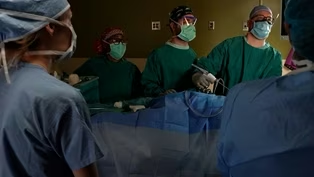
[MUSIC] The month of April Marks Donate Life Month, a time to raise awareness about organ donations and encourage registration.
Of the 123,000 Americans currently on the wait list for an organ transplant, nearly 100,000 of them need a kidney.
On average, 13 people die every day waiting for a kidney.
As one doctor with the University of Louisville Health Teri Garr Transplant Center explains, that's where living donors can truly make a difference.
>> Kidney disease is a silent disease, okay, you will not know you have kidney problems until the numbers drop really low.
People will not even notice that they have symptoms.
And they usually say, I was feeling fine.
I don't know what was going on at a given time.
There are at least 100,000 patients waiting for a kidney.
There are nearly 500,000 patients who are on dialysis and 100,000 patients who are listed waiting for a kidney.
So waitlist deaths also matter because there's almost 13 people who die every day waiting for a kidney.
The reason we would like to transplant them early is because they have a survival benefit.
An average deceased donor kidney lasts around 10 to 15 years, whereas a living donor kidney lasts around 10 to 25 years.
So that's a big difference, right?
Going from 50% survival at five years on dialysis to living 25 years with a living donor kidney, that's a major difference.
Living donors are like I always tell their angels, wanting to do this organ donation saves lives and transforms many lives around patients.
Anyone who wants to be an organ donor, please sign up at the DMV and let them know that you want to be an organ donor.
You can safely donate a kidney, and if you have any loved ones who are struggling with kidney problems or on dialysis, it doesn't hurt to get informed about living donations or even volunteer to be evaluated.
When you're being evaluated to be a donor, you go through a rigorous, thorough process.
Before you donate, you have to be in good health.
You have to be free of kidney problems, diabetes, and high blood pressure.
And only when you go through this checklist that's pretty rigorous is when you say you're a donor.
That means if you donate a kidney, say if you donate a kidney, your outcomes compared to the general population are almost the same.
Because when you go through this checklist, you're pretty healthy.
So we cannot predict the future.
But you can always say that these patients have lead a relatively normal life compared to the general population.
For the donor, it becomes an amazing process because you literally changing someone's life, you're giving them a second chance at life.
>> It's officially derby season.
The Kentucky Derby Festival kicks off with Thunder over Louisville on Saturday, followed by the 152nd run for the roses on May the 2nd.
This Sunday, our Kelsey Starks sits down with legendary jockey Pat day to talk about his long racing career and why he still calls Louisville home.
>> You know, I've been asked on numerous occasions, what is it that makes the Derby so special?
And you just said it.
The people, the area.
It is the event in.
In Louisville.
It is the event.
It's called Derby Town.
You know, truck drivers going through breaker one nine, going through Derby Town, you know, and, and but the whole area, southern Indiana and all of Kentucky, everybody, you know, it's almost like we start getting ready for the next year immediately after the race finishes, you know, on the first Saturday of May, when it's made official, they start ramping up for the next year.
And then, you know, we have Thunder over Louisville, which is a real kick off.
And then it really gained speed and it just keeps building and building and building culminates with the with the running of the Derby and, you know, and Louisville plays a it's a tremendous host for this wonderful event.
And Churchill Downs, of course, it's large enough to handle a massive crowd and they're getting better every year.
You know, it's just it's it's special.
>> You can see the full conversation this Sunday on Inside Louisville.
That's at noon eastern, 11 a.m.
central right here on KET.
Our Toby Gibbs has his own derby story.
And this week in this look at this week in Kentucky history.
>> Doctor Thomas Walker, a physician, explorer and stockholder in the Loyal Land Company, visited present day southeastern Kentucky on a mission to explore and survey the area.
[MUSIC] He passed through the Cumberland Gap on April 13th, 1750.
He would name the gap and the Cumberland River after William Augustus, the Duke of Cumberland.
Colonial troops and the British battled at Lexington and Concord, Massachusetts, on April 19th, 1775, when word of the battle reached Kentucky, a group of settlers named their town Lexington in tribute.
Isaac Burns, also known as Isaac Murphy, was born April 16th, 1861, somewhere in central Kentucky.
It's not clear where he was the son of free black parents, and went on to be the highest paid jockey in America, winning three Kentucky derbies.
John Wilkes Booth shot the only Kentucky born president, Abraham Lincoln, at Ford's Theater in Washington, DC on April 14th, 1865.
Lincoln would die the next morning, the Titanic struck an iceberg and sank the night of April 14th and the morning of April 15th, 1912, Louder Davis Parrish, a 60 year old native of Woodford County, was a second class passenger.
She was rescued.
She would die in 1930.
Kentucky native Patricia Neal won the Academy Award for Best Actress on April 13th, 1964, for her role in the Paul Newman movie HUD.
And that's what was happening this week in Kentucky history.
I'm Toby Gibbs.
>> And that'll do it for us tonight.
We sure hope to see you tomorrow night.
Take good care.
Auditor Ball To Testify Before Congress
Video has Closed Captions
Clip: S4 Ep363 | 58s | Wednesday's hearing will focus on fraud in federally funded programs run by states. (58s)
Beshear Drops New Hint About 2028 Presidential Campaign
Video has Closed Captions
Clip: S4 Ep363 | 1m 44s | Over the weekend, Beshear said his 2023 re-eleciton campaign may not have been his last. (1m 44s)
How Living Donors Can Make a Difference
Video has Closed Captions
Clip: S4 Ep363 | 3m 4s | April is Donate Life Month. (3m 4s)
JCPS Program Keeping Kids Engaged in Reading
Video has Closed Captions
Clip: S4 Ep363 | 3m 42s | Student learned new skills over spring break including how to play chess and soccer. (3m 42s)
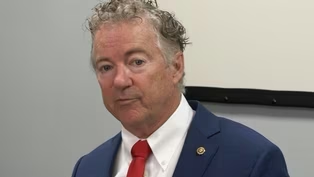
Sen. Paul Talks Iran, the Pope and Federal Hemp Ban
Video has Closed Captions
Clip: S4 Ep363 | 3m 40s | Sen. Paul discussed the Iran war while speaking to reporters in Elizabethtown. (3m 40s)
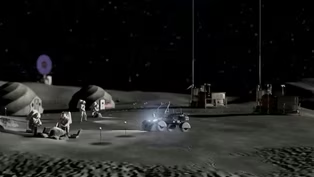
What Artemis II Means for Future Space Exploration
Video has Closed Captions
Clip: S4 Ep363 | 4m 24s | Kentucky's JPL NASA Ambassador reflects on the record-setting mission and what comes next. (4m 24s)
Providing Support for PBS.org
Learn Moreabout PBS online sponsorship
- News and Public Affairs

Top journalists deliver compelling original analysis of the hour's headlines.

- News and Public Affairs

FRONTLINE is investigative journalism that questions, explains and changes our world.












Support for PBS provided by:
Kentucky Edition is a local public television program presented by KET