State of the Arts
Kimberly Camp: Dollmaking Fine Art at Play
Clip: Season 44 Episode 8 | 5m 31sVideo has Closed Captions
Kimberly Camp brings joy to the three-millennia-old art form of dollmaking.
For Kimberly Camp, dollmaking is both art and craftsmanship, blending painting, sculpture, sewing, and storytelling to bring each figure to life. We met Camp at her studio in Collingswood, NJ where she continues a career spanning over 50 years, using her work to bring joy and vitality to this three-millennia-old art form, connecting ancient traditions to contemporary culture.
Problems playing video? | Closed Captioning Feedback
Problems playing video? | Closed Captioning Feedback
State of the Arts is a local public television program presented by NJ PBS
State of the Arts
Kimberly Camp: Dollmaking Fine Art at Play
Clip: Season 44 Episode 8 | 5m 31sVideo has Closed Captions
For Kimberly Camp, dollmaking is both art and craftsmanship, blending painting, sculpture, sewing, and storytelling to bring each figure to life. We met Camp at her studio in Collingswood, NJ where she continues a career spanning over 50 years, using her work to bring joy and vitality to this three-millennia-old art form, connecting ancient traditions to contemporary culture.
Problems playing video? | Closed Captioning Feedback
Where to Watch State of the Arts
State of the Arts is available to stream on pbs.org and the PBS app.
Providing Support for PBS.org
Learn Moreabout PBS online sponsorshipCamp: The doll really tells me where it wants to go.
And so it's a matter of free-form thought that goes into the creative process.
I literally just sit down and make whatever the heck I want to make.
Sometimes they're animals, sometimes they're humans, sometimes they're combination.
Sometimes they're creatures.
We don't really know exactly what they are.
It's there for play.
It's there for fun.
I know a piece is finished when I'm sitting at my work table, laughing my head off.
[ Laughing ] That looks like that'll be about right.
It's really all about making art that people enjoy, that makes them smile.
That's what art's supposed to do for people.
Artists broadly comment on the world.
We know what ancient cultures did because of what artists left us.
And I often tell people, if an artist hasn't made it, it didn't happen.
It's the hand sewing that gives it the attitude, the posture, you know, all of that.
And so that's why the hand sewing is really important.
My name is Kimberly Camp.
I'm a painter and a dollmaker.
I had the privilege of working in the museum field for over 25 years, and having been a painter now for 50-plus years, and it gave me the opportunity between the two of those and the dollmaking to travel, to explore different cultures.
I've been a working artist since I was 11 years old, and my first show, I was 12.
I always had fabric around, sewing machine, and was always doing something with my hands.
I was born and raised in Camden, New Jersey, and I spent as much time in the library as I did at the art supply.
I would learn -- I'd read about different cultures.
All of that sort of came together and gets combined when I make dolls.
I start making dolls first by making heads, hands, feet, horns, hooves out of clay, different kinds of clay.
And I have a whole slew of fabric that I've collected over the years in my travels all around the world, dolls require the ability to sculpt, paint, sew, engineer the form, adorn.
It takes the understanding of different fabrics and what they will do, different clays and what they will do, different beads and what they represent.
It takes a multiplicity of skills to get there.
If you define fine art as something where people are using a multiplicity of skills, well, then, dolls are fine art.
There's a definite connection between art, craft, and spirituality.
And this whole thing about folk tradition is interesting because crafts primarily were made by women.
It has been decades in the making of getting the fine-art world to accept fine craft.
It's really interesting that, in this society, in this culture, labels mean so much, especially when it comes to the creative process.
And I've had people say, "Oh, she makes African-American dolls."
I'm like, no, "I make dolls, and I'm Black American."
What's Black art?
No, I'm an artist, and I do what it is that I want.
We tend to, I think, get too hung up in categorizations.
Sometimes they help us understand.
Sometimes they obscure our ability to imagine.
The artist has the right to expression, whether it comes from any place or not.
Sometimes I do specifically make a doll for a particular purpose.
I do Orisha dolls, which come out of Yoruba-based religion.
I wanted to focus on the fact that it's immigration that gives this country its richness of texture.
My mother's side of the lineage are all Geechee Gullah, from the Carolinas, and I borrowed from Geechee Gullah stories, which were br'er rabbit tales, and made a series of dolls, mostly anthropomorphic, that had elements of them that reflected my family.
So when you say "dolls," people sort of reminisce of what you had when you were a kid.
Adults need dolls, too -- to play, to imagine, to dream.
As far back as we can go, every culture has always had dolls.
The paddle dolls from Middle Kingdom, Egypt, are the oldest ones that we know of that were made for play.
It makes perfect sense that we, as people, would make things in our image.
When I do a workshop with people, typically I will teach them how to make what it is that they want.
I'm going to put this clay in your hand.
and you make the face that you want.
I think that's the most valuable way that you teach people.
I think that most of the people who have my dolls have them in their houses.
I have my own doll collection of pieces that I've collected from around the world, and I only collect the ones that are made by hand, by regular, everyday people.
Making things brings me joy.
And when I turned 50, I said I was going to do something every day that brings me joy.
Whatever's in the news, whatever's going on in the world, when I go over to my table and start making stuff, all of that floats away.
People have more in common with each other than they think.
We're part of a continuum.
Everybody has those experiences.
They are not limited to one or the other.
And I hope that my dolls do this to remind people that we're all really the same.
Human nature has not changed in the 2 million years we have been on the planet.
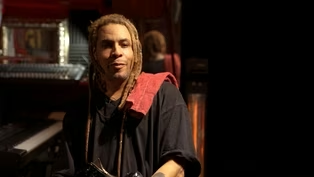
Omar Edwards: Tapping Into Expression
Video has Closed Captions
Clip: S44 Ep8 | 5m 44s | Omar Edwards: Tapping Into Expression (5m 44s)
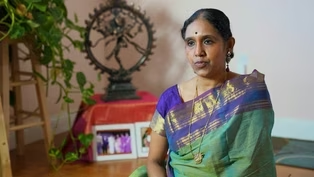
Ramya Ramnarayan: Bharatanatyam, Tradition & Change
Video has Closed Captions
Clip: S44 Ep8 | 6m 4s | Ramya Ramnarayan connects students to a living tradition of the Bharatanatyam dance form. (6m 4s)
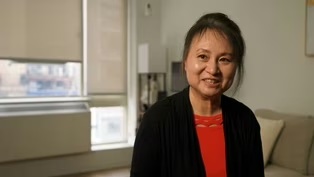
Video has Closed Captions
Clip: S44 Ep8 | 6m 29s | Yang Yi, master of the guzheng, passes the ancient tradition down to her students. (6m 29s)
Providing Support for PBS.org
Learn Moreabout PBS online sponsorship New Episode
- Arts and Music

Innovative musicians from every genre perform live in the longest-running music series.
 New Season







 New Episode
 New Episode

Support for PBS provided by:
State of the Arts is a local public television program presented by NJ PBS