State of the Arts
Ramya Ramnarayan: Bharatanatyam, Tradition & Change
Clip: Season 44 Episode 8 | 6m 4sVideo has Closed Captions
Ramya Ramnarayan connects students to a living tradition of the Bharatanatyam dance form.
As a performer and choreographer, Ramya Ramnarayan has spent decades ensuring Bharatanatyam continues to thrive across generations, connecting her students to traditions they may not otherwise encounter. Based in Edison, NJ, the celebrated dancer and educator uses her teachings to preserve the artform while allowing her students to evolve it.
Problems playing video? | Closed Captioning Feedback
Problems playing video? | Closed Captioning Feedback
State of the Arts is a local public television program presented by NJ PBS
State of the Arts
Ramya Ramnarayan: Bharatanatyam, Tradition & Change
Clip: Season 44 Episode 8 | 6m 4sVideo has Closed Captions
As a performer and choreographer, Ramya Ramnarayan has spent decades ensuring Bharatanatyam continues to thrive across generations, connecting her students to traditions they may not otherwise encounter. Based in Edison, NJ, the celebrated dancer and educator uses her teachings to preserve the artform while allowing her students to evolve it.
Problems playing video? | Closed Captioning Feedback
Where to Watch State of the Arts
State of the Arts is available to stream on pbs.org and the PBS app.
Providing Support for PBS.org
Learn Moreabout PBS online sponsorshipRamnarayan: I have spent all my life training in the art form Bharatanatyam.
I see dance and music as one of the best universal connects beyond the boundaries of countries or cultures or race.
It's just universal.
It's an unspoken dialogue between the artist and the audience.
So what I evoke is called bhava, and what they enjoy and feel is called rasa.
All dance forms and all music forms has the ability to bridge gaps.
My name is Ramya Ramnarayan.
I am a performing and a teaching artist.
I have been a performer since age 11.
I see myself as a lifelong student.
I did so many collaborations with so many phenomenal artists, both from the diaspora as well as outside of the Indian diaspora.
In addition, I am true to my form.
I'm a soloist.
I'm an artist who headlines in big festivals in India.
I toured in 12 cities in the United States.
Bharatanatyam is very beautiful, nuanced classical dance from India.
India has over eight classical forms.
It is closely in comparison with a form like ballet, which is mostly performed in a formal setting.
The art typically has been learned by both boys and girls.
There are two important aspects of Bharatanatyam, the first being Nritta, or abstract dance, where you would see the dancer using the movements of the body, gestures of the hands, and creates firm, rhythmic footwork by weaving geometrical and symmetrical patterns.
The footwork is done with the bare feet tapping, but also in demi-plié position.
The second aspect is expressional dance, where the dancer uses the same movements of the body, same gestures of the hand, but now each of these gestures are alphabets to dance language.
The dancer tells a story, creates an idea, and can tell an entire sequence of events.
Anything under the sun.
It's very important the dancer uses certain tools.
One is called angika, movements of the body, both minor and major limbs.
Vachika, words or poetry.
Aharya, how the dancer is dressed.
And last is Sattvika, what we feel within.
Continuing education is very important for me, as a performer as well as a teacher.
This is something that I immersed myself doing all the time.
[ Clapping rhythmically ] Ramji: I've been doing this since I was 5.
I'm 21 now.
She does a very, very good job of finding a way to connect it to our real lives in whatever way that might be, and in doing so, one, allows us to emote and accurately convey the meaning of the piece, and, two, give us a deeper appreciation for the mythology itself.
Chandrasekhar: She finds a single thread between everything that she does and keeps that as like a string of continuity.
She emphasizes the fact that you need to know music, you need to know rhythm.
And then she brings in the story.
Ramji: I think, especially growing up in the United States, when all of this culture and mythology can sometimes feel foreign or hard to connect with, her teaching for dance goes beyond just dance itself, but for life and for my understanding of my culture, as well.
Chandrasekhar: In the diaspora, there are so many different ways that culture changes and transforms, and finding that here is super important to me.
Ceyyur: Guru Ramya has been in the New Jersey area since the '90s, and I would credit her for being one of the reasons that this community has such a thriving Indian classical art scene.
She makes it accessible to the community, not just the Indian community, but the greater New Jersey arts community.
Ramnarayan: I've been selected to be a roster artist of the Young Audiences of New Jersey, and I've been working with students in over 250 public-private schools.
The assembly program is an hour-long presentation, but very interactive.
I'm engaging with all of them at the same time, introducing them to Indian dance, and how dance and music is part of all of us all the time.
Melody, rhythm, and mime is called Bharatanatyam.
All: Bharatanatyam.
Ramnarayan: They experience a little bit of Indian dance by joining me on stage in these two interactive sections.
We also do a very interesting quiz where they're just, like, so excited and interested to share all that they have noticed.
I'm just humbled by this opportunity to be able to share.
I only wanted to be a student of dance, student of Bharatanatyam, and that was what I seeked.
Then my path changed to me becoming a teacher and then a teaching artist.
In my understanding, the word "tradition" means change.
So only when there is change, art grows, and it thrives in environments.
I see tremendous hope and scope and greatness for this art thriving at its best height outside of it.
Narrator: Last on the show, Kimberly Camp preserves and reimagines the age-old art of dollmaking.
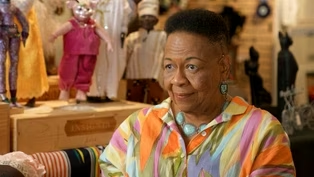
Kimberly Camp: Dollmaking Fine Art at Play
Video has Closed Captions
Clip: S44 Ep8 | 5m 31s | Kimberly Camp brings joy to the three-millennia-old art form of dollmaking. (5m 31s)
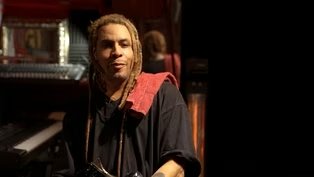
Omar Edwards: Tapping Into Expression
Video has Closed Captions
Clip: S44 Ep8 | 5m 44s | Omar Edwards: Tapping Into Expression (5m 44s)
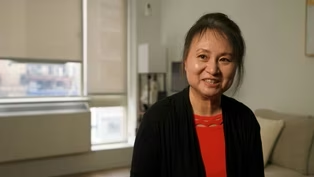
Video has Closed Captions
Clip: S44 Ep8 | 6m 29s | Yang Yi, master of the guzheng, passes the ancient tradition down to her students. (6m 29s)
Providing Support for PBS.org
Learn Moreabout PBS online sponsorship New Episode
- Arts and Music

Innovative musicians from every genre perform live in the longest-running music series.
 New Season







 New Episode
 New Episode

Support for PBS provided by:
State of the Arts is a local public television program presented by NJ PBS