Living St. Louis
Lambert Airport Director Rhonda Hamm-Niebrugge Retires After 16 Years
Clip: Season 2026 Episode 14 | 6m 52sVideo has Closed Captions
After 16 years as the director of Lambert Airport, Rhonda Hamm-Niebrugge is set to retire.
As Rhonda Hamm-Niebrugge prepares to retire in August 2026 after 16 years leading St. Louis Lambert International Airport, she reflects on the challenges, achievements, and defining moments that shaped the airport's transformation during her tenure.
Problems playing video? | Closed Captioning Feedback
Problems playing video? | Closed Captioning Feedback
Living St. Louis is a local public television program presented by Nine PBS
Support for Living St. Louis is provided by the Betsy & Thomas Patterson Foundation.
Living St. Louis
Lambert Airport Director Rhonda Hamm-Niebrugge Retires After 16 Years
Clip: Season 2026 Episode 14 | 6m 52sVideo has Closed Captions
As Rhonda Hamm-Niebrugge prepares to retire in August 2026 after 16 years leading St. Louis Lambert International Airport, she reflects on the challenges, achievements, and defining moments that shaped the airport's transformation during her tenure.
Problems playing video? | Closed Captioning Feedback
Where to Watch Living St. Louis
Living St. Louis is available to stream on pbs.org and the PBS app.
Providing Support for PBS.org
Learn Moreabout PBS online sponsorshipWe could not be more excited today with our partnership with Air Canada and our nonstop service to Montreal.
After 16 years as the director of St.
Louis Lambert International Airport, Rhonda Hamm-Niebruegge is set to retire at the end of August 2026.
She recently sat down with Nine PBS to reflect on her tenure, the challenges, the hard-won successes and one of the most dramatic moments.
I'd been in the job about 14 months.
Felt really good about the plan we were trying to create and put forward to build back this airport, try to make sure that the business community understood this industry.
As we were doing all of that and really sort of bringing people into the fold, the Good Friday tornado hit.
(glass shattering) - My husband and I were celebrating a birthday dinner that Friday evening, and then I received the call from one of the young men that was in our airport operations tower and said, you know, Rhonda, we just got hit.
And I said, hit, hit by what?
And he said, the tornado immediately.
You know, we hopped in the car and my heart just sank.
And when I walked in, it was a mess in terms of, you know, the windows broken and everything upside down and computers blown away.
It was calm.
I found out that there were especially no deaths, thank God.
The police were in place.
The firefighters were in place.
Our operational team that was here was out helping people, gathering, making announcements.
And all of a sudden it made me think, "Okay, we can get through this."
That night I started getting calls from all the business leaders that I had spent the last year trying to bring to the table about what happened in this industry and what we need to do to pull together to think about the future.
All of a sudden they're all calling, "What do you need?
Where can we help?
Like, we need plywood to board up windows.
We need dump trucks.
We need people to help pick up trash.
We need food.
We've got people working around the clock."
And all of that just appeared.
So from that initial shock of, "Oh my God, I don't know what to expect, and can we handle this?"
to all the support that came through and opening the very next day in 100% on Monday of our operation, I think was an incredible opportunity for us to really showcase the airport.
When Lambert was first built in 1956, it set the aesthetic standard for airports all over the country.
Designer Minoru Yamasaki's iconic domes mimicked the shapes and wonder of flight, while also feeling distinctly futuristic.
But not everything would stand the test of time as well as Yamasaki's domes would.
Hamne Brugge and her team have been working with the airlines to secure approval and funding for an enormous renovation that would see a consolidated terminal, new, easier-to-navigate road system, and more parking.
It's a good feeling to know that our airline partners have enough faith and trust in us that we're good stewards of the airport, that they authorized the first $335 million.
The second phase was another $650 million.
It includes all of the design work and for the program management teams, for the construction management teams, but it also brings into play some more of the outdated buildings that need to be relocated, like the new airfield maintenance and the new de-icing pad.
We're getting a new commissary distribution unit.
We're moving our ground service fueling.
All of those are really revitalizing the campus.
Over the generations, everybody's been good stewards of this airport, but it's now time to think about the next five or six decades, and that's what we're doing.
With the renovation anticipated to take at least four more years, the project will be handed over to Hamm-Niebruegges successor.
But this upgrade is only possible because of the director's other major focus during her time at Lambert.
Ladies and gentlemen, I'd like to welcome you to St.
Louis' Lambert Airport.
After becoming TWA's primary domestic hub in 1974, St.
Louis Lambert experienced a time of rapid expansion, increased passenger traffic, and the addition of nonstop flights to Europe.
- And people in St.
Louis got very accustomed to having lots of flights.
It peaked really in the year 2000, 30 million passengers per year coming through.
American Airlines bought TWA in 2001.
Then 9/11 happened, and the hub at St.
Louis was no longer seen as important and something to be retained.
Half of the flights were eliminated, and it was a real psychological blow, I think, to St.
Louisans who enjoyed amazing connections internationally.
- There was not a lot of faith in the airport at the time.
The frustration of having lost that status, of having lost that international, and really people not understanding this industry or what was happening, you know, it's been my whole life since 1982.
So I came from the airline side, so I understood the industry and some of the changes.
So I think what I realized initially was we just we have to help educate this the community and we have to build partnerships to make people feel like they're part of where we're going and how we get there.
The airline partnerships have been a really I think key success of my time.
The growth that we've seen with Southwest seeing the connecting traffic coming back through this airport.
This region offers so much for visitors, for residents, for young adults and students, but the ability to move our community forward is absolutely essential as we think about growing the reach and the impact of our visitor economy.
But you can only do that to a limited degree without a great airport and great connectivity.
So we think about the future of St.
Louis, it's directly tied to Lambert International and improved connectivity.
I think today is probably the proudest moment of my career.
When I first took this job, you know, over 16 years ago, the business community came and they said, "Rhonda, you have one priority.
It's to get London service back."
And I thought, "Okay, well, that won't be that hard, right?"
Sixteen years later, we've answered that plea.
"It's bringing back some of what St.
Louis was.
We have the companies that are doing trade.
We have universities that attract talent and students from all over the world.
Part of it is really recognizing it, and now these flights legitimizing just exactly who we are.
That is St.
Louis being a globally competitive city.
- All of a sudden, people looked at the airport again with pride, and that's what's important to me, you know, making sure that people have pride in our airport.
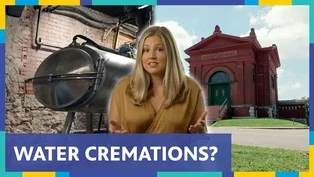
The Groundbreaking Past (And Future) of The Missouri Crematory
Video has Closed Captions
Clip: S2026 Ep14 | 7m 14s | Missouri Crematory continues to pioneer alternative end-of-life services through water cremation. (7m 14s)
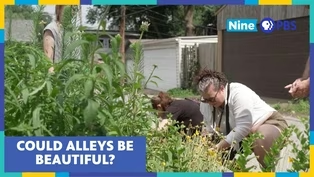
How Native Plants Are Transforming South St. Louis City
Video has Closed Captions
Clip: S2026 Ep14 | 4m 24s | Alley Asters works to transform St. Louis alleyways into native plant gardens. (4m 24s)
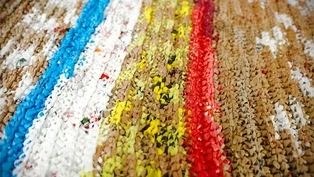
Plarn Quilts | What Do I Do with This?
Video has Closed Captions
Clip: S2026 Ep14 | 5m 10s | Volunteers crochet plastic grocery bags into sleeping mats for people experiencing homelessness. (5m 10s)
Providing Support for PBS.org
Learn Moreabout PBS online sponsorship









Support for PBS provided by:
Living St. Louis is a local public television program presented by Nine PBS
Support for Living St. Louis is provided by the Betsy & Thomas Patterson Foundation.