Living St. Louis
The Groundbreaking Past (And Future) of The Missouri Crematory
Clip: Season 2026 Episode 14 | 7m 14sVideo has Closed Captions
Missouri Crematory continues to pioneer alternative end-of-life services through water cremation.
One of the first modern crematories west of the Mississippi, the Missouri Crematory helped introduce cremation to America in 1888 through the widely publicized cremation of advocate Elizabeth Todd Terry, and today the site continues to pioneer alternative end-of-life services through water cremation.
Problems playing video? | Closed Captioning Feedback
Problems playing video? | Closed Captioning Feedback
Living St. Louis is a local public television program presented by Nine PBS
Support for Living St. Louis is provided by the Betsy & Thomas Patterson Foundation.
Living St. Louis
The Groundbreaking Past (And Future) of The Missouri Crematory
Clip: Season 2026 Episode 14 | 7m 14sVideo has Closed Captions
One of the first modern crematories west of the Mississippi, the Missouri Crematory helped introduce cremation to America in 1888 through the widely publicized cremation of advocate Elizabeth Todd Terry, and today the site continues to pioneer alternative end-of-life services through water cremation.
Problems playing video? | Closed Captioning Feedback
Where to Watch Living St. Louis
Living St. Louis is available to stream on pbs.org and the PBS app.
Providing Support for PBS.org
Learn Moreabout PBS online sponsorship- What do I want to happen to my body after I die?
It's an important but often uncomfortable question that humans have been dealing with for, well, forever.
For centuries, burial was the most popular option in the U.S.
But one building in St.
Louis was, and still is, an epicenter of change in funerary methods.
So St.
Louis has a really neat hidden gem in the Missouri crematorium.
It's only one of the, it's like the sixth oldest one in the country.
It came about in the 1880s.
And before that, if you were cremated, you would have had to go to Pennsylvania.
Amanda Clark is a public historian at the Missouri Historical Society.
While cremation was a common practice in many cultures for centuries, the Christian belief in the resurrection of the body after death made cremation taboo in the US around this time.
In 1888, the Missouri crematory was the first of its kind to be built west of the Mississippi, and it marked a huge shift in attitudes about death.
You start to see more spiritualism after the Civil War, people being more open to this idea that we can connect with the dead on a spiritual level.
And once you see that shift, you start to see a little more acceptance to the idea of not needing your body to be physically preserved afterwards.
In St.
Louis, this idea was ushered in largely by German immigrants, specifically German revolutionaries who arrived in the late 1840s.
Political revolutionaries tend to be artists, musicians, people that are a little more open to progressive ideas.
That movement is called the German Freethinkers.
The Freethinkers are the ones that are open to cremation as being an option, so they're the ones that are introducing these progressive ideas to St.
Louis.
A German immigrant named Albert Todd had the Missouri crematory built, but he died before it was completed.
So he does not get to be cremated there, but his daughter, Elizabeth Todd Terry, is able to be cremated there and she's the first cremation to happen at her father's crematory.
She was able to prepare ahead and when she was cremated, she made sure that the front page of the newspapers carried the story of her cremation with very detailed description of what would happen to her remains.
And I think while he led the way to get it done, her doing that is the biggest story in the beginning of that crematory.
- What was once considered a radical idea started gaining acceptance in St.
Louis.
Slowly, cremations began to tick up.
A number of prominent Missourians have been cremated at the facility, including Frank James, Jesse James' brother.
And the Missouri crematory would influence the rest of the western United States.
So it would take a few years, but it definitely was on the forefront, and it would have influenced other cities.
According to the National Funeral Directors Association, over 60% of people choose cremation today, which is an exponential increase from the 1970s, when only about 5% of people were cremated.
And that number is only projected to grow over the years.
The Missouri Crematory was instrumental in bringing about change in funerary practices in the late 1800s, but that building is still making headlines about how remains are processed today.
We are the first providers of alkaline hydrolysis, or what's known as aquamation, here in the state of Missouri.
That's John Hughes, funeral director and owner of Hughes Funeral Alternatives.
He moved his business to the historic crematory a little over three years ago and brought the first alkaline hydrolysis machine to Missouri.
Hughes took us on a tour of the crematory to get a closer look at how the aquamation process works.
This machine will do a process in anywhere between four to six hours, fall in process, the chamber isn't open, and what's left is mineral ash remain, mineral bone particles that are then dried and processed into the fine ash, placed in an urn and then given back to the family.
What is the solution made up of?
So the solution is about 95% water, and then the other 5% would be alkali, and that's just to mimic what the alkalinity in the soil does during burial, we can mimic that process here in this machine.
Because we're controlling the amount of alkali, the time, and the temperature of the water, we can do it in a much faster time span.
It's currently the only place in Missouri that provides alkaline hydrolysis, or aquamation, for remains.
So we thought, as we were looking for a new building to expand from where we originally opened, we thought this would be a good marriage of the first aquamation machine would be in the first crematory building here within the state.
When Hughes Funeral Alternatives moved in, the Missouri crematory hadn't done cremations in the facility for decades.
We just took the, I guess, the footprint of the building and, you know, fit for our process of aquamation.
His company also owns the historic columbarium, which holds cremains, but is now undergoing construction, and a chapel and mausoleum that was built on the property in the 1970s.
What is the cost of aquamation compared to other funeral services?
So the overall cost of aquamation, it's very comparable to what a normal direct cremation would be, if not less.
So it would be, in most cases, under $2,000 for everything.
It's also eco-friendlier than flame-based cremation.
Aquamation produces a carbon footprint 18 times smaller, with 90% less natural gas, 60% less electricity, and 90% less CO2 emissions.
Every year we tend to serve more families.
As more people find out about what this process is, not only acceptable here in Missouri, but it's opened up and offered here within the state.
The practice of acclimation isn't available or even legal in many states due to historic laws and slow changes in the industry.
We have served families, in fact last month we served four families alone from the state of Texas.
It's not legalized in Texas, so we are the closest machine.
Still, Hughes admits this process may not be for everyone.
I don't expect everybody to choose this.
My goal is that everybody has the option to choose this.
More people are becoming more and more eco-friendly.
Personally, I never did like the aspect of putting somebody in open flames and heat, so that's how I got interested in this, and then I just slowly kind of gravitated towards the eco-friendly version of this.
We also hear a lot that, you know, we had a hard time thinking about putting our father or grandfather in flames or fire, and for whatever reason, that water is just a more peaceful mindset for them as they say goodbye to the loved one.
So that's why I think what we do here is important.
So getting back to that uncomfortable question, what do you want to happen to your remains after death?
Would you choose aquamation for yourself?
Let us know what you choose and why in the comments for Living St.
Louis I'm Veronica Mohesky.
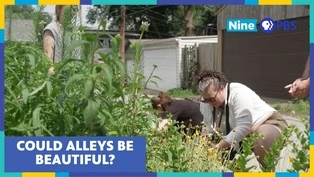
How Native Plants Are Transforming South St. Louis City
Video has Closed Captions
Clip: S2026 Ep14 | 4m 24s | Alley Asters works to transform St. Louis alleyways into native plant gardens. (4m 24s)
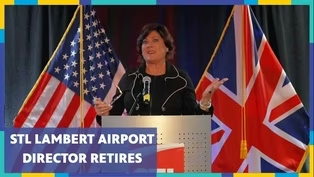
Lambert Airport Director Rhonda Hamm-Niebrugge Retires After 16 Years
Video has Closed Captions
Clip: S2026 Ep14 | 6m 52s | After 16 years as the director of Lambert Airport, Rhonda Hamm-Niebrugge is set to retire. (6m 52s)
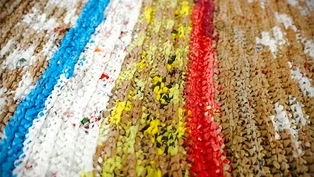
Plarn Quilts | What Do I Do with This?
Video has Closed Captions
Clip: S2026 Ep14 | 5m 10s | Volunteers crochet plastic grocery bags into sleeping mats for people experiencing homelessness. (5m 10s)
Providing Support for PBS.org
Learn Moreabout PBS online sponsorship













Support for PBS provided by:
Living St. Louis is a local public television program presented by Nine PBS
Support for Living St. Louis is provided by the Betsy & Thomas Patterson Foundation.