LA’s Stadiums Confront Their Environmental Impact
Season 7 Episode 1 | 24m 44sVideo has Closed Captions
LA stadiums tackle climate impact with smart waste, water, and energy innovations.
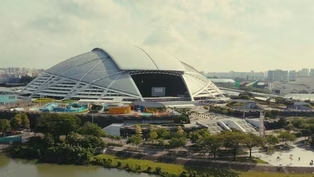
Every year, millions of people visit Los Angeles stadiums – driving economic benefits, but also higher emissions, waste, and energy use. To address these climate change issues, venues like the LA Memorial Coliseum and Crypto.com Arena are testing innovative sustainability solutions, from food waste reduction and cup recycling to water conservation and energy storage.
Problems playing video? | Closed Captioning Feedback
Earth Focus is a local public television program presented by PBS SoCal

LA’s Stadiums Confront Their Environmental Impact
Season 7 Episode 1 | 24m 44sVideo has Closed Captions
Every year, millions of people visit Los Angeles stadiums – driving economic benefits, but also higher emissions, waste, and energy use. To address these climate change issues, venues like the LA Memorial Coliseum and Crypto.com Arena are testing innovative sustainability solutions, from food waste reduction and cup recycling to water conservation and energy storage.
Problems playing video? | Closed Captioning Feedback
How to Watch Earth Focus
Earth Focus is available to stream on pbs.org and the free PBS App, available on iPhone, Apple TV, Android TV, Android smartphones, Amazon Fire TV, Amazon Fire Tablet, Roku, Samsung Smart TV, LG TV, and Vizio.
Providing Support for PBS.org
Learn Moreabout PBS online sponsorship[Crowd cheering] Narrator: What do you think happens when hundreds of thousands of people pour into Southern California's stadiums and arenas to watch their favorite sports teams and entertainers?
Well, there's an enormous boost to a city's economy and community pride.
But there's also trash.
A lot of trash.
And let's not forget the lights on, toilets flushing, cars all idling in one spot, waiting to get in, and the trucks it takes to get the food and merch to the stadium.
This environmental impact is challenging cities to rethink their sustainability while keeping the fans coming back.
[Click] Announcer: This presentation is made possible in part by... a grant from the Orange County Community Foundation.
In Los Angeles, there's a lot of choices that Angelenos have for where they go for entertainment.
Woman: There are so many dimensions of any event or any venue and the events that it's holding, which are critical from a sustainability perspective.
So, for example, the design of the structure itself, how much energy does it use?
Is it designed in a certain way so-- where energy usage is minimized as much as possible?
There are lots of, you know, sustainable buildings that we can think about, the way the ventilation is, the way certain parts of them are shaded.
So, that is going to historically reduce the cost of running that particular building and that venue.
And that is something that we have to think at the onset, before we start even, you know, designing the stadium.
Narrator: Early sport competitions, like hunting, fishing, and horse racing were rooted in the landscapes in which they took place.
And by the 20th century, there was a rapid growth in professional leagues, leading to the building of massive stadiums and a lot of spectators to fill them.
That started shaping both the economy and the environment.
They face significant challenges when it comes to sustainable design practices, especially for structures that have already been built.
Man: The game experience is, of course, the centerpiece.
In sports architecture, there is a really interesting focus on a singular activity, which is the sport.
It's shown in the shape of the buildings that everything has a focal point.
The seating... everything looks at a center.
We tried to be a little bit multifunctional, so a soccer stadium would also need to house a football field, which is a little bit narrower and a little bit longer.
So, we would make sure that you can do both sports in a stadium.
Just like at SoFi, it's an NFL stadium, but it's big enough to also have the World Cup come.
From that, we can offset a few-- a few requirements, you know, access around the field, and then you already create the bowl.
So, this bowl is a result of capacity.
You know, 50,000 people, you have to have enough space to house them.
That's one track of a design process.
The other track of the design process would be the question, what is the-- what is the experience that you want to create, and for who do you want to create it?
I can show you an example of a stadium like this that we did for the World Cup in Brazil.
The interesting part about this is that this is built on the site of an existing stadium that had this opening to the lake.
This is beneficial because it allows air to go into the stadium.
It's good for ventilation, and this air actually comes over the lake.
So, there's a cooling effect from the lake for the air that then enters the stadium.
All this has to be designed with sustainability in mind so that I can take advantage of the conditions I find on site.
If the next sort of phases of development or construction is considering some of those things, we are slowly sort of changing that building into a quasi-sustainable structure.
With reconstruction, renovation, if we start changing some things, it can still happen.
I design a stadium for now and for the foreseeable future.
We can't really predict what's gonna happen in the next 40, 50 years.
And in the end, we're solving a local problem by designing a stadium where we can see the impact of climate change.
We have to accommodate for hotter summers and more extreme weather.
If we look at the history of sports facilities, the one thing that hasn't changed is the sport itself and that we're watching it.
[Crowd cheering] Monalisa: Energy costs are very high in these stadiums, especially, you know, with all the lights and all the different types of equipment that we are using.
You know, when it comes to, say, building design, like, for example, if we are designing buildings which require a lot of air conditioning to keep it cool, then obviously the energy costs are going to go high.
But the buildings can be designed in a certain way that we block the sun rays in a certain way that doesn't reach in into the building and heat it up, and, therefore, it requires cooling.
[Crowd cheering] Man: 15 to 20,000 people come through our venue for any given event.
We have lots of theatrical lighting and use quite a bit of power.
On a typical day, we're using about 10,000 kilowatt hours.
We pay about 24 cents per kilowatt hour.
We're on the roof of Crypto.com Arena looking at our solar panels.
We installed these solar panels in 2008 that generate 364 kilowatts.
We use this power every day while the sun is up.
Then, in 2012, decided to install a fuel cell system that provides us 500 kW, 24 hours a day.
That system, with incentives from the city, was able to be cash positive for the building and save us money and take energy usage off the grid by the time it was even turned on.
Through the Bloom Energy and the solar panels, you know, we're probably saving $100,000 a month off the energy that we're generating.
Monalisa: The best way to sort of reduce some of that impact is to transition to renewable energy.
Solar and wind both are very competitive economically.
So, switching to renewable is going to be one of the biggest sort of, you know, step that people can do.
And producing your own energy using solar panels and all of that is going to be something that every big building structures can consider and reduce some of their reliance on traditional energy and therefore reduce their ecological footprints.
Narrator: One natural element that stadiums do use a lot of is water.
Maintaining grass for an NFL field can require about 36,000 gallons of water per irrigation cycle.
And don't forget the millions of gallons used in restrooms, concessions, and cooling systems.
Some stadiums can consume between 600,000 and a million gallons of water during a single game.
For hockey arenas, there's an additional demand-- turning water into ice.
Man: Ice is a science.
To make a good sheet of ice involves a lot of variables.
It's about 10,000 gallons of water.
About a month before the start of the season, it's a crew of about 8 to 10 that come in, and it's literally one sheet at a time.
And it takes three days.
There are coolant lines that run underneath the slab of concrete.
And we'll turn those on, let them get to a certain temperature, and then we'll start putting water by misting it.
We mist water in a pattern to cover the whole sheet.
Currently, it sits about an inch and a half right now of ice.
We're always looking for an initiative or something that can be our next step towards becoming a more sustainable building.
This was step one.
A typical building like this will use 10,000 to 12,000 gallons a day for a cooling tower.
If we can get to the point where we're reclaiming about 10,000 to 12,000 gallons, then, for us, we would be making a huge dent into our water consumption, our water bills-- which is another thing that we consider.
But at the same time, it's the right thing to do to not be taking city water if we can reclaim it from the current systems that we have in here.
[System humming] So we're in one of our two plenums where we have the air handlers pulling in air out of the arena, forcing it into this room where we do two things-- One, we have air filters that are going to filter that air, make sure it's scrubbed, ready to go.
And then we have the dehumidifiers.
This is-- these are two of the ten that are on this side.
We have another ten on the west side, on the other side.
These two dehumidifiers are going to pull the water out.
We're going to collect it down a series of tubes here, and these tubes are going to collect into a well.
So, these pipes come in and fill up this well here.
What we do is collect the water... There's a pump that has to still take it up one more level, and then it'll be gravity-fed all the way down to the cooling towers.
So, we're using this water to offset the amount of water that we're using on a daily basis.
Narrator: Now for the issue that consumers can control-- kind of-- waste.
According to the U.S.
Environmental Protection Agency, attendees at sporting events in America generate about 39 million pounds of waste each year.
In California, under Public Resources Code section 42648, stadiums and other large venues are legally required to divert waste from landfills.
In response, many sports stadiums have implemented zero-waste initiatives to address both the environmental impacts and the operational responsibilities associated with large-scale events.
There was a 2019 report which said that, in the United States, about 53,000 tons of waste has been produced in just one of these bigger venue events-- not all, because we don't have that data.
We've not collected that data systematically, but these large venues, very prominent venues, yes, you still have some ways of measuring what kind of waste is generated, but if we sort it well, if we are able to reduce 90% of it or more of it, then we are substantially reducing the waste that goes into our landfill and sort of sending some of that waste back into either recycling or composting.
Sustainability is such a large opportunity to improve for our stadium.
And so, for us, it's identifying what we can control.
I can't build more space.
I don't have the opportunity to redo this whole building, you know, it's-- So, what can we control?
What we can control is what we put in the waste stream and then how we sort it.
Monalisa: The diversion of waste has to be 90% or over for it to be called a zero-waste event.
So, stadiums sort of started with this outcome or objective in mind, that, let's start with events, individual events, where we are able to divert 90% or above waste away from landfills, so, through recycling, composting, or finding ways to reuse some of those things so it doesn't go into the landfill.
And many stadiums, many venues are relatively sort of successful because it's difficult to manage the whole operation, but it's easy to manage specific events with that objective in mind.
But there's a lot of effort that's going into making that process more smooth and efficient.
The Coliseum's sustainability program started in 2015 with an idea to sort the trash and try to achieve zero waste.
For USC football games, we're between 50,000 to 60,000 fans, and in sustainability, your front line is the fans, so you're trying to have them sort themselves.
So, you put the waste streams of compost and recycling.
In our stadium, we don't even offer a landfill receptacle, because everything that we're selling should be one of those two categories.
Monalisa: It's essentially the garbage and the trash that is produced.
So, it's the drinks that they are drinking, it's the paper napkins they are using, it's the hot dogs that they are eating, and whatever leftover there is of that.
I mean, the enormous amount of waste that sort of shows up in these places-- some places, I've seen numbers like 80%, 70% is basically wasted.
In our last home game, we had close to eight tons of compost and almost six tons of recycling.
It depends on the time of game.
These last two games, we had 12:30 kickoff, right at lunchtime.
So, we see a lot more compost, always doing a second compactor of recycling.
All these factors that, because of our history and sorting for, you know, eight seasons, we've seen that we can staff appropriately.
And then I know Matty had a question about those being compost-- yeah, the hats, and we found out that they were, so, you guys can keep showing them the same-- The way that trash looks like gathering all that after an event, it's that we have a bull pick where staff comes around and does a little snake on the stadium, and they pick up only recycling-- that means cans, water bottles, recyclable cups, anything that's recycling.
So, from event start to maybe five days afterwards, they're still sorting this trash 24/7.
[Metal clinking] So, right now, we have robots or, you know, these kinds of automotive sort of systems, which can separate different types of metals and alloys very well.
The problem with plastic in particular is that there are so many different types of plastic, and they are constantly coming up with new varieties of plastic.
We have to also consider, you know, the cost of recycling and the pollution and the energy cost that sort of goes on.
Like, sometimes you have certain kind of plastics which essentially just burns.
You really can't recycle.
If you heat it, it's going to just burn, and only very little of the original material will be remaining.
Rest of it will get converted into some sort of fumes, which is going to add to our air pollution.
You know, like, we have to look at it from a long-run sort of perspective.
Is it really worthwhile to say that, yes, we did recycle it, when you had to add, you know, 20 times more of new material?
Man: Zero waste is always a goal for a lot of arenas in the sports and entertainment field.
Trying to hit zero waste with different programs like the ARCA program is helping us achieve that.
Waste diversion has always been a big part of Crypto.com Arena.
We've been sorting our waste for years now.
So, this is very similar to what you would see in a souvenir cup that you would come and purchase at a Kings game or Lakers game, except the only difference is, instead of taking it home to use over and over again, you're giving it back to us so then we can wash it and sanitize it and bring it back for a future event.
These are our new waste bins that we have all throughout the arena.
So, these are just installed for this hockey and basketball season, and we have them strategically located in areas where we sell beverages, so our guests can dispose of them in the areas where they purchase.
And it takes a lot of coordination between our guest experience teams, our security teams, janitorial staff, and our food and beverage team to educate our guests and make sure that they're capturing all these cups before the end of the day.
The r.Cup program is actually more waste avoidance than waste diversion.
So, it's just a way for us to continue that journey of avoiding waste to landfill.
In a stadium like this, you will find that anywhere between 40 to 80% of all the waste coming out of the facility is likely food waste or compostable material in some form.
That can be cardboard, paper, or compostable serviceware and cutlery.
Managing food waste in traditional, centralized facilities, you're going to have large, inefficient garbage trucks averaging about two and a half miles per gallon.
And in a place like L.A., they'll be traveling hundreds of miles per day.
They'll be dropping this food waste material off at a landfill where it's going to process anaerobically and release methane gas.
Matthew: The food that's going into this machine is coming from our main kitchen.
As they're cleaning out the concession stand, all the leftover hot dogs, hamburgers-- instead of that going to landfill, now it can come into the digester and help make the compost that we'll use around the stadium.
This machine is big enough to handle all the food waste after our 60,000-person football games.
Tanner: We load the machine on the right-hand side, and it's going to process linearly through the machine continuously and then output on the left-hand side.
And that allows businesses to continue to load it throughout the day.
So, you can put in 20 pounds in the morning, 100 pounds at noon, and 200 pounds in the afternoon, and it's gonna continue processing.
Matthew: This machine is gonna take us to the next level of our sustainability goals.
Man: See these?
These are clear.
But check the bottom.
This one here.
See that?
So, once the recycling gets here, what happens is that, for example, one of our staff members will crack open that bag and literally rip it open and start sorting.
So, if we can look over here, he's actually putting all the recycling into one single bin, and that bin then gets transferred over here to our compactors.
And our compactors, what we do is that we insert these-- we call them chalupas, and we insert the chalupa inside and then, that gets lifted into this bin, and this compactor gets filled up.
At the end of the sort-- maybe that's, like, five days later-- this compactor will get hauled out by our hauler.
So, all the extra trash that's in the stadium that doesn't go to composting, recycling, or reuse-- which we have a lot of programs for reuse-- that goes to landfill.
So, we only have a little bit of landfill, I'd say about 1.5 to 2 tons a game, which is still a lot, but compared to this, we do about 6 to 8 tons of compost a game alone.
Monalisa: Events are constantly booked back to back.
It's not like, you know, yeah, you have one event, then you have three, four days free to actually figure out what to do with that waste, you know, sort it properly and then do the next event and then have another three, four days to sort that.
You really don't have that kind of a time.
So, time is also very challenging from a logistic perspective.
Narrator: While stadiums generate greenhouse gas emissions through waste and other operations, a significant share of their overall carbon footprint comes from transportation.
Fans, teams, and suppliers traveling to and from events contribute large volumes of carbon dioxide to the atmosphere.
According to the Natural Resources Defense Council, the combined greenhouse gas emissions from all National Hockey League games during a single regular season amount to more than 500,000 tons of CO2.
At Dodger Stadium, with its 16,000 parking spaces, an estimated 930,000 miles are driven to and from the stadium for each game, producing more than 828,000 pounds of carbon dioxide every game day.
Monalisa: The other one is, of course, the transportation part of it-- how people are commuting to that place.
And that connects to the community around that particular stadium as well, because if you have lots and lots of people coming in, using cars, there is traffic congestion, there is noise congestion.
Those are things, negative externalities, that then the community is experiencing.
And often, those community members are not the ones who are actually attending those events.
The other thing that I think is also very critical is, how do we involve community in sustainable solutions in these events?
For example, I said 70 to 80% of the waste in many places is food.
Again, we are sorting it, and then we are sending it to some place where, hopefully, it's getting, you know, composted, but it doesn't have to be transported.
Like, you know, they can be community programs where schools or different sort of community organizations could start a composting program in the venue, where most of the composting material is going to come from these larger sort of, you know, events and stadiums, for example.
That way, they are creating some manure, some resources for themselves to be used in the community or even to sell, in some ways.
Like, organic waste, organic manure is something that people are willing to pay a reasonable amount of money for.
Narrator: Across Southern California, stadiums are reimagining what it means to bring tens of thousands of people together.
New technologies combined with a commitment to preserving both history and the environment are driving designers, engineers, and operators to confront the challenges of emissions, waste, and sustainability.
If I had a wish list for the sustainability, it would be to continue what we're doing-- We certainly don't want to go backwards.
We want to maintain our zero waste standards.
We would like to find other ways and still be a leader in the industry, so, ultimately, someone looks at us as an example that, "Hey, if a hundred-year-old building can do it, we can do it also."
So, success, I think, should be measured in not only in the building coming into existence, it should also consider how a building can be... taken away again.
Some of these solutions, like diverting waste from landfill, is a relatively easy solution.
It just requires a little bit of planning and, depending on the size of the venue, a little bit of resources too-- I don't want to minimize that part-- but it is something that people can sort of start thinking about.
I would suggest people to try out one of these zero-waste events and sort of see how it feels and be patient, because people are really excited about being in that venue for that event, and I think these little messages are really critical.
They can go a long way.
So, be patient with that.
Narrator: From zero-waste programs to renewable energy investments and innovative transportation solutions, these venues are beginning to redefine what it means to host thousands, while striving for a more sustainable future.
[Fireworks crackling] [Crowd cheering] [Announcement over intercom] [Crowd continues to cheer] [Noise dies down] Announcer: This presentation is made possible in part by... a grant from the Orange County Community Foundation.
LA’s Stadiums Confront Their Environmental Impact (Preview)
Video has Closed Captions
Preview: S7 Ep1 | 30s | LA stadiums tackle climate impact with smart waste, water, and energy innovations . (30s)
Providing Support for PBS.org
Learn Moreabout PBS online sponsorship

- News and Public Affairs

Top journalists deliver compelling original analysis of the hour's headlines.













Support for PBS provided by:
Earth Focus is a local public television program presented by PBS SoCal