
Lawsuit Challenges Grass Removal Law
Season 8 Episode 45 | 26m 46sVideo has Closed Captions
A lawsuit challenges grass removal to save water and beavers call the Wetlands Park home.
In an effort to save water, the state of Nevada says non-functional turf must be removed, starting in 2027 but now homeowners, HOA’s and even a church say the plan is killing thousands of trees. Plus, the Clark County Wetlands Park is home to dozens of species of animals, including beavers.
Problems playing video? | Closed Captioning Feedback
Problems playing video? | Closed Captioning Feedback
Nevada Week is a local public television program presented by Vegas PBS
Lawsuit Challenges Grass Removal Law
Season 8 Episode 45 | 26m 46sVideo has Closed Captions
In an effort to save water, the state of Nevada says non-functional turf must be removed, starting in 2027 but now homeowners, HOA’s and even a church say the plan is killing thousands of trees. Plus, the Clark County Wetlands Park is home to dozens of species of animals, including beavers.
Problems playing video? | Closed Captioning Feedback
Where to Watch Nevada Week
Nevada Week is available to stream on pbs.org and the PBS app.
Providing Support for PBS.org
Learn Moreabout PBS online sponsorship-Nevada relies heavily on the Colorado River but is now proposing to take even less water from it.
We'll tell you why.
Plus... More plaintiffs claim water conservation efforts are killing their trees.
What's next in their lawsuit against the Southern Nevada Water Authority.
And... -Most people don't usually consider the desert to be a place that beavers live.
They made their way up the Las Vegas Wash, and they've been fruitful and multiplied.
-We take you to Clark County Wetlands Park, where beavers are showing off their ability to adapt.
How they got there in the first place, that's this week on Nevada Week.
♪♪ -Support for Nevada Week is provided by Senator William H. Hernstadt and other supporters.
-Welcome to Nevada Week.
I'm Amber Renee Dixon.
Despite a dry winter, the Lower Colorado River Basin states of Nevada, Arizona, and California are offering to further cut the amount of water they get from the river.
The Lower Basin states say these cuts are part of a plan to stabilize the river's water supply and would be in addition to the water reductions they proposed earlier this year when negotiations with the Upper Basin states failed.
Those negotiations are to determine how the Upper and Lower Basin states manage the Colorado River and how much water each state gets from it.
The current guidelines for that are set to expire at the end of this year.
So what impact is the new proposal having?
Joining us now, Alan Halaly, Water and Environment Reporter for the Las Vegas Review-Journal.
Welcome back.
-Thank you for having me.
-This newest proposal, what are they proposing and how significant are these cuts?
(Alan Halaly) They are pretty significant, perhaps the most significant we've seen in modern history.
You know, we're talking about cuts to the tune of 3.2 million acre-feet across these three states.
And for Nevada, that could be about 50,000 acre-feet per year in 2027 and 2028.
And beyond that, the states are exploring how they could potentially add 700,000 acre-feet to that total.
That could be an additional 50,000 per year for Nevada.
Now, you may know that Nevada has the smallest share of the Colorado River.
We have 300,000 acre-feet.
We routinely operate within those boundaries.
Last year, our water use came in just below 200,000 acre-feet.
But if this goes through as proposed, this could be the time where we take almost a third of a cut in our water allocations.
And that's just where the negotiators are at this point in trying to stabilize the system in this historically dry year.
-For some context, an acre-foot of water is...?
-An acre-foot of water is-- The metric usually is that it's enough to sustain two single-family households for a full year.
-Okay.
So Lower Basin States, including Nevada, are sweetening the deal.
What has the Upper Basin's response been?
-Really, there's been radio silence.
We saw the Upper Basin call for a third-party mediator to, I suppose, break through in some of these stalemate talks that we've been seeing for years now.
But the reality is, the Upper Basin has not offered any mandatory conservation commitments.
They have discussed voluntary ones.
But in my conversations with the Lower Basin negotiators, they cast some doubt on that.
They talk about, very frequently, that they feel that pain every year, even in not dry years, because of their obligation to send water downstream to us here in the Lower Basin.
-Will you remind our viewers what the Upper Basin says is its reasoning for not making any cuts or proposing any cuts.
-Right.
Well, they say, you know, because they don't have reservoir storage as significant as we do here with Lake Mead and Lake Powell is very closely tied to those releases to Lake Mead.
They say that they can't take those cuts because every year, no matter if it's a wet or a dry year, they have to shut off users and their state engineers have to proportionately take some of those cuts for folks.
So they say that they don't have any more to give, that we should live with the river that we have.
The overuse problem is largely a Lower Basin problem, but the Lower Basin is also really the only party here that's offering something on the table.
-So the Lower Basin cuts, are they going to happen?
What happens next?
-Yeah.
So the Arizona legislature will have to approve it, as well as California and Nevada water agencies.
I believe it should be discussed at the next Southern Nevada Water Authority meeting, and it's pending that as well as the release of potentially some federal funding, that additional 700,000 acre-feet that I discussed that they're exploring.
They say very clearly that they cannot do that without some additional federal funding.
-Okay.
So the operating guidelines expire at the end of this year.
The new proposals from the Lower Basin extend this out to 2028.
I mean, am I saying that correctly?
Would that push these negotiations back, give more time?
-That's what the implication is, I think.
I think this is the Lower Basin saying, you know, We're kind of at our wits end.
There needs to be some immediate, you know, sweeping cuts to stabilize the system, and this is what we can offer in the short term, absent some Upper Basin cooperation.
-If there is no deal reached, then the federal government will step in, but they are already stepping in.
What actions have they taken?
-Yeah.
So this year they released water from Flaming Gorge Reservoir, which is upstream of Lake Powell, into Lake Powell to avoid a scenario where they might not even be able to send water downstream to Lake Mead because of the plumbing problems there.
And in addition to that, they are-- they are reducing the releases from Lake Powell into Lake Mead by more than a million acre-feet.
So that's significant, not in any tangible way for our water supply at the moment, but as soon as this fall, we could see about a 40% reduction in hydro power generation at Hoover Dam.
And that's significant maybe not for urban Southern Nevada but for some of our rural utilities that tend to rely on that almost exclusively for their power generation.
-Lastly, tell us about this past winter and its ability to impact the drought.
-Absolutely, yeah.
It's been a really meager year for snowpack in the Rocky Mountains.
You know, you may remember that 2002 was the year that we kind of started taking water conservation seriously in Southern Nevada, because of just how poor the yield was when we talk about runoff into Lake Powell.
And water managers and hydrologists are saying that this could beat it.
The runoff season runs from April through July, so we're still kind of in, in the thick of it.
But, yeah, I mean, we're talking about like 20% of normal, and that's particularly concerning.
I mean, you probably see a lot of headlines about runoff and snowpack, but this year is the one that really is going to put the system to the test.
-Alan Halaly, Las Vegas Review-Journal, thank you for joining Nevada Week.
-Thank you.
-We move now to what have become controversial water conservation efforts.
Starting next year, Colorado River water delivered by the Southern Nevada Water Authority cannot be used to water nonfunctional grass.
That's the result of Assembly Bill 356, which became law during Nevada's 2021 legislative session.
The law empowered the Water Authority to develop a plan to identify and remove what it considers nonfunctional grass by the end of 2026.
Nevada's Assembly Committee on Ways and Means sponsored the bill and in 2021 said this about what kind of grass the water authority would not target: (Howard Watts) First of all, while we're not defining it in statute, this bill does not target common areas for communities.
That is functional turf.
So the green spaces that people enjoy, including in multifamily developments, is not what is intended to be addressed with this bill.
However, medians and other areas that really do not serve a purpose there--as has been said by some, the only time anyone steps on it is when it's being mowed--that's the turf that we're looking to address under the provisions of this bill.
-But since then, several homeowners say the opposite has happened.
They say the Water Authority coerced HOAs to remove the green spaces in their communities that people actually used, and they blame the removal of that grass for the deaths of mature trees in their neighborhoods.
Those homeowners, along with some homeowners associations and even a church, are suing the Southern Nevada Water Authority as a result.
And joining us now to expand upon their claims is their attorney, Sam Castor, Managing Partner with the law firm Lex Tecnica.
Thank you for joining Nevada Week.
-Happy to be here.
-Will you first explain what grass removal has to do with trees dying?
(Sam Castor) Absolutely.
Trees and grass have a symbiotic relationship.
And especially here in Nevada where tree roots are oftentimes exposed to higher temperatures, grass provides a cooling effect and also retains the water so the tree can stay healthy and keep off insects and other types of disease.
And so SNWA has been removing nonfunctional turf and not taking into consideration that as they remove grass over the roots of these trees, the trees die within a year or two.
And so SNWA has directly and indirectly caused the death of over 100,000 trees here in the Las Vegas Valley over the last few years.
-And that's allegedly, correct?
-It's not allegedly.
That's according to Norm Schilling, who's SNWA own expert, a highly decorated arborist who has calculated that over the past few years, SNWA has killed more than 100,000 trees.
And we're talking very mature 40-year-old trees and obviously some younger trees that aren't able to survive the heat without some type of grass protection.
-How can you prove that it is the grass removal and not other factors like disease or extreme heat, because that is what the Southern Nevada Water Authority says, is that we are "experiencing the corresponding impacts of ongoing drought conditions and unprecedented levels of extreme heat, including disease and pests that are causing tree stress and mortality throughout the valley.
This is occurring regardless of whether the ground beneath is rock, grass, or undergoing a landscape conversion."
-So SNWA is our experts, including Norm Schilling and several others that have provided extensive YouTube instructional videos on how to take care of trees during a conversion.
All of them agree that when you remove grass over tree roots, especially trees in certain species--so ash, pine--the trees die if they're not extremely carefully cared for.
Astroturf increases the temperature substantially.
SNWA's own reports say that grass reduces the temperature in the immediate area by anywhere from 6 to 10 degrees.
And so when you're dealing with heat and a tree is exposed to a spike in heat, prolonged heat exposure, and then also is unable to retain the moisture necessary to fight off that heat, the trees decay and die.
And there's a lot of anecdotal evidence of this.
All someone has to do is walk down a neighborhood and look at the houses that have astroturf versus grass or rock, and you can see that the trees with astroturf and rock are dying.
-So in your lawsuit, you say that SNWA's unlawful overreach has now caused more than $300 million in tree loss damage.
Is that what you're seeking in this lawsuit?
What are the plaintiffs after?
-The plaintiffs aren't after money; we're after unity.
Vegas is incredible.
We can do amazing things.
We've already conserved extensive amounts of water.
We've reduced our water use dramatically, even though Vegas is one of the fastest growing cities in the United States over the last 20 years.
And so what we're saying is the SNWA is using this water conservation cause, which is a just cause, improperly.
They're using it to abuse Las Vegas residents, and they're dramatically overreaching.
They have more power than the police, they have no oversight, and they're destroying Las Vegas.
And so that's something that needs to be checked by the Nevada Constitution, by fundamental law, due process.
And right now, none of those laws are being honored by SNWA.
They're basically pretending like they don't answer to anyone and they can do whatever they want.
They've changed the rules consistently.
These rules are in their service rules.
They're not even law.
And the law AB 356 doesn't actually give them the authority to take any grass out.
It just gives them a directive from the legislature to identify a plan to remove grass, but they do not have any actual police power.
But they patrol these neighborhoods in their police-like cars that say wasting water is against the law or it's against the law to water on days that you're not allowed to.
That's not true.
That's just a service rule that they have.
And they're forcing people, scaring people, creating fear, uncertainty, and doubt to basically abuse Las Vegas.
And that needs to stop.
-So you just want them to stop-- -Correct.
---stop what they're doing entirely?
-Yeah.
I think the SNWA's job is pretty clear in their enabling statute.
Their job is to get us more water.
Their job is to advocate for us.
And there's this doctrine that's a fundamental legal premise in water law called the doctrine of beneficial use.
If you don't use the water, you lose the water.
And it's insane to me that SNWA is saying, Well, we need to start using less so that we can give more away.
Instead, SNWA should be acting like an advocate.
They should be advocating for more water, sourcing more water, not placating the upper states, not pretending like they need to be nice.
Yes, we can disagree and still be professional and respectful with each other, but Vegas needs more water.
And Pat Mulroy herself, the former head of SNWA, has, on the record several times, said we cannot conserve our way out of this problem.
We need more water.
And the person that's supposed to do that is John Entsminger at SNWA, and he's not doing it.
-Want to go back to the trees.
And there is one plaintiff in this case who had the grass removed in the landscape strip in front of their house and replaced it with what the SNWA said was drought-resistant ground cover.
That has not impacted the tree there, correct, or has that tree been impacted?
-The trees have seen more stress, but it is a better situation for the trees.
-So that does prove-- well, at least the SNWA says in their response that that shows you can do turf removal and a tree can survive.
-That's true, but you can't walk on these types of lower water use grass.
They're usually clover or some type of non-grass river type of grass.
And in that situation, if you walk on it, it kills the plant.
And so in that same neighborhood, the-- I think you're talking about the Edingtons-- -Yes.
- --in particular.
They have a park, Wingbrook Park, that was frequented by people with dogs, children doing lemonade stands.
It ran right along the front of their neighborhood.
It was a community gathering space.
People would use it every single day.
It's right next to a playground.
-There are pictures in the lawsuit of how that was being used.
-Yeah.
And unfortunately, SNWA said that that grass was, quote/unquote, nonfunctional or useless.
It's not useless; people use it all the time.
And the trees that are affected by that grass are now decaying and dying.
They're ash trees and other trees that have, in that same neighborhood, have begun to die within a year or two after this type of conversion.
-And so that park example contradicts what we heard Assemblyman Howard Watts say in that sound bite from earlier.
At the same time, though, isn't that the HOA's decision whether to remove that grass; it's not the homeowner's decision?
-Oh, absolutely.
Well, let me say it this way: The HOA and the homeowner have unique rights.
The homeowner has what's called an undivided property interest in the common area, and so the homeowner does have claim on that grass.
Also the HOA has an opportunity to protect that grass, and they have an obligation under NRS 116 to ensure that if something happens to those common areas, they have to get consent from the HOA members.
And so, yes, the HOA has the voice.
Yes, the HOA is the watchdog to make sure that that is protected or used the way the community wants it to be used.
But they still have to listen to the homeowners, and they have to get their consent.
-Okay.
But what homeowners do have control over is their own home.
-Yes.
-And there are plaintiffs in this case who have converted the property, the grass at their own home and received rebates from the Southern Nevada Water Authority.
How can you justify that?
-Well, that's actually not entirely true.
So SNWA was misrepresenting that, unfortunately, and that's part of the litigation.
I think you're talking about Alexander Neal, who was also-- -Or the Edington family.
-So the-- Yeah, the Edington's primary interest was over their common area grass.
But Alexander Neal, he had converted, because what happened was the HOA said, Well, we're not going to water the grass that we're contractually obligated to water anymore, even though it's on your property, because every HOA has different rules and agreements.
-That one is so bizarre to me-- -It is.
- --because you look at-- I had to look up on Zillow these homes, and I don't see any grass in front of any of the homes.
-Yeah.
It's all died.
-But that was the homeowner's grass, you're saying?
-Yeah.
It's the homeowner's property.
-It was the HOA's responsibility to water their grass?
-Yeah.
Sometimes HOAs have-- When you create an HOA, you have these obligations that it's an agreement with the homeowners that there are certain things the homeowners will do and certain things the HOA will do.
And Las Vegas, 50% of Las Vegas is in HOAs.
We're probably one of the largest congregation of HOAs in the United States.
And so when, when that particular HOA created itself, it said, we will water these areas that are yours to make sure that they're uniform.
We'll landscape and take care of them, but it's still your property.
And it's because they wanted to create a uniform environment, make the community esthetically pleasing.
And so when SNWA misrepresented to the HOA that they could no longer use that water on that grass, then the HOA decided that they had to stop watering that grass.
And then Mr.
Neal faced a very serious dilemma.
The trees and the grass that were supposed to be taken care of by the HOA were no longer receiving water, and they began to die.
And that materially affects the property value and the use of the home.
And so he converted, but he did not accept rebates on the houses that are at issue in the litigation.
-I think that's a big issue is property values, because if you're going into a community and you see all this beautiful grass, you may be more inclined to purchase there.
It offers something that the dry desert landscaping does not.
-100%.
-And I do need to read some of their statement on this topic.
"Collectively, we need to acknowledge our scarce water resources and extreme heat challenges and continue making sensible outdoor landscaping choices that apply to everyone.
Homes, businesses, schools, and parks have been built for more than a decade in compliance with Water Smart development codes valleywide.
Water conservation has taught us one thing: There is always a portion of the community that won't like doing their part."
We'll have you back on.
We'll be following this.
Thank you so much for joining Nevada Week.
And to our final story now.
A legendary broadcaster and nature documentary trailblazer, David Attenborough, recently turned 100.
And in honor of his birthday and the premiere of the PBS film Life on Earth: Attenborough's Greatest Adventure, Vegas PBS held an event at Clark County Wetlands Park.
Located on the eastern edge of the Las Vegas valley, it's a constructed wetland and includes nearly 8 miles of the Las Vegas Wash, which works as a filtration system for the valley's excess water as it returns to Lake Mead.
It's also a critical habitat for wildlife, including--and this may come as a surprise to you--beavers.
They're actually native to Southern Nevada and were the topic of our panel discussion at Wetlands Park.
(Ben Jurand) It's not entirely clear necessarily how they got here, but the general theory is that when the Las Vegas Wash became an urban river, basically it connected to the Colorado River, and that's where the beavers live and come from.
So they made their way up the Las Vegas Wash.
We provide all of the trees and raw materials for them to make a living out here, and they've been fruitful and multiplied.
-Lauren, with what you know about beavers, how is it possible that they are surviving in this desert climate?
(Lauren MacLeod) It's funny because they're actually adapted in a lot of ways that our desert animals are also adapted.
So some of that is attributed to their behavior.
They're nocturnal and they live underground.
So most of our desert animals are adapted, whether it's living in rock crevices or burrows, to get to that cooler underground space.
But beavers are doing the same thing along river banks and along the shoreline habitats where they're digging those holes to stay in that cooler temperature.
And of course water, too.
I mean, water is a great place to cool off as well.
So they have kind of a combination of resources going for them.
-How would you describe their role in the ecosystem here?
-Of course, the beavers are wetlands' engineers.
They are the ones who are able to change an environment and make it more conducive for a lot of different animals and a lot of different plants.
-That's in other areas-- -Well-- - --but here?
-So basically, because we need to allow the water to flow--this is a constructed wetlands--so we have created a lot of habitat out here with lots of different trees.
If we allowed the beavers to dam up all that area, a lot of the stuff downstream wouldn't make it.
So we basically have to take-- We have to undo a lot of their work.
-Every morning?
-Every single morning.
We've got, actually, part of our crew goes out there and pulls out all of the stuff that they put on their dams to get the water to flow.
They come out the next night, put it all back, and it's just a continuing cycle.
[laughter] -But they are great architects, right?
Lauren, how are they modeled in modern-day, well, architecture and in nature?
-Yeah.
I mean, I think it's only in, you know, the 20th century and present that we've realized just how effective beaver dams are at maintaining and regulating a healthy ecosystem.
And so people have realized this and have actually begun implementing this in various areas in our country where they build essentially an artificial beaver dam.
So it's something that's built off of natural material, you know, weaved willow and things like that, that adapts in the same way that a beaver's dam does, because we've seen just how efficient it can be in maintaining our ecosystem.
-Okay.
So they're working at night.
And if you want to see them, you can try, right?
You offer beaver walks?
-Absolutely.
-What time do people have to get here?
-Very early.
So we start our beaver walks before the sun comes up; they start at 5 a.m.
We do have two scheduled this summer.
One is on June 13, and one is on July 11.
Both of them are at 5 a.m., so if you're interested in seeing beavers, that's probably the best time to do that.
-Okay.
And I tried to do it on a very condensed timeline this past week.
I got here-- Well, I was supposed to get here at 5:45.
I got here at 6:00, and we didn't see any.
-You just missed them.
-We saw beaver tracks.
We heard them.
We didn't see any.
But I'm bringing this up because it highlights even more the important work of Sir David Attenborough in that he and his crew were around the world patiently waiting to get some of these images of animals that people would never have seen.
Here, though, at Clark County Wetlands Park, you kind of rely on volunteers.
-We have over 120 active volunteers here, and they act as our eyes and ears out in the park in a lot of ways.
So we do have different folks who like to just go out on the trails.
They bring their cameras.
They report conditions, but they also record the wildlife that they see out here.
-Okay.
Just a couple more things.
This may be Beaver 101 for some of you, but will you tell our viewers about their teeth?
-Yeah.
Yeah, absolutely.
So if you haven't seen a beaver in person, you've probably seen photos of them.
And usually those photos feature those iconic two front buck teeth that they have.
And they are teeth similar to many other rodents that never stop growing.
And so one of the benefits of chewing wood, as beavers do, is to file down those teeth naturally.
But it also allows them to continue to chew wood and contribute to their diet and also to their engineering practices.
-And because of those teeth, if you walk around the wetlands, you will notice that there are trees with a barrier around them because you don't want them damaging trees.
-Yes.
-Okay.
So you're keeping them out.
All right.
Thank you both so much for joining Nevada Week.
-Thank you.
-Absolutely.
Thank you.
-And thank you for watching.
For any of the resources discussed, go to vegaspbs.org.
And I'll see you next week on Nevada Week.
♪♪♪
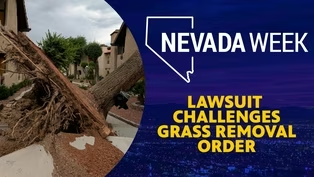
Lawsuit Challenges Grass Removal Order
Video has Closed Captions
Clip: S8 Ep45 | 12m 52s | Nevada’s turf removal mandate faces a lawsuit claiming the water-saving effort is killing trees. (12m 52s)
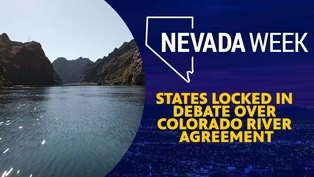
States Locked in Debate Over Colorado River Agreement
Video has Closed Captions
Clip: S8 Ep45 | 6m 39s | With a federal deadline looming, Colorado River states debate how to split the dwindling supply. (6m 39s)
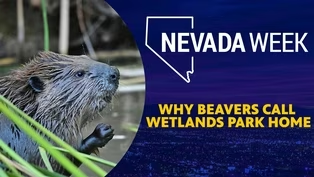
Why Beavers Call Wetlands Park Home
Video has Closed Captions
Clip: S8 Ep45 | 5m 48s | The Clark County Wetlands Park is home to hundreds of bird, reptile, beavers and mammal species. (5m 48s)
Providing Support for PBS.org
Learn Moreabout PBS online sponsorship New Episode
- News and Public Affairs

Top journalists deliver compelling original analysis of the hour's headlines.
 New Episode
- News and Public Affairs

Today's top journalists discuss Washington's current political events and public affairs.
 New Episode
 New Episode
 New Episode
 New Episode
 New Episode
 New Episode
 New Episode
 New Episode
 New Episode
 New Episode
Support for PBS provided by:
Nevada Week is a local public television program presented by Vegas PBS