Prairie Yard & Garden
Learning to Grow in Barrett: Growing at WCA Schools
Season 37 Episode 10 | 28m 45sVideo has Closed Captions
Eric Sawatzke and his students raise food for area's food shelves.
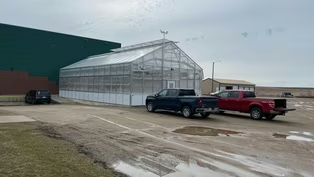
Eric Sawatzke and his students at West Central Area School in Barrett are on the grow. They are learning how to raise flowers and food to benefit themselves and many others in the community as they help stock the area's food shelves with fresh produce.
Problems playing video? | Closed Captioning Feedback
Problems playing video? | Closed Captioning Feedback
Prairie Yard & Garden is a local public television program presented by Pioneer PBS
Production sponsorship is provided by Shalom Hill Farm, Heartland Motor Company, North Dakota State University, Friends of Prairie Yard & Garden, and viewers like you.
Support provided by:


Prairie Yard & Garden
Learning to Grow in Barrett: Growing at WCA Schools
Season 37 Episode 10 | 28m 45sVideo has Closed Captions
Eric Sawatzke and his students at West Central Area School in Barrett are on the grow. They are learning how to raise flowers and food to benefit themselves and many others in the community as they help stock the area's food shelves with fresh produce.
Problems playing video? | Closed Captioning Feedback
How to Watch Prairie Yard & Garden
Prairie Yard & Garden is available to stream on pbs.org and the free PBS App, available on iPhone, Apple TV, Android TV, Android smartphones, Amazon Fire TV, Amazon Fire Tablet, Roku, Samsung Smart TV, and Vizio.
Buy Now

Visit the Prairie Yard & Garden Website
Do you love gardening? Consider becoming a friend of Prairie Yard & Garden to support this show and receive gifts with your contribution. Visit the link below to do so or visit pioneer.org/donate.Providing Support for PBS.org
Learn Moreabout PBS online sponsorship(ambient music) - This past winter, I had an email and also a newspaper clipping sent to me by two different people regarding a new greenhouse built at the West Central Area School in Barrett, Minnesota.
I am Mary Holm, host of Prairie Yard and Garden, and I just love to hear about people learning about horticulture, especially young students.
Come along with me as we pack up the cameras and check out this new greenhouse and the learning program happening there.
- [Announcer] Funding for Prairie Yard and Garden is provided by Heartland Motor Company, providing service to Minnesota and the Dakotas for over 30 years in the heart of truck country.
Heartland Motor Company, we have your best interest at heart.
Farmers Mutual Telephone Company and Federated Telephone Cooperative, proud to be powering Acira, pioneers in bringing state-of-the-art technology to our rural communities.
Mark and Margaret Yackel-Juleen in honor of Shalom Hill Farm, a nonprofit rural education retreat center in a beautiful prairie setting near Windom, Minnesota.
And by friends of Prairie Yard and Garden, a community of supporters like you who engage in the long-term growth of the series.
To become a friend of Prairie Yard and Garden, visit pioneer.org/pyg.
(bright music) - The FFA motto is learning to do, doing to learn, earning to live, living to serve.
From what I've heard, this motto really seems to apply to the new greenhouse program at the West Central Area School in Barrett.
I called up Eric Sawatzke, the ag instructor at the school to find out more.
And he said, "Come for a visit."
Thanks for letting us come to visit, Eric.
- Thank you so much for coming out here.
- Now, tell us about yourself and your background.
- Sure, so I grew up in Central Minnesota, a dairy kid.
I grew up on a dairy farm and got involved in FFA and after high school, I decided I wanted to become an ag teacher.
I really enjoyed what we did in FFA.
And to the motto, everything that we do is such a great learning environment.
And so I started teaching and now I've been doing this for 15 years, in the last six here at West Central Area Schools.
- [Mary] How did you get started with the idea of building a greenhouse here?
- [Eric] So I was lucky enough to be at Dassel-Cokato schools prior to this who had a greenhouse.
And so I taught there and had a wonderful group of horticulture classes and college level courses that we even taught at that greenhouse.
And so I knew what hands-on plant science really could be.
When I moved up to this area, we looked at the school and just saw that there wasn't a hands-on plant science and it was a very crop production heavy part of the state.
So it was very obvious to me that we needed to have that hands-on opportunity available to them.
- [Mary] How did you go about getting support in the community for a greenhouse or horticulture program?
- [Eric] So we've got a lot of community members that dove in really early on.
I've got a couple that are here today that'll do a great job at telling us about that.
- [Mary] What were the goals of building the greenhouse?
- [Eric] So initially, it was all about plant science education.
We knew that we had students that were gonna work with plants in their future careers out in this part of the state.
So we needed to have hands-on live action work.
That learning to do, doing to learn aspect.
We can't learn this just from a textbook.
We're not gonna excite students about plant science from a textbook.
So we have to have this in addition to all the text work that's done too.
And so we started with that and then it became a very big changing point when some of the community members said yes, but we also, we wanna get more local food movement happening.
And so we need to have fresh food in Western Minnesota.
Is there a way that we could use the greenhouse to grow vegetables and fruits and actually be available for our residents in the area?
And that's really where a lot of the groundswell support came from.
There was both the agriculture farm production side and then this need for direct local food that really developed a lot of interest and support.
- So how did you decide what kind of greenhouse and what size to build?
- Yeah, so after having, already spent over a decade teaching in agriculture, I had a lot of great connections, many great ag teachers and FFA advisors in Minnesota.
A lot of experts that have had greenhouses, some that are building their second greenhouse in their career.
And so I reached out to a number of those.
The one that we actually did a visit to, Chisago Lakes, they had a retiring ag teacher who had a greenhouses his entire career.
He went to get a new greenhouse built before he retired and we decided at that point, it's a local Twin Cities company aiding our company, to go with them because of the quality they did there.
And we haven't questioned that decision from the very beginning to even today.
So we had to come up with a pretty good number.
It was an expensive greenhouse.
This is one of the most high tech greenhouses that there are available with a lot of bells and whistles to it.
And it was intended to be that way so that the students can work on plants and not be spending their time watering plants shading all the time.
They could be actually doing the works propagation and cuttings and everything else to get that, took a lot of funding.
So we established a budget initially a goal of $300,000 to raise with some big grant dollars being the first part of that.
But I will tell you the very first person that came to me was a local farmer and he handed me a check for a thousand dollars.
And he said, "We have to in this.
This is the most important thing that we can do for our students."
And it was a groundswell from there that brought in 65 different funders that paid for the greenhouse.
So it was a mixture of different things that happened.
The initial group that started it was, we have five different communities in our school district, all having strong Lions clubs.
And our Lions clubs got involved in this process of raising the funds for hunger relief.
They also had an international grant program that had a hundred thousand dollars grant and they said this falls right in line with that program and their goals.
And so we were able to capitalize on that.
But then I spent time during, about a two and a half year period writing grants to different organizations, and then we had different types of grants that even farmers were able to get for us through nomination programs and whatnot.
So the community did the work to get the money brought in from all these different aspects.
From the very beginning on day one, we had started out with some really strong supporters.
We had Debbie Lacey, who is also not just a Lions Club member, but also the coordinator of the local food shelf.
She's been involved since day one in our community meetings and our planning.
And then Sue Kulbeik is also a Lions Club individual who has been a big leader regionally and even gone on international trips with Lions International and made those connections to help us build that ground swelling support.
- [Mary] So can I meet them too?
- [Eric] Absolutely.
(lighthearted music) - Nothing beats the delicious aroma of fresh baked bread in the kitchen.
It smells so good as it fills the house and reminds me of when I grew up on our family farm in North Dakota.
Since the history of mankind, grains were considered very essential and have always been a staple for consuming a healthy and nutritious diet.
That's why we travel to Askegaard Organic Farm near Moorhead, Minnesota, a six generation farm that specializes in small grains, oil seeds, and legumes.
Mark Askegaard and his family are proud to not only grow their crops organically, but also package and market a wide range of premium organic golden omega flax seed, wheat berries, whole wheat flour, pinto beans, and soybeans.
- Farming organically to me means that I'm helping the environment.
I'm growing a healthy product for people to eat and consume because we grow a lot of food grade products.
And I just think that clean air, clean water are important.
So I'm not putting anything detrimental onto our soil or our land so that people will have better health.
- [Mary] Askegaard Organic Farm sells its products in grocery stores and food cooperatives throughout the upper Midwest.
They also provide their organic products like whole or mill flax seeds and rolled oats directly to bakeries and food service institutions throughout the nation to share the quality and benefits of locally grown organic whole grains with their customers.
- It's very important to us to be able to grow mill and package our own products on farm because we are able to have complete control of the product.
Our farm slogan is from the field to you.
And that embodies our goal of having quality control over our product from the field all the way to your dinner plate.
- So the next time you plan on baking a homemade treat or looking for a healthy snack, consider using whole grain products grown organically.
To find organic grain producers and products in your area, visit minnesotagrown.com.
- Hi Mary, my name is Sue Kulbeik, and I'm from the Elbow Lake Lions and I'm about to become district governor for the Lions in this area.
- How did you get tied into this project?
- Well, I got a call one day from Debbie Lacey from the Food Shelf who's also a Lion and was aware that I had written a grant previously for this area for a handicap accessible fishing pier at our local campground.
And so she thought I might have some knowledge about grants that might be available from Lions International.
Debbie and I started having meetings with Eric and looking at the scope of the project and what the costs were gonna be and a lot of the details.
And then I started to put the package together that we send into Lions International for review by all the international directors.
There's 150 directors from around the world.
Lions is the largest service organization in the world.
And so these directors make a lot of important decisions about how all the funds we raise are spent on big projects.
The max you can apply for is a hundred thousand dollars.
So we thought why not shoot for the sky?
And that's exactly what they awarded us.
And it was something about that grant kind of giving credibility to the whole project.
And then other grants started to come in and more donations from local folks started to come in and it's just taken off from there.
- [Mary] So what was the idea in addition to education for starting the Greenhouse?
- [Sue] Well, this is a hunger grant through Lions International.
And so we had to show them how we would be providing food to the communities around here.
So we are providing food to the food shelves.
The kids will be selling food at farmer's markets around the area.
So they're gaining experience on writing business plans and marketing plans and through the whole process.
And at the beginning, Debbie Lacey is the director of the food shelves in Elbow Lake and in Hoffman and she's also a Lion.
So it worked really well that we were able to tie these organizations together.
- I'm Debbie Lacey, I'm from the Grant County Emergency Food Shelf at Hoffman Kensington Food Shelf as their coordinators.
Also, I'm a local farmer and a local Lion from the Wendell Lions.
- What does this program mean for the things that you are involved in?
- It brings research back to our kids, teaching them.
And for me as a farmer, my husband is on the Minnesota Research Council.
The researchers from the U of M were complaining about that they didn't have researchers who are on understanding ag.
Another thing is I'm a food shelf coordinator for two food shelves in Grand County.
And we were noticing that my produce was coming from local grocery stores, from the food banks was almost towards the end of their life.
So it was either try to push it out the door or you wound up throwing it away, which is not a good thing either.
And we wanted fresh produce.
By having it here in the county, I get it right at the beginning from the kids.
And my clients are looking for the fresh produce 'cause I have senior citizens who cannot afford fresh produce.
I have families with kids who are learning in our school system how to eat produce and what their bodies need.
My husband and I sat down with Eric.
That was the first time I got to meet him on my deck at the lake and I said, "Eric, this is our dream."
This is what we need as farmers.
And Eric was already thinking about it and he took the ball and went rolling with it and we couldn't be more happier.
- Well, thanks so much for stopping in and visiting with us and I'm gonna visit with area to get some details about this beautiful facility.
- Oh, you're gonna love it 'cause what the kids have learned already is just a hundred times more than what we thought.
You know, you've got boys and girls that are learning how to do electrical, plumbing, plant, grow food, and it's a win-win for our community.
- Eric, please tell me what it took to build this greenhouse.
- Sure, yeah.
So like I said, we had this built by AJ Lauer Company.
And what was great about that decision was they designed this, they talked us through the process.
I actually reached out to them back in 2019 when we first started envisioning things and really got serious late 2020 when the the dollar started to roll in and it looked like we were gonna do something.
Their engineers talked with us almost on a daily basis about what we were envisioning here and they tailored it to our needs.
And then when that time came, we had did a little bit of a site excavation just to get the soil ready and conditions in place.
And then had a concrete, local concrete company come and lay the pad.
And from there on, the entire rest of the construction was done by the company, the Greenhouse Construction Company.
They designed everything, they installed it so that they know how all those components needed to go together.
So any of those issues.
I didn't even have to deal with very many wrinkles in the process.
And then the watering system, the heating system, the ventilation, they do all of those components.
There's even a computer modulation system that's app based that I use to run this greenhouse.
All of that is run through their programming.
Not only that, but if I wanted to, it's smarter than me.
I can say I want the curtains to be opened up and it'll say, "Well, it's a little too sunny or it's a little too windy for the ventilation."
I don't want the vents to blow open because of a strong North wind tonight or something like that.
And it'll ask me again if I'm sure if I wanna do that and stop me if I shouldn't.
Yeah, it's amazing.
- So do the students learn about that too?
- Oh, absolutely.
So our students have access to the app.
So I have greenhouse managers that have taken our plant science class successfully that I've kind of hand selected.
They are in control of this operation and they can make that adjustment from their phone from home.
There's a trust level there that's obviously built up, but definitely we want them to know and experience that so that they have an interest in plant production, that they've got the experience before they ever leave high school.
- So do you have more horticulture things besides just the greenhouse?
- We sure do, yeah.
And actually, during that whole fundraising process, our local electric cooperative actually donated what's called a gross shed.
It's a self-contained unit.
It's all hydroponic.
And so what we do in there are there are nutrient film trays and Dutch buckets.
We're raising lettuce in there, we're raising some vining plants, some vegetables in there.
We've been able to harvest 36 heads of lettuce on a weekly basis.
And when we can get into full production, that is very significant for our local food shelves to be able to do that.
Then after the greenhouse was built, there were some dollars that our school had available and actually, our technical coordinator for the school that works with our computers and our TVs and everything else, he was interested in getting more hands-on experiences for younger students and he was able to allocate funds and we bought eight hydroponic towers and we split them between our elementary school.
So our fourth graders are raising food every single day.
And so the interest in the hands-on plant science is fourth grade through 12th grade now.
The greenhouse is on an app, the grow shed is on an app, all the grow towers.
This world of technology has quickly made plant science really exciting and engaging for the students.
- [Mary] Is this greenhouse used just during the school year or is it gonna be year round?
- [Eric] The intention is that this is a year round.
We're gonna figure out what summer's gonna be like.
This'll be our first summer in here, but our intent is to have a plant sale this spring and use that as a funding source to be able to keep things rolling.
But then we are gonna plant a lot of vegetable crops here in the spring for the food shelf that we'll raise throughout the summertime, and then we'll go into some kind of a fall set up for a mum sale, do some kind of fall foliage sale or something like that.
But then we'll have plant science class both semesters so that all throughout the year, we're going through different periods of growth patterns with always having not just the flowering plants, but those vegetables for the food shelf at the same time.
- So did the students start all of the plants from seed or did you buy some in as cuttings or how did that happen?
- Yeah, great question.
It's a combination of all.
We want them to start the seedlings.
We have a germination chamber here, just like you'd see at a university or some kind of a seed facility.
So they can see that germination rate at its highest point.
That's great for them.
They can understand starting tomatoes or peppers in a germination chamber versus lettuce, which doesn't need that extra heat.
And then they move them into a flow table where those seedlings can grow for a while, establish their roots, and then move them into some of our potted areas.
Then we will buy some of those plugs.
So sometimes it's more effective to buy a flat full of some peppers or a flat full of something else.
So we will do that as well so they can see that process.
But then we'll do some of our own cuttings as well.
We'll take in some tomatoes and do some topping and then we'll allow them to do the rooting so they can experience that too.
- [Mary] How many students do you have here in the horticulture classes?
- So our students that get to experience this, every ninth grader goes through here.
So we have a required agriculture class.
So we have 60 students that will go through in ninth grade.
Then we have our plant science class and our greenhouse managers.
And we'll see probably another 40 to 45 students each school year go through that process along with the middle schoolers and fourth graders using the grow towers.
So we really add up the numbers really quickly.
And our program has grown from it.
We had a recruitment event with our seventh and eighth graders this fall and talked about the greenhouse.
And we've really only had two or three FFA members in our program in seventh and eighth grade.
This year, we have 35 students that joined FFA and are working in the greenhouse because of it.
Well enough hearing from me and other adults about this.
You really need to hear from the kids.
So let's hear from some of those.
(ambient music) - I have a question.
I have several shady areas in my yard and I don't wanna grow more hostas.
What do you recommend?
- Well, there's quite a few things that grow well in shade here besides hostas and coral bells, which are very commonly grown.
This right here is the Japanese spikenard, Aralia cordata, also called Sun King, which loves to grow in the shade and has a beautiful light yellow green color.
So that helps to brighten up a cool dark spot.
Also, astilbes, which come in a variety of sizes from quite short to a few feet tall.
And they have these feathery plumes in shades of pink and white and red.
So that'll also help brighten up a shady spot with some very nice flowers.
These are past peak.
But even the old flower heads look pretty cool.
Another thing, over here we have a Siberian bugloss, the Brunnera macrophylla.
This is a white model leaf variety, and they have beautiful little sky blue flowers in the springtime, much like a forget-me-not to which they're related.
And they'll re-seed a little bit in the garden, but they make a nice bright spot in a shady garden.
And another good group of plants for the shade are the rodgersias.
And there's a number of different species, but they're all fairly similar.
They have big palmately divided leaves and they love the shade and they send up flower spikes, a couple of feet tall, sort of like an astilbe, fluffy, sort of feathery flowers.
So that's a great one for the shade.
And also many different kinds of ferns.
Remember the ferns, they're great in shady gardens.
- [Announcer] "Ask the Arboretum Experts" has been brought to you by the Minnesota Landscape Arboretum in Chaska dedicated to welcoming, informing, and inspiring all through outstanding displays, protected natural areas, horticultural research, and education.
- Hi, Mary, I'm Alexa, and I'm a junior here and a greenhouse manager at West Central Area.
- What is a greenhouse manager?
- We have a couple different kids here and we dedicate a class period or two a day and we just run around here and we help out working with plants.
I can help out where I'm needed, but my main focus is with our hydroponic systems.
We have three different kinds here.
We have the grow shed, which is located just out there, a tower garden, which is what I primarily focused on last year, and we also have my gardens, which is new to us this year.
And our elementary schools, we ordered eight of them and a couple of them are in our fourth grade classrooms.
- Tell me about the hydroponic system a little bit more.
Do you actually grow everything in the grow shed or do you start it here in the greenhouse or tell me about that.
- Yeah, so we have a germination chamber right back there and a flow table, depending on what we're trying to seed.
We'll either start it right away in the germination chamber if they need higher humidity and moisture levels.
If not, we just pop them right in the flow chamber and that just kind of helps keep the moisture in there so they can germinate nice and strong.
And then once they have roots coming out of the bottom of their rock, well, we just pop them right in our grow sheds, specifically that we harvest pretty routinely.
- [Mary] So who does the harvesting?
- [Alexa] Yeah, so that's kind of a group effort.
Whoever's available.
It can take a while.
And so yeah, it's really just whoever can help out.
- When it's so terribly cold here, how do you get the plants from in here out to the grow shed without them freezing?
- That is a funny question.
I'm glad you asked that.
So we have clear like dome lids we will put on top of our trays, and then we just run.
- Alexa, what are some of the things that you've learned here in the greenhouse already?
- Yeah, I've learned a lot just about different plants, how they work, and then I've also learned just how beneficial this is to our community and everyone involved.
- [Mary] Is this something you think that you might want to do in the future?
- [Alexa] Definitely.
I've learned a lot and it's definitely something that I'm looking into.
- Wow, this is so great.
Thanks so much for coming and talking to us.
- Thank you.
- I am Mylee Vocu.
I'm a sophomore here at West Central Area.
I do greenhouse managing first hour, and I'm specifically focusing on this entire contraption right here and it's gonna show a bunch of strawberries.
- How did you decide you wanted to do an experiment on strawberries?
- It was kind of started off as a joke when I was a ninth grader in Sawatzke's class and I said, "Sawatzke, we're gonna get a greenhouse and I want strawberries."
He's like, "Okay, I don't think we can do those, but or we will try it."
And I said, "Okay."
And then all of a sudden, I'm a greenhouse manager next year and he's like, "We can do strawberries at the greenhouse."
And I said, "Okay, can I be a part of it?"
He said, "Yeah."
- So did you start the strawberries from seed or did you get plants?
- We got little plugs that were already sprouted and they were an inch, inch and a half tall, and we just put them in these little five-pound bags and started growing.
- [Mary] What kind of soil did you grow them?
- [Mylee] A regular potting soil that just is mixed with little fertilizer.
- [Mary] So how did you decide what variety or varieties you wanted to grow?
- One of them is called the pineberry, and I saw it and it's a white strawberry with red seeds.
It tastes like a pineapple and it's mixed with pineapple and they're completely natural and I thought it was the coolest thing ever.
I saw it at the grocery store, I ate them, and I was like, "Okay, let's grow some."
And then I did some regular just red strawberries that you'll find.
- And have you found that there's a difference in the growth of the two?
- Oh yes, by far.
The pineberries are super big and fluffy and not very big on height wise, just overall width.
The red strawberry is super tall, but not as very fluffy and width wise as the pine berries are and the red strawberries have more sproutings that will grow more strawberries, but the pineberries, not so much.
- So have you noticed much difference in the harvest or have you had a harvest already?
- I harvested about 30 red strawberries a few weeks ago, ate them, a few of the other classes ate them, and they were delicious, the pineberries.
I've had about two out of this entire batch, but that's very common.
- Okay, well, so is this an experiment that's gonna keep on going?
- I would really, really hope so.
I hope some people younger than me will carry on the little strawberry experiments and hopefully, eat them as well.
- So you're a greenhouse manager.
Who waters In the summertime?
- [Mylee] I actually have this cool little timer hooked up to my strawberries.
So they just machine water and they water about three times a day for a few minutes, sometimes in the morning, the afternoon, and then late at night so we don't have to come in and water them.
- How do you get to be a greenhouse manager?
- I thought in, with Sawatzke, I had a first hour class last semester and I thought, "Wow, I would really love to just work with all the plants."
And I love the cacti, I love the Wandering Jews, everything, and I really love strawberries.
- [Mary] What are some of the future goals or plans for the program here?
- [Mylee] Actually, for a lot of them, we will be selling the plants just to come in and bring more vegetables and fruits.
And the hanging baskets above us actually might be sold as well.
The strawberries, we have AFCS, a home ag class here that eventually once we have a huge harvest for the strawberries, we'll be able to give that class them so they could work with it and possibly give to the food shelf and see if anyone likes the pineberries.
- [Mary] How is it important that people learn about local grown foods and how this greenhouse can tie into that?
- [Mylee] I think it's very important to have locally grown foods so you don't have any of the extra fertilizer, the bugs, like any of that, especially if they don't get washed off in the other departments.
And when they come in, you have no idea what has touched the fruits.
But as soon as you grow your own foods or have a school that grows their own foods, you know that there's not gonna be bugs, there's not gonna be dirts or anything on my strawberries especially.
And even if there was, we do thorough washes with everything.
- Well, thanks so much.
- Thank you.
(gentle music) - [Announcer] Funding for Prairie Yard and Garden is provided by Heartland Motor Company, providing service to Minnesota and the Dakotas for over 30 years in the heart of Truck country.
Heartland Motor Company, we have your best interest at heart.
Farmers Mutual Telephone Company and Federated Telephone Cooperative, proud to be powering Acira, pioneers in bringing state-of-the-art technology to our rural communities.
Mark and Margaret Yackel-Juleen in honor of Shalom Hill Farm, a nonprofit rural education retreat center in a beautiful prairie setting near Windom, Minnesota.
And by friends of Prairie Yard and Garden, a community of supporters like you who engage in the long-term growth of the series.
To become a friend of Prairie Yard and Garden, visit pioneer.org/pyg.
(ambient music) (lighthearted music)
Learning to Grow in Barrett: Growing at WCA Schools
Preview: S37 Ep10 | 30s | Eric Sawatzke and his students raise food for area's food shelves. (30s)
Providing Support for PBS.org
Learn Moreabout PBS online sponsorship

- Home and How To

Hit the road in a classic car for a tour through Great Britain with two antiques experts.












Support for PBS provided by:
Prairie Yard & Garden is a local public television program presented by Pioneer PBS
Production sponsorship is provided by Shalom Hill Farm, Heartland Motor Company, North Dakota State University, Friends of Prairie Yard & Garden, and viewers like you.