
Let’s Have a Letter “e” Party!
5/5/2023 | 57m 32sVideo has Audio Description
LET’S LEARN about babies! Meet baby animals. Learn how human babies change as they grow.
LET’S LEARN about babies! Meet baby animals. Learn how human babies change as they grow. Subtract as baby birds leave their nest. Read CHICK, CHICK, PEEP, PEEP, PEEP and words with long e. Sing a song in Spanish. One-hour programs help children ages 3-7 learn in school and at home. Content provided by Memphis Zoo.
See all videos with Audio DescriptionADProblems playing video? | Closed Captioning Feedback
Problems playing video? | Closed Captioning Feedback
Let's Learn is a local public television program presented by THIRTEEN PBS
Let’s Have a Letter “e” Party!
5/5/2023 | 57m 32sVideo has Audio Description
LET’S LEARN about babies! Meet baby animals. Learn how human babies change as they grow. Subtract as baby birds leave their nest. Read CHICK, CHICK, PEEP, PEEP, PEEP and words with long e. Sing a song in Spanish. One-hour programs help children ages 3-7 learn in school and at home. Content provided by Memphis Zoo.
See all videos with Audio DescriptionADProblems playing video? | Closed Captioning Feedback
How to Watch Let's Learn
Let's Learn is available to stream on pbs.org and the free PBS App, available on iPhone, Apple TV, Android TV, Android smartphones, Amazon Fire TV, Amazon Fire Tablet, Roku, Samsung Smart TV, and Vizio.
Providing Support for PBS.org
Learn Moreabout PBS online sponsorship- [Announcer] Ready to learn?
- Hi.
- Hi, friends.
- [Announcer] It's time to share a story, read and write... - Let's take it from the beginning.
- Discover science, sing... ♪ Hello, friends Play, and so much more.
- We're exploring with light.
- [Announcer] Stay tuned for lessons and activities.
- And the keyword is?
- Apple.
- Awesome.
[bright music] - [Announcer] Funding for this program was provided by the JPB Foundation.
[bright music] - Hi, friends.
How are you today?
My name is Katherine and I'm so excited to be here with you today.
We are going to be reading this story called "Chick, Chick, Peep, Peep, Peep," and it is written by the author Xiao Mao and it was illustrated by Hisana Sawada.
So, I am so excited to start reading this story with you.
But first, I want to introduce my special guest.
This is Genevieve.
Say "Hi," Genevieve.
- Hi, I'm Genevieve.
- Nice to see you, Genevieve.
Are you excited to read this story with me today?
Yes?
So, one of the wonderful things about this story is that not only do we see a mama hen and her baby chicks, we also get to do counting because this story has numbers, and it kind of lets you see the different kinds of numbers there are, depending on, well, I'm not gonna give too much of it away, but if you are learning your numbers or if you are a number master and a mathematician already, then you'll be able to use your expertise as we read this story.
So, are we ready, friends?
Are you ready?
Okay, let's see what happens.
"Chick, Chick, Peep, Peep, Peep."
"Chick, chick, peep, peep, peep."
And we see the mama hen and her baby chicks.
Oh, our first number.
What number do you see, Genevieve?
- One.
- One.
So, "The first chick jumps onto the step."
- Like this.
- Yes.
- Like this.
- Like you're walking up a step, this little chick is jumping up a step.
It's jumping up to Number One.
"Peep, peep, peep.
The second chick jumps onto the step."
So, then we see that the first chick is going up to Step Two while the other chick goes up to Step One.
So, we see the numbers one and the number... - Two.
- Two.
- Turn the page.
Turn the page.
- Let's turn the page.
"Peep, peep, peep.
The third chick jumps onto the step."
So, we're seeing the chicks jumping one step higher each time.
We have a new number.
What number is this, Genevieve?
- Three and I'm using my fingers as the little chicks.
- Three and you're using your fingers to show where the chicks are standing.
So, we have one, two, three so far.
Hmm.
What do you think comes after three, Genevieve?
I have one, two, three- - Four!
- Four.
"Peep, peep, peep.
The fourth chick jumps onto the step."
So, now we have one, two, three- - Four.
- Four steps.
Wow.
"Peep, peep, plop!
The fifth chick falls down."
[gasps] Oh no.
And look, there's something here that's happening.
I think you used a word about this the other time, Genevieve.
You said usually some stories have- - Problems.
- Problems or a conflict.
I've seen here that there is a little problem happening.
What is the problem in this story right now?
- [Genevieve] It fell down.
- The baby chick fell down.
So, here we have all the other baby chicks and they're on the staircase.
We see them, one, we see the there's two, three, four, five.
Those baby chicks are on stairs, but then we don't see the number one because he wasn't or she wasn't able to jump up to the step.
She fell down.
- It's like you are trying to do something new, like I just learned how to do monkey bars and that one just learned how to go a step.
- I love that example, Genevieve.
So, Genevieve shared that she's learning how to do monkey bars, and then sometimes when you're learning something you might fall, but you try again, and this reminds me, actually, Genevieve, of your baby brother.
When your baby brother was learning how to walk and how to first go up steps on the stairs, he also fell down, and that was very scary.
- And when I tried to go up monkey bars and I tried to go to the hard problems like math problems.
- Absolutely.
So, just like when you're trying something new for the first time, like these baby chicks are, it can be a challenge, but you keep on trying just like the baby chick in this story, see?.
Next page.
"Oops!
Try again."
And here's the baby chick.
He tried but then fell.
But you know what?
The mama hen looks like she's pushing him.
"Try again."
"Peep, peep, peep.
The fifth chick jumps onto the first step.
Peep, peep, peep.
The other chicks cheer her on."
Let's cheer the baby chick on.
Go baby chick.
Go baby chick.
"Peep, peep, peep.
She jumps onto the second step.
Peep, peep, peep.
She jumps onto the third step."
She's getting there.
"Peep, peep, peep.
Oops!"
[gasps] And then we see the baby chick fall down one.
Oh no.
How do little chicks feel, Genevieve?
How do you think they feel?
- [Genevieve] Surprised and really sad.
Nervous.
- [Katherine] Yes, maybe surprised that she fell, sad to see that she fell and that she might be hurt.
But guess what?
The other chicks cheer her on again.
"Peep, peep, peep.
The fifth chick jumps onto the fourth step."
- [Genevieve] He can't see this.
[both laugh] - [Katherine] I can't see.
I'm so nervous.
Is she gonna make it to the fifth step?
- I can't look.
I'm so happy.
- I am so happy.
"Peep, peep, peep.
She jumps onto the fifth step."
Yay!
- Yay!
- Guess what?
The fifth chick is reunited with the rest of her siblings at the very top.
That's so exciting.
"Hooray!
Five chicks enjoy a tasty treat.
Peep, peep, peep!"
- [Genevieve] Yay, now it's food that's yummy.
- [Katherine] Now she's like, "After all this hard work, I can enjoy my apple.
This is the best."
- [Genevieve] And he got a big one.
- Yeah, she got a big juicy one.
So, friends, now it's gonna be this time that we're gonna be doing an activity.
So, I have a couple of cubes here, Genevieve, and you know what I'm gonna do?
I also have a couple of numbers.
So, in this activity, you can just get a piece of paper, and maybe you can have an adult or you yourself can write this down.
So, for example, I'm gonna pick a random number.
Ready?
What number is this?
- Four.
- Four.
So, I have the number four.
Now you know what you can do?
You can go around your house and find four of any objects.
So, maybe I can find, hmm, four pieces of paper.
I can find four stuffed animal toys.
I can find four pencils.
- Four cubes.
- So, in this case, Genevieve found four cubes.
Let's check, ready?
- Let's put them- - One, two.
Oh, you're making them into steps, right?
One, two.
- Hey, want me to make a- - Three and four.
Great.
So, I'm gonna take one more number.
Are you ready everyone?
Okay.
Okay, you can get the next number, but what number is this, Genevieve?
- Two.
- Two.
You see that, friends?
Let's show it to our friends really quick.
Two.
So, now you can grab any two objects around the house, or right now we're using these cubes.
Genevieve, you found one, two.
There are two cubes on here.
Excellent.
- Let's put them in an order.
- Oh, that could be another activity you do.
Afterwards, you can put them in order so it does look like a stepping stone, like a staircase.
Okay, last one.
Ready?
Grab a number.
Grab a number.
- Grab the one.
- One, you were right.
You saw the sign, right?
Let's show our friends.
One.
Okay, so then you found the one cube.
And there you go.
Here we have the number one.
- Wait, we need space for three.
- Oh, hmm.
- So, we have one, two.
It looks like we're missing the number three.
Let's see.
- Can I go?
- Yeah, here's- - Actually, you go.
- I go?
Okay.
Here's three.
So, I'm gonna fit it in.
One, two, three.
I find an object that has three.
One, two, three cubes.
And the last one is the number- - Five.
- Five.
- I have a I.
- Let's show our friends the number five.
- And what about making line with these once it's done?
- Oh, maybe, but let's check.
One, two, three, four, five.
You could bring five objects around your house.
And then there we go.
We are set.
One, two, three, four, five.
So, it was so great sharing this story and doing this fun activity with you.
- Like five crayons.
- Like five crayons, yes.
Okay, so, thank you, friends.
Have a great rest of your day.
Bye.
[bright music] [energetic music] - Hi, friends, it's Isabel, and welcome to my home.
Today, we are having an E party.
Get it.
We are going to be learning about how the E at the end of the word can help an E say "eee," its long sound.
Are you ready to see how the E can help the E say "eee"?
[children cheer] Great!
Let's get started with a phonemic awareness activity.
Today, we're going to play The Rollercoaster Game.
In The Rollercoaster Game, we're going to listen very closely for the sound that the E is making in words.
We're going to listen for the sounds eee, the long sound, or eh, the short sound.
If you hear eee, the long sound, I want you to hold your thumb up like this, and if you hear eh, the short sound, today, I want you to hold your thumb down like this.
Eee.
Eh.
Eee.
Eh.
Are you ready?
Great.
The first word today is seat.
Can you say that word?
Let's take it on a rollercoaster.
Seat.
Do you hear eee or eh?
That's right.
You heard the eee.
Let's try that again.
The next word is set.
Can you say that word?
Let's take it on a rollercoaster ride.
Set.
Huh?
Mm?
Mmm.
Good job.
The next word is feet.
Take it on a rollercoaster.
Feet.
Great job.
You're doing really good at this.
Have you played this game before?
Let's try another word.
The next word is meat.
Meat.
That's right.
Last one.
Mess.
Take it on a rollercoaster.
Mess.
Good job.
Now you're ready to build some words with me.
[children cheer] Hi, friends.
We're back and we're ready to build some words.
I started with one word here.
This word has everything we already know.
I know that the P says "puh," the E says "eh," the T says "tuh," so If I said peh-teh, what would the word be?
Pet.
Like a cat.
Right?
Now, I have an extra E here.
Let's see what happens when I add the E to the end of this word, I know that this E that comes at the end is silent, shh, and it's telling this E to say its long sound of eee, right?
So, what would this new word be?
Puh-eee-teh.
Pete.
Pete.
Hmm.
But Pete is a name, right?
So, should this be a lowercase P?
Absolutely not.
We've got to change it.
Now this makes sense.
What's this word again?
Pete.
It's a name.
Let's try another word together.
Do you know what this word says already?
You are so smart.
[kisses] I love it.
Meh-tuh.
Met.
Now, if I add the E to the end, mee-tuh.
Mete.
Mete.
But that's not the meat I'm used to like ham or turkey.
This mete means to give out something, like Superman metes out justice.
Mete.
Okay, let's try one more.
Let's see.
What could we do here?
T. Hmm.
Do you know what this says?
I see a blend at the beginning.
Stuh.
Eve.
Steve.
That's a name, too.
Can I use a lowercase letter at the beginning of a name?
No.
I have to change it to an uppercase letter.
That makes more sense.
What does this say?
Great job.
Now we're ready to read some words together.
You're going to see three lines of words.
I want you to look at each line before we read it.
You're going to read it out loud and I'm going to read it silently.
I want you to think, what do you notice before you begin to read?
Let's look at the first line.
That's right.
I see the silent E at the end of each of these words, so I know that the E that comes before the silent E is going to say its long sound.
That's right.
It's going to say, "Eee."
Okay, are you ready?
Let's go.
Eve.
Steve.
Pete.
Mete.
Excellent.
Now, let's look at the second line.
I don't see any silent Es at the end of the word, so I know that the E inside of these words are going to say... "Eh," that's right.
It's going to say its short sound.
Are you ready?
Nest.
Pest.
West.
Fest, like a party, an E party.
Now we're up to our third and last line.
What do you notice about these words?
Some have the silent E at the end and some don't.
Let's see how we do.
These.
Them.
Theme.
Did you see how that's a thuh?
Then.
Theme is a big idea in books.
Great job reading.
Now we're ready to take everything we've learned and read our sentence.
These cats are so happy.
[claps] You did such a great job.
Now we're going to take everything that we've learned about the E at the end of the word that helps the E before it to say its name or long sound to write one word together.
Are you guys ready?
Good.
Grab yourself a pen or something to write with and a piece of paper or something to write on and meet me right back here.
[bright music] Welcome back, friends.
Are you ready?
[children cheer] That's great.
The word of the day is mete.
Superman will mete out justice.
Mete.
Let's tap that out together.
Mmm-eee-tuh.
Okay, are you ready to write it?
Go ahead.
- [Supportive Person] Woo!
- Yes.
Did you write this?
Mmm eee tuh.
[gasps] It's silent.
Good job.
We've done so many great things with our silent E that helps the E say its long sound of eee today, and I hope you practice listening for the sounds that our vowels make in words using The Rollercoaster Game.
And until next time.
See you soon, friends.
Bye.
[bright music] - Hi.
My name is Ayanfeoluwa.
Today, I'm going to do a multiplication trick.
Let's get started.
So, nine times one equals 09.
[upbeat music] Then you add on the left side, subtract on the right side.
Let's go on to nine times two.
So, nine minus one equals eight.
Zero plus one equals one.
So, it's 18.
Add on the left.
Subtract on the right.
We'll go on to nine times three.
So, eight minus one equals seven.
[bright music] One plus one equals two.
So, it says 27.
All done.
Bye-bye.
[bright music] - Hi, everyone.
Thanks for coming.
Welcome to my classroom.
I'm Ms. Zoe, and today, we are gonna learn about subtraction.
Subtraction is another way to take away from something.
So, today we're going to learn how to start with 10 and take away any number from zero to five.
So, what our activity is going to include, we have a bird's nest that I made, and we have an adult bird.
We have 10 baby birds.
We have playing cards.
There are digits, numbers with the corresponding dots.
Now, I know not everybody's gonna have a bowl and birds and baby birds to use.
You can use stuffies.
[energetic music] You can use pompoms.
I have big pompoms and small pompoms.
You can always use those, too.
Whatever you have a number of.
We're doing babies 'cause we've been learning about babies in our class: baby animals, human babies.
Our class especially loves baby birds, baby kittens, and human babies.
We have been learning about taking care of them and what they need so they can grow up and be healthy, happy, and then go on to be adult birds, kittens, or babies.
Today I have with me- - Evaluna.
- And we're so excited to have you today.
So, today we're going to learn how to subtract from 10 using numbers zero to five.
Remember, subtraction is taking away, so we have our baby birds and we start off with 10.
All, right Evaluna, can you pick your first card?
- Okay.
[bouncy music] [Ms. Zoe gasps] - What number is that?
- Zero.
- Zero.
So, how many birds did we start off with?
Do you remember?
How many birds in the nest?
- One, two, three, four, five, six, seven, eight, nine, 10.
- All right, so we start off with 10.
We don't take anything away, which means there are still 10 baby birds in the nest.
Great.
All right, Evaluna, put the baby birds back.
Let's try another one.
- They're already there.
- You're right.
Silly me.
All right.
What number is that?
- Five.
[Ms. Zoe gasps] - Five.
Can you count the dots?
- One, two, three, four, five.
- Great.
All right, so five baby birds have to fly away.
- [Evaluna] Yo, friends, come on.
- Count them out.
One, two... Three, four... Five.
All right.
So, how many left in the nest?
- [Evaluna] One, two, three, four, five.
- Great, so we started off with 10 birds, five flew away, which means five are left.
So, 10 minus five equals five.
Great job.
Okay, put the birds back.
- Put the bird away.
Put the bird away.
Great.
This one bird, where are you going?
[vocalizes rhythmically] - Now, Evaluna, do you remember how many birds we started off in the nest with?
How many?
Do you remember how many?
- [Evaluna] Yeah.
One, two, three, four, five, six, seven, eight, nine, ten.
- Beautiful counting.
10.
- 10.
- All right, flip a card.
[upbeat music] What number is that?
- Three.
- Three.
Can you count the dots for me?
- One, two, three.
- Excellent.
So, how many birdies are going to fly away?
- Three birds.
- Three.
Can you count them as you take them out?
- [Evaluna] One, two, three.
- All right.
So, 10 baby birds in the nest.
Three flew away.
How many are left in the nest?
- [Evaluna] One, two, three, four, five, six, seven.
- Seven.
10 minus three equals seven.
All right, put the birdies back.
We're doing amazing.
So, one of the things, at home, is you want to try to have them remember that you're always starting off with the number 10.
So, Evaluna, how many birds are in there?
Can you remember without counting?
- There were 10.
- How many?
- 10?
[Ms. Zoe gasps] - High five.
Great job.
All right, so we start off with 10.
Let's see how many fly away.
- One.
- One, can you show them?
- One.
- One.
All right.
How many baby birds fly away?
- [Evaluna] Pew-pew.
- [Ms. Zoe] Pew-pew, and how many birds are left in the nest?
- One, two, three, four, five, six, seven, eight, nine.
- Right, so 10 minus one equals nine.
Awesome job.
All right, put 'em back one last time.
[bouncy music] - Do the other one?
- One more card.
What number is that?
- One, two.
- Two.
All right, so how many baby birds are going to fly away?
Can you count them as you take them out?
- [Evaluna] One, two.
- Two, and how many baby birds are left?
How many birds are left in the nest, Evaluna?
You gotta count them.
- [Evaluna] One, two, three, four, five, six, seven, eight.
- Eight, so 10 take away two equals eight.
Now once your child gets really good at zero to five, you can add six to 10 so they can start subtracting 10 from any number from zero to 10.
All right, Evaluna.
Great job.
Super proud of you.
High five.
Thank you for coming and playing with us.
Say "Bye."
- Bye.
[bright music] - Hi, I'm James, and my wife Kimberly and I have three wonderful boys: Jayden, Jordan, and Justin.
I know as a father that learning starts at home.
Let's squish them to juice.
Hey, is that how we get grape juice?
- Yeah.
- It is very important for me to be there for my child's education, so I like to communicate with my child's teachers to let 'em know that, "Hey, we're a team."
Hey, Ms. Vann, how are you?
I like to connect with my kids' teachers the first week of school, but it's never too late to do so.
When I communicate with my kids' teachers, I also keep in mind that they're very busy, so I keep the messages very short and sweet, and I like to ask them what is it that my kids are learning this year?
What are the expectations?
How do we know that they're actually achieving what you need them to achieve?
What can I do to help my child?
The goal for my child is to learn, and together with the teacher, I know we can fulfill that.
Sometimes we need to practice their words or their numbers, especially multiplication, so we'll take it to the rooftop and we'll grab some chalk and we'll draw out the numbers.
It's a cool way to reinforce the lessons that the kids have in school and have some fun with your child.
I like to check in every couple weeks.
- [Teacher] Because you moved up two reading levels this time.
- Nice.
Or whenever I see that my child is not learning what I think he's supposed to learn for that week.
By building a solid relationship with the teacher, my child knows that I care, and so does the teacher, and that's a win for all of us.
Perfect job.
Gimme five.
- Gimme five.
- All right, let's go.
[upbeat music] [bright music] - Hi, friends.
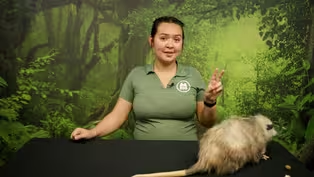
My name is Jo and I'm an animal interpreter here at the Memphis Zoo in Memphis, Tennessee.
And one of the things I get to do every day is talk about the amazing animals that I get to work with.
Today, we're going to talk about animal babies, and all animals start life as babies, but each baby begins life in a unique way.
Let's learn about where babies come from and how adults care for them.
What did you look like as a baby?
Did you take care of yourself or did you need quite a bit of help from the adults in your life?
Some animals, like the elephants, still need a lot of help when they're little from their parents, but Banana here was able to take care of himself right away.
Come on.
Let's go meet some other animal babies and find out where they came from.
Where do babies come from?
Well, they come from their parents.
Some are born from their parents' bodies, some come from eggs laid by their parents, and some are a little bit of both.
Let's go meet some animals that give life birth.
Now, what is live birth?
Live birth just means that a baby came straight out of the body of one of its parents.
So, what kind of animals give live birth?
Mammals, which are animals that have hair like humans, typically give life birth, but sometimes even fish or reptiles, like snakes and lizards, can have live babies as well.
Now, just how many babies can be born at one time?
Sometimes it's just one, other times it's two, but other times there's way more.
Take opossums, for example.
They can have up to 12 babies at one time.
That's a lot of kids to take care of.
Grace here is an opossum and opossums give live birth, but not only that, but she has a special pouch that she uses to hold her babies in when they're really small.
Kangaroos have a pouch.
That's because both kangaroos and opossums are what's called a marsupial.
These are mammals that have pouches to help keep their babies nice and safe while they grow.
Not every baby is born this way, though.
Some come from eggs.
Now, what is an egg?
Eggs are a protective space that some baby animals grow inside before they're ready to enter the world.
Depending on the animal, they either use their heads, their feet, arms, or their beaks to break free, which helps them build up their muscles to survive later in life.
Different species can lay anywhere from one to thousands of eggs at a time.
Humans can't lay eggs, but birds like chickens, reptiles like snakes, amphibians like frogs, or even fish are capable of laying eggs.
And guess what?
All of their eggs are completely unique from each other.
Some are wet and even a little slimy, some are neon green, sometimes they're blue, and other times they can even be the size of a football.
Certain species have to survive on their own right after they enter the world.
This is Banana, the Indian star tortoise, and at one point he was just a teeny tiny egg.
Pregnant turtles and tortoises will go and lay their eggs in a safe space to grow, and after multiple months, the babies will hatch out on their own without the help of their parents.
Unlike human babies, they know how to take care of themselves right away.
Other animal parents stick around short-term to help care for the baby, meaning that they'll help the baby get just strong enough to be on their own.
Sometimes, they'll help their kids for a few weeks.
Other times, they'll only need help for a couple of days.
Female emperor scorpions will help care for their babies for about two weeks, and they can have up to 32 babies at once.
All 32 will crawl onto her back after they're born, and she keeps all of them there until their bodies are strong enough to survive without her help.
Not all babies are like tortoises and can survive on their own.
Sometimes, they still need help from their parents to find food, shelter, and even protection from larger or scarier predators.
Female alligators, for example, will build a nest and lay around 40 eggs.
She then sits on the nest for about two months, keeping her eggs safe and warm while patiently waiting for her babies to hatch.
They then stick around with Mom for up to two years before going off on their own.
She keeps them safe from predators like birds, raccoons, snakes, or even other alligators that like to eat eggs.
But there are other baby animals that will stick around with their parents even longer, like the African elephant.
On average, an elephant will stay with its mother for around 16 years, but their whole family will help take care of them and keep them safe.
Once they reach 16 years old, they can begin making their own families.
We learned so much about baby animals today.
Can you remember what we learned?
All animals start life as babies and all babies come from their parents.
Can you remember the two ways that they can be born?
That's right.
They can be born live or come from an egg.
Sometimes, baby animals spend a long time with their parents, like the elephant, learning how to act like one until they can survive without them.
Other times, baby animals know how to take care of themselves right away, like turtles and tortoises.
We learned about so many animal babies today, but I want to know, what do you think was the cutest?
I really love the baby alligators.
While families come in all different shapes and sizes, I just want to remind everyone that no matter what your family looks like, it is special and you play an important role in it.
From all of us here at the Memphis Zoo, we want to thank you for coming and learning with us.
Bye.
[bright music] - Hi, everybody.
My name is Maria.
- And I'm Mia.
- And this is our sweet puppy Hopper.
And if you notice, we have some special guests with us today.
So, we want to talk to you about babies and what babies can do and what babies cannot do.
So, we've decided to call them Mary and- - Elizabeth.
- Okay?
So, we'll be talking about Mary and Elizabeth all through our time together today.
Okay, so babies.
You know, Mia, when I was thinking about babies, I looked in our photo album and I found all these pictures of you, so I'm going to be showing you pictures of Mia as a baby.
So, Mia, what was going on here?
- [Mia] I don't even know.
[Maria laughs] - This was when she was born.
And what is the expression on your face?
- Crying.
- She's crying.
Now, why do you think she's crying?
- I don't know.
- Well, you were crying because you were inside a warm place in my stomach, and then you came out, and it was bright, and it was cold, and you just cried a big cry, and that's how babies communicate.
When babies feel uncomfortable, when they're hungry.
Why else might a baby cry?
- They have a dirty diaper.
- Yes, their diaper is dirty.
If they're bored, they'll want a little... - They're tired.
- They're tired.
So, this is how babies communicate.
They communicate by crying because they don't know how to speak or use any words, okay?
So, we have to pay special attention to babies, because if they're crying, it's usually for a reason, and so the adult has to really look at the baby to figure out why they may be crying.
Okay?
Okay, so I have another picture.
Now, this is a picture of you laying on your stomach doing, do you know what this is?
- [Mia] I'm playing.
- You're playing, but you're doing tummy time.
So, babies when they're born and as they get a little older, their backs and their necks are not very strong yet and they can't sit up, okay?
So, we have to help babies strengthen that part of their bodies, so I used to put you on a little mat on the floor and you see, there's a little toy hanging.
And I would put you on your stomach, and you would try to lift your head up, and you would try to lift your head up.
And as you got older, you would try to grab the toys from above you.
So, that is a fun way in which the babies play.
They develop muscles in their back and their neck and it's called tummy time, okay?
And once a baby is able to do that, they're then able to sit up, okay?
Now, Mia, I want to ask you, after a baby is able to sit up, what kinds of things can a baby do once they're able to sit up?
- They can maybe start crawling or soon walking.
- Yeah, so once they're able to set up, it's what happens before they can start crawling or walking.
Now, once a baby is able to sit up, you can even put them in a highchair.
Now, Mia, I want to talk to you about how babies start crawling.
What do you think a baby needs when they start crawling?
- Well, like a soft place to crawl on.
- Why?
- So they don't hurt themselves.
- Right, and what do you need to be careful of?
The area around you?
- Sharp objects or corners.
- Yeah, so when babies start crawling, oh my goodness, you have to be so careful about what's on the floor.
Like Mia, I am looking at the floor right now and I see things that a baby could grab, put in their mouth.
So, when you have a baby that's starting to crawl around, what do you need to do?
- You need to make sure it's a clear, safe environment.
- Yeah, what about Miller's Legos?
- No, no Legos for the baby.
- Well, 'cause what happens if we leave his little Legos on the floor?
- He could bite them and try to eat them?
- Yes, they could put it in their mouth.
So, when you have a baby that's starting to crawl around on the floor, you have to make sure the whole area is clean.
Now, Mia, when you were crawling, you used to crawl everywhere, and we had to be so careful because sometimes, you'd hit your head and you get these little knots on your head.
Now, do you remember when Miller was crawling?
- [Mia] Yeah, I remember.
- [Maria] What did he do that was silly when he crawled?
- He would crawl backwards a lot of the time.
- Yes.
Miller.
You know, a baby crawls like this underneath, and instead of going forward, Miller used to crawl backwards, and his little feet would just get stuck under the couch, and we'd have to pull him out, because his feet would get stuck because he used to crawl backwards.
But then eventually, he learned to crawl moving forward.
Now, once a baby, Mia, is able to crawl, before they can walk, what do you think they need to be able to do?
- Well, they need to be able to support themselves with their hands.
- Yeah.
- Yeah.
- So, once a baby is really comfortable crawling, what you might see them doing is pulling themselves up to stand up.
So, what they do, 'cause they're very smart, is that they will pull themselves up to stand up, and they might do it on a chair, you know, not on the chair, but they'll put their hands on the chair, anything they can do so that they can pull themselves up and stand up.
And they feel so proud because they're able to stand, okay?
So, once a baby is able to do that, and that's usually about 10 months, it's different for all babies, nine to 10 months, what comes next?
- Walking.
- Walking.
Now, I remember when Mia started walking, okay?
She was holding on to things, 'cause first babies hold onto things, but then she let it go.
And then what happened?
- I started walking and balancing.
- She took a step.
She took a step and she started laughing, and we all clapped for her.
And then when we clapped for her, what did you do?
You fell.
- Yeah.
[Maria laughs] - Because we all clapped for her and we were so excited, and then she fell, but she was okay.
So, that's what babies do a lot of.
They start walking around and they love it, and then you have to be careful because then they fall, [laughs] and then eventually they get faster and faster and faster till they can... - They can walk normally.
- Walk normally, and then they can do really cool things in the house and in the playground.
You know, once you were one and you were able to walk around, I took you to the playground, and then you were able to meet other little kids your age, and you guys would run around the playground together, and I had to follow you around everywhere, because babies need our attention.
They need adult attention to keep them safe.
- Yep.
- So, thank you for listening to us and hearing about how babies grow and move.
Thank you to our special guests Mary and... - Elizabeth.
- I'm so glad they were able to join us today.
And I hope you have a wonderful day.
And if you have a baby in your house or a baby in your family, think about the things you told us, and you may want to ask some questions.
Or if there's a grownup in your house that can talk to you about when you were a baby, what kinds of questions might you ask?
- You can ask like, "When did I take my first steps?
What was my favorite food when I was a baby?"
- What was your first... - Word?
- Word, your first word.
Okay?
So, ask those questions because you might find out some really interesting things about yourself.
And I hope you have a wonderful day.
- Bye-Bye.
- Bye!
[bright music] >> Hola amigos, my name is Diane, mi nombre es Diane.
Today I'm going to show you something very special that you can practice at home with mom and dad and also with your amigos at school.
Are you ready for that?
Okay, I'm going to teach you this.
It's very easy, the first thing you'll need and the most important part is to have a body.
Do you have your body yourself?
Yes.
We have bodies.
Tenemos cuerpos.
Can you say "cuerpo"?
Cuerpo.
i¡Muy bien!
So I'm going to teach you a few parts.
The first one is the head, the cabeza.
Can you show me your cabeza?
You can move your cabeza.
Left and right.
Left and right.
Now that you have cabeza, you also have your shoulders, your hombros.
Hombros.
Hombros.
♪ Hombro derecho, hombro izquierdo, hombro, hombro ♪ You also have your rodillas.
Your knees.
♪ Rodillas, rodillas, rodillas, rodillas ♪ And you also have your feet.
♪ Pies, pies, pies, pies Cabeza, hombros, rodillas, pies.
Cabeza, hombros, rodillas, pies.
But you also have your hands.
You have some hands right there?
Let me see.
Mm-hmm.
♪ Manos, manos, manos, manos Atrás.
Oh.
¿Dónde están las manos?
Oh, right here.
Alright.
Now that we have manos right here, we're going to get ready to start this song, and put everything together, okay?
The first thing you're going to need is to have some manos that you already showed me, manos, manos, manos.
And you also need some feet.
Pies, pies, pies.
You need boca.
Do you have a boca right there?
Let me see.
Do you have a mouth?
Yeah!
It's right here!
Boca, boca, boca.
And you need to move your body like this.
♪ Cha, cha, cha Easy, right?
Okay, let's do it.
So you say, ♪ mis manos hacen...♪ ♪ Mis manos hacen pam, pam, pam ♪ ♪ Mis pies hacen... ♪ Mis pies hacen... Are you ready?
You have that?
Yes, that's easy.
Manos -- pam, pam, pam.
Manos -- pam, pam, pam.
Pies -- pom, pom, pom.
Pies -- pom, pom, pom.
♪ Mi boca dice: "La, la, la" Let me hear you.
♪ Mi boca dice... Mm, ♪ la, la, la i¡Muy bien!
Y tu cuerpo, your body says, ♪ Cha, cha, cha ♪ Mi cuerpo hace cha, cha, cha Now that you have all of those, you're ready to start.
Now you follow me, and I follow you, and then we're going to do it faster.
Are you ready?
Okay, listos y... ♪ Mi cuerpo, mi cuerpo, hace música ♪ ♪ Mi cuerpo, mi cuerpo, hace música ♪ ♪ Mis manos hacen -- pam, pam, pam ♪ ♪ Mis manos hacen... ♪ Mis pies hacen -- pom, pom, pom ♪ ♪ Mis pies hacen... ♪ Mi boca dice: "La, la, la" ♪ Mi boca dice: "La, la, la" ♪ Mi cuerpo hace cha, cha, cha ♪ Mi cuerpo hace Cha Cha Cha ♪ Okay, so now, you have the basics, you got the song, but I want to show you different things that you can also do with your hands and your feet.
You can just touch your hair like this, tocar tu pelo with your hands.
And what about if we can drum like this.
Puedes tocar un tambor.
♪ Pum, pum, pum, pum, pum, pum, pum ♪ And also with your feet, show me your feet, pies, pies.
You can march, un, dos, tres, cuatro.
Un, dos, tres, cuatro.
Or you can also dance, you can bailar.
♪ Du, du, du, du, du, du du-rum ♪ ♪ Du, du, du, du, du, du du-rum ♪ And, if you combine that, it's going to be very beautiful to see everything together.
So we're going to do it, but faster this time.
We're going to do the song, you follow me, and I follow you.
We have manos... Pies... Boca dice: "La, la, la", boca dice: "La, la, la".
Cuerpo hace cha, cha, cha.
Cuerpo hace cha, cha, cha.
Are you ready to do it faster?
¿Más rápido?
If you want me to do it faster, you have to say, "i¡Más rápido, más rápido, más rápido!"
Alright.
That means, "Faster, faster, faster!"
Okay, let's go, let's go.
Uno, dos y tres.
♪ Mi cuerpo, mi cuerpo hace música ♪ ♪ Mi cuerpo, mi cuerpo hace música ♪ ♪ Mis manos hacen... ♪ Mis manos hacen... ♪ Mis pies hacen... ♪ Mis pies hacen... ♪ Mi boca dice: "La, la, la" ♪ Mi boca dice: "La, la, la" ♪ Mi cuerpo hace cha, cha, cha ♪ Mi cuerpo hace cha, cha, cha Hmm, I think we can do it even faster.
Más rápido.
Ready?
Okay.
Get ready.
We're going to do it now.
Uno, dos y tres.
♪ Mi cuerpo, mi cuerpo hace música ♪ ♪ Mi cuerpo mi cuerpo hace música ♪ ♪ Mis manos hacen... ♪ Mis manos hacen... ♪ Mis pies hacen... ♪ Mis pies hacen... ♪ Mi boca dice: "La, la, la" ♪ Mi boca dice: "La, la, la" ♪ Mi cuerpo hace cha, cha, cha ♪ Mi cuerpo hace cha, cha, cha Ooh!
That's fast!
Es muy rápido.
But what about if we wanna do it slower?
i¡Más lento, más lento!
That means slower, and slower, and slower.
Okay, we're going to try.
It goes like this.
♪ Mi cuerpo, mi cuerpo hace música ♪ ♪ Mi cuerpo, mi cuerpo hace música ♪ ♪ Mis manos hacen... ♪ Mis manos hacen... ♪ Mis pies hacen... ♪ Mis pies hacen... ♪ Mi boca dice: "La, la, la" ♪ Mi boca dice: "La, la, la" ♪ Mi cuerpo hace cha, cha, cha ♪ Mi cuerpo hace cha, cha, cha ♪ Faster?
¿Más rápido?
Let me hear you.
i¡Más rápido, más rápido, más rápido!
Okay, okay.
Here we go.
Uno, dos y tres.
♪ Mi cuerpo, mi cuerpo hace música ♪ ♪ Mi cuerpo, mi cuerpo hace música ♪ ♪ Mis manos hacen... ♪ Mis manos hacen... ♪ Mis pies hacen... ♪ Mis pies hacen... ♪ Mi boca dice "La, la, la" ♪ Mi boca dice "La, la, la" ♪ Mi cuerpo hace cha, cha, cha ♪ Mi cuerpo hace cha, cha, cha Pam, pam.
Oh, you are good, you are good.
That's awesome, that's very, very fun.
Remember you can always do faster, más rápido, slower, más lento, with mom and dad, and also with your friends at school.
Do you remember what you need?
Yes, we need cabeza, ¿verdad?
We have our head, we have our manos... You have your pies.
And you have your body to cha, cha, cha.
And you also need your mouth for your "La, la, la".
Are you ready?
Okay.
One more time.
Uno, dos y tres.
♪ Mi cuerpo, mi cuerpo hace música ♪ ♪ Mi cuerpo, mi cuerpo hace música ♪ ♪ Mis manos hacen... ♪ Mis manos hacen... ♪ Mis pies hacen... ♪ Mis pies hacen... ♪ Mi boca dice: "La, la, la" ♪ Mi boca dice: "La, la, la" ♪ Mi cuerpo hace cha, cha, cha ♪ Mi cuerpo hace cha, cha, cha Pam, pam.
Great job, amigos!
i¡Buen trabajo, amigos!
I'll see you next time for another amazing song.
Stay tuned, thank you so much, see you later, bye, bye!
- [Announcer] Funding for this program was provided by the JPB Foundation.
[bright music] ♪ ♪ [dramatic electronic jingle]
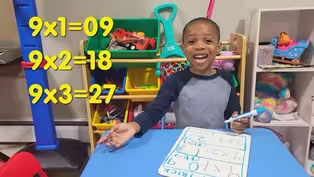
AYANFEOLUWA SHOWS SOME MATH TRICKS!
Video has Audio Description
Clip: 5/5/2023 | 1m 13s | Ayanfeoluwa shows some math tricks! (1m 13s)
Video has Audio Description
Clip: 5/5/2023 | 6m 5s | Jo Olson talks about animal babies at the Memphis Zoo. (6m 5s)
Video has Audio Description
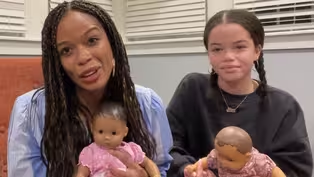
Clip: 5/5/2023 | 9m 2s | Maria Begg-Roberson and her daughter explore how adults care for babies. (9m 2s)
CHICK, CHICK, PEEP, PEEP, PEEP
Video has Audio Description
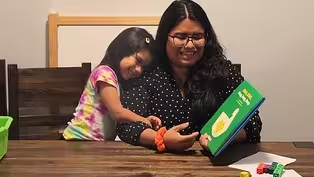
Clip: 5/5/2023 | 10m 7s | Katherine Rodriguez reads CHICK, CHICK, PEEP, PEEP, PEEP by Xiao Mao. (10m 7s)
Video has Audio Description
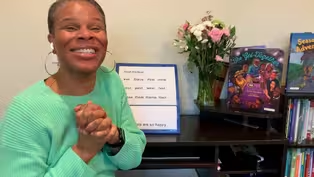
Clip: 5/5/2023 | 11m 30s | Isabel Simmons explores how an e at the end of a word makes a middle e sound long. (11m 30s)
Video has Audio Description
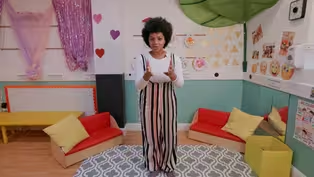
Clip: 5/5/2023 | 9m 27s | Diane Sanlatte teaches the Spanish song “Mi Cuerpo.” (9m 27s)
SUBTRACTING FROM 10 WITH BABY BIRDS
Video has Audio Description
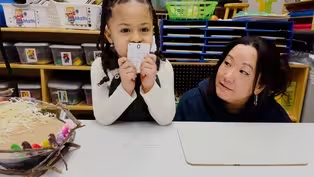
Clip: 5/5/2023 | 6m 52s | Zoe Kleinmann and two students subtract from 10 using toy baby birds in a nest. (6m 52s)
Providing Support for PBS.org
Learn Moreabout PBS online sponsorship















Support for PBS provided by:
Let's Learn is a local public television program presented by THIRTEEN PBS